


Is your medical laboratory losing patients due to chaotic navigation?
You are losing patients not because your laboratory works poorly, but because a person coming to you for the first time is confused, holding another clinic’s referrals, surrounded by unfamiliar hallways.
They search for the reception desk, then the examination room, then try to figure out where to go for results. Every one of these hesitations means minutes of waiting, nervous glances at the clock, and the thought, “next time I’ll go somewhere simpler.”
Queues in the laboratory grow not only because of workload. Chaotic navigation forces patients to ask the same questions, double-check, and walk back and forth—and this creates crowding even where patient flow is small.
A tired person doesn’t decipher signs; they simply remember the negative experience. And that experience is passed on: to family, colleagues, and in reviews. If a blood draw took ten minutes but finding the room took forty, the patient will judge you by those forty.
Lost loyalty is a direct loss of revenue. A patient who once got lost within your walls is more likely to choose a different laboratory center next time, even if your prices are more convenient and your equipment more accurate. Service starts at the doorstep, and navigation is its most important part.
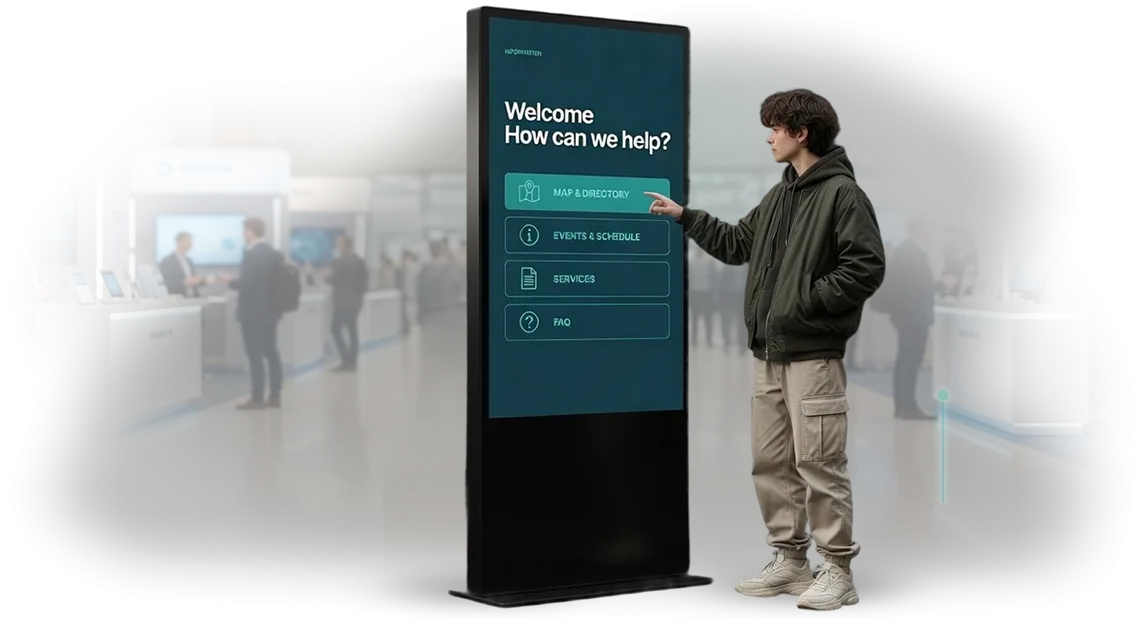
That is why we develop interactive information kiosks for medical laboratories. A kiosk at the entrance shows patients the route to the right room, helps them join the electronic queue, and tells them where to go for results.
It’s not just a “screen with a map”; it’s a full-fledged digital assistant that takes the load off administrators and gives patients back a sense of control.
Deploying such a kiosk increases the laboratory’s throughput without expanding staff: people stop crowding around the reception counter and move faster from the entrance to the treatment room chair.
And you get predictable service that patients are willing to return to—and recommend to their acquaintances.
What an information kiosk will bring to your laboratory: patient flow and loyalty
Patients often arrive at the laboratory already stressed: they are unwell, in a hurry, and a long wait only heightens the tension.
An information kiosk changes this scenario: patients handle most routine actions themselves, while reception staff keep time for complex questions and unusual situations.
The first benefit is self-service booking for all types of tests. Patients choose a convenient time, see current prices, and confirm the appointment immediately.
Arriving at the scheduled time shortens the visit from 20–30 minutes to 5–7, and for you it reduces peak load on the reception desk.
The second benefit is clear guidance at every step. The kiosk helps patients find their way around referrals, tells them which room to go to, and reminds them about preparation rules. This reduces the number of mistaken visits and questions to the administrator like “Where do I go?”
The third benefit is getting completed results through the kiosk. Patients do not need to wait in line again—they simply scan their barcode or enter the order number, and the form prints automatically. This frees up reception and saves time for both patients and your staff.
The fourth benefit is increased loyalty. The faster and clearer the visit, the more willing patients are to return and recommend the laboratory to friends.
The kiosk turns a routine trip into a predictable, comfortable process, and that directly affects the share of repeat visits.
Implementing a kiosk also supports your staff: the administrator does not have to repeat the same thing ten times. The reception desk redirects that freed-up time to helping those who really need support and to providing competent consultation. The result is faster service and a calmer atmosphere in the lobby.
Kiosk formats for a medical laboratory for different tasks
In a medical laboratory, different points of patient contact require different kiosk formats. Some visitors come to book tests, others need to find their way around departments, and still others already have a referral and want to complete the visit quickly.
A universal solution often loses to a specialized one: the interface becomes overloaded, and the visitor wastes extra time. So we offer a set of formats—each one addresses a specific task.
| Kiosk format | For whom | What it gives the client |
|---|---|---|
| Touchscreen kiosk for booking | Patients who plan a visit and are ready to choose a convenient time | Reduces the reception queue; booking happens without an administrator |
| Information stand for navigation | Visitors coming to the laboratory or a new branch for the first time | Reduces the flow of questions to staff; patients find the room on their own |
| Hybrid with referral printing | Patients with a doctor’s referral who need to complete a form | Eliminates manual filling; data goes directly into the laboratory system |
| Kiosk for issuing results | Patients who come to collect completed tests | Frees up staff; results are received quickly and without queues |
The formats are easy to combine in one hall: a stand at the entrance helps orientation, a touchscreen kiosk near reception handles booking, and a hybrid with printing speeds up registration.
As a result, the load on administrators decreases, patients move from entrance to providing a sample more quickly, and the laboratory gets more satisfied visitors without expanding staff.
When designing, we take into account patient flows in the specific space: where queues form, which questions are asked most often, and which scenarios should be automated first. Thus each kiosk works toward a measurable result—reduced service time and increased visitor loyalty.
How kiosk deployment works: from brief to launch
Deploying a kiosk in a medical laboratory is not just installing equipment; it’s a structured process that saves staff time and makes patient service simpler. We work transparently: you see the result at every stage and can adjust it before launch.
A typical project takes two to three weeks—the exact time depends on the number of services and integrations with your systems.
Stages of work
-
Brief and task analysis. You tell us which laboratory services need to be covered: booking, receiving results, information about test preparation. We clarify patient scenarios and give a preliminary timeline estimate.
-
Structure and interface design. We develop the screen logic considering the laboratory’s specifics—large buttons, clear navigation for patients of different ages. We agree on mockups with you before development begins.
-
Development and testing. We build the interface and set up integration with your booking and results systems. We test every scenario on professional equipment so everything runs reliably at launch.
-
Review and revisions. You evaluate the test version of the kiosk and give feedback. We make changes until the interface is convenient for you and your patients.
-
Installation and configuration in the laboratory. We deliver the kiosk, install it in a convenient place, and connect it to your network and printers. We provide a short training session for administrators—no special preparation is required.
-
Launch and support. The kiosk begins serving patients. We stay in touch: update information materials, consult, and respond quickly to any questions. Support continues after launch—it’s part of our work.
You participate at key points: at the brief, when approving the interface, and during final acceptance. No “black boxes”—you always understand where the project stands and when the kiosk will start benefiting the laboratory.
What is included in the delivery: a package for your laboratory
When a laboratory orders an information kiosk, it is important to understand what is included in the cost and what you receive in the end. We deliver a complete “turnkey” solution: from the hardware to a finished screen loaded with information.
No hidden payments and no need to search for subcontractors yourself—you get a working tool for your laboratory.
Here is what the delivery package consists of:
- Kiosk hardware. A touchscreen with a durable enclosure suitable for high-traffic spaces. We install, connect, and configure it—all you have to do is press the power button.
- Software. Your kiosk interface with sections for visitors: booking an appointment, test readiness status, prices and services. It runs on a stable architecture optimized for touch control.
- Content preparation. We load the laboratory’s up-to-date information: services, prices, discounts, news. After that, you can easily change data in a dedicated editor—without calling developers.
- Staff training. We provide a 1–2 hour training session for administrators and medical registrars: how to turn it on, restart, and replace on-screen information. Your employees will start working with the kiosk immediately after installation.
- Warranty and technical support. We provide a warranty on hardware and software and give you a communication channel for urgent issues. We resolve problems promptly and update the system and content when necessary.
This package saves you a lot of hassle: you don’t need to coordinate suppliers, watch for device compatibility, or look for separate specialists. You get one document, one package, and one contact for all kiosk-related issues.
Delivery and installation time depends on your city, but on average takes 7–14 days from mockup approval. We’ll tell you more about each item during a free consultation—just contact us.
Case study: how a kiosk reduced waiting time in a laboratory by 40%
In a medical laboratory, patients most often leave because of long queues. The reception desk is overloaded, the administrator is distracted by phone calls and visitor questions, and during peak hours the line stretched to 20–30 minutes.
This led to lost customers and negative reviews, even though the laboratory itself worked efficiently and quickly.
We installed a self-service information kiosk in the lobby. Patients choose the type of test themselves, pick a convenient time, pay by card, and immediately receive a ticket—without involving the administrator.
Reception staff were freed up for complex questions, and the visitor flow stopped bottlenecking at the entrance.
Results after two months: average waiting time fell by 40%, and the reception desk’s throughput grew by one and a half times. Patients started leaving without providing their tests less often, and the share of repeat visits increased.
The kiosk paid for itself because the laboratory now serves more clients during the same working hours.
“We used to have a queue of 10–15 people during peak hours, and people would leave. With the kiosk, waiting time dropped by 40%, and the administrator stopped working themselves to the bone.
We didn’t expect one device to relieve the process so much—now we’re planning to install the same kiosks in two other departments,” says the head of the MedLab laboratory, Anna Sokolova.
How to choose a kiosk for non-standard tasks?
When a laboratory faces a non-standard challenge—for example, combining appointment booking, result delivery, and biomaterial collection into a single scenario—a standard kiosk from the catalog is no longer the solution.
In such cases, what matters is not just a “box with a screen,” but the working logic that mirrors the laboratory’s internal processes and is clear to your patients.
We approach every project individually: first, we study how your laboratory actually works, what steps a patient goes through, and what data they need. Based on that, we design the scenario—from the first touch of the screen to the final receipt or ticket. Such a kiosk does not look like a foreign object; it becomes part of the reception department.
If the main task is integration with the MIS, we handle the technical side: configure data exchange so test results are pulled automatically and patients can access them without involving an administrator.
This cuts queues, reduces staff workload, and eliminates errors in data transfer—exactly what directly affects the laboratory’s reputation.
Selecting a kiosk for non-standard tasks is not about choosing a model from a price list; it is about jointly designing a solution. We start with an audit: what scenarios do you have, which of them are worth automating, and where are the bottlenecks.
Then we propose a solution that covers current needs and leaves room for growth—for example, adding new services or additional integration.
As a result, you get not just a machine, but a working tool that pays off through faster service and patient loyalty. We support the project at all stages—from the initial brief to launch and ongoing support.
Adaptation to your logistics, MIS integration, and a clear interface—all of this is resolved before installation so the kiosk starts providing value immediately after being switched on.
Frequently asked questions about kiosk operation in a laboratory
Before launching a kiosk, customers often have the same concerns: what happens if it breaks down, how to update information, how reliable the equipment is.
We’ve gathered the five most common questions about kiosk operation in a laboratory and answered them briefly—so you understand how everything works before the project begins.
What happens if the kiosk breaks down during operation?
We use professional components designed for 24/7 operation. In the event of a failure, the kiosk restarts automatically and returns to working mode—no data is lost. If the issue is more serious, we resolve it remotely or send a technician on site.
How often does the content need to be updated?
Content is updated through a personal account without involving programmers. A manager or administrator changes prices, promotions, and test descriptions in a couple of minutes. All changes are published immediately, so visitors always see up-to-date information.
How reliable will the equipment be?
We supply kiosks in durable enclosures and test every unit before shipping. The equipment is designed for an intensive visitor flow—more than 1,000 touches per day—and works reliably for years.
Who is responsible for kiosk maintenance?
We take full responsibility for technical support. You communicate with one specialist who helps with configuration, updates, and solving non-standard tasks. No fuss and no long email threads.
What does the warranty cover?
We provide an official warranty for hardware and software. If something fails, we fix the problem free of charge and quickly—which means no unexpected expenses for you.
Get a free kiosk estimate for your laboratory
Are you planning to install an information kiosk in a laboratory but don’t know where to start? Leave a request—we’ll calculate a solution for your tasks free of charge: we’ll help you choose the format, plan the placement, and assess the budget.
No obligation: the cost estimate and consultation are a gift, even if you are just exploring options.
After you get in touch, you receive a ready-made plan in five steps:
- Estimate request — you describe your situation: how many visitors, which services need automation, and whether you already have a waiting area.
- Space analysis — we review the layout, customer flows, and connection points. We advise where the kiosk will be convenient and won’t create queues.
- Format and function selection — we determine what you specifically need: test booking, result delivery, payment, or reference information. We propose the optimal configuration.
- Cost estimate and timeline — we prepare a transparent cost calculation, a list of works, and realistic launch dates. You see what you are paying for and when you will get the result.
- Free consultation — we go through the details: integration with your laboratory system, maintenance, and staff training. We answer your questions and show examples of completed projects.
- Turnkey launch — after approval, we take care of production, installation, configuration, and testing.
As a result, you get not just a “kiosk,” but a working tool that relieves administrators and speeds up customer service. You can order a kiosk for your laboratory in one click—fill out the form, and we’ll call you back within one business day to discuss the details.