


MFC: How to Reduce Queues and Improve Service Quality
Every day, thousands of people visit the MFC for certificates, documents, and services — and face queues. Even with good organization, peak hours turn into waiting that irritates visitors and puts extra strain on staff.
Time is the most valuable resource, and it is exactly what both the visitor and the center itself lose.
The queue problem directly affects service quality: tired visitors are more likely to express dissatisfaction, and staff are forced to get distracted by recurring questions like "where do I go?", "what documents are needed?", "how long is the wait?".
This reduces operational efficiency and creates a sense of chaos even where processes have long been streamlined. The solution is not adding more windows, but intelligently redistributing the flow.
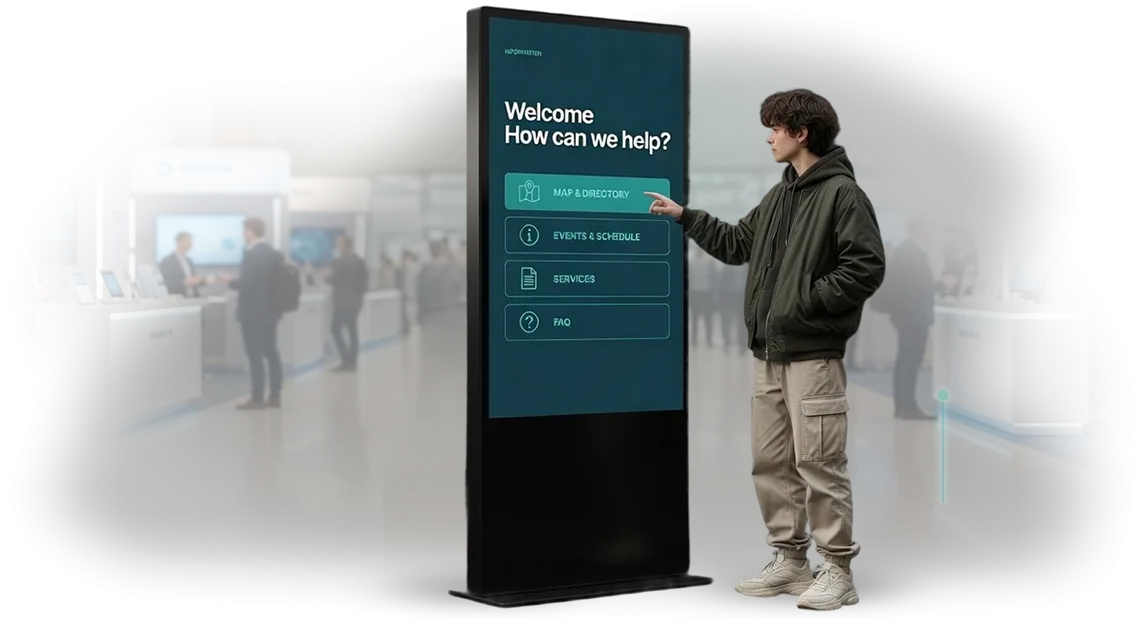
A modern information kiosk takes on routine tasks: it points visitors to the right office, prints electronic queue tickets, shows the list of required documents, and accepts advance bookings.
Visitors no longer depend on verbal guidance and can quickly find the information they need on their own. As a result, those who came for a simple service get through without approaching an administrator, while staff focus on genuinely complex matters.
For an MFC, this means a noticeable boost in efficiency without expanding staff: shorter queues, lower workload for personnel, and higher throughput. In addition, the kiosk shapes a modern image of the center — tech-savvy and caring.
Visitors remember not the waiting but the speed and convenience, which means they come back again and recommend the center to others.
We have already helped state and municipal institutions implement such solutions — from equipment selection to interface customization for specific services. We know how to integrate a kiosk into MFC operations with minimal process changes and maximum impact. Tell us about your challenges — we will advise on how to reduce queues specifically in your center.
What an Information Kiosk Delivers to Visitors and Administration
Benefits for visitors: speed and independence
An information kiosk removes the main pain point — waiting. While others sit in line, the visitor independently selects the needed section, checks the list of documents, or books an appointment. All this takes just a couple of screen touches, with no staff involvement.
The system guides users step by step and immediately prints a reference note. The visitor doesn't need to figure out office locations — the kiosk directs them to the right window.
And if consultation is required, the device points out who to contact so the visit doesn't turn into a scavenger hunt.
Benefits for administration: fewer routine requests
The kiosk handles typical questions: where the office is, what documents are needed, how to fill out an application. Staff stop repeating the same answers and can focus on directly receiving citizens. This reduces the load on the information desk and cuts queues even during peak hours.
Benefits for management: consistent quality and positive feedback
When routine tasks are taken over, administration gains time for complex inquiries. In a review, the MFC "My Documents" noted that after kiosk installation, average waiting time during peak hours decreased by a third.
Visitors orient themselves faster, and staff work more calmly — without a stream of identical questions and unnecessary rush.
Such a kiosk is a way to improve convenience and efficiency without expanding staff. A modest investment pays off with order in the hall and the positive impression visitors leave with.
Information Kiosk Formats for Different Tasks
In a multifunctional center, visitors come with different needs: booking services, searching for information, paying state fees. One universal kiosk for all cases isn't always convenient — it is better to match the format to the specific visitor flow and zone. This reduces queues, takes routine questions off staff, and boosts visitor satisfaction.
We develop kiosks for MFCs tailored to your processes. The table below shows formats already operating in centers and the benefits they bring you.
| Kiosk format | For whom | What it delivers to the client |
|---|---|---|
| Service booking | Visitors who need time with a specialist | Self-booking without an administrator, fewer queues and phone calls |
| Information and navigation | Those looking for an office, documents, or opening hours | Quick answers to questions, reduced staff workload |
| Payment of state fees and services | Those paying duties or fines | Payments accepted without a cash desk, transparent receipts |
| Combined MFC kiosk | All visitor flows | Booking, information, and payment in one place, configured for peak loads |
We will select and configure a kiosk for your MFC's needs: menu, scenarios, design — everything will be adapted. Development, deployment, and support are on our side.
Kiosk Development Stages: From Brief to Launch
Developing a kiosk for an MFC is not buying a "box with a screen," but a structured process that starts long before installation and ends with support in real operation.
Over ten years, we have refined this path so the client always sees what is happening and understands the timeline for each step.
-
Brief and task immersion. You describe which services need to be covered, who the users will be, and which scenarios should work without staff assistance.
We clarify requirements, study the regulatory framework, and define the feature set — from electronic queue to document scanning.
-
Prototype and screen scenarios. We show how a visitor will move through the menu: how to find a service, what they see at each step, where to click to avoid confusion. You approve the interface logic and design before programming begins.
-
Technical architecture and work plan. We fix the equipment list, integration scheme with MFC systems, and external services. You receive a plan with dates and milestones — no "magic" and no surprises mid-project.
-
Kiosk development and configuration. We build the software and connect modules: appointment booking, ticket printing, fee payment, online consultations. In parallel, we prepare remote management and statistics collection — which services visitors search for most often.
-
Testing on real scenarios. We verify operation with bank cards, passport scanners, queues, and edge cases — freezes, connection drops. At this stage, we find and fix anything that could slow visitors down after launch.
-
Launch and staff training. We install the kiosk, configure access, and conduct a short briefing for employees. You receive a clear manual: how to update content, what to do in case of failure, and where to turn for help.
-
Support and development. We take on technical support, form updates, and regulatory document updates. When the MFC adds a new service, we add it to the interface in advance — without stopping the kiosk or requiring extra approvals.
The result: you get a transparent process in which the kiosk arrives on schedule, passes validation with real visitors, and keeps working after handover — with minimal involvement on your part.
What Is Included in the Kiosk Software Package
What is included in the kiosk software package? For the client, it is not just a program but a ready-to-use bundle: licenses, interface, training, and warranty.
Let's break it down point by point so you know exactly what you are getting and can align expectations with the contractor.
- Licenses for all software. You receive a complete set of rights to use the kiosk in your MFC, with no hidden fees and no ties to a specific workstation.
- Interface configured for MFC services. We adapt screens and navigation scenarios to your regulations and incorporate the institution's corporate style.
- Content management module. You independently update the service list, opening hours, and contact information without involving developers.
- Documentation and instructions. Ready-made reference materials for staff and visitors, plus guidelines for quickly resolving typical situations.
- Team training. We conduct a workshop for administrators and operators — after it, personnel confidently work with the kiosk and the electronic queue.
- Warranty support and updates. For the entire contract period, we provide technical maintenance and regular updates to keep the kiosk current.
- Integration with MFC systems. We connect the kiosk to your electronic queue and ensure stable data exchange.
Case Study: How We Accelerated Service in an MFC
The queue at an MFC is the main pain point for both visitors and administrators. People lose 20 to 40 minutes waiting, staff are forced to repeat the same information ten times over, and the workload is distributed unevenly: a morning rush, an afternoon lull. We proposed a solution that removes this strain without expanding staff.
A telling case is the deployment of an interactive kiosk at the MFC "My Documents" in one district center. Before launch, the average queue wait was 25 minutes, reaching 40 during peak hours.
After kiosk installation, visitors began independently booking into the electronic queue, selecting the needed service, and immediately receiving a ticket with their window number and expected wait time.
The result after the first month of operation: the average wait dropped to 7 minutes, a 70% reduction. The number of visitors served per day grew by a third — with the same staff workload.
In addition, the kiosk absorbed routine questions: people began approaching consultants less often with "where do I go?", allowing specialists to focus on direct assistance.
Implementation did not require stopping MFC operations: the launch was carried out overnight, and staff trained in a single day. Two months later, management ordered similar kiosks for two more branches — interactive booking became part of the service standard.
If you want the same result in your MFC, we will start by analyzing current load and calculate the effect before installation.
Frequently Asked Questions About Kiosk Development and Implementation
When implementing kiosks, colleagues from MFCs share the same concerns: how often does the equipment break, who will maintain it, and how quickly will everything go live. Our team hear these questions constantly — let's share honest answers to the most common ones.
Here are typical client concerns and how we address them in practice.
What happens if the kiosk breaks down during working hours?
We provide a warranty on the equipment and built-in software. For the duration of repairs, we supply a replacement unit so the visitor service window never closes. We monitor the technical condition remotely — we often manage to resolve a problem before staff even report it.
How long does kiosk implementation take?
The timeline depends on the number of locations and the feature list: for a typical MFC with specialist booking and ticket printing, a couple of months is enough. We work in stages, so within a month you already see a prototype and can adjust the scenarios.
How is information on the kiosks updated?
Content is changed through a personal account — announcements, tariffs, opening hours. Updates reach all kiosks automatically, with no trips between branches. For urgent notices, there is a remote publishing function from a single screen.
Does the kiosk integrate with the electronic queue and MFC databases?
Yes, we connect kiosks to standard electronic queue systems and accounting services. A visitor books in, takes a ticket, and the data immediately enters the shared system. When needed, we develop secure adapters for local software.
What warranty and support are provided after launch?
Basic warranty service is one year; after that, we sign a service agreement. Support responds during working hours, and a field engineer arrives within the agreed timeframe. We train MFC staff in basic operations so they feel confident.
Order Turnkey Development of an Information Kiosk
An information kiosk for an MFC is not just a stand with a screen, but a full-fledged tool that relieves staff and simplifies life for visitors.
By ordering turnkey development, you get a ready solution that works from day one: no searching for contractors piece by piece, no lengthy approvals, and no hidden stages. We take on the entire cycle — from idea to launch and support.
One order — and you have a system that helps visitors independently obtain certificates, book into queues, pay for services, and find the information they need. You don't worry about settings or technical support: after launch, we stay close and answer for the result.
Your staff are not distracted by recurring questions, and visitors experience a modern level of service.
What you get when ordering a kiosk from us:
- A ready-to-operate device with preinstalled software — just plug it in.
- An interface adapted to MFC tasks: simple, clear, with large buttons and prompts.
- Integration with your internal systems — from electronic queue booking to visit tracking.
- Staff training and instruction manuals: personnel know how to assist visitors and manage the kiosk.
- Technical support and updates after launch — you are never left alone with problems.
- The ability to refine the solution for your services: add new sections, change logic, adapt to your regulations.
Leave a request for development — in the reply, we will send a commercial proposal and a preliminary implementation plan. We will show how the kiosk fits into your lobby and give you timeline guidance.
All questions about budget and technical details are discussed before the contract is signed — you know in advance what you receive and the cost calculated after audit.
How to Choose a Kiosk Format for Your Task?
The choice of kiosk format directly depends on the tasks you want to solve: reducing queues, speeding up certificate issuance, making navigation around the building clear, or freeing staff from typical requests.
Before looking at models, determine which visitor scenarios occur most often in your facility and what should happen in the first minutes of their visit.
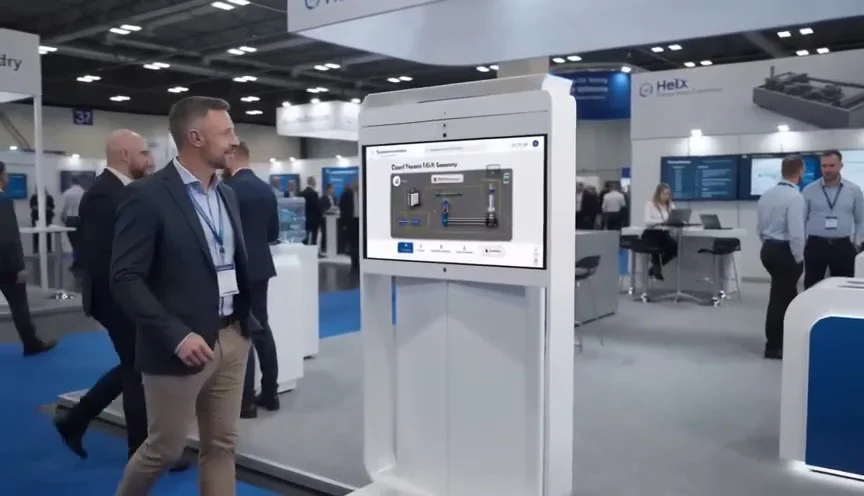
If the main goal is to relieve service windows and speed up handling, a floor-standing kiosk in the waiting area is the optimal solution.
It is highly visible, convenient for people of different heights, and easily handles tasks such as advance booking, getting an electronic queue ticket, or submitting an application independently. This format reduces staff workload and shortens the visitor's time in the facility.
When space is limited or the kiosk is needed for targeted scenarios — for example, floor-by-floor navigation or obtaining a specific certificate — compact wall-mounted and desktop options are worth considering.
They take up no usable floor space, are installed faster, and fit more easily into the existing MFC interior. At the same time, they cover the key need: visitors find the required information independently without distracting staff.
Our recommendation is to start with an audit of visitor flow: assess peak load, typical requests, and placement zones. Based on this data, we will select the kiosk format, functionality, and quantity that will truly pay off.
This way, you get not a "kiosk for the sake of a kiosk," but a tool that solves a specific task for your MFC and makes service noticeably faster.