



Pickup points lose customers due to queues and chaos
The pickup point is the face of your online store, but it's exactly where customers are most often lost.
The buyer waited several days for their order, and instead of fast pickup, they get a queue, a crowd at the counter, and an employee who is simultaneously answering phone calls, searching for a parcel, and processing returns. In such moments, even a loyal customer starts to doubt your service and looks for alternatives.
The losses from chaos at a pickup point are obvious: dissatisfied customers leave without their orders, write negative reviews, and tell acquaintances about a bad experience.
Queues at the pickup point stretch out during peak hours, and the cost of a mistake is not just staff nerves but also your reputation. Every such case increases customer churn and reduces the likelihood of a repeat order.
The problem is not lazy employees or heavy workload. Handing out orders manually when the flow is constantly growing is impossible without losing speed and quality.
Trying to hire more staff or expand the floor space doesn't solve the main issue: customers need a clear, fast, and predictable service that works without failures and doesn't depend on the human factor.
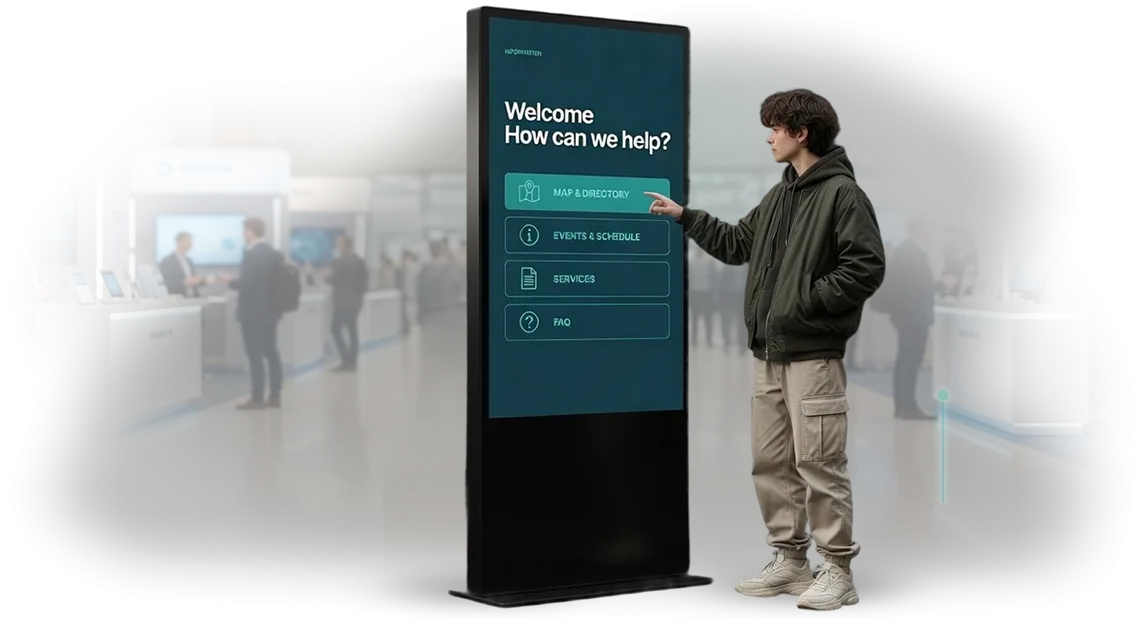
The solution is an information kiosk for the pickup point. It takes over routine operations: the customer finds their own order, confirms receipt, and the employee only hands over the parcel.
This is pickup automation that cuts service time several times over and removes chaos even during the busiest hours. Implementing a kiosk is not a replacement for staff but a tool that lets employees focus on truly important tasks.
Wehave been helping businesses set up such processes for over 10 years.
We develop systems that easily integrate into the existing workflow of a pickup point, preserve your procedures, and quickly pay for themselves by reducing customer loss and growing repeat orders.
In the following sections, we'll show how exactly a kiosk turns a pickup point into a growth point for your company.
What will change after installing an interactive kiosk
The pickup point is the place where the customer sees your service for the last time. If there are queues and bustle here, even fast delivery won't save your reputation. An interactive kiosk removes the main pressure points: waiting, order search, and staff errors.
After installation, you'll notice changes on the very first working day:
- Service speed. The customer finds their order by code or phone number on their own and receives it in a couple of minutes — without a long wait in line. This is especially important during peak hours.
- Customer loyalty. The faster the pickup, the more willingly a visitor returns and recommends the point to acquaintances. Minutes of waiting turn into repeat orders.
- Pickup control. The system records every operation: what was handed out, to whom, and when. Mix-ups and disputed situations disappear, and the owner always has an up-to-date picture of stock levels.
- Process automation. Staff stop spending time on routine tasks — searching for orders, filling out paperwork, checking against the list. The freed-up hours go to actually helping visitors.
- Order at the location. No crowd at the counter; every visitor understands where to go and what to do. Even with a large flow, pickups run calmly and predictably.
For a business owner, this means higher throughput without expanding headcount and clear control over all operations. And customers get a service they want to return to.
We develop interactive kiosks to fit the specific tasks of a particular pickup point — from interface to pickup logic. Contact us to discuss your location and receive a preliminary estimate.
Formats of interactive kiosks for pickup points
At a pickup point, a kiosk covers different tasks: from self-service order pickup to informing about additional services. The choice of format depends on the size of the premises, visitor flow, and how you want to offload staff.
We use three proven options — from a compact stand to a multimedia terminal — and each one pays off through service speed.
It's important to understand: a kiosk is not just equipment but a tool that reduces queues, lowers the load on employees, and increases customer loyalty. Below are typical scenarios to help you determine which format suits your pickup point.
| Format | Who it's for | What it gives the customer |
|---|---|---|
| Compact stand | Pickup points with limited space, 1–2 workstations | Receiving and handing out orders without a separate administrator desk, saving space and a quick start |
| Pickup terminal | Medium and large pickup points with a steady flow | Self-service at pickup — the customer finds the order themselves and confirms the handover, the queue moves 2 times faster |
| Multimedia kiosk | Pickup points with additional services | Payments, loyalty program enrollment, promotion information — additional revenue without staff involvement |
All formats run on professional equipment and adapt to your network's brand style.
The software is configured to your processes and, if needed, integrates with the inventory system you already use — so the kiosk becomes part of your infrastructure rather than a separate "island." If you're not sure which option to choose, we'll advise you based on your tasks, floor space, and projected flow.
How the project proceeds: from brief to launch
A turnkey project saves you from having to dive into technical details. We guide you along a clear route — from the first brief to a working kiosk at the pickup point — with approval at every stage. You always know what's happening and control the timeline.
-
Brief and task immersion. We discuss which pickup point the kiosk is for and what tasks it should solve: information, navigation, booking, feedback. We record expectations on functionality and deadlines so there are no surprises later.
-
Plan and work estimate. We prepare a detailed development plan with stages and deadlines. You receive a transparent document showing what will be done and when, as well as what will be required from your team for approval.
-
Layout and design approval. We show interface and design options adapted to your brand and pickup point style. We make revisions before development starts — this saves time and budget.
-
Development and testing. We build the kiosk software, fill it with your content, and test it against real scenarios: what the visitor sees, how quickly they find what they need. You receive a link for a test run and leave comments.
-
Equipment installation and setup. We install the kiosk at your pickup point, connect it to the network, and configure remote content updates. Everything works right after being switched on — without lengthy commissioning work.
-
Launch and support. We check performance in real conditions and train staff in the basic actions. After that, we take on maintenance: content updates, technical support, and a quick response to any failures.
This approach lets you launch a kiosk at the pickup point within a predictable timeframe and with a clear result. You don't manage a contractor — you get a working tool for customers and employees.
What you get in the delivery package
When you order an interactive kiosk for a pickup point, you get not just a device but a ready-made turnkey solution.
This saves you from assembling a project piece by piece: separately hunting for hardware, separately ordering the interface, separately arranging installation and support. With us, one contractor covers the entire process — from delivery to launch and ongoing operation.
Here's what's included in the delivery package:
- Kiosk equipment — the housing, touch screen, system unit, and peripherals are already matched to the tasks of your pickup point. Everything is tested and coordinated with one another, so the device works stably from day one.
- Software and interface — the system is configured to your business process: customers see the order status, can complete a pickup, or use additional services. The look and logic are developed with your brand in mind.
- Installation and connection at your location — we deliver, install, set up, and verify the kiosk on site. You don't need to find a separate crew or deal with technical details.
- Staff training — we conduct a short briefing for employees: how to use the system, how to help customers, what to do in simple non-standard situations. Staff can start working with the kiosk immediately after launch.
- Warranty and support — the equipment comes with a warranty, and the software includes free updates and hotline assistance. If a question comes up, you contact us and get a solution instead of looking for the person who "should have been there yesterday."
- Documentation and instructions — short memos for staff and a procedure guide for typical situations. All in Russian, without unnecessary technical complexity.
With this package, you get a working kiosk rather than a list of tasks. You don't need to coordinate multiple contractors, approve timelines, or dig into technical nuances — everything is included in one contract and one budget.
Case study: how we sped up order pickup 2 times
When ordering kiosk development for a pickup point, clients most often fear one thing: a complex implementation won't pay off and won't speed up operations, but will only add headaches for staff.
We decided to test this in practice and took on a project for a network of pickup points that was choking on queues during peak hours.
We installed interactive self-service kiosks and integrated them with the pickup point's inventory system. Visitors found their orders by number on their own and confirmed receipt — the employee only had to hand over the parcel from the shelf.
No staff retraining or complex instructions: the interface was built on logic familiar to every customer.
The result exceeded expectations. The average pickup time was cut in half — from 4 to 2 minutes. Staff load during peak hours dropped by a third, and the pickup point's throughput nearly doubled.
Most importantly, customers stopped getting annoyed by the wait: the share of repeat visits grew by a quarter in the first months.
The pickup point manager summed up the result this way: "We used to think a kiosk was a toy. Now it's our main tool: the queue clears itself, and employees actually get to focus on important tasks instead of explaining to everyone where their order is."
If your order pickup is losing customers because of slow service, this is solvable. We take on the entire cycle: from analyzing your processes to launching the kiosk and training staff.
Tell us about your task, and we'll show how to speed up your pickup point without unnecessary costs.
How to choose the right format for your task?
Choosing a kiosk format starts not with specifications but with the task of your pickup point: clearing the queue, offloading staff, or speeding up pickup. There is no universal device — the same task can be solved with a floor stand, a wall-mounted panel, or a compact terminal. We select a solution for your conditions, not the other way around.
The main guidelines are floor space, visitor flow, and budget. If queues form during peak hours, you need a large screen and a simple menu so customers can find information themselves without distracting staff. For a small pickup point, a compact format is enough: it saves space and quickly pays off.
Solution selection takes additional tasks into account: online payment, document printing, video connection with an operator, integration with the inventory system. We help determine the minimum sufficient set of functions so you don't overpay for extras.
A short consultation is enough — we'll ask a few questions about your business and offer two or three suitable formats with a cost estimate and timeline. The choice becomes transparent: you see what you're paying for and what effect you'll get. After launch, the configuration can be changed by adding new modules.
As a result, a business kiosk works like a full-fledged employee: it offloads staff, speeds up service, and increases customer loyalty. We support the project from format selection to launch and guarantee that the solution matches your task.
Frequently asked questions about interactive kiosks
We've gathered the common concerns of pickup point owners about kiosks and are answering them directly. our team has more than ten years of projects behind it: we've seen these questions in dozens of companies and know what usually holds people back.
What happens if the kiosk breaks down on the busiest day?
The kiosk warns about failures on its own and doesn't freeze under peak loads. If a problem occurs, we connect remotely, and if needed, we quickly replace the equipment.
How long does development and launch take?
A standard project takes two to three weeks from the moment functionality is approved. This includes the interface, configuration for your processes, and testing. In urgent cases, we can build a working version in a few days.
Will the kiosk work with our inventory system?
Yes. The integration is designed around your inventory system: order pickup and parcel intake are synchronized automatically, without manual data entry.
Who handles kiosk maintenance?
We take on remote monitoring, preventive maintenance, and updates. You don't need a separate specialist — the kiosk works on its own.
What guarantees do you provide?
The warranty on equipment and software is fixed in the contract. We fix failures free of charge and update the system to match changes in your operations — these are standard terms.
If your question isn't on the list — ask us, and we'll reply within one business day.Start your kiosk installation project today
Leave a request on the website or by phone — it will take a couple of minutes. We'll get in touch for a consultation, clarify the tasks of your pickup point, and offer a turnkey solution: from equipment selection and interface design to launch and staff training.
You'll receive a cost estimate, an implementation plan, and clear deadlines — without hidden work or unexpected surcharges.
How the work proceeds
- Request — we record the task, answer initial questions, and agree on a convenient time to talk.
- Consultation — we discuss visitor flow, kiosk usage scenarios, and integration with your inventory system.
- Cost estimate — we prepare a transparent cost breakdown and a commercial proposal within one to two business days.
- Design — we agree on the operating logic, menu structure, and screen appearance.
- Production and delivery — we manufacture the kiosk and install it at your pickup point.
- Launch and training — we configure, test, and train staff to work with the system.
- Support — we stay in touch, update content, and refine features as your business grows.
A typical project takes two to four weeks — the exact timeline depends on interface complexity and the need for inventory system integration. We set the dates in the contract and take responsibility for the result at every stage.
What you get by starting the project now
- Turnkey project — one contractor is responsible for equipment, software, design, and launch.
- Transparent implementation timeline — you know the start date and the readiness date from day one.
- Cost estimate within 1–2 days — no prepayment at the estimate stage and no "fine print."
- Support after launch — consultations, updates, and refinements whenever they're needed.
- Staff time savings — the kiosk handles routine visitor questions, while staff focus on their own tasks.
Take the first step: send a request — and today you'll receive a preliminary cost estimate and implementation plan for your pickup point.