

In a sports complex, guests get lost and go to competitors
Visitors to a sports complex often come for the first time and do not know where the required gym, locker room, or reception desk is located. The guest spends time searching, gets nervous, is late for the start of a workout — and next time chooses a more convenient club.
This pain point costs more than it seems. A visitor discusses a negative experience with their trainer, colleagues, and on social media, and the complex loses not only the one-time payment but also memberships, group classes, and corporate orders.
Directional signs and a live reception desk only partially solve the problem: signs become outdated, and the administrator is busy with other tasks.
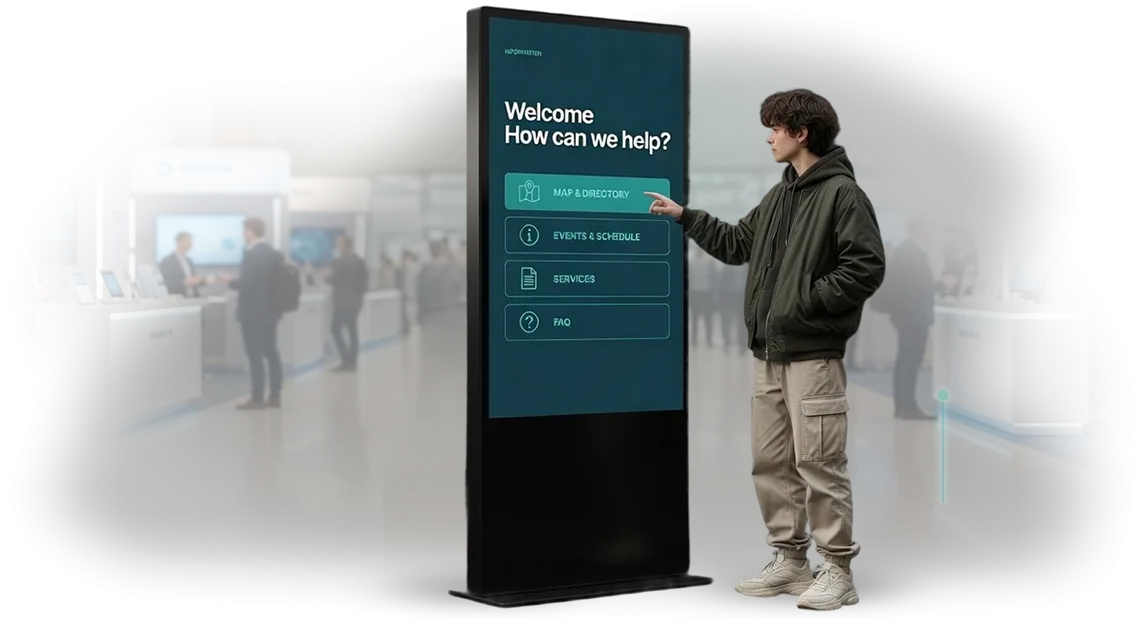
An information kiosk at the entrance changes the service scenario. In 30 seconds, a visitor finds the right gym, trainer's schedule, current promotions, or the route to the pool without staff assistance.
The kiosk operates around the clock, never gets tired, and answers questions faster than a live employee — this relieves the administrators and reduces queues at the reception desk.
Most importantly, the guest feels cared for from the first minute. Simple navigation reduces the number of people who get lost, and a comfortable visit directly affects return rates: a satisfied visitor renews their membership and recommends the complex to friends.
An information kiosk is an investment in customer retention and predictable service that works for your business every day.
We design kiosks for the tasks of a sports complex: from navigation to schedules and payment for services, and we make sure guests stop getting lost and going to competitors.
Sports complex: what benefits an information kiosk provides
Navigation in a large sports complex is a pain point that visitors feel immediately. Time lost finding the right gym, locker room, or trainer diminishes the impression even of excellent service. An interactive kiosk solves this problem and turns navigation into a tool that earns money.
our team designs kiosks that work for your image and revenue, not just hang on the wall. Here is what your business gets after launch.
Increased visitor loyalty
Athletes and guests appreciate it when their time is respected. A kiosk helps them quickly find a gym, trainer, schedule, or available lane — without waiting in line at the administrator. The visitor gets an answer in 30 seconds and comes back again. A loyal client means a stable membership and positive recommendations.
Convenient navigation inside the complex
Huge buildings and multiple floors confuse even regular guests. An interactive map with a list of zones and services eliminates the chaos. Visitors do not stand in a crowd, do not bother the staff, but immediately go to their destination.
Relieved administrators focus on sales and client work instead of showing the way for the hundredth time.
Improved image
A modern kiosk is a sign that the complex keeps up with the times. Technology creates a premium impression even before the workout begins. Guests perceive the club as serious, reliable, and caring — this works for your reputation and sets you apart from competitors.
New leads and additional sales
The kiosk is a point for informing about new services. Personal training, group programs, massage, or a bar — visitors see promotions and offers they might not have learned about otherwise.
Showing additional services at the right moment increases the average check and engages guests in new directions.
A properly configured display system is your showcase. The kiosk suggests, reminds, and sells without staff involvement, providing value around the clock.
Information kiosk formats for your facility
Every sports complex greets guests in its own way: some need navigation around a large building, others need automatic booking for group classes, and still others need to relieve the administrator's workload.
We select the kiosk format for the specific entry point and visitor scenario — which is why the solution starts working immediately, without lengthy refinements.
Here are typical options already used in fitness centers, pools, and sports clubs:
| Format | For whom (zone) | What it gives the client |
|---|---|---|
| Touch counter | Reception, lobby | Building navigation, workout schedule, class booking in a few taps |
| Floor-standing kiosk | Corridors, waiting areas | Helps visitors without staff involvement: find a gym, check the schedule, pay for a one-time visit |
| Wall-mounted panel | Entrance area, elevator lobby | Compact event poster and schedule, QR code for quick booking — takes up no floor space |
| Mobile stand | Events, exhibitions, open workouts | Flexible placement anywhere in the facility, quick relocation without reconfiguration |
This division covers all scenarios: from self-service navigation to booking into the club system. And if you need to combine two formats, we will create one interface for all screens — visitors will not notice the difference. We will select a solution for your tasks, visitor volume, and budget.
How kiosk development goes from brief to launch
For a sports complex, it is important that an information kiosk starts delivering value quickly and without failures. We have structured the development process so that you see the result at every step and can influence it.
- Kiosk brief. First, we dive into the tasks of your sports complex: what information visitors need, how they use it, and which scenarios matter. We fill out the brief together with you, defining goals, timelines, and expectations.
- Analysis and prototype. Based on the brief, we build the structure of the future kiosk: sections, navigation, texts. We show you a clickable prototype — you see how a visitor will interact with the screen before development even begins.
- Layout approval. We approve the design mockup taking into account the complex's brand identity. At this stage, you make edits and see how the kiosk will fit into the interior and how it will look to visitors.
- Development and content. Our specialists build the kiosk on a professional platform and connect the necessary modules — workout schedule, facility map, news, advertising. We fill it with content you provide or help you prepare it.
- Testing and launch. We test the kiosk in real conditions: navigation, response speed, resistance to load. After successful testing, we install the equipment and launch the kiosk in your sports complex.
- Post-launch support. We train your staff and set up remote monitoring. If visitors actively use the kiosk, we update content, add new features, and ensure stability.
What is included in the delivery of an information kiosk
When ordering an information kiosk for a sports complex, you get not just "hardware with a loaded program" but a complete working station that starts delivering value from day one.
The package includes everything needed for launch, administration, and stable operation: from licensed software to instructions and staff training. You will not have to deal with technical details — we handle them turnkey.
What is included in the delivery:
- Licensed software — a pre-installed kiosk system with no limitations on term or functionality. You get legal software with updates and technical support.
- Admin panel — an intuitive interface for content management: workout schedule, event poster, zone navigation, club promotions. Updating information takes minutes without involving developers.
- Operating instructions — short manuals for staff and administrators in Russian: how to turn on the kiosk, replace content, and resolve common issues.
- Staff training — a personal session for sports complex employees: how to use the admin panel, add events, and manage the schedule. Employees can start working right away without special skills.
- Certificates and documents — the necessary documents for official operation of the equipment in your complex. They confirm quality and compliance with requirements, eliminating questions from inspectors.
- Connection and startup instructions — a step-by-step guide that allows your administrator to quickly install the kiosk at the deployment site.
- Warranty support — direct communication with our team if questions arise. You are never left alone with the equipment.
Thanks to this package, you do not need to hire a separate specialist or understand technical nuances. You get a clear tool that works for results — helping visitors find their way and saving your staff time on routine questions.
Case study: reducing queues at a fitness center
At one of the fitness centers in the «Athletics» chain, queues constantly built up at the reception desk: the peak occurred in the morning and evening when visitors came for workouts.
Administrators spent time processing memberships and booking groups — this caused both clients and additional service revenue to be lost.
We proposed installing an interactive self-service kiosk. Visitors select their direction, book a workout, or pay for additional services themselves — without an administrator's involvement. Implementation took two weeks, and staff were trained in one day.
What changed in numbers
One month after launch, the average waiting time at reception decreased by 35%. Bookings for group classes doubled — the kiosk suggested available slots and offered alternatives when a group was already full.
An additional effect was relieving administrators: they stopped doing routine operations and focused on selling personal training and caring for guests.
There are no more queues at peak hours, and the complex's management notes increased loyalty: visitors appreciate the ability to book in 30 seconds without waiting in line.
The result proved stable: after six months, the kiosk continues to maintain the same indicators. The client ordered three more such terminals for their other clubs.
How to choose a kiosk format for your tasks?
Choosing a kiosk format for a sports complex comes down to three questions: where it will stand, who will use it, and what tasks it should solve.
A visitor comes for a specific service — to book a workout, find a gym, check the schedule — so the kiosk should not force them to navigate a complicated menu.
The first criterion is location. In the lobby at the entrance, a kiosk works with the flow: shows the schedule, zone map, and helps beginners quickly find their bearings.
At the reception or in the waiting area, it solves more specific tasks: booking a class, reserving a court, information about a trainer. A universal scenario in a passage often loses to two simple kiosks in different parts of the complex.
The second criterion is the usage scenario. If a guest uses the kiosk standing and on the go, large navigation and a minimum number of steps to the result are important: three taps — and the booking is confirmed.
If the kiosk is in a waiting area, you can create a richer interface with details about the club, coaching staff, and additional services. Think about what your visitors search for most often — schedule, prices, trainers, or available booking times — and build from that.
The third criterion is integration with your internal processes.
A kiosk is useful not only as an information display but also as a tool for relieving staff: booking through a kiosk reduces the reception queue, and a short survey immediately after training gives more honest feedback than asking someone to fill out a form at home. This should also factor into the format selection logic.
The main advice is to start not with configuration but with tasks. During a consultation, we discuss placement zones, typical visitor scenarios, and administrator preferences, after which we propose a specific format: floor-standing, wall-mounted, or compact.
A properly selected kiosk pays off through guest convenience and time savings for your team, not through a list of specifications.
Frequently asked questions about kiosk development
For a client, kiosk development is not about hardware but about predictability. You want to know in advance that the system will handle peak-hour load, that the project will be delivered on time, and what will happen after launch. Without these answers, it is hard to commit to an investment.
A kiosk for a sports complex serves hundreds of people daily: booking, scheduling, navigation. That is why it is important for us that you understand the process from the very beginning — we explain the key points that most often raise questions.
Is it reliable — a kiosk working continuously in the lobby?
We use professional equipment and a fault-tolerant system designed for thousands of taps per day. If something goes wrong, we restart the interface remotely — the visitor will not be left without the needed information and will not see a failure.
How long will kiosk development take?
A typical project takes about a month. During this time, we go through the brief, prototype, design, programming, testing, and launch. We record all dates in the plan and keep you informed, so you always know when you will start using the kiosk.
What about warranty and updates?
We provide a warranty on the software and hardware. After launch, we stay in touch: we update schedules and posters, add sections, and fix texts. This works remotely and without lengthy approvals.
Can the kiosk integrate with our accounting systems?
Yes, we embed the kiosk into your infrastructure: scheduling, booking, club cards. You do not need to change familiar processes — the kiosk becomes part of them, reducing queues and relieving the administrator.
Order information kiosk development
Ordering an information kiosk for a sports complex is easier than it seems.
You do not need to understand technical details or write a detailed specification: just send a request, and within two days we will prepare a full project estimate — with a brief, timelines, and a technical specification.
You will receive a clear action plan and an accurate cost estimate before work begins, with no hidden expenses.
After ordering, you will have access to:
- a personal brief — we will define the kiosk's tasks, target audience, and usage scenarios;
- a project assessment — we will determine the necessary functionality and help you avoid overpaying for unnecessary features;
- a technical specification — a structured document understandable to both your team and contractors;
- timeline calculation — a realistic schedule with checkpoints for each stage;
- a fixed estimate — you know the cost in advance, with no additional charges along the way;
- recommendations for placement and integration with the complex's management system;
- post-launch support — staff training, updates, and prompt technical support.
We are a team and for over 10 years we have been developing interactive solutions for business. Our experience shows that a kiosk in a sports complex pays off through navigation, class booking, and additional service sales.
Send a request through the form below or write to us in a convenient messenger — we will respond within one business day, and within two days we will send a ready plan and a preliminary estimate.