


Insurance Company Loses Customers Due to Inconvenient Services
A client walks into an insurance company office with one goal: to quickly purchase a policy, get a consultation, or settle a claim. But instead, they face a queue at the reception desk that takes 15–20 minutes, sometimes longer.
A negative impression forms even before talking to a specialist: every minute of waiting is a reason to open a competitor’s app and compare terms.
Inconvenient service acts like a filter, weeding out even loyal customers. A person who has wasted time in line is unlikely to come back—they will probably choose another insurer where policy issuance takes a couple of minutes.
And if they also tell colleagues and acquaintances about the experience, the company’s reputation will suffer more than from any advertising mistake. Losing customers starts with exactly such small things.
Competition intensifies every year: online aggregators, mobile apps, and other insurers’ offices work faster and more conveniently. You can retain a customer only with service that matches the speed of digital channels.
The office has long ceased to be just a point of sale—it is part of the brand experience, and it is here that the decision is made whether the customer will return to renew their policy.
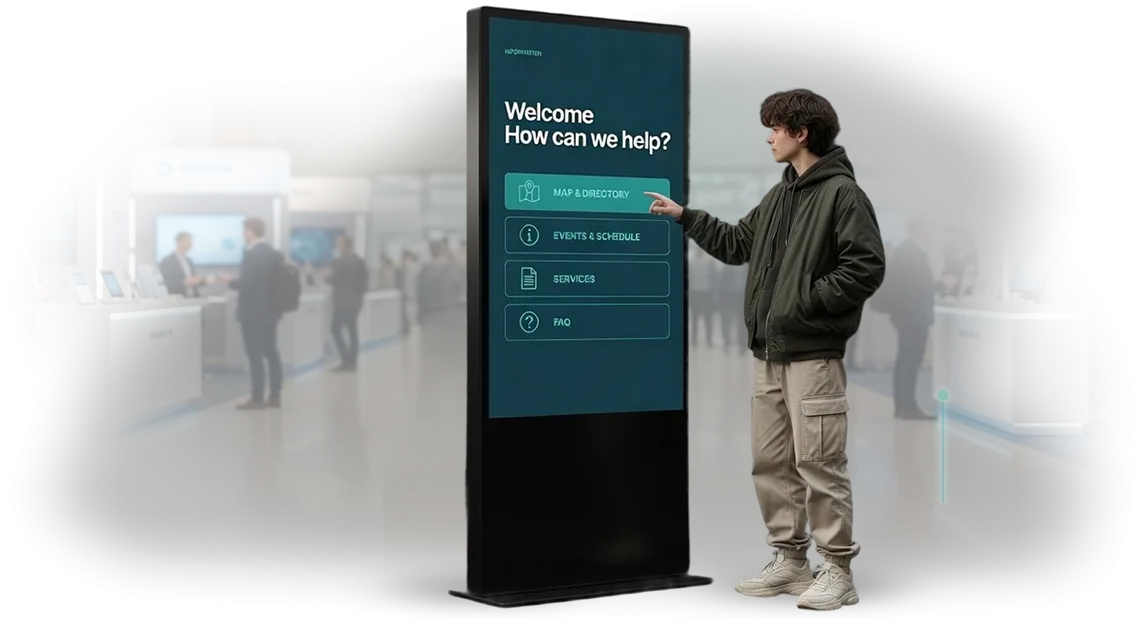
An information kiosk in an insurance company addresses this pain: it reduces queues, handles routine operations—checking application status, selecting a program, booking a specialist appointment—and allows employees to focus on complex matters.
We design such solutions for the needs of the insurance business and help companies stop losing customers due to inconvenient service.
Benefits of an Information Kiosk for an Insurance Company
Service Speed Without Queues
In an insurance company, a client often arrives feeling anxious: they need to purchase a policy, report an insured event, or get a quick consultation.
An information kiosk lets them resolve these matters in a couple of minutes—the visitor selects the relevant section, checks the status of their request, or prints a handout without waiting for an available employee.
Service speed becomes a competitive advantage. While a manager handles a complex case, the kiosk simultaneously serves a stream of routine requests. Queues shrink, and every client feels that their time is valued.
Reduced Staff Workload
Employees spend a significant portion of their workday answering the same questions: what documents to bring, how to get a certificate, where the nearest office is. The kiosk takes over these tasks, freeing the team for genuinely complex inquiries and selling additional products.
Instead of repeating instructions, managers now advise on insurance programs, help choose a policy, and close deals. This increases office efficiency without expanding headcount and reduces staff fatigue.
Increased Satisfaction and Loyalty
The kiosk operates without breaks or days off—a client can get a certificate or check the status of their request even outside business hours.
Accessibility and predictability create a positive interaction experience with the company, and a positive experience directly affects loyalty.
A modern kiosk strengthens the image of a tech-driven insurer that earns trust. Clients get used to convenient self-service, return more often, and recommend the company to acquaintances. As a result, churn decreases and the share of repeat requests grows.
Interactive Kiosk Formats for Different Tasks
In an insurance company, the flow of visitors varies: someone comes for a policy, someone to settle a loss, and someone is just choosing a program.
A single kiosk format is not always convenient: a wall-mounted panel at the entrance and a floor-standing terminal in the waiting area solve different problems.
A properly selected format reduces queues, eases staff workload, and leaves clients with the impression of a modern office.
| Kiosk format | Who it is for | What it gives the client |
|---|---|---|
| Touchscreen kiosks | Visitors with questions about policies, rates, and services | Independently obtain the needed information, submit a callback request, or book an appointment—without waiting for a consultant |
| Wall-mounted kiosks | Clients already in line or waiting for their appointment | Spend their time usefully: check the status of their request, view promotions and loyalty programs—the negative impact of waiting is reduced |
| Floor-standing terminals | Clients with limited mobility and those who need quick access | Convenient screen tilt angle, simple office navigation, and fast appointment booking with a specialist—service without barriers |
In one office, it makes sense to combine formats: a wall-mounted kiosk at the entrance reduces the flow, a touchscreen station in the waiting area relieves the administrator, and a floor-standing terminal near the offices speeds up appointment booking.
All formats work on a single platform—data is synchronized, and you see the full picture of interactions. This helps track demand for services, popular products, and automatically suggest the next step to the client.
How Kiosk Development Goes from Brief to Launch
A clear process is half the success of a project. We have broken the work into stages so you always know what is happening, when the result will be ready, and where you can influence the development.
- Brief and interview. We discuss the kiosk’s objectives in your office: what matters most—booking a consultation, calculating policy costs, or checking request status. We determine which data can be displayed and which requires employee involvement.
- Plan and estimate. We record the structure of the future kiosk: the number of screens, navigation logic, timelines for each stage, and budget. You receive a document that is clear without technical details.
- Prototype approval. Before programming starts, we show a clickable mockup on a regular screen. You see how a visitor will interact with the kiosk and can make edits without additional costs.
- Development and integration. We build the interface and connect it to your accounting systems—for example, the policy database or CRM. This happens in parallel with finalizing texts and visuals to avoid wasting time.
- Testing with real scenarios. We test scenarios that arise in an insurance office: product selection, preliminary premium calculation, and printing an application form. We make sure that even a new client can figure it out within a minute without prompts.
- Launch and staff training. We install the kiosk, adapt it to your space, and briefly explain to employees how to assist visitors. You receive a ready-made instruction manual and technical support contacts.
- Support and enhancements. After launch, we stay in touch: we update tariff information, add new services, and promptly fix any issues. This does not require renegotiating the contract—just write to the chat.
Thanks to this structure, you understand from day one what is happening with the project and can plan the kiosk launch for a date that suits you.
What Is Included in the Interactive Kiosk Delivery
When you order an interactive kiosk from us, you receive a complete turnkey solution. Below is the full delivery set: hardware platform, software, design mockups, instructions, and warranty.
- Hardware platform: durable enclosure with an anti-vandalism screen, floor-standing or wall-mounted option. The equipment is tested for long-term operation under intensive use, so the kiosk does not fail during peak hours.
- Software: a content management system so you can update insurance products, rates, and promotions yourself. Clients see up-to-date terms without involving a programmer.
- Design mockups: a branded interface and menu structure that reaches the desired policy or consultation booking in three touches.
- Staff instructions: a short guide on powering on, settings, and daily checks. Staff can get the hang of it in 15 minutes.
- Warranty and service: official warranty on hardware and software, remote diagnostics, and fast replacement of parts. In the event of a failure, the kiosk’s operation is restored remotely or with an engineer visit.
- Customer documentation: acceptance documents, certificates, and technical documentation for accounting and management.
This package allows you to launch the kiosk within a few days after delivery. You do not need to look for contractors—one team handles all issues, and the kiosk immediately speeds up customer service.
Real Case: How a Kiosk Accelerated Customer Service
For the insurance company Garant, we developed an information kiosk that solved two tasks at once: reducing queues in branches and giving clients the ability to submit an application, obtain a certificate, or check their policy status on their own.
Before the implementation, people waited for a specialist on average 15–20 minutes—during peak hours the wait stretched to half an hour, and some clients simply left.
The kiosk took over the routine operations that used to be performed by an operator. Submitting an application, printing a certificate, paying for a policy—all of this now takes 3–5 minutes, without employee involvement and without data errors.
In two months of operation, the kiosk handled more than 10,000 requests, and the average queue time decreased by 40%. The share of clients who resolve their issue on their own, without being transferred to a specialist, reached 87%.
Staff stopped spending time on routine and focused on complex products—property insurance, health insurance, and integration with partner programs.
At the same time, service quality improved: clients do not wait, do not get stressed, and receive the service through a clear interface. Repeat requests increased by 63%—people come back because they remember that things are fast here.
The company’s management appreciated the result: after six months, we launched the same kiosks in five more branches and set up remote technical support. The project became a growth point: revenue instead of queues, loyalty instead of complaints. This is what digitalization looks like when it pays off and works for you.
Frequently Asked Questions about Kiosk Development and Support
A kiosk is technology, and it must work without interruption, especially when part of the customer flow depends on it.
We have gathered answers to the questions that insurance companies most often ask before ordering: what happens if it breaks, how integration with databases will go, how long development will take, and how secure customer data is.
What happens if the kiosk breaks down?
We handle warranty service and remote monitoring. In the event of a failure, a specialist connects to the kiosk remotely and, in most cases, resolves the issue without a site visit.
If repair is needed, we replace the unit or device under the agreement so that the kiosk is not out of service for more than a day.
Is it difficult to integrate the kiosk with our databases and systems?
No. The kiosk works as another access channel to your data. We integrate over secure channels with your insurance products and accounting systems. We test all settings in a staging environment, so the launch does not disrupt current business processes.
How long does development take?
A standard kiosk with a branded interface and basic functionality takes 3–4 weeks.
If additional scenarios are needed (policy calculation, agent appointment, payment acceptance), the timeline increases, but we immediately record it in the contract and provide a stage-by-stage plan. You see intermediate results every week.
How secure is the storage of customer data?
The kiosk does not store personal data itself—information is transmitted only to your system over a secure channel. Access is restricted by a role-based model, and all actions are logged. This complies with requirements for handling personal data and prevents leaks.
Still have doubts? Ask us directly: we will explain how we solve non-standard tasks and what guarantees we provide at each stage.Get a Cost Estimate for a Kiosk for Your Task
Every insurance office is different: its own products, customer flows, and service formats. A ready-made template kiosk often does not fit—it either fails to solve the task or costs more due to unnecessary features. We prepare an individual solution for your way of working: from consultation to project estimate.
Leave a request, and we will prepare a cost estimate that takes into account:
- specific scenarios: policy issuance, online claim submission, agent appointment;
- the number of locations and their load—we will design the kiosk for your customer flow;
- integration with your internal systems and databases so the process is not slowed down;
- implementation timelines and a stage-by-stage plan—from delivery to launch on site;
- warranties and post-launch support: staff training, updates, technical support.
In the estimate, you will see not just a “box with a screen”, but a complete set of work: scenario design, software setup, test launch, and employee instructions. Transparent, with no hidden fees.
Ordering a kiosk with a custom solution is a way to get exactly the tool that will speed up service and reduce the load on the front office. Leave your contacts—we will call you back, clarify your tasks, and send you the cost estimate and project estimate within one business day.
How to Choose the Right Information Kiosk Format?
Choosing the right kiosk starts not with the model, but with three questions: where it will be placed, what task it should solve, and what kiosk budget you have allocated.
By answering them, you eliminate many unnecessary options and settle on a format that truly works to your advantage.
The right format for the task is the main criterion. If the kiosk is needed only to display rates and answer frequently asked questions, a compact touchscreen stand is sufficient.
If it must help clients submit applications, book consultations, or check request statuses, you will need a larger panel with user-friendly navigation and possibly additional data entry devices.
The space and installation location also determine the choice. In a spacious waiting area, a floor-standing kiosk looks good and immediately attracts attention.
For a small office or administrator’s desk, a wall-mounted option is suitable because it does not take up usable floor space.
At the same time, the requirements for the kiosk are equally important: stable construction, wear resistance, a clear interface, and accessibility for visitors of different heights.
The kiosk budget affects the depth of functionality. The basic configuration covers the task of information provision, while the extended configuration adds the ability for online processing and integration with your accounting system.
We always recommend starting with the main task—this allows you not to overpay for unnecessary options and still get a reliable solution.
In our practice, choosing a format takes one or two days: we discuss the tasks, space, and budget, and prepare a proposal with precise equipment requirements and implementation timelines. As a result, you get a kiosk that pays for itself by reducing staff workload and improving service.