


Infomat for polyclinics: doctor appointments without queues and phone calls
Every day, patients lose hours in queues at the reception desk just to see a doctor. Phone calls to the polyclinic get stuck on hold, and booking by phone takes time away from both patients and administrators.
As a result, a visit to the doctor turns into an ordeal, and the polyclinic itself gets a stream of dissatisfied visitors.
The second problem is manual booking errors. Paper tickets, double bookings, mixed-up offices. The administrator has to handle the queue, answer phone calls, and fill out records at the same time. Patients cannot check the schedule on their own without distracting staff.
Electronic appointment scheduling in a polyclinic via an infomat solves these problems.
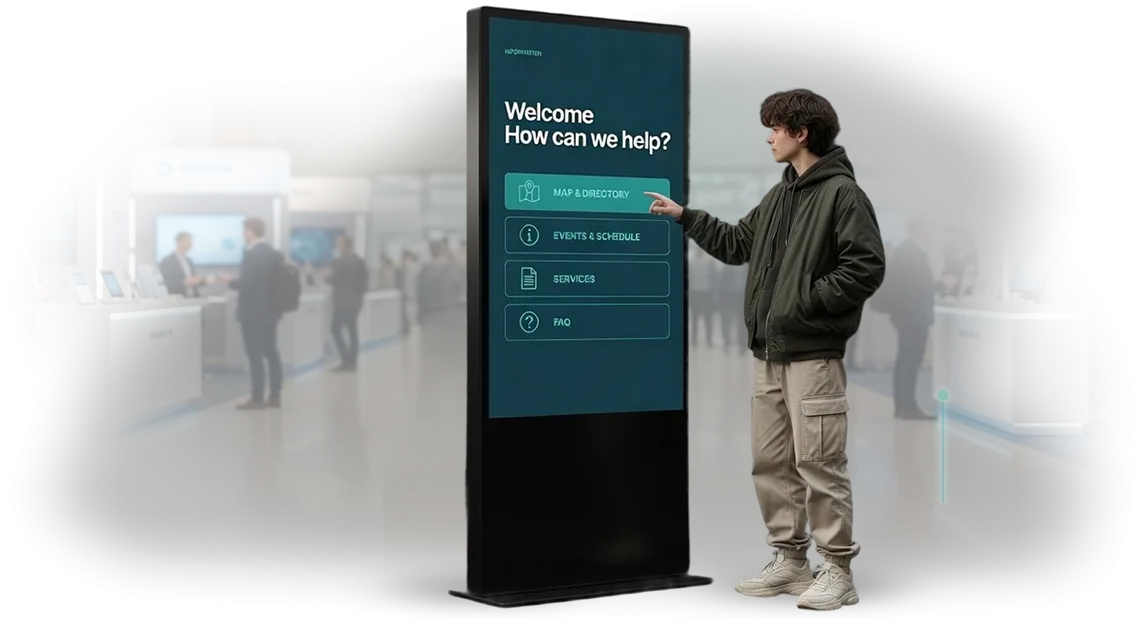
An infomat for polyclinics lets patients book a doctor appointment in a minute: the patient selects a specialty, date, and time in a user-friendly interface, and the system itself finds the nearest available slot.
This reduces the load on the reception desk, eliminates errors, and makes booking transparent for both parties.
Our engineers have already implemented such kiosks in dozens of medical institutions. For example, at the city polyclinic «Медсервис», after the infomat was installed, the queue at the reception desk halved, and patients stopped calling to confirm appointments. Implementation takes from two weeks, and managing settings does not require a programmer.
Doctor appointments without phone calls: how to save staff time
Queues at the reception desk and constant phone calls are the main source of chaos in a polyclinic. The administrator answers the same questions, gets distracted from in-person service, and patients get annoyed by waiting.
The infomat takes over the routine part of the work: booking a doctor appointment without phone calls and unnecessary contacts takes just a couple of screen taps.
The reception desk stops being a hot spot. Staff only handle tasks where a person is really needed: complex cases, first-time visits, consultations.
The workload on staff decreases, and the administrator's time is freed up for more important work — this is noticeable from the first week of the infomat operating.
Patients also feel the difference. Instead of waiting in line or making endless attempts to get through, they independently choose a doctor, date, and time in a convenient interface. No "all lines are busy" or "call back later".
The kiosk operates without breaks or weekends, so booking can be done at any time, even after the reception desk has closed.
For doctors, this is also an advantage: the schedule fills evenly, without peak loads and gaps that are inevitable with chaotic phone calls. Patients arrive on time, get less anxious while waiting, and therefore appointments run more calmly and efficiently.
In the end, the whole polyclinic benefits: fewer queues, a relieved reception desk, satisfied patients, and calm staff. The infomat pays off not only financially but also in the institution's reputation — people return to a place where their time is respected.
Interactive kiosk form factors: what types exist and for which tasks
In a polyclinic, the user is most often a patient who is in a hurry, anxious, and does not want to figure out an interface. Therefore, the form factor of the kiosk should reduce stress: booking a doctor appointment takes less than a minute, without queueing or staff assistance.
The same scenario works differently in a lobby, near a doctor's office, or outdoors — hence the choice of enclosure.
We select the enclosure for the specific placement point, rather than "fitting" the task to the device.
The cost of an infomat depends directly on the durability of the enclosure and the type of mounting, but in any case the investment is quickly recovered by relieving the reception desk and reducing the queue flow. Below are the three main form factors we work with in clinics.
| Form factor | Who it is for | What it offers the client |
|---|---|---|
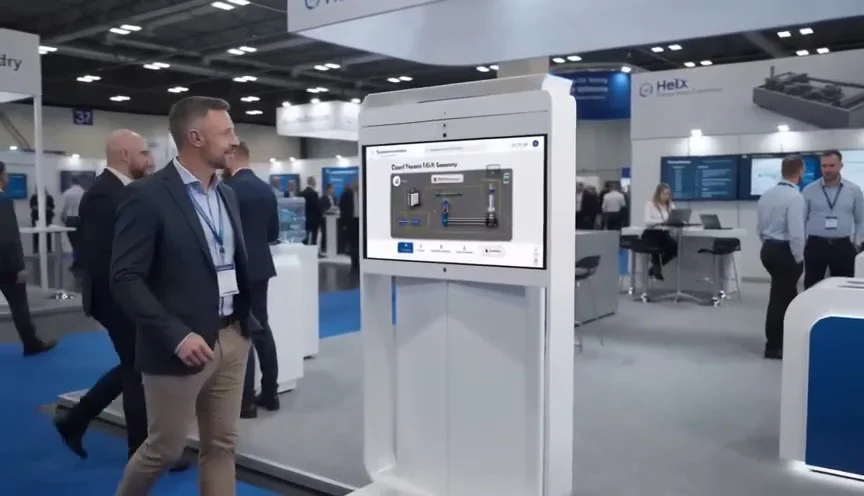
| Floor-standing infomat | For lobbies and reception areas | Doctor appointment booking without a queue, navigation hints to doctor's offices, resistance to high visitor flow |
| Wall-mounted terminal | For corridors, narrow areas, zones near doctor's offices | Saves floor space, quick booking in a couple of taps, accessibility for elderly patients |
| Outdoor kiosk | For the clinic façade | Self-booking and schedule access before the medical facility opens, protected enclosure for any weather |
This approach allows you to start with a single floor-standing infomat in the lobby and later add wall-mounted terminals in departments — without replacing the system or reconfiguring everything.
How installation and setup work in 5 steps
Installing an infomat in a polyclinic is not just mounting equipment. How the connection to the medical system is handled determines whether patients can immediately book a doctor appointment without a queue and whether the reception desk can be relieved.
We have structured the process to address all questions before launch and provide staff with clear instructions.
- Brief and site audit. We visit the polyclinic, assess visitor traffic, the location of power outlets and network points. We discuss doctor appointment scenarios so that the infomat solves your specific tasks rather than just standing in the lobby.
- Placement plan and approval. We propose an installation layout: the infomat should not obstruct the patient flow and should be convenient for older people. We approve the sketch before work begins.
- Infomat installation. We secure the structure, connect power and network. We work during off-peak hours to avoid inconveniencing visitors and staff.
- Connection to the medical system. We set up integration with doctor schedules, patient insurance policies, and the electronic queue. The schedule is pulled automatically, without manual intervention.
- Interface setup and testing. We check the main scenarios: doctor search, time selection, ticket printing. We fix errors before the first patients see the infomat.
- Launch and staff training. We launch the infomat and train administrators and receptionists to work with the system. We provide a short reference guide and remain available for consultations after the launch.
What is included in the delivery: a complete package for the client
We deliver not a "hardware box", but a working turnkey solution — from the terminal enclosure to staff training.
Everything needed to launch doctor appointment booking in a polyclinic is already included in the price: you don't need to purchase equipment separately, look for a contractor for installation, or figure out licenses.
The complete package for the client includes:
- Terminal with an anti-vandal enclosure, touchscreen, and built-in printer — adapted for lobbies and corridors of medical facilities.
- Doctor appointment software: electronic schedule, selection of specialist and time, ticket printing or sending to the patient's phone.
- Software licenses and all updates for the duration of the contract — no hidden fees or annual "surprises".
- Installation and commissioning at your site: network connection, configuration according to polyclinic regulations, and integration with your scheduling system.
- Staff training: a short briefing for administrators and reference guides for patients, so the terminal starts working on the day of launch.
- Warranty on the terminal and components — from 12 months, with prompt replacement in case of failure.
- Service maintenance: scheduled inspections, remote diagnostics, and priority engineer visits in case of failures.
This composition removes procurement, setup, and contractor search from your team's shoulders — you get a single point of responsibility.
The warranty on the terminal and licenses are fixed in the contract, so kiosk operation remains predictable, and time spent in the queue to see a doctor remains minimal.
Case study: the queue for appointments shrank threefold
At one district polyclinic, booking a doctor appointment turned into an ordeal: a queue formed before the reception desk opened, and patients spent 20–30 minutes just to get in to see a general practitioner.
Complaints over the phone and in the feedback book grew, administrators could not keep up with phone calls, and some visitors simply left without waiting for an appointment.
Solution: infomats with automatic booking
We installed two infomats in the lobby, connected to the schedules of all doctors. The patient selects a specialist, sees available slots, and immediately receives a ticket — without involving a registrar.
Administrators freed up time for complex issues, and a traditional counter was left for elderly visitors.
From that moment on, booking a doctor appointment takes less than a minute. The queue in the lobby shrank threefold within the first month, and the share of self-service bookings via infomats grew to 60% of the total flow.
Patients stopped coming at random — everyone arrives at their assigned time, which reduced corridor congestion and improved schedule accuracy.
Results in numbers
In the first six months of the infomats operating, the polyclinic saw a measurable effect: average wait time at the doctor's office fell from 25 to 8 minutes, no-shows decreased by a third, and the reception desk's throughput increased — the same staff now handle 40% more requests.
The head physician noted: "For us, this is not just technology, but a real reduction in staff workload and the return of smiles to patients."
The experience showed: automation of booking is not a replacement for live communication, but a way to remove routine.
Infomats pay off by relieving the reception desk and increasing satisfaction, and most importantly, patients stop associating a visit to the polyclinic with hours of waiting.
How to choose the right kiosk for your task?
To decide how to choose an infomat and the right kiosk, evaluate three parameters: the premises, patient flow, and budget. These same criteria determine how quickly the installation pays off and how long it will last without failures.
First, assess the location. If the entrance area is small or the corridor is narrow, a compact floor-standing kiosk with a small screen will work — it does not block passage and easily fits the existing layout.
In a spacious lobby, a full-height terminal with a large screen looks better: it is visible from a distance and itself guides patients toward booking, reducing the load on the reception desk.
The second criterion is flow intensity. In a polyclinic with high attendance, the kiosk must withstand constant use and accidental impacts. Therefore, a sturdy metal enclosure and a protected screen are not a luxury but protection against downtime.
If the flow is moderate, a neat kiosk with a classic design that matches the institution's overall style is enough.
The third factor is the budget for the terminal. Compact wall-mounted or floor-standing models with basic functionality cost several times less and pay off faster.
Premium-class models are justified where the infomat becomes the face of the institution and works with a large number of services.
It is important to understand: even an inexpensive kiosk, when properly configured, fully covers the main task — booking a doctor appointment without a queue.
We select the form factor to match your premises, flow, and budget, calculate the load, and provide a warranty on the equipment. As a result, you get an infomat that does not gather dust in a corner but actually relieves the reception desk from day one.
Common concerns: breakdowns, security, training
Concerns before implementing infomats are understandable: new equipment, medical data, patients with different levels of experience. We address these issues systematically — and here is what it looks like in practice.
What if the infomat breaks down?
The equipment operates 24/7, so we build in failure protection in advance: remote status monitoring, self-diagnostics, and rapid replacement of components.
Professional components last several times longer than ordinary consumer hardware, and service response is within a couple of hours during clinic working hours.
The warranty on the equipment and support are included in the price — repairs will not be an unexpected expense for you. While replacement is underway, staff work through a backup plan, and we make sure the booking point does not sit idle.
Won't patients' personal data leak?
The infomat works with data only within your medical system and does not store anything extra. All transmission is protected in accordance with the requirements of personal data legislation, and access is differentiated by staff roles. There is no open information on the screen — data is automatically cleared after the session ends.
We also help you configure the access policy and action logging so you can report comfortably to regulatory authorities.
Patients won't figure it out, and staff won't want to change their usual process?
The interface follows the logic of "three steps to a ticket": large buttons, voice and on-screen prompts, and an emergency button to call an administrator.
A 15-minute training session is enough for guidance — we conduct it for all staff, including the older generation of patients.
For staff, booking through an infomat means less routine: more time for appointments instead of paperwork. Implementation does not restructure the workflow; it relieves it.
Managers usually have a few such questions — and all of them are resolved at the setup stage. Below we briefly answer other common concerns: about implementation timelines, compatibility with the existing system, and total cost of ownership. If you don't find your question — just write to us, and we'll try to give a substantive answer within a business day.Start with a consultation: cost estimate in 1 day
Patients are increasingly choosing self-service booking, while the reception desk is drowning in phone calls and queues.
An infomat with a doctor appointment function solves this problem, but only if it is properly integrated into your polyclinic's processes: the model is selected, the schedule is configured, and integration with the medical system is established.
That is why we start with a consultation. Within one day, we identify the scope of tasks, the number of patient flows, and the requirements for screen usability — and prepare a cost estimate for an infomat tailored to your institution. You get not abstract figures, but a list of concrete tasks and timelines.
- Infomat cost estimate — an honest quote for your task, with no hidden extra charges.
- Consultation on automating doctor appointments — we answer questions on integration, load, and launch.
- Transparent work plan — a list of stages and the result of each.
- Launch timelines — you understand when the system will start working in the lobby.
- What we need from you — minimum requirements; we take care of the rest.
- Support after launch — staff training, updates, and maintenance.
Leave a request for a consultation — we'll call you back within a business day, clarify the details, and send you the estimate. You can resolve the queue problem and automate doctor appointments quickly: start with a conversation that takes no more than 15 minutes.