

Losing guests due to slow check-in? Implement a reception stall list
A guest arrives after a long journey and sees a queue at the reception desk. After five minutes of waiting, they are already irritated; after ten, they are ready to leave or post a negative review.
In the hotel business, first impressions decide everything: slow guest check-in directly hits your rating, repeat bookings, and revenue.
A reception stall list is a tool that turns the chaos at the desk into a clear, manageable flow. The system sees in real time which stations are free, which guests have already arrived, and who is still filling out documents.
The administrator does not need to shout across the lobby or personally escort guests — the list itself suggests which staff member should handle the person. The reception queue clears faster, and check-in speed grows without hiring additional staff.
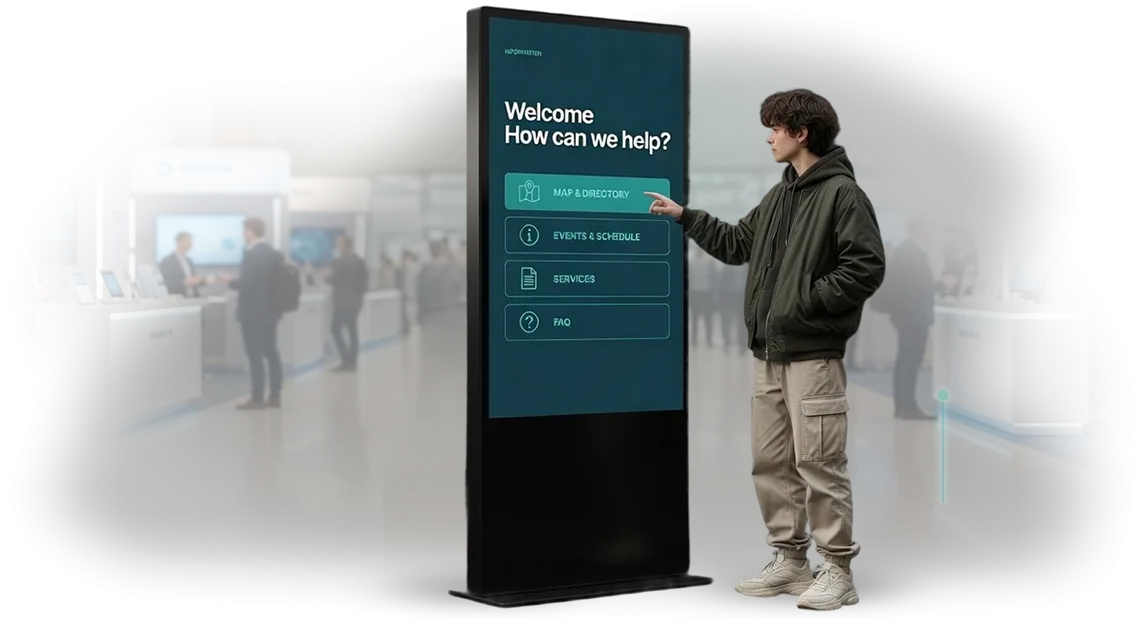
We embed this list into an interactive kiosk at the entrance: the guest marks their arrival, sees their place in the queue, and immediately receives a station number or ticket.
When a staff member becomes free, the system calls the next guest — no one crowds, loses patience, or walks away. The reception stall list connects the kiosk, administrator workstations, and the overall hotel picture, so even at peak hours check-in takes just minutes.
Implementing a reception stall list also solves hidden problems: fewer errors in manual assignment, easier check-in for tourist groups, and calmer staff. Guests see that they are expected and return more willingly.
We will configure the entire scheme for your hotel — from station placement to administrator training — so the system works from day one.
What you get from an interactive kiosk in your hotel
An interactive kiosk in a hotel is not just a screen at the desk but a tool that changes the guest's impression from the first minutes. Instead of waiting in line, the guest independently confirms their booking, selects a convenient option, and receives the key.
Check-in speed drops from 10–15 minutes to 2–3, and this very moment shapes the first impression of your service.
Fast check-in directly affects guest loyalty. The less friction at the entrance, the higher the chance that the guest will return and recommend the hotel.
The kiosk removes peak load from administrators: they handle live communication and non-standard questions, while the system takes over routine tasks.
It is also important that the kiosk extends service coverage. It works around the clock, so late arrivals, early departures, and large groups do not create chaos at the administrator's desk.
Guests can get information about services, restaurants, spa, and excursions at any time — without phone calls and waiting.
The kiosk's effect and benefits are measured not only in time but also in revenue. Additional services can be shown on the screen, and some guests order them right away.
At the same time, all statistics — on check-ins, preferences, and popular services — stay with you and help improve the service.
We design the kiosk around your hotel's tasks: from a compact station to the reception stall list format, where all key guest scenarios are collected on one screen.
Our engineers adapt the scenarios to your interior and processes, and you get a ready-made solution that works for loyalty and speed.
Interactive kiosk formats for hotel tasks
Guests remember service, and speed is its main part. The faster the check-in and service delivery, the higher the hotel's rating. At the same time, administrators are often busy with phone calls and disputes — and the queue at the desk grows.
A properly selected kiosk format (reception stall list) solves exactly the task that is currently slowing down your service and pays for itself through staff time and satisfied guests.
Four kiosk formats for hotel tasks
We select the configuration and scenario for a specific area: lobby, reception, restaurant, or spa. Note which service point is currently overloaded — and you will see your format in the table.
| Format | Who it is for | What it gives the guest |
|---|---|---|
| Registration station | Guests checking in and out | Check-in in 2–3 minutes without a queue; the administrator handles only complex questions |
| Information stand | Lobby visitors | Hotel navigation, list of services and entertainment; the reception desk is relieved |
| Guest terminal | Guests at the pool and in leisure areas | Order spa, transfer, and excursions without a call — additional hotel sales |
| Menu terminal | Restaurant and lobby bar | Self-service food ordering; the average check grows thanks to on-screen prompts |
Whichever format suits your hotel, we cover the entire cycle: equipment selection, interface in the required languages, integration with the hotel management system, and staff training. The solution starts delivering value from day one — without lengthy setup or downtime.
Reception: how we develop a kiosk for your hotel
Guests do not like waiting at the reception, and administrators spend time on routine questions. A kiosk removes this load, but only if it is thoughtfully designed for your hotel. We develop the kiosk in stages so you can control the result and budget at every step.
Below are the main project stages. At each stage, you see an interim result and can make edits, so the final product exactly matches your expectations. This reduces risks and unnecessary spending.
- Brief. We record the kiosk's tasks: faster check-in, hotel navigation, and additional service sales. We study your scenarios and guest specifics.
- Design. We create the screen structure, navigation logic, and design mockup, taking into account your brand style and your team's wishes.
- Approval. You receive an interactive prototype and test it before development starts. After approval, changes are made only within the agreed scope.
- Development and content. We build the interface and connect texts, photos, and price lists. We set up several languages if your guests need them.
- Testing. We run real scenarios: check-in, taxi call, breakfast order. We make sure the kiosk works without staff involvement.
- Launch and training. We install the kiosk, set up integration with your systems, and brief the administrators.
- Support. We accompany the operation: update content, add services, and monitor stability. You can always request an improvement.
This approach eliminates the risk of a "checkbox kiosk": you get a tool that really relieves the reception and speeds up service. And we are responsible for the system working and evolving together with your hotel. This is not just a device delivery but systematic work with your team and guests.
What is included in the interactive kiosk delivery
We deliver the interactive kiosk as a ready-made turnkey solution. This means you receive not scattered parts but a fully assembled and tested system — all you need to do is plug it into the network.
The package includes:
- Equipment: industrial touchscreens, a durable enclosure, and protection from the environment — everything is selected for your task and location. You do not worry about compatibility and wear.
- Software: an interface that every visitor understands and a convenient management system. Content can be changed in a couple of minutes without programmers.
- Design: styling in your company's brand identity, adapted for the kiosk. The screen becomes part of the brand, not a random device.
- Documentation: instructions for users and administrators, maintenance regulations. Staff quickly get up to speed, and failures are prevented in advance.
- Installation and setup: our engineers install the kiosk, connect it to power and network, and verify all operating scenarios.
- Training and support: we transfer all knowledge to your staff, provide a warranty, and stay in touch after launch.
This package saves your time and money: no need to search for different contractors, solve compatibility issues, or hire a separate administrator. You get a working kiosk and focus on your own tasks.
Case study: how the kiosk paid for itself in three months
For the Verkhniy Bereg hotel, we built a kiosk that solves the main pain of any check-in — the queue at the reception desk. Previously, guests waited 15–20 minutes to check in, which spoiled the first impression.
We installed a self-service touchscreen station at the entrance and configured it for the hotel's operations.
The kiosk's results appeared within the first week: average check-in time dropped from 18 to 4 minutes, and the station worked without delays in the morning.
Guests began writing "fast" and "comfortable" in their reviews — the hotel's overall rating on booking sites grew by 20%.
As for payback — the kiosk paid for itself in three months. We calculated it together with the hotel: savings on staff hours, fewer errors in transactions, and growth in direct bookings. The administrator's freed-up time went into live communication and solving non-standard requests.
This hotel case study shows that the kiosk does not replace people but relieves them during peak hours. We trained the staff and prepared instructions for guests, so the launch went without stress. Guests who prefer live communication can always choose the desk — human service is preserved.
After three months, every second guest used self-service, and the share of repeat stays grew by 15% — guests return to places where they were welcomed quickly.
We continue to support the project and show the hotel manager every month how the kiosk affects check-in time and staff load.
How to choose a kiosk format for your hotel?
Choosing a kiosk format starts not with the device model but with the question: what exactly hurts at your front desk? A hotel with 10–15 rooms may not need a separate terminal at all — one compact touchscreen at the reception is enough.
But a resort complex with 200+ rooms already needs a combination: one kiosk for fast registration of arriving guests, and a second for information, navigation, and additional service sales.
The good news is that in almost every case you can get by with one of three proven scenarios: a station for self check-in, an information kiosk for guest orientation, or a hybrid solution that covers both tasks. We select for a specific hotel, not an average across the market.
It is enough to assess the peak arrival flow, the average check for additional services, and how ready the staff is to delegate routine to a machine.
After a short audit, you receive a recommendation with calculations: how many kiosks you need, which functionality to keep, how long the launch will take, and how quickly the load on administrators will drop.
This is usually no more than a couple of weeks from scenario approval to the first check-in through the terminal. We design the interface around your hotel's logic, connect it to the property management system, and set it up so guests can use it without staff prompts.
If you are unsure which format to start with, send us a description of your hotel: the number of rooms, the typical arrival flow, and which tasks you want to offload first.
We will show which kiosk will pay off fastest and help you launch a pilot on one terminal before scaling to all locations.
Frequently asked questions and concerns about hotel kiosks
Concerns before launching a hotel kiosk are understandable: will the system work without failures, will it fit into existing processes, will the launch drag on for months?
In practice, most fears are removed by proper preparation and support — we structure the work so you get a predictable result, not problems.
Here are the answers to the questions that hotel owners and managers most often ask before launch:
How reliable is the kiosk? What if the equipment fails on a busy day?
We use professional components designed for round-the-clock operation in high-traffic locations — a hotel lobby is a familiar environment for them.
The system is designed so that even during a communication or power failure, guests do not lose data: the booking continues in offline mode and synchronizes when the network is restored.
We also set up remote monitoring: our engineers notice deviations before they affect the guest. If intervention is still needed, we respond quickly, and most issues are resolved remotely.
Will the kiosk work with our booking system?
Yes, this is one of the key stages of the project. We adapt the registration station to your hotel management software so that check-in, key issuance, and data loading happen without manual duplication. Integration is tested on real scenarios, not under ideal conditions.
Your administrators will be able to continue working in their familiar interfaces — the kiosk simply takes over the routine part of their duties rather than breaking established processes.
How long does the launch take? Will it stop the reception from working?
A typical project takes from a few weeks for scenario adaptation to full launch. We do not ask you to stop the reception: in parallel with installation and setup, we test everything in test mode. We switch to live operation once you are confident that everything is stable.
The launch happens during hours of minimum load, so guests do not notice the changes. Your team also receives short training in advance — an administrator only needs basic skills to help guests from the first days.
Who will maintain the kiosk after launch?
We support the project after handover as well: we update scenarios, monitor stability, and quickly help when questions arise. Support terms are fixed in the contract, so you know what to expect.
For everyday situations, guests can always turn to the administrator — the kiosk does not replace people but frees them for genuinely important interaction with guests.
Did not find your question? Describe your hotel's situation — we will tell you what the solution would look like in your case.Ready to discuss an interactive kiosk for your hotel?
We know that every hotel lives by its own rules: one has an overloaded administrator desk, another has guests getting lost in search of the spa and restaurant. An interactive kiosk helps solve these problems — but only if it is designed for your specific needs. That is why we start not with a standard offer but with a conversation about your tasks.
Leave a request for a kiosk — and within one business day we will have a short consultation to clarify the format, location, and use scenarios.
Based on that, we will prepare a personalized cost calculation and a preliminary implementation plan: what needs to be refined, what materials we will need from you, and what stages we will go through before launch. No hidden work and no vague deadlines — only specifics for your property.
What you get after your request:
- A personalized cost calculation for your task — without "average market prices".
- Scenario recommendations: check-in, property map, menu, attractions.
- A preliminary implementation plan with stages and timelines.
- Consultation on integration with your hotel management system.
- A clear contract with the scope of work fixed.
- A payback calculation: how the kiosk saves administrator time and improves service quality.
We work remotely, but this does not affect the result: the project manager, designer, and engineers are in touch, and you make the decision. To get the calculation and implementation plan, just write to us — it takes a couple of minutes. We will take care of all the preparation.