

Stall reception design: how not to lose guests at the entrance
Guests decide whether to stay or leave within the first minutes after entering. An inconvenient check-in desk means queues, confused visitors, a ruined first impression and, as a result, lost bookings.
Often it is right here that a business silently loses up to half its potential customers without ever getting the chance to offer them anything.
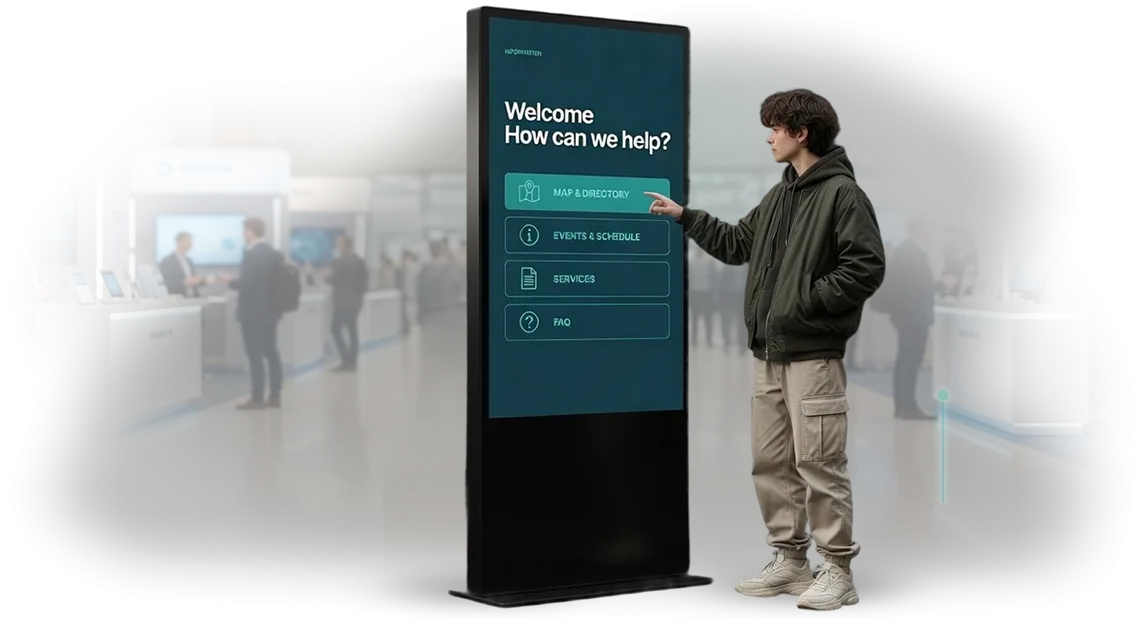
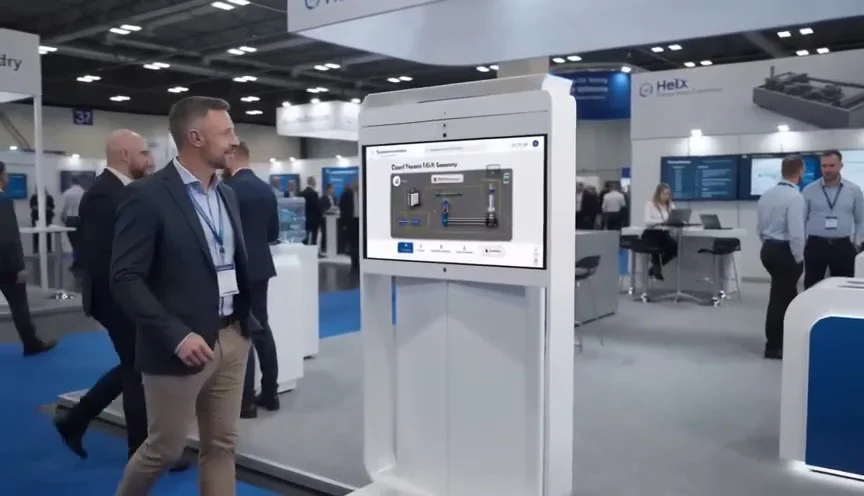
Stall reception design is the engineering of the guest reception area where every detail is thought through: the placement of counters, traffic routes, information signs and interactive kiosks.
When a guest understands where to go and how long the wait will be, they feel cared for from the threshold. A comfortable hotel reception desk speeds up check-in many times over and simultaneously reduces visitor stress.
Properly organized reception directly affects guest conversion: guests checked in faster are more willing to purchase additional services, leave positive reviews and return again.
A convenient front desk reduces staff workload — employees can focus on real interaction instead of “putting out fires” in the crowd. This translates into a tangible increase in average check and repeat visits without additional advertising spend.
We design front-desk zones together with interactive kiosk development, based on real guest behavior scenarios. We analyze traffic flows, account for peak loads and the specifics of your format so that every visitor can easily and quickly walk from the entrance to the counter.
As a result, you get not just a stylish counter, but a working tool that does not lose guests at the entrance — it converts them into loyal customers.
What a well-designed reception desk delivers: 5 measurable benefits
A well-designed reception desk is not just furniture but a tool that directly affects revenue and guest experience. Here are 5 measurable benefits you get from properly designing the reception area.
-
Check-in speed — up to 3 times faster. Guests spend less time on registration thanks to an efficient layout and clear guidance. At the Atlas Hotels chain, such desks cut waiting time by three — staff process guests faster and people spend less time tired in line.
-
Upsell growth of 15–25%. A desk with an interactive kiosk offers guests spa programs, dining and excursions right at check-in. This turns waiting into a revenue source: the guest hasn’t even reached their room yet, but has already booked dinner.
-
Shorter queues at peak hours. The interactive kiosk handles the routine — bookings, payments, key printing. The live queue moves faster even at full hotel occupancy, and staff are not overloaded with repetitive questions.
-
Loyalty boost — up to 80% repeat visits. Guests remember an easy check-in and a modern atmosphere. Personalized on-screen greetings and a comfortable desk generate positive reviews and the desire to return.
-
A recognizable hotel image. An unusual desk becomes part of the brand identity and appears in guests’ social media photos. This provides free audience reach and more direct bookings via the hotel’s website.
Each benefit is measurable and achieved through the right ergonomics and interactivity. Tell us about your hotel — we’ll advise which growth areas a new reception desk can address.
Kiosk development formats: choose the right one for your hotel
The check-in desk is the first thing a guest sees, and the impression and speed of check-in directly depend on it. There is no one-size-fits-all solution: a small hotel doesn’t need a bulky desk, and a large complex doesn’t need a compact kiosk. That’s why we have divided kiosk development formats to match different tasks.
Comparison of kiosk formats
| Format | For which hotel | What it gives the hotel |
|---|---|---|
| Stationary desk | Hotels with high guest flow and 24-hour registration | Fast check-in, staff workstations, a presentable lobby look |
| Mobile desk | Small hotels, lobby with limited space | Compactness, easy removal for events, design refresh without renovation |
| Modular structure | Chain hotels and growing properties | A unified style across all locations, easy addition of features — payment terminals, printers, lighting |
A mobile desk is suitable for fast check-ins and off-site registrations. A stationary kiosk offers maximum functionality and reliability in a permanent location. A modular structure is a compromise for those planning to change their lobby configuration.
We will help you choose the right format for your floor area, budget and guest scenarios — then design, manufacture and install it. You get a desk that saves staff time and improves guest comfort.
Project stages: from brief to launch in 6 steps
A clear process means a predictable timeline and budget. We run the project from brief to launch in six steps, and at every stage you know what is happening and when the result will be ready.
No “black boxes”: all production deadlines for the desk and design approvals are recorded in the plan before work starts.
Six steps from idea to working kiosk
-
Brief and task discovery. You tell us where the kiosk will be located, who your visitors are, and what scenarios they need: consultation, booking, payment, wayfinding. We clarify details and propose solutions for your task.
-
Plan and commercial proposal. We set out the kiosk development stages, timeline, budget and areas of responsibility. You receive a clear plan and can make changes before work begins.
-
Design and approval. We develop the kiosk’s appearance, keeping your brand identity and ergonomics in mind. We present visualizations and an interface prototype, making changes until you say: “that’s it”.
-
Implementation and assembly. We build the enclosure, software and content in parallel. At each stage you see the intermediate result — no surprises at final handover.
-
Testing and launch. We test the kiosk in real scenarios: restarts, power fluctuations, simultaneous touches, content updates. Then we install the equipment on site and train your staff.
-
Support and growth. After launch we stay in touch: we update content, add features and monitor stability. If the product or seasonality changes, we adapt the kiosk to new tasks.
A typical project takes 3–5 weeks; complex solutions take a little longer. The key point is that you know the kiosk development stages in advance and can plan the launch without rushing.
What’s included in the delivery: a package for seamless front-desk operation
You get not drawings and components, but a working kiosk that you can plug in and use on delivery day. All elements — from the desk to the software — are selected, assembled and tested by our team, so you don’t need to hire separate contractors.
The development cost is fixed in the contract before work begins and does not change during the process.
The package includes:
- A finished desk with equipment, assembled and configured to match your design and tasks.
- Licensed software: menu, catalog, presentation, feedback form — everything needed for operation.
- An admin panel so you can update content yourself without programmers.
- Detailed instructions for staff and administrators in plain language.
- Staff training: held online or on site, showing how to operate the kiosk and handle typical situations.
- A warranty on hardware and software, plus technical support for the entire service life.
- Updates and refinements for new tasks — for example, adding new sections or integrating with your services.
Thus, you get a single point of responsibility: our team handles all kiosk operation issues. You don’t need to dig into technical details — just contact us, and we will quickly restore operation or make changes.
Case study: how we accelerated hotel check-in by 40%
Guests don’t like queues. During peak season, check-in at the hotel stretched to 15–20 minutes: the administrator was distracted by calls, bookings and excursion questions.
Unhappy guests started their stay on a negative note, and some left angry reviews even before receiving their keys.
We addressed this pain point with interactive information kiosks. The self-check-in desk connects to the hotel management system and handles standard questions: breakfast, Wi-Fi, transfer, area map.
Guests complete registration themselves in 6–7 minutes, freeing the administrator for personal interaction and complex requests.
The result of the implementation: check-in time down 40% and guest satisfaction up 22% according to internal surveys.
Guests note that they no longer feel a “conveyor belt”: control over the process reduces stress, and staff become friendlier because they don’t repeat the same information dozens of times.
— Earlier we were afraid that kiosks would depersonalize service, — says the front office manager at the Riviera Hotel. — In fact, it turned out the opposite: first impressions became more positive, and check-in stopped being a “hit-or-miss with the queue” lottery.
The desks have already paid for themselves within a season, and we are preparing the second wave of installations.
This case is an example of how a properly designed check-in desk drives loyalty and repeat bookings. The client gets speed and a clear process; the hotel gets measurable growth in key metrics and relief for administrators.
How to choose a reception design for your interior?
Choosing a reception design starts not with an image but with three questions: what function should the desk serve, what style is your interior, and what budget is allocated for the structure.
The answers determine the shape, materials and details that will work for your business, not just decorate the lobby.
The materials of the desk set the tone for the entire space. Stone and metal mean status and durability, wood means warmth and comfort, glass and acrylic mean lightness and modernity.
It’s best to build the color scheme on the interior palette: a contrasting desk becomes an accent, while one close to the walls blends in and visually expands the guest greeting area.
| Design | Materials | For which interior | What it gives the client |
|---|---|---|---|
| Classic | Wood, marble | Traditional-style hotels | Status, trust, premium impression |
| Modern | Metal, glass, concrete | Loft, minimalist, hi-tech | Lightness, technology, focus on architecture |
| Eco-friendly | Solid wood, stone | Eco-hotels, country resorts | Warmth, closeness to nature, coziness |
| Budget | Laminated particle board, plastic, film | Small hotels, hostels | Savings without sacrificing function or neat appearance |
Whichever option you choose, it’s important to consider the desk’s workload: the guest meeting area, space for documents and payments, and staff access. We design the structure around your working scenario and interior, rather than offering template solutions.
We measure the space, select materials and colors, and calculate the estimate and timeline — so the reception becomes a working part of the hotel, not a source of problems.
FAQ: answers to doubts before ordering
Before ordering a kiosk, natural doubts arise: what happens if it breaks, how difficult is content management, and when will the investment pay off. Without clear answers, automation looks risky, especially when the kiosk meets customers every day.
We address these concerns with a warranty, a maintenance service schedule and a payback calculation at the brief stage. Below are answers to frequently asked questions.
What does the kiosk warranty cover?
The warranty is 12 months on all modules. In the event of a malfunction, an engineer arrives within two business days and fixes the issue on site or replaces the unit. For chains, we keep spare parts in stock — downtime is excluded.
Is it difficult to operate the kiosk and update information?
No. You manage content through a simple panel: change prices, add a promotion, replace a video — changes appear immediately.
We carry out preventive maintenance once a quarter, plus remote monitoring: the system itself reports a problem in advance, so customers never see a non-working screen.
How quickly does a kiosk pay for itself?
Usually within 6-18 months depending on the scenario. In the case of the coffee&go coffee chain, kiosks in locations with queues increased orders by 30% and halved service time. Six months later, the client ordered installations in ten new venues.
Order kiosk development — get a cost estimate and plan today
Leave a request — and today you’ll receive a cost estimate, implementation plan and preliminary production timelines. We don’t delay our response or ask you to fill out long forms: a short task description is enough, then we’ll propose a solution and include it in the estimate.
This approach saves time: you understand the budget and stages before the project begins. For a standard kiosk, we offer ready-made solutions that speed up production; for a custom one, we calculate an individual plan based on your tasks and audience. In any case, you receive a transparent estimate with no hidden costs.
What you get immediately after contacting us:
- a cost estimate for development and production — clear and fixed, with no “asterisks” or additional payments along the way;
- a step-by-step work plan with deadlines for each stage;
- a production proposal: timeline, scope, delivery and installation terms;
- configuration and design recommendations for your visitors;
- an agreed payment schedule and final budget;
- the contact of a dedicated manager who oversees the project from request to launch;
- a preliminary layout or sketch, if you need to approve the solution with management.
For most projects, we prepare an estimate within one business day. We give production timelines immediately and record them in the contract — you can calmly plan an opening, event or installation without risk of delays. Leave a request for an estimate: by today, you’ll have an action plan and a clear cost.