

Stall reception table: how to remove queues at the reception
After a long journey, a guest wants to get the key in a minute, not stand in line at the desk. While the administrator processes one person's documents, new arrivals pile up behind — and tension grows with every call to the reception.
This is a familiar situation for many hotels: the check-in peak falls in the evening when tour groups return, and the registration desk cannot keep up.
But even a small flow seems huge if registration takes 10–15 minutes. Every minute of waiting lowers the impression of the hotel before the guest has even seen the room.
Administrators spend time on mechanical operations — passport checks, filling out forms, explaining rules — instead of welcoming guests and creating a service atmosphere.
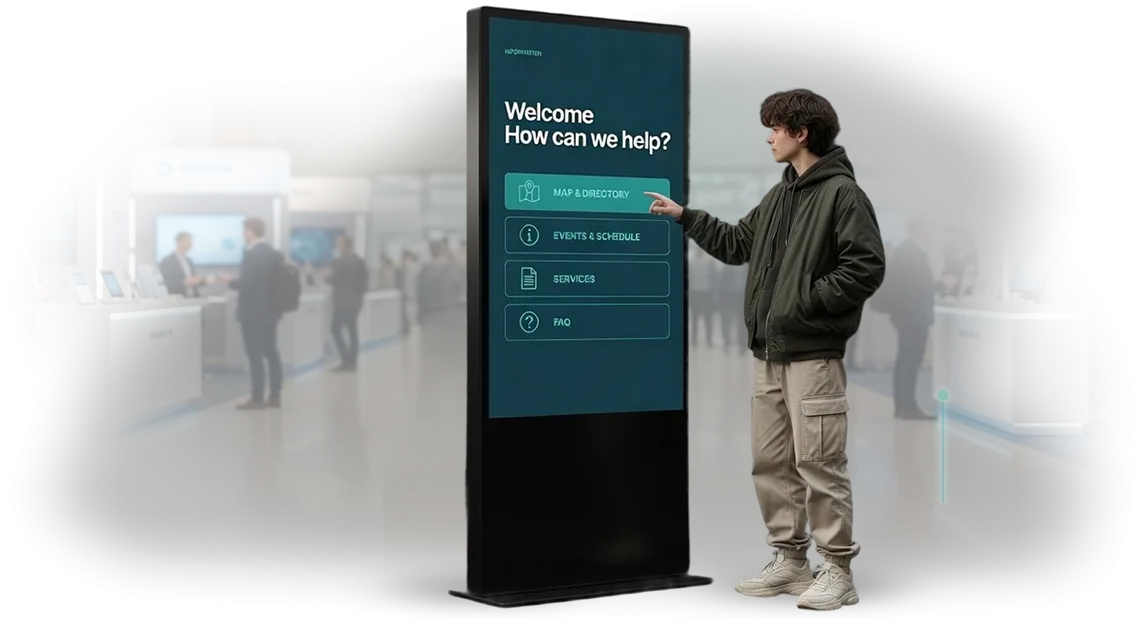
The solution that removes this pain is the self check-in kiosk (stall reception table). Guests scan their documents themselves, confirm their booking and get a key in 2–3 minutes, without staff involvement.
Queues at the reception disappear even at peak hours: some guests naturally move to self-service, while administrators focus on those who need live assistance.
Guest self-service directly affects check-in speed: booking data is pulled automatically, and limits and additional services are configured to the hotel's regulations. You retain control over processes and quickly send guests to their rooms.
As a result, the first minutes of staying at the hotel pass easily — without queues, fuss and extra stress.
Benefits: faster check-in, guest loyalty, revenue growth
The registration kiosk (stall reception table) solves the hotel's main problem — the queue at the administrator's desk during peak hours.
Guests complete registration on their own in a couple of minutes, while the administrator is freed up for live communication and non-standard questions. The hotel gets more satisfied guests without expanding staff.
Faster check-in
The kiosk handles all routine steps: checks the booking, reads documents, issues the room key. The process takes 1-2 minutes instead of the standard 5-10 at the desk, so even when several groups arrive at the same time, nobody waits in line.
A quick start to the vacation shapes the first impression that guests spread in reviews and social media.
Guest loyalty
When people don't stand in line after a long journey, they feel the hotel's care. Staff greet guests personally, help with luggage and advise on the property's facilities. Such service boosts ratings on travel platforms and motivates guests to return for their next vacation.
Additional sales
At registration, the kiosk offers guests a room upgrade, late check-out, dinner at the restaurant or a spa treatment. This is an unobtrusive prompt at the moment when guests are in a vacation mood and ready to pay for experiences. The hotel gets additional sales without administrator involvement and without discounts.
Implementation takes only a few weeks, and the effect is visible within the first month. We handle setup, launch and staff training — you get a working service that pays off through speed, loyalty and a higher average check.
Stall reception table formats for hotels of different classes
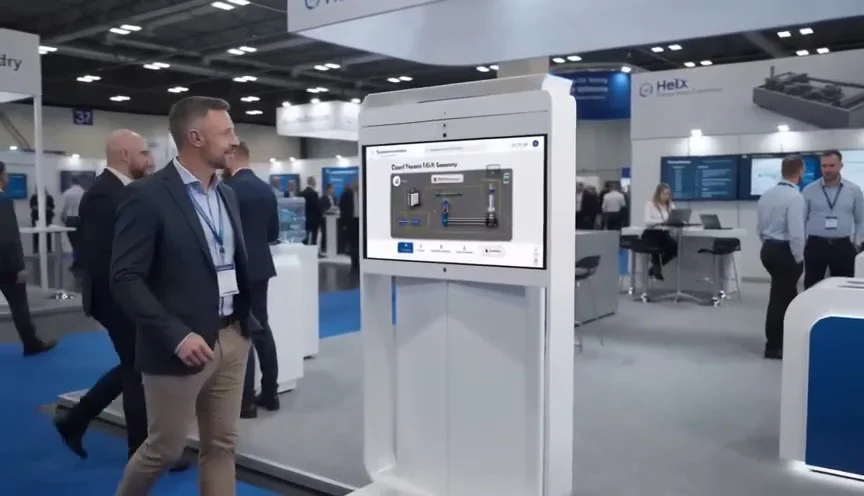
A hotel may look different, but guest expectations are the same: check in quickly, get answers to questions and not crowd around the desk. The stall reception table format is not just a screen in the lobby, but a tool that reduces the load on administrators and increases loyalty.
We offer three proven formats — stationary, mobile and fully autonomous — and help you choose the optimal one for the hotel class, guest flow and building layout.
| Format | Who it is for | What it gives the client |
|---|---|---|
| Stationary kiosk | Hotels with a classic reception desk and an active check-in flow | Speeds up registration, relieves staff during peak hours, looks like a thoughtful interior element |
| Mobile kiosk | Hotels with transformable spaces: lobby bar, business zone, event halls | Moves quickly to match tasks — group arrivals, conferences, seasonal guest surges — without major construction changes |
| Fully autonomous kiosk | Apartment hotels, serviced residences, facilities without a 24-hour desk | Provides self check-in at any time, reduces night-shift costs and does not lose guests arriving late |
All formats share the same logic: guests check their booking themselves, receive a key or access code, and the data immediately enters the hotel management system. The administrator sees the check-in status in real time and joins only when personal communication is needed.
You can start with one format and then scale the solution to other areas — the equipment can be upgraded without replacing the entire system.
We will select the configuration for your hotel class, budget and flow volume so that the kiosk pays for itself from the first weeks of operation.
How the development goes: from brief to launch
A transparent process is what sets our work apart. You always know where the project stands, what is ready and what happens next. No "black boxes": we coordinate every step with you so that the result exactly matches expectations.
The development of a kiosk for the guest reception desk (stall reception table) follows clear stages. Below are the main steps we take together with you.
- Brief and task analysis. We define the kiosk's goals, the audience and the installation location. We study the premises and traffic to propose the best scenario.
- Interface prototype. We show the screen map and navigation logic without design. You make edits before layout starts.
- Design approval. We prepare a design in your brand style — from fonts to colors. You approve the layout, and we move to assembly.
- Development and content loading. We program the logic, connect content, upload data. We make a test version on your or our equipment.
- Kiosk testing and launch. We check touch control, failures and information updates. We install the solution, adjust it to the premises and train staff.
- Support and development. We update content at your request and add new sections. The system works and evolves without rework.
The whole process takes 3 to 6 weeks depending on complexity. You get not "raw" code but a ready-to-use solution that is convenient to operate and easy to manage. At every stage there are clear reports — you always understand what you are paying for.
What is included in the delivery: a complete set for your hotel
When you order a kiosk from us, you get not just a device but a turnkey package ready to work. We take care of everything: from selecting a stand to match your interior to setup and staff training.
No fiddling with equipment, no searching for contractors and no long approvals — only a result that immediately starts working for your service and saves guests' time.
- Stand and built-in equipment — we install and connect everything ourselves and neatly hide the wires. The kiosk looks complete and does not spoil the lobby view.
- Interface for your hotel — registration screen, room information, property map, local attractions and hotel services. Styled in your brand and in the required languages.
- Integration with your property management system (PMS) — booking data is pulled automatically, the guest checks in faster, and the administrator does not have to transfer information manually. This reduces the load on the reception during peak hours.
- Staff training — we conduct a training session for administrators and housekeepers and provide simple instructions and videos. Your employees work confidently with the kiosk from day one.
- Warranty and after-sales service — during the warranty period we service the equipment, update the software and promptly replace failed parts. You are never left alone with the hardware.
- Option to expand — later you can add a payment module, receipt printing, key-card dispenser or additional screens for advertising. The package scales with the hotel's growing tasks without replacing the entire kiosk.
Case study: one hotel increased check-in speed by 40%
At the chain hotel CityStay Hotels, a queue gathered at the reception desk every evening: guests returned tired, and check-in took 15–20 minutes. Administrators filled out documents manually while new visitors waited — this created a negative first impression.
We installed an interactive self check-in kiosk next to the desk. Guests scan their documents, choose a room, pay a deposit and receive a key-card — the administrator gets involved only in non-standard situations.
A month later, measurements showed: check-in speed grew by 40%, and the average time dropped from 12 to 7 minutes. During the two peak hours, the kiosk serves up to 30 guests per hour — this relieves staff and removes the queue.
What changed in numbers
- The check-in queue disappeared even at peak hours.
- Staff stopped wasting time on routine operations and focused on service.
- Repeat visits increased by 15% — fast check-in influences the desire to return.
After three months of operation, the hotel ordered similar kiosks from us for two other properties. We received a repeat order because the measurable result spoke for itself: payback came faster than expected, and guests became noticeably more loyal.
How to choose the right kiosk format for your task?
Choosing a kiosk format starts with the task, not the design: how many visitors pass through the point, what scenarios they need and where the equipment will be installed.
In a small hotel, a compact reception stand — stall reception table — is enough; it fits into the lobby and combines check-in and consultation. In a large complex or airport, freestanding kiosks with a reinforced body and clear navigation work better.
The second step is to think through the scenarios. A guest can easily check in and learn about services and routes; a clinic visitor can sign up for an appointment; a shopper in a mall can find a store or promotion.
The more tasks a kiosk has, the more important a simple interface is, so that a person can manage without staff help. This reduces the load on employees and speeds up service.
Integration with your systems is equally important. The kiosk must send data about appointments and orders directly to the right employee — otherwise the terminal creates manual work.
Therefore, choosing a solution includes not only the body and screen, but also the operating logic, data access and content updates without a programmer.
We help you choose a format for your task: we analyze guest flow, premises, budget and scenarios, and propose the optimal configuration — from a single stand for a hotel to a network of kiosks for a large complex. You get a solution that scales as your business grows. One call — we'll show you options on real cases, calculate timelines and costs.
FAQ: what if the system fails?
We understand: the main fear when introducing a kiosk is that it will let you down at the most critical moment. So we build the system with a safety margin, provide a written warranty and stay in touch after launch. This is not an option but a service standard.
Below we answer the questions most often asked before the start. If you don't find yours — write to us, we will reply the same day and record everything in the contract.
What if the kiosk stops working during an event?
We have an on-duty hotline and remote access to the system. In most cases, we resolve the issue in 30–40 minutes without visiting the site. If a replacement is needed, we bring a backup kiosk and configure it within two days.
What warranty do you provide and what does it cover?
We provide a warranty on the equipment and preinstalled software — from 12 to 24 months. We handle repairs and component replacement; the terms are fixed in the contract in advance.
How quickly will you respond to a request?
Reaction time is 2 hours on weekdays; resolving a critical issue takes 24–48 hours. If the kiosk cannot be repaired on site, we install a temporary replacement so the venue does not sit idle.
Is staff training difficult?
Everything is designed for an employee without technical training: an online or on-site briefing, a short video guide and a support chat. Staff start working confidently from the very first day.
Order a kiosk development and transform the guest experience
An interactive kiosk is not just a screen at the guest reception desk (stall reception table), but a way to relieve staff and shorten the customer's path to the service.
We design the interface around your visitors' scenarios, so it is clear without any prompts — even for those who see a kiosk for the first time.
Ordering a kiosk from our team means getting a ready-made turnkey solution. We handle planning, design, development, setup and support. You don't need to understand technical details: you get a working service within the agreed timeframe.
What you get after ordering:
- A kiosk ready for independent operation — connect it and use it on launch day.
- An interface for your audience — clear and convenient for guests of any age.
- A simple content management system — change promotions and schedules in 5 minutes.
- Integration with your systems — appointments and notifications work together with the kiosk.
- Detailed statistics — see what guests find useful and improve your service.
- Technical support — updates and assistance remain with you after launch.
To start the project, send a request through the form below. We'll ask 3-4 questions about your task, prepare a plan and call you back within one business day. You will receive a clear cost and timelines — without hidden payments.