

Interactive Kiosks: Why Guests Walk Past
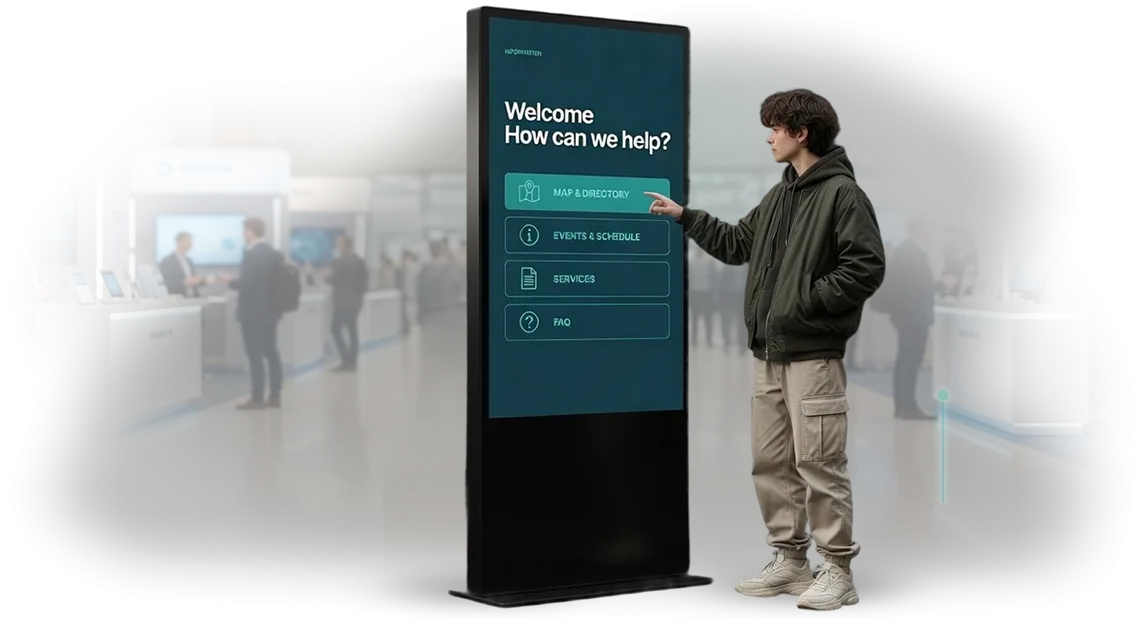
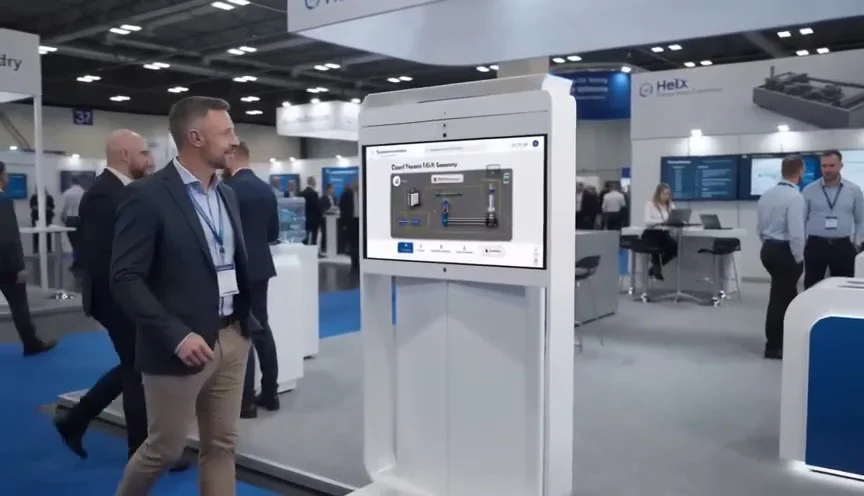
Interactive kiosks are installed to simplify navigation and speed up service, but they often go unnoticed. Visitors glance at the screen and walk past — because they see a static menu, not value for themselves. Attention is held for a couple of seconds at best, and the investment in equipment never pays off.
The problem is not the hardware but the approach to engagement. Today's guests expect instant response and vivid experiences: a list of items and a “back” button are not enough. A regular kiosk triggers no emotion, provides no quick answer, and encourages no action.
As a result, interest fades, foot traffic drops in the zones the kiosk is supposed to support, and revenue falls — cafes, shops, exhibition halls, and hotels lose customers where they could be earning.
We change that scenario. Our engineers design interactive kiosks as a full-fledged attention tool: with a clear interface, a dynamic scenario, and fast response to visitor actions.
We design not just screens but interactive complexes that gently guide guests to the right department, product, or promotion.
When the format allows, we amplify the effect with unconventional solutions — for example, an interactive complex with a Magium interactive floor, which in itself becomes a magnet for families and children.
As a result, the kiosk starts working for business: it attracts attention, increases time spent by the display, and improves conversion to purchase.
We don't sell “hardware for hardware's sake”; we make sure every touchpoint delivers measurable results — guest interest, more orders, and brand loyalty.
What You Get from Modern Equipment
Longer Dwell Time
Interactive floor complexes hold guests' attention several times longer than static displays. A person gets involved in a game or in exploring information, so they spend 3–5 minutes at the screen instead of 15 seconds.
For you, this means more audience contact and a live queue even during “dead” hours. During this time, guests have a chance to explore the assortment, see promotions, and remember key benefits.
Brand Memorability
Game mechanics and visual effects are remembered better than any banner. The guest becomes a participant themselves — which means they feel more connected to the brand and return more willingly. After the event, people mention you on social media, and that is free reach.
Built-in mechanics make it possible to link the game to the product, so the brand association arises naturally.
More Leads from Customers
Interaction scenarios collect contacts: quizzes, surveys, consultation requests, or loyalty program registration. Each screen is configured so that, at the end, the guest leaves their data. Across our projects, conversion to a lead reaches 30-40% of all participants. That means new clients and a base for repeat sales without advertising spend.
Modern Image
Glowing screens, adaptive animation, and instant response to movement create the image of a technology-driven company. This builds trust with clients and partners even before direct contact.
We assemble interactive solutions on professional equipment, so operation remains stable in the busiest locations. And if something breaks, we restore it quickly so your venue doesn't sit idle.
The Magium Interactive Floor Complex: Formats
The Magium interactive complex is not a single device but a flexible system of formats that we configure for a specific task.
Where it will be placed matters: in a children's center, a business center lobby, or a waiting area — this determines whether you need floor projection, a touch panel, or a full-fledged kiosk.
We select the configuration so the space works for you: attracts attention, entertains, or helps visitors quickly find their way.
Below are the standard options our clients order most often. Each format includes hardware, content, installation, and ongoing support — you get a ready-made turnkey zone.
| Format | For whom | What it gives the client |
|---|---|---|
| Floor projection (interactive floor) | Children's centers, museums, shopping malls | Creates a “wow” effect, keeps visitors engaged, and increases time spent in the area |
| Touch wall | Exhibitions, schools, corporate offices | Engages several people at once and works as a live presentation of services |
| Interactive kiosk | Shopping malls, government institutions, stadiums | Helps visitors find information on their own and reduces the burden on staff |
| Combined complex | Amusement parks, large events | Combines several zones into a single space and increases overall audience reach |
We can also add branded graphics and scenarios to any format — tailored to your brand or event. This way the complex doesn't just entertain guests; it collects contacts, showcases products, or provides navigation — depending on the goal. You choose the priority, and we turn it into a ready-made solution.
How a Project Works: From Brief to Launch
We don't just supply equipment; we support the project from the first meeting through the daily operation of the interactive complex. This removes the client's biggest risks: timeline mismatches, installation errors, and “dead” zones that visitors don't use.
Below is a clear set of stages, so you can always see where the project stands and when launch will happen.
- Brief and site audit. We meet with you (in person or online) and clarify your objectives: increase visitor engagement, entertain children, boost brand awareness. We measure the space, examine lighting, traffic, and placement points — this forms the basis for an accurate estimate and timeline.
- Concept and commercial proposal. We prepare the scenario for the interactive zone: which modes will be active, what content will be used, and how the complex will fit into the interior. We show the layout plan, draft mockups, and lock in the cost within your budget.
- Approval. We make edits together with you, approve the final technical specification, and sign the contract. At this stage, you receive the full scope of work and a launch date — with no hidden fees or “surprises” along the way.
- Production and implementation. We manufacture the complex and configure the software and content according to your scenario. In parallel, we prepare the site: if needed, we run cables and reinforce mounting points — so installation goes quickly and cleanly.
- Installation and commissioning. We install the equipment, calibrate sensors, and test the interactive floor's response in real conditions. We eliminate any possible glare, shadows, and false triggers — the complex must work reliably from day one.
- Launch and support. We train the staff: how to start scenarios, change modes, and resolve minor issues. After handover, we stay in touch and, when needed, update content, add new games, and support the complex throughout its entire service life.
This approach saves your time: you make decisions at key milestones, while we handle all the engineering. In the end, you get not just an “installed kiosk” but a ready solution that starts delivering value right away — both on opening day and months into operation.
What Is Included in the Delivery: The Package for Your Space
You receive a complete interactive complex, not just a box of hardware.
We cover the entire cycle: select the equipment for your space, create the content, deliver, install, and train your staff — on launch day, the kiosk is already working and solving your task: informing, entertaining, selling.
- Hardware included — touchscreen panel, protective housing, mounting hardware, and cables. Everything is selected for your room, traffic, and design, so you don't have to source anything separately.
- Licensed software — we install and configure the management system, build the interface in Russian, and add English if needed. You don't pay for subscriptions or worry about renewals.
- Digital content for your task — we develop menus, catalogs, facility maps, promotional banners, or games. If the space calls for an interactive floor, we integrate it into the overall complex as well.
- Installation and commissioning — our engineers deliver the complex, install it, connect it to your network, and test it on site. You get a working system without having to do it yourself.
- Staff training — we run a short hands-on session: how to turn on the kiosk, change content, and handle common situations. Employees will be able to work without calling a specialist.
- Warranty and technical support — all equipment is covered by a warranty, and our support team responds during business hours, helping remotely or with a site visit. If something breaks, we restore it quickly.
- Integration with your systems — we can connect the kiosk to your accounting system, CRM, or product database, so on-screen data is always current without manual updates.
Case Study: Engagement Up 2.5x in a Month
For the family entertainment center Raduga, we built an interactive complex combining an information kiosk and an interactive floor.
Before that, parents and children in the waiting area were bored: average dwell time never exceeded five minutes, and many left before their sessions began. The owners saw that the area was losing money and came to us for a solution. With a steady flow of up to 300 visitors a day, the growth potential was obvious.
What We Did
We developed a unified scenario: at the kiosk, a child selects a difficulty level for the task and then completes it on the floor; parents can connect from their smartphone and control the game. This turned waiting into an engaging experience.
Within a month, the metrics had changed dramatically: dwell time grew from 5 to 15 minutes, and guest engagement increased 2.5 times. The number of game sessions per day grew from 40 to more than 100, and the area became the most popular in the center.
Result for the Business
The increase in dwell time directly affected revenue: demand for the cafe and related services grew, and guests began returning more often.
After two weeks of operation, the client ordered an expansion of the complex to a second location — a repeat order, the strongest indicator of the project's return on investment.
We continue to support the complex: updating games, monitoring statistics, and looking for new growth points together with the client.
How to Choose the Right Solution Format for Your Goals
Choosing an interactive kiosk or an interactive floor complex often comes down to two extremes: buying the most expensive option “for future growth” or skimping on what matters and then paying extra for upgrades.
Neither path is beneficial — you pay either for unused features or for fixing mistakes after launch.
The right approach is to start from your goals, not from a picture in a catalog. Ask yourself: who will use the solution — visitors, customers, employees? What should they do — get information, feel entertained, linger by the display? The answers determine the functionality, screen size, control type, and placement area.
For example, wayfinding in a mall only requires a simple touchscreen kiosk, while attracting attention to a new collection calls for an interactive floor complex that involves people in a game.
Budget is the second side of the choice, but not the main one. We recommend setting a cost range before discussing details, then selecting a solution that fits within it and solves your task by 80–90%.
The remaining 10–20% are those “nice-to-haves” that can be added later without changing the basic configuration. That way you don't overpay for unnecessary elements and get a result that pays off within the first months of operation.
That is exactly why we start with a free brief: you describe your situation, and our engineers propose 2–3 formats with different levels of functionality and cost.
You see what you are paying for and choose the option where every feature works to your advantage — greater visibility, higher sales, or better navigation. This saves time and money even before development begins.
If you're in doubt, just write to us. We'll send examples of completed projects, provide pricing guidance, and help you choose a format that suits your space and budget.
Frequently Asked Questions About Implementation and Maintenance
Implementing an interactive complex with an interactive floor is not just about purchasing equipment; it is a process that should go smoothly, without surprises. Here are the answers to the questions clients ask most often.
How long does installation and launch take?
A typical project takes 3 to 7 days. This includes an engineer's site visit, installation, configuration, and staff training. The timeline depends on the size of the space and site readiness: the fewer variables, the faster.
Is the complex difficult to install? Does the room need preparation?
Preparation is minimal: a level floor and a power outlet are enough. We deliver, assemble, and connect the equipment ourselves. No redevelopment or renovation is required — installation takes one working day.
What happens if the equipment breaks down?
The complex comes with a 12-month warranty. During this period, our engineers repair or replace parts free of charge. We also offer a post-warranty service agreement — we visit the site within a few days. We are also available remotely: most issues are resolved remotely.
How does launch and staff training work?
After installation, we run a test launch: we check all modes and tune the system to your space and objectives. Then we train administrators and staff — 1–2 hours is enough for your team to work confidently with the complex and change content.
Order a Project and Get a Quote Within a Day
You have already seen the potential of interactive formats: a complex with Magium interactive floor software holds visitors' attention, increases dwell time, and delivers measurable results for business.
It makes your venue stand out from competitors and gives people a reason to return. All that remains is to turn the idea into a working solution with clear timelines and a budget.
Leave a request — within one business day, we will contact you, clarify your objectives, and prepare a cost estimate. The consultation is free and carries no obligations: you will get a clear picture of the project, format recommendations, and a budget estimate.
Our engineers will tell you how they have already implemented dozens of similar venues and what worked best.
What you'll get after contacting us:
- A preliminary estimate of cost and timeline for your site;
- Format selection: kiosk, interactive floor, or turnkey complex;
- Recommendations on placement and scenarios to strengthen the result;
- An honest assessment: what is needed for launch and what can be simplified;
- Answers to questions about installation, launch, and ongoing support.
To order a quote or simply get a consultation, leave a request on the website or write to us. We will respond within a day, send a commercial proposal, and suggest next steps — without pressure or unnecessary phone calls.