

OKOF Interactive Table: Why Visitors Walk Past Your Booth
Visitors walk past your booth in a matter of seconds — even if the product is genuinely interesting. Their gaze glides over static banners, no one picks up brochures, and conversations start only with those who came with a clear intention.
As a result, the exhibition participation budget doesn't pay off, and the sales department returns with a couple of warm contacts instead of a stream of interested clients.
The problem is not the location or the number of booth staff. Today's visitors are used to interactive experiences on their phones and expect the same kind of response from a brand at an event.
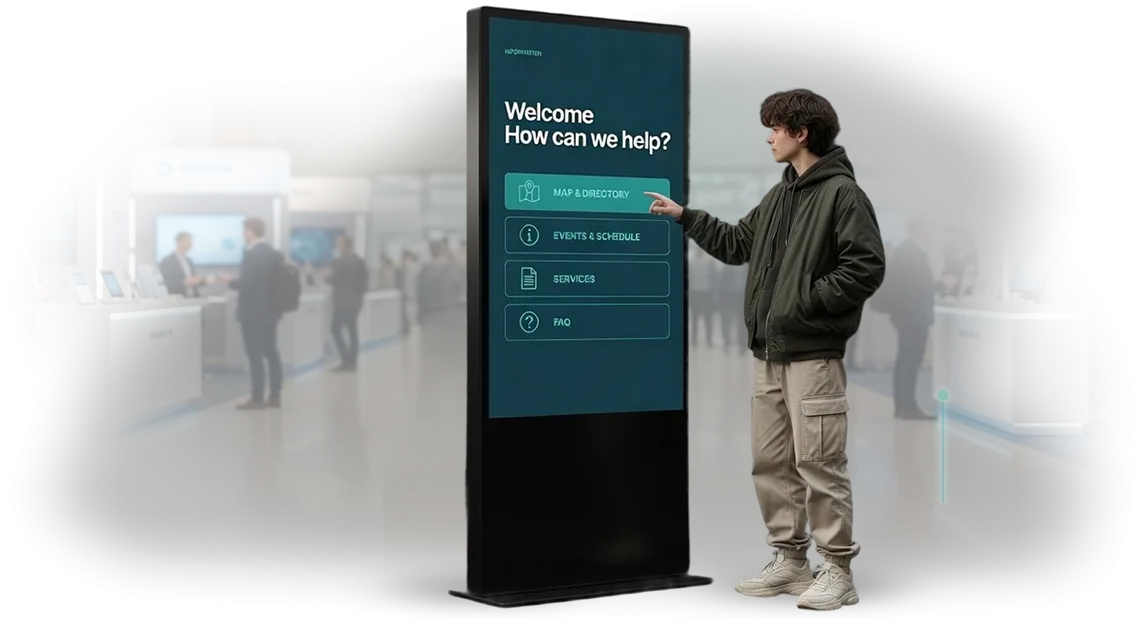
Information kiosks and the OKOF interactive table change the dynamics: people touch the screen themselves, choose a scenario, and explore the product at their own pace. This engages more strongly than any greeting — the visitor stays at the booth for minutes, not seconds.
When a visitor interacts with an interactive table, they don't just look — they participate. You can show a 3D catalog, configure a product, find the nearest office, or leave a contact in exchange for useful material.
Such participation is memorable and sparks conversation — which means your managers have a natural reason to start a dialogue and qualify the client.
We help clients turn exhibition booths into a space that attracts attention and collects contacts. We design scenarios tailored to business goals, prepare content, and supply equipment that works reliably all day long.
The OKOF interactive table from our team is a tool that pays for itself from the very first event thanks to an increase in the number of inquiries and the depth of engagement with visitors.
What You Get from Installing a Kiosk
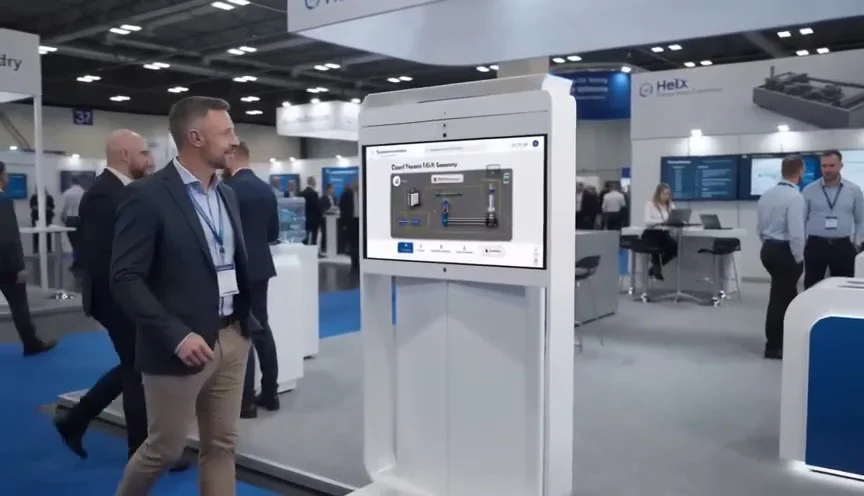
An interactive kiosk turns a passive observer into an active participant. Visitors approach, touch the screen, study the information, and spend several times longer at the booth than during a standard demonstration. This directly increases how well your offer is remembered and sets you apart from competitors.
The technical side is fully handled by our team. We use professional touch equipment from proven global brands, such as Samsung — it is designed for high loads and works without failures in high-traffic areas. You get stable performance and don't have to worry about technical issues.
The kiosk also collects visitor contacts in one click and transfers them to your accounting system. No manual entry, no lost records — only leads ready for processing. This turns an ordinary booth into a source of real leads for your sales department.
A bright screen with your logo works to increase brand awareness. Visitors take photos of the interactive kiosk and share them on social media — you get free coverage long after the event ends.
As a result, the kiosk pays for itself through increased time at the booth, more contacts, and more leads.
Kiosk Formats for Different Tasks and Spaces
The space dictates the format: you can't place a massive terminal in a narrow niche, and a small counter would get lost in a spacious lobby. We select the kiosk design based on your venue and task — so the equipment serves the flow of visitors rather than just standing there.
Compare three basic formats.
| Format | Who it's for and where | What it offers the client |
|---|---|---|
| Countertop kiosk | Reception desks, exhibitions, small waiting areas | Saves space, deploys quickly, convenient for information, reservations, and payments |
| Floor-standing kiosk | Lobbies, shopping malls, airports, museums | Handles heavy foot traffic, visible from afar, works as a standalone information point |
| Wall-mounted kiosk | Narrow passages, elevator halls, entrance areas | Takes up no floor space, protected from damage, always in the visitor's line of sight |
Countertop models are usually chosen for service areas and events, floor-standing models for high-traffic locations, and wall-mounted models where every square meter matters. In each option, we carefully consider ease of use and durability to ensure the kiosk lasts for years. The right format directly affects service speed and the visitor experience.
How the Project Works: From Brief to Launch
We have built a transparent development process for the interactive table: you always know where the project stands and what comes next. We call it Turnkey Kiosk — a procedure of seven stages formalized in the contract. It allows you to launch the kiosk on time and without unexpected costs.
- Brief — we discuss the kiosk's objectives, target audience, installation location, and desired functionality. You fill out a short questionnaire or answer our manager's questions.
- Plan and estimate — we set timelines, cost, and scope of work. You receive a detailed commercial proposal and approve a contract that specifies all stages and deliverables.
- Design and approval — we prepare interface mockups and enclosure designs. We make revisions until you are satisfied with the result — and only then do we move to production.
- Production — we manufacture the enclosure, source reliable components, assemble and test the device. At this stage, you can visit the production facility and evaluate the quality in person.
- Programming — we develop the software, configure the content management system and integrations with your services. We show intermediate versions so you can monitor progress.
- Launch — we deliver and install the kiosk, test all scenarios, train staff, and hand over documentation. You receive a fully operational solution.
- Support — we stay in touch, update content, perform scheduled maintenance, and quickly resolve any issues. Support is included for the first month and can continue at your request.
At every stage, you receive intermediate deliverables: mockups, prototypes, and test versions of the interface. This way you control the process and see what you are paying for, while we reduce risks and avoid surprises. After launch, you are never left alone with the equipment — we stay in touch.
What's Included in Delivery and Launch
You get a complete turnkey package: equipment, software, design, installation, and staff training. Nothing needs to be sourced separately — all work and materials are agreed in advance.
- Kiosk delivery. We deliver the equipment for your task: a floor-standing kiosk, an interactive table, or a wall-mounted panel. Everything is already assembled, configured, and ready to operate on the installation day.
- Kiosk software. We install licensed software with an intuitive interface. You update content yourself through a simple control panel, no developers required.
- Design and branding. We create screen mockups in your corporate style. The information is structured and clear for visitors: navigation, promotions, schedule, catalog — all within a single brand concept.
- Installation and connection. Our installation team places the kiosk at the required location, connects it to the network, and brings it into operation. We set up operating schedules and access levels.
- Staff training. We conduct a short briefing: powering on, uploading news, handling unusual situations. We provide retraining if needed.
- Warranty and support. Official warranty covers both hardware and software. During this period, we resolve issues and update applications free of charge.
This saves anywhere from a few days to several weeks on your launch. You pay for the result: the kiosk starts engaging visitors from day one.
Case Study: How an Interactive Table Increased Time at the Booth
Exhibition visitors rarely stay at a regular booth for more than a couple of minutes: they pick up a brochure, ask a question, and leave.
For a property developer, that's not enough — sales only happen through live dialogue, and that requires time, which is usually in short supply.
We suggested that the developer Novy Kvartal use an interactive table with apartment layouts.
Instead of a consultant repeating the same information, visitors chose the floor themselves, looked at options, and compared areas — while the manager stepped in at the moment of interest.
What Changed
Before the table, the average time at the booth was about one minute — people managed to grab a brochure and walk on. Most left without contact because they were too shy to approach a manager with questions.
With the interactive table, time at the booth doubled: visitors spent several minutes at the screen studying layouts and came back again with specific questions. It also won over those who had been too shy to approach — they touched the screen first, then started a conversation.
Business Result
Over two exhibition days, the table collected hundreds of interactions. The number of qualified leads grew two and a half times compared to the previous participation, and managers spent their time not on greetings, but on working with already interested clients.
The client got the main thing — not a "pretty screen", but a clear funnel: more time at the booth, more live dialogues, and more contacts that turned into sales.
Common Concerns: What If the Kiosk Breaks Down
A kiosk is equipment, and any equipment sometimes needs attention. That's why we design the system from the very start to keep downtime minimal and your staff focused on their work.
What if the kiosk breaks down in the middle of the workday?
The equipment is covered by warranty, and all integration work is covered by a separate contract. If something fails, you call us — we check the status remotely and, if necessary, come with a replacement part. In most cases, the issue is resolved within two business days, without any prolonged downtime.
Is it difficult to update content and manage the kiosk?
No, you don't need a programmer. Content is updated through a simple admin panel: upload the files, click "publish" — and that's it. The system monitors the kiosk on its own and notifies your designated person if attention is needed. Retraining staff takes no more than an hour.
How do we account for the kiosk in bookkeeping and assign an OKOF code?
We support the project until full launch: we prepare documents, help with proper accounting treatment, and advise which OKOF code to apply for your type of kiosk. You won't have to figure out the classifiers yourself — everything will be handled correctly the first time.
We address these concerns as early as the brief stage by recording warranty obligations, response times, and service procedures in the contract. You get a working solution, support at all stages, and clear documentation — without hidden complications. If you still have questions, just write to us — we'll respond within one business day.Leave a Request: Get a Cost and Timeline Estimate
Submit a request for a free estimate — within 1-2 business days, we'll send you the cost and implementation timeline. No pushy phone calls: we'll answer your questions in the format that suits you and suggest a solution that fits your budget.
To make the estimate accurate rather than "market average," we'll ask a few clarifying questions: where the installation is planned, who will use the kiosk, and which features are important. After that, we'll set the timeline and stages — so you'll know exactly what you'll get and when.
What's Included in the Estimate
- Free consultation: we'll analyze your goals, audience, and installation locations.
- Format selection: a touchscreen kiosk, interactive table, or multimedia complex to suit your goals.
- Transparent estimate: cost of design, equipment, installation, and content — no hidden charges.
- Stage-by-stage timelines: design, development, delivery, launch — with specific dates.
- Integration check: the ability to connect to your catalog, product database, or accounting system.
- Warranty and support: staff training and post-launch assistance.
As a result, you'll receive a commercial proposal with a fixed cost and work plan. If you need to stay within a tight budget, we'll suggest an optimal configuration — without unnecessary options, but with all the key functions preserved.
Submitting a request costs you nothing — you only gain the specifics needed to make a quick decision. We'll get in touch at a convenient time, answer all your questions, and prepare an estimate you can immediately show to management or your client.
How to Choose a Kiosk Format for Your Task?
The kiosk format is not a matter of taste, but a decision that directly affects the return on investment. When choosing, we look at three things: what task the kiosk solves, what space is allocated for it, and what budget the client has in mind.
Our engineers select the design for each specific case rather than offering a standard solution that might not fit.
Let's start with the task. If the kiosk needs to quickly provide information about a product or service and work as an information point, a compact model will work.
If the goal is to keep visitors in the area, tell the brand's story, or give a product presentation, an interactive table or large-format panel is better.
The more complex the scenario, the more interaction capabilities you'll need — and it's normal for the format to be chosen to fit the scenario, not the other way around.
The second factor is the site. The square footage and layout determine where and how the kiosk will be placed. For narrow corridors and small halls, wall-mounted designs work well; for open lobby space, floor-standing models.
It's important to consider foot traffic: in high-traffic areas, you need durable equipment and protection from accidental impacts; in quieter zones, you can use a more open layout.
Finally, the budget. Choosing a kiosk doesn't mean you have to take the most expensive option. We calculate the total cost of ownership: screen, enclosure, software, installation, and support. This way, you get a working tool that pays for itself, not just a pretty stand.
If the budget is limited, we'll offer an option with partially replaced components or equipment rental for the duration of a promotion.
As a result, you get a kiosk format that fits your space, fulfills the task, and stays within budget. We handle the selection, estimate preparation, and turnkey implementation — all you have to do is approve the solution and start the project.