


How to Reduce the Load on Airport Information Desks?
Every morning at major airports, passenger traffic grows — and so does the queue at the information desk. People ask the same questions: where is the check-in counter, how to get to the departure gate, where the luggage storage is.
Information desk staff simply cannot answer everyone, especially during peak hours and the holiday season, while irritated travelers start missing their flights.
Airport managers see that hiring additional staff for every shift is expensive and inefficient: during quiet periods employees stand idle, and during peak hours queues still form. This leads to negative reviews, missed flights, and a damaged airport reputation.
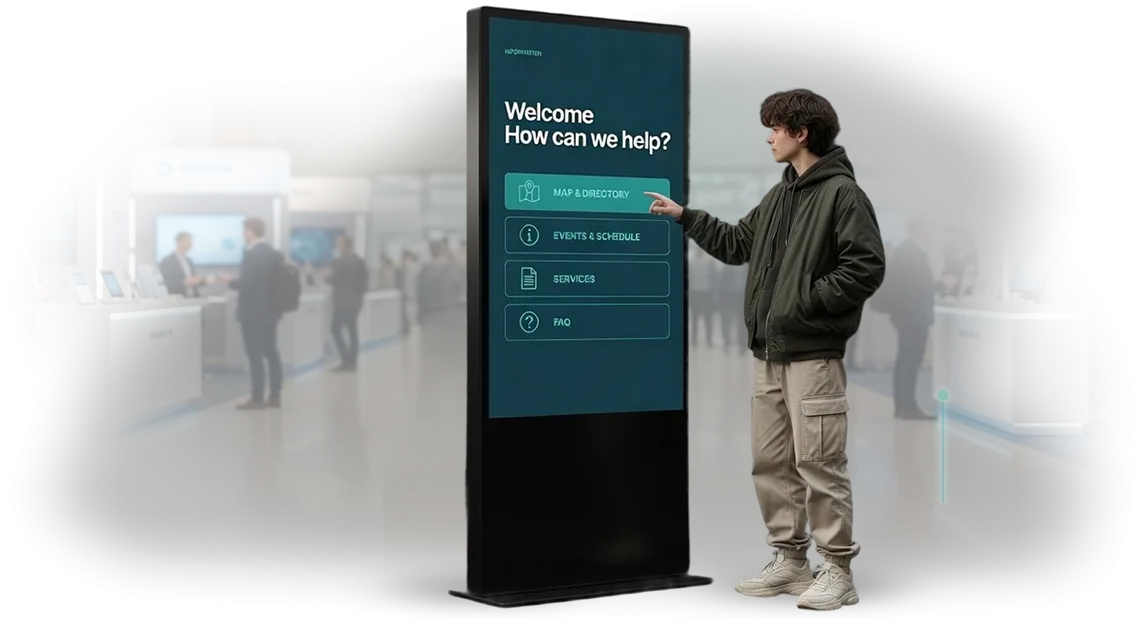
An interactive information kiosk takes this load off staff. It handles typical passenger requests: shows the terminal map, provides directions to the right counter, and explains where elevators, escalators, cafés, and luggage storage are located.
A traveler only needs to touch the screen — and gets an answer in a minute, without waiting in line or talking to an employee. The kiosk can also provide up-to-date flight information: delays, boarding gates, baggage carousels.
A significant share of questions is resolved without human involvement — this is a direct reduction of the load on the information desk.
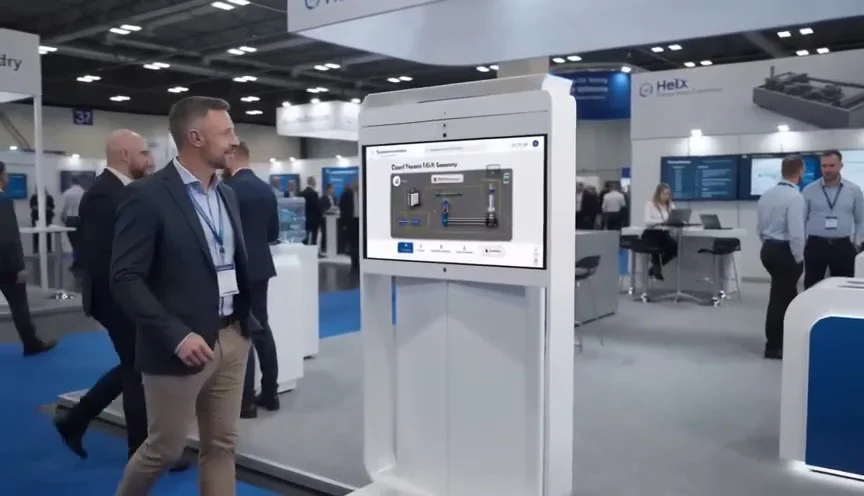
Terminals are placed in high-traffic zones: at entrances, in screening areas, and next to the information desk, so passengers can use them at any moment. An interactive kiosk operates around the clock and reliably, even when the information desk is closed.
As a result, queues shorten during peak hours, and human staff focus on genuinely complex requests and special situations that require an individual approach.
Kiosk content is easy to update, so navigation and flight information are always current — when changes are needed, edits can be made centrally.
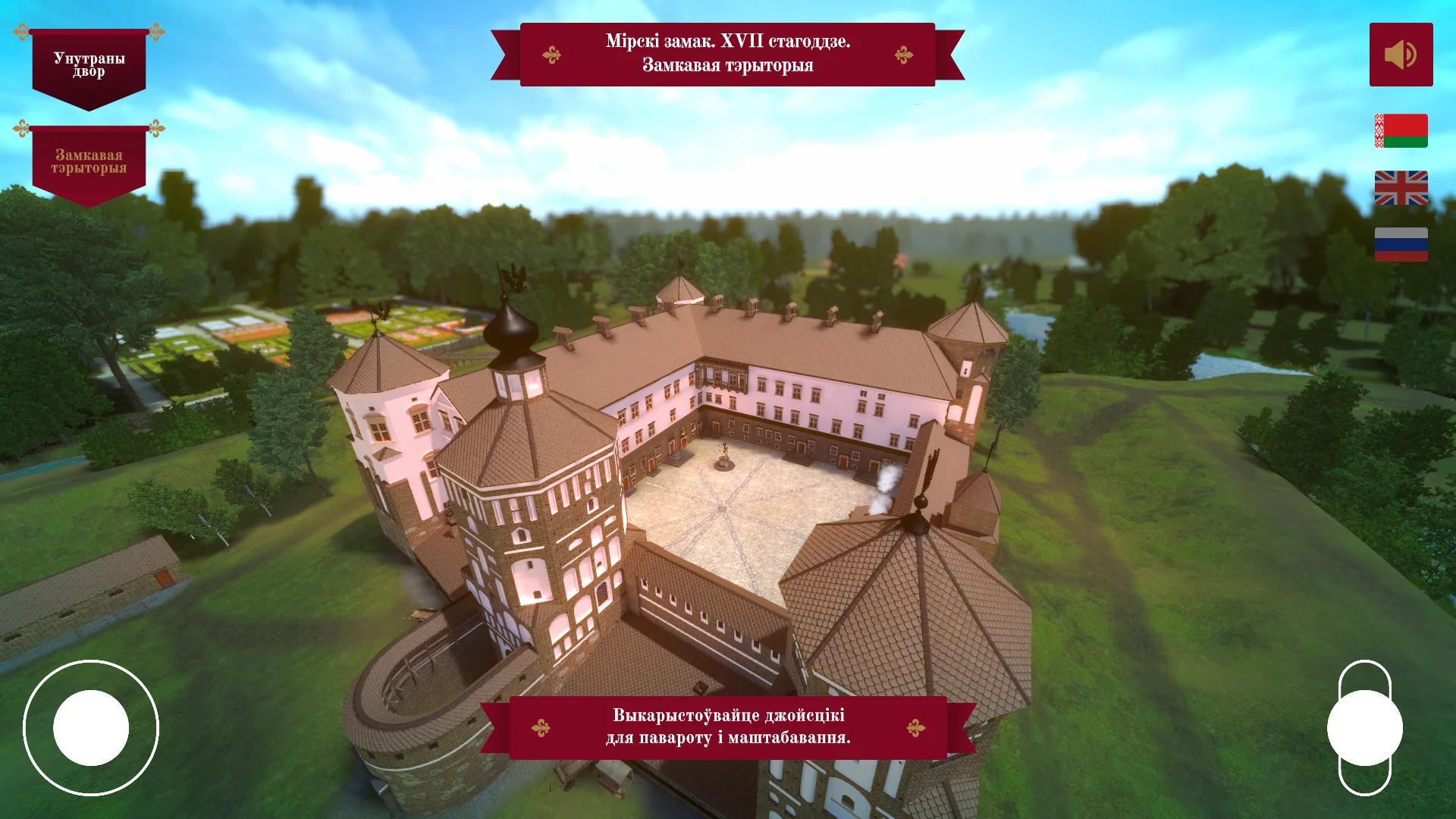
When developing kiosks for airports, we rely on passenger logic and design interfaces that are clear to people of all ages and skill levels. Navigation is built on simple visual cues rather than long command lists — this reduces the number of errors and repeat inquiries.
We also help with implementation: terminals fit naturally into the existing infrastructure and become part of the airport's digital navigation.
In the end, the airport gets a tool that genuinely reduces the load on the information desk, speeds up service, and makes travel more comfortable for every passenger.
What Changes After Implementing an Interactive Kiosk
Airport passengers value speed and predictability.
The kiosk removes the main pain point — the need to search for an information counter or wait for an employee's response: a person independently finds the way to the gate, the flight, boarding time, and the location of cafés and rest areas.
As a result, the passenger spends less time getting oriented and feels that the airport cares about their comfort.
For operations teams, this is also a noticeable relief. Part of the routine questions — "where's the exit?", "how long for baggage?", "how do I find a pharmacy?" — is handled by the kiosk, while human staff switch to non-standard situations.
There are fewer queues at the information desk, fewer repeated inquiries, and current information is always at hand. Another plus is anonymized request statistics: the airport sees what passengers search for most often and can improve navigation and the placement of services.
Implementing a kiosk is not just buying equipment; it's a managed investment in service quality. We work with professional touchscreen stands with protection against dust and temperature changes, adapted for round-the-clock operation in the airport building.
We — our team — handle scenario design, installation, and configuration, so the client gets a turnkey solution: from a multilingual interface to remote information updates.
Key changes noticed by both passengers and airport services:
- Passengers find their way around the terminal faster and are less likely to be late for boarding.
- The information counter is unloaded, and staff handle in-person inquiries.
- The airport receives data on popular requests and can improve services.
- The solution pays off through reduced staff workload and higher satisfaction.
Interactive Kiosk Formats for Airports: How to Choose
Choosing a kiosk format for an airport is not about design — it's about the efficiency of each zone. A passenger in the departure hall and a passenger in the transit zone have different goals, so the equipment should also be different.
A well-chosen format shortens queues, unloads staff, and improves service — without unnecessary costs for space and maintenance.
| Format | Where to Place | For Which Tasks | What the Client Gains |
|---|---|---|---|
| Floor-standing touch terminal | Terminal entrance, waiting hall, baggage claim area | Terminal navigation, flight and gate search, reference information | Passengers find their way faster, fewer questions to staff, reduced counter workload |
| Wall-mounted kiosk | Near elevators, escalators, and passages between terminals | Quick reference: directions, travel time, nearest services | Space savings, targeted assistance at decision points, even passenger flow distribution |
| Compact kiosk stand | Check-in area, ancillary services counters | Service enrollment, ticket purchases, flight status information | Additional revenue, shorter queues at counters, self-service |
| Kiosk with printing function | Transfer zone, boarding gates | Boarding pass printing, booking confirmation, status check | Faster boarding, reduced staff workload, lower risk of missed flights |
In every project, we match the format to the specific task: we consider passenger traffic, zone size, and interaction scenarios. For a large hub, 3–4 floor-standing terminals at the entrance are enough; for a regional airport, compact wall-mounted solutions.
The key is that the airport kiosk gives a quick answer and requires no training — then passengers use it on their own.
We design floor-standing stands, wall-mounted terminals, and combined solutions. Already at the brief stage, we propose zone layouts and calculate the load so the equipment actually works rather than just sits there.
If you're not sure which format fits — request a consultation; we'll show you using your terminals and flows as examples.
How Interactive Kiosk Implementation Works in 6 Steps
Implementing an interactive kiosk is a project where you see every step. We don't hide processes behind the scenes: from the brief to the working device, you know what's happening, who's responsible for what, and when you'll get the result.
Six Steps from Brief to Launch
- Brief and technical specification. You describe what task the kiosk solves: terminal navigation, flight information, or passenger services. We define the operating logic and propose suitable equipment, and you approve the format.
- Plan and installation timeline. We agree on a schedule that accounts for the specifics of your site. You receive clear dates for production, delivery, and installation — without unexpected rescheduling.
- Layout approval. We develop the interface design: menu structure, buttons, and visual style to match your brand. Edits are made on the layout, before installation — it's fast and doesn't require extra costs.
- Assembly and configuration. We prepare the kiosk and software. We upload your materials, test navigation scenarios, and configure content updates so information can be changed without replacing the device.
- Installation and kiosk launch. We deliver, install at the agreed location, connect power and network, and run final checks. The device starts working on launch day — with no downtime.
- Ongoing support. Technical support, monitoring of software status and updates. You don't have to think about the kiosk — it runs reliably, and we keep an eye on its condition.
The result is a predictable process with no surprises. You get a working kiosk within the agreed timeframe and support after launch.
What's Included in the Interactive Kiosk Delivery
You don't need to coordinate multiple contractors or worry about whether the equipment, software, and installers will get along with each other. We supply the kiosk turnkey: we handle development, assembly, installation, and support.
The airport gets a working service by the agreed deadline — without last-minute scrambling before the opening of a new terminal or the start of a seasonal schedule.
The standard delivery package includes:
- Kiosk hardware — enclosure, touchscreen, computing unit, and communication modules, assembled and tested before shipping.
- Virtual concierge software — airport map, flight search, navigation between terminals, routes to the boarding gate, and information about waiting areas.
- Content update system — airport staff can change schedules, advertising banners, and movement maps themselves through an intuitive panel, without involving a developer.
- Screen design and content — styling in the airport's brand style, translations into key passenger languages, and maps adapted to your terminal layout.
- Installation and commissioning — on-site visit by specialists, installation at the right spot, connection to the airport's power supply and network, and final tuning to real passenger traffic.
- Instructions and procedures — short guides for the operations service, daily check rules, and action plans for emergencies.
- Post-launch support — remote monitoring, software and content updates on request, so the kiosk stays current and functional.
This way you get a single point of responsibility: one contract, one contractor, and a predictable outcome. Passengers find their way around the airport faster, the load on the information desk drops, and you don't waste time on endless coordination between suppliers.
How a Kiosk Helped an Airport Cut the Queue at the Information Desk
A typical airport information desk is always at peak load: in the morning and evening, queues form from passengers asking the same questions.
Whether to rebook a ticket, where the boarding gate is, how to reach the hotel faster — answering all this takes time, and during peak hours there's a shortage of both staff and patience.
We installed interactive kiosks in the main hall area and near the entrance to the check-in counters.
Passengers got the ability to resolve typical questions on their own: find their flight, see the route to the gate, check baggage rules, or call for staff assistance with a single touch.
Implementation Results
Four weeks after launch, the queue at the information desk shrank by almost half, and the average time to get an answer dropped from six minutes to one.
Passengers stopped crowding around the counter: 70% of inquiries are now handled by the kiosk, while human staff focus on non-standard situations — escorting passengers with reduced mobility and managing complex transfers.
Demand for the kiosks exceeded forecasts: each unit processes more than two hundred sessions per day, without any loss of service quality.
The administration noted that passengers now go through pre-flight procedures more calmly, and a repeat order of the system for a new terminal confirmed that the solution pays off not only during peak hours but also in day-to-day operations.
Client Review
"We expected to reduce the load on the information desk, but we got more — convenience for passengers and real time savings for staff.
The kiosks have become part of the navigation; without them, the terminal no longer operates as effectively," — head of the airport's passenger services department.
The case shows: our team doesn't just supply equipment — it integrates into the client's operational processes. We take on flow analysis, interface configuration tailored to the airport's logic, and staff training so that results are visible in the first weeks.
A typical airport information desk is always at peak load: in the morning and evening, queues form from passengers asking the same questions.
Whether to rebook a ticket, where the boarding gate is, how to reach the hotel faster — answering all this takes time, and during peak hours there's a shortage of both staff and patience.
We installed interactive kiosks in the main hall area and near the entrance to the check-in counters.
Passengers got the ability to resolve typical questions on their own: find their flight, see the route to the gate, check baggage rules, or call for staff assistance with a single touch.
Implementation Results
Four weeks after launch, the queue at the information desk shrank by almost half, and the average time to get an answer dropped from six minutes to one.
Passengers stopped crowding around the counter: 70% of inquiries are now handled by the kiosk, while human staff focus on non-standard situations — escorting passengers with reduced mobility and managing complex transfers.
Demand for the kiosks exceeded forecasts: each unit processes more than two hundred sessions per day, without any loss of service quality.
The administration noted that passengers now go through pre-flight procedures more calmly, and a repeat order of the system for a new terminal confirmed that the solution pays off not only during peak hours but also in day-to-day operations.
Client Review
"We expected to reduce the load on the information desk, but we got more — convenience for passengers and real time savings for staff.
The kiosks have become part of the navigation; without them, the terminal no longer operates as effectively," — head of the airport's passenger services department.
The case shows: our team doesn't just supply equipment — it integrates into the client's operational processes. We take on flow analysis, interface configuration tailored to the airport's logic, and staff training so that results are visible in the first weeks.
What If a Kiosk Breaks Down or Needs Improvements?
Any kiosk is equipment, and it can fail. The key question isn't how to eliminate risk, but how quickly you can get the device back up and running.
We build the system so that a failure doesn't turn into downtime: the kiosk uses fault-tolerant components, and the software side includes automatic monitoring of key nodes.
If a failure does happen, you're not left alone with the problem. Our support team follows a clear procedure: we accept the request, diagnose remotely, and, if needed, dispatch a specialist to the site.
For airports, where every hour of downtime means dissatisfied passengers, we define a module replacement scenario and a backup startup scheme in advance.
Improvements and content updates are a different story. We don't "abandon" the project after launch: you update schedules, maps, and reference information — either yourself through an intuitive panel, or through us by request. Changes ship quickly and don't require rewriting the system.
Here's a typical question we hear in negotiations:
What happens if the kiosk breaks down on the busiest day?
There's a response procedure for that. The contract specifies response and replacement times — usually hours, not weeks. We leave a set of critical spare parts on-site and provide access to remote diagnostics.
If the device can't be repaired on site, we replace it with a backup unit and handle the repair at the service center. For the airport, the impact on passenger flow is minimal.
Let's Discuss an Interactive Kiosk Project for Your Airport
Every airport operates by its own rules: passenger flows, navigation scenarios, brand identity, and security requirements.
A standard kiosk won't work here — you need a custom solution that fits into the infrastructure, reduces the load on information counters, and makes navigation truly simple for passengers.
Our team has been developing interactive systems for transportation facilities for over 10 years.
We know how to combine passenger convenience with the goals of operational staff, so we start not with hardware but with your scenarios: who uses the kiosk, what questions are asked most often, and what should happen after a screen touch.
Leave a request for a kiosk — and right after you get in touch, you'll receive:
- Priority consultation with an engineer and analyst, not just emails with a manager;
- A preliminary project estimate based on your input — timelines and scope of work;
- Kiosk configuration selection for the tasks of a specific terminal or waiting area;
- Recommendations on integrating the kiosk into the airport's existing infrastructure;
- A showcase of relevant projects and answers to questions about integration with airport systems;
- A service development plan after launch — content updates, new scenarios, analytics collection.
From there, everything moves on a transparent schedule: we lock in requirements, prepare a prototype, agree on design and logic, and then launch a pilot. At every stage, you see exactly what you'll get and when the kiosk will start working for passengers.
To get a consultation and an individual project estimate for your airport, simply leave a request on this page. We'll contact you within one business day and offer a solution that will pay off through passenger convenience and a lighter load on your information desk.