


Developing an Interactive Kiosk for Business Centers: Why You Need It
Every visitor enters a business center with a specific goal, but often faces chaos: confusing navigation across floors and buildings, long queues at the information desk, wasted time and nerves.
This creates a negative first impression and directly translates into dissatisfaction among both guests and tenants, whose clients arrive late for meetings or even cancel their visits altogether.
People are used to getting answers instantly, and if an information panel or concierge cannot keep up, any business center risks losing a client before negotiations even begin.
Think about “hidden” losses: poor navigation forces visitors to spend an extra 10–15 minutes in the lobby, creating crowds and overloading the reception desk.
This affects the image of the entire building and reduces its appeal as a location for major companies' headquarters—because tenants pay, among other things, for the status and comfort of their guests.
We solve this problem comprehensively, turning information chaos into a clear route.
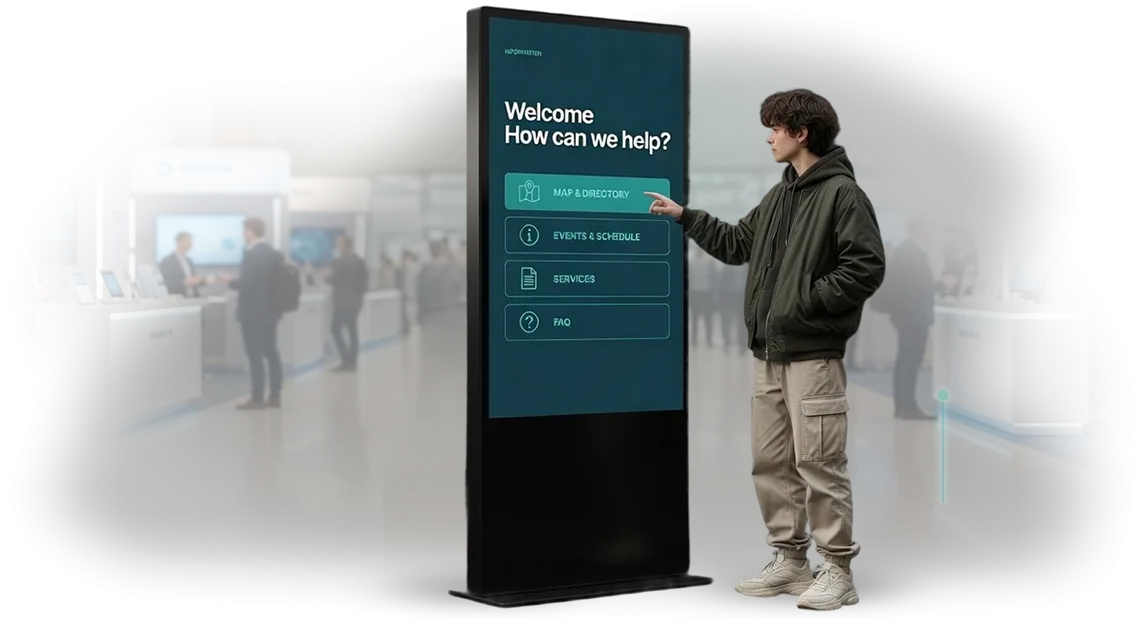
Professional interactive kiosks and information panels replace paper signs and plaques, synchronize with the meeting room booking system, and help visitors build a route to the desired company in one click.
This is not just equipment in the lobby—it is a tool that saves your staff time at the reception desk and increases the loyalty of everyone who crosses the building's threshold.
An interactive kiosk for a business center is your 24/7 digital employee, treating guests and tenants with equal courtesy.
It instantly finds a company, shows the office location on the floor, maps a route through the lobby, and even answers typical questions about café or parking hours.
Business centers that have implemented such solutions report reduced workload for administrators and significantly faster visitor flow—which directly affects space occupancy and rental income.
A ready-made information panel not only fulfills a navigation function, but also becomes a platform for internal advertising and tenant announcements, adding value to your property.
Implementation is quick and does not require major lobby redevelopment, and the results are felt from the very first days: discipline, order, and guest confidence.
Get a working tool that will elevate the building's status and free you from a stream of repetitive questions—leave a request, and we will show you how it works at your facility.
What Benefits an Interactive Kiosk Brings a Business Center and Its Tenants
Business center visitors often get lost in the lobby, searching for the right office or meeting room, while reception administrators answer the same questions dozens of times a day.
This creates queues, irritates guests, and distracts staff from truly important tasks—meetings, issuing passes, and handling conflict situations. An interactive kiosk removes this burden, turning self-navigation into a quick and pleasant process.
The result is increased guest and tenant satisfaction, staff time savings, and a higher overall level of service in the building. The business center gains a working digital tool that pays off through client loyalty and the reputation of a modern venue.
Relieving the Reception Desk and Speeding Up Service
Guests find the office they need themselves using the map or search, without approaching the administrator. Reception staff only handle matters that genuinely require their involvement—issuing passes and face-to-face communication. Queues shrink, service speed increases, and administrators gain time to deliver quality service.
Convenient Navigation for Every Guest
The kiosk works like a virtual concierge: it shows the route to the desired company, elevator, or meeting room, and helps find a tenant by name or type of service.
The visitor does not need to remember verbal directions—they receive a clear map and confidently reach their destination. This is especially important in large buildings with complex layouts.
Increasing Tenant Loyalty
When clients easily find the office and arrive on time, tenants see the benefit of being located in your building. A modern kiosk is an additional argument for retaining current residents and attracting new ones.
The business center becomes for them not just premises, but a well-thought-out environment with a high level of customer service.
Modern Image and Added Value
An interactive kiosk shapes the impression of the building as a tech-savvy and attentive venue. Guests remember the convenience, recommend the business center to colleagues, and owners get another tool to enhance the property's appeal in the eyes of potential tenants.
We work with professional equipment—the kiosk operates reliably even during peak hours, and we handle support and content updates.
Kiosk Formats for Business Center Needs: From Navigation to Virtual Concierge
In a business center, a kiosk solves several tasks at once: it helps visitors find their way, reduces the load on the reception desk, and creates a modern image for the management company.
But one and the same format is not effective both in the lobby and in the elevator hall—each location has its own usage scenario.
We select a format based on the specific area and task: where the kiosk is installed, who uses it, and what the visitor should get. Below are typical solutions most often ordered for business centers.
Main Formats
| Format | For whom | What it gives the client |
|---|---|---|
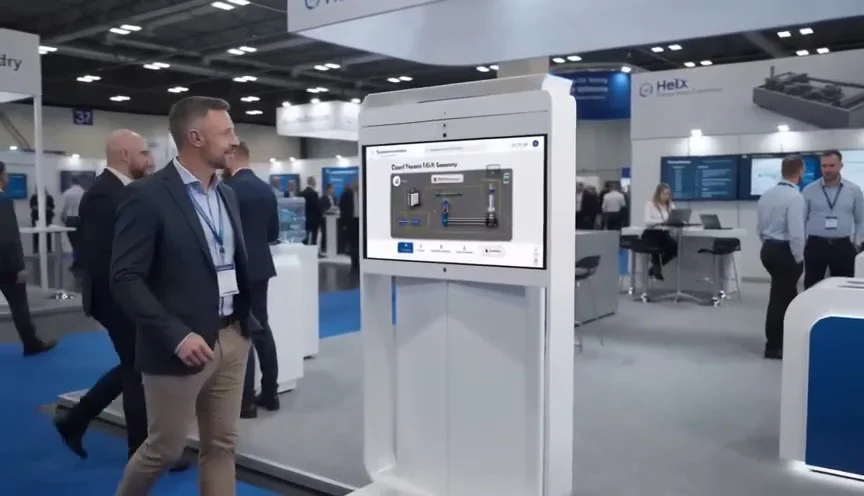
| Floor-standing kiosk | Guests and visitors in the lobby | Quick building navigation, tenant map, and reference information without queuing at the reception desk |
| Wall-mounted panel | People in elevator halls and waiting areas | Quick reference: floors, cafés, meeting rooms, upcoming events |
| Virtual concierge | Visitors and tenants at any time | Round-the-clock answers to questions, meeting room booking, taxi and service calls—without an administrator |
| Touch table | Meeting rooms, lounge areas, waiting areas | Interactive presentation of the business center and tenants, an impressive showcase for guests |
It is important that all kiosks are integrated into a unified system: content is updated centrally, and the management company receives usage statistics.
This way, any format works not as a standalone device but as part of an infrastructure that improves service and optimizes business center staff operations.
How Kiosk Development Works: Stages from Brief to Launch
We understand how important it is for the kiosk to become a convenient assistant for guests and not create extra load on the reception.
That is why the development process is transparent: you participate at every stage, see intermediate results, and make decisions—from the initial brief to launch and ongoing support.
-
Brief and task analysis — we determine who your visitors are, what questions they ask most often, and what needs to be automated. You receive a documented understanding of the goals and the expected result.
-
Technical specification and mockup — we prepare a document with the kiosk structure, navigation scenarios, and response logic. You approve it and make edits before development begins.
-
Design concept — we show the look and feel of the interface, selecting a style that matches your business center. You see the future kiosk before programming starts and approve the visual solution.
-
Development and content — we build the interactive system, adding catalogs, maps, news, and advertising materials. On intermediate versions, you see how the kiosk will work.
-
Testing and launch — we test the kiosk on real user scenarios, fix any issues, install the equipment, and hand over a fully working kiosk with clear instructions.
-
Support and growth — we update information, monitor stability, and add new features as your business center grows. You can always count on our responsiveness.
What Is Included in Kiosk Delivery: Customer Package
A kiosk's configuration is not just the enclosure and screen. We deliver a fully ready solution: from a vandal-resistant structure to a system that updates content on its own.
All you need to do is plug the kiosk into the network, and from the very first day it will start helping visitors. There is nothing extra to purchase and no need to coordinate with other contractors—everything is included in a single package.
- Vandal-resistant enclosure — durable steel with a protective coating withstands accidental impacts and scratches, keeping the kiosk looking presentable even with heavy lobby traffic.
- Touch screen — reliable touch equipment responds instantly to touch, works in any lighting, and requires no special maintenance. Visitors use the kiosk easily without guidance.
- Interface and navigation — designed around your business center's layout: floor map, tenant directory, events, and photos of the premises. Guests effortlessly find the office or café they need.
- Content update system — you independently change information about available spaces, events, or new tenants through a simple control panel. No programmer required.
- Installation and setup — an engineer delivers the kiosk, installs it, connects it to the network, and tests it. Everything works without surprises on launch day.
- Administrator training — a short guide for staff: how to replace content, reboot the system, and resolve common issues. We also leave a reference sheet by email.
- Warranty and support — we provide a warranty on the equipment and software, respond promptly to requests after launch, and visit your site if necessary.
This approach saves the management company from hidden expenses: everything is included in the contract cost—from equipment to warranty service. Administrators don't need to understand the hardware: we install everything, configure it, and show you how to use it. As a result, you get a working self-service kiosk turnkey and full control over its content.
Case Study: Interactive Kiosk for a 12,000 m² Office Center
A 12,000 m² office center means dozens of tenants, hundreds of visitors, and chaos during peak hours. Guests got lost in the corridors, the reception queue grew, and administrators explained the way ten times over.
For the management company Business Center "Orion" we developed and installed an interactive kiosk that became the complex's primary navigation tool.
Instead of live consultations—endless and time-consuming—a self-service point emerged: the guest finds the tenant on their own, receives step-by-step directions, and gets background information about the center.
How the Kiosk Changed Operations
The main result—the reception queue nearly halved during morning hours. Visitors stopped waiting for an administrator's response, and staff were freed up for matters that truly require live involvement: issuing passes, negotiations, and urgent situations.
The kiosk is synchronized with the internal tenant and signage database. As a result, navigation accuracy has reached 100%—the system always shows an up-to-date list of companies and floors.
Even new office center employees orient themselves without assistance, and guests no longer miss meetings because of wandering through the building.
The kiosk additionally hosts event listings and tenant press releases. For the center, this is an additional information channel that works around the clock and requires no staff presence.
Project Success
The interactive kiosk paid for itself within the first months of operation: administrators' workload dropped by 30%, and the number of negative reviews about navigation in the business center fell to zero.
The management company ordered a second kiosk for the neighboring building, and a year later—a complete interface update to accommodate new tenants and event formats.
This case confirms: a well-designed kiosk is not just a “touch panel in the lobby,” but a tool that saves staff time and makes the business center convenient for every guest.
If your building has a similar task—navigation, information desk, or reception relief—we are ready to replicate this result. Tell us about your situation, and we will select a solution tailored to your area and visitor flow.
How to Choose the Right Kiosk Format for Your Business Center's Needs?
Choosing the right kiosk starts not with a model, but with answers to three questions: how many visitors pass through your business center, what area is available for installation, and which scenarios the terminals should cover.
The logic of “navigation, reference, service requests” determines the equipment format, its interface, and even the number of units. So first define the tasks—everything else will adapt to them.
If hundreds of people pass through the lobby per hour, the kiosk must work quickly and not create queues. A touch panel with a well-designed menu and large buttons serves a visitor in a minute—this relieves the reception and speeds up service.
With a small visitor flow, a single compact terminal with tenant navigation and a floor map is enough—the key is that it does not obstruct pedestrian traffic.
The installation area and layout also determine the choice of kiosk. In a narrow elevator hall, a wall-mounted panel is appropriate; in a spacious atrium, a freestanding unit with two screens for different user categories works well.
A well-thought-out configuration helps integrate the digital directory into the interior without creating obstacles and preserving access for people with limited mobility.
Set your budget once the scenario is clear: for example, a basic self-service kiosk with a map and tenant contacts costs significantly less than an interactive portal with meeting room booking and a support service.
There is no need to buy the maximum set of features—it is better to choose a format that pays off through staff time savings and higher service quality.
We help clients choose the kiosk profile exactly this way: we analyze the business center's traffic, area, and tasks, and then offer the optimal configuration—from ready-made solutions to fully tailored ones for your scenario.
Answers to Frequently Asked Questions About Implementing Interactive Kiosks
Before implementing an interactive kiosk, business center owners typically have a few common questions: how difficult is it to install, who will update the information, and what happens if there is a malfunction. Let's go through them one by one—briefly and without technical details.
How long does kiosk installation and setup take?
A standard kiosk is ready for use on the day of delivery. We pre-configure the software for your business center, connecting the tenant directory, floor map, and navigation.
You don't need to hire a separate specialist—just ensure there is access to electricity and the network at the site.
How do I update information about tenants and events?
Updates are made through a simple web interface: your administrator changes texts, uploads new banners, or adds a tenant in a couple of minutes, without a developer's involvement.
All changes are applied instantly and simultaneously to all kiosks—if there are several in the business center.
What happens if the kiosk freezes or the internet goes down?
The kiosk can operate autonomously: the main navigation and catalog are stored locally, so even if the connection is lost, visitors can continue using the directory.
The system monitors its own state and will alert your facilities team about a malfunction—in most cases, a restart is enough, and it can be performed remotely.
Who handles maintenance and support?
We take care of technical support: performance monitoring, platform updates, and data backup. You only need to contact the support service in unusual situations—by phone or chat, and we respond within a business day.
An interactive kiosk is not a one-off “piece of hardware,” but a part of the business center's infrastructure. That is why we design it so that installation, content, and support do not create extra work for your team. You get a working tool for navigation and visitor communication, while operational matters remain on our side.Order Interactive Kiosk Development for a Business Center: What's Next?
Imagine: business center guests find the office they need in a minute, tenants are satisfied with the service, and a modern kiosk stands at the entrance—all of this works without your involvement. All that's left is to order the development—we will take over from there.
We will contact you within one business day, clarify the tasks, and select the optimal kiosk format. You won't have to dive into technical details—we will prepare a solution that easily fits into the business center's infrastructure.
What you get when you order interactive kiosk development from us:
- Configuration selection tailored to your premises and visitor flow.
- Interface prototype before development begins—you see the result in advance.
- Modular content: map, navigation, tenant directory, events.
- Adaptation to your business center's corporate style.
- Integration with internal systems: schedules and news.
- Warranty on software and equipment, administrator training.
- Post-launch support: updates and technical assistance.
Each item addresses a specific need—from quickly finding an office to up-to-date event information. The kiosk becomes a working tool for improving service and the loyalty of tenants and guests.
Leave a request—we will call you back at a convenient time, answer your questions, and prepare a commercial proposal with clear next steps. An interactive kiosk for a business center is an investment in comfort and reputation, and we will help you make it right.