


Interactive Kiosks for Hospitals and Clinics: Fewer Queues
Every outpatient clinic and hospital knows: the hardest place is the reception desk. Patients have to wait in line at reception to book a doctor's appointment or get a ticket, while administrators spend time on routine operations instead of helping people.
In the end, patients suffer from lost time and staff suffer from constant overload and conflict situations.
An interactive kiosk in a medical facility solves this problem. It lets patients independently book an appointment with a specialist, choose a convenient time, and get a ticket in a matter of seconds — without an administrator's involvement.
Electronic doctor's appointment booking via the kiosk works around the clock, so even at peak hours the line moves faster, and the reception desk is no longer crowded.
For the clinic, this is not just modern equipment but a way to reduce staff workload. Personnel shift from mechanical functions to real help for patients, and the reception desk stops being the bottleneck.
Patients see that their time is valued — this directly affects the institution's reputation and their willingness to come back.
We design such kiosks with medical facilities in mind: an intuitive interface for patients of any age, a simple menu, and booking and navigation options. We adapt the solution to your processes so it fits into the clinic's workflow and pays off quickly. As a result, you get fewer queues, calmer patients, and unburdened staff.
What Changes in a Clinic After Installing a Kiosk
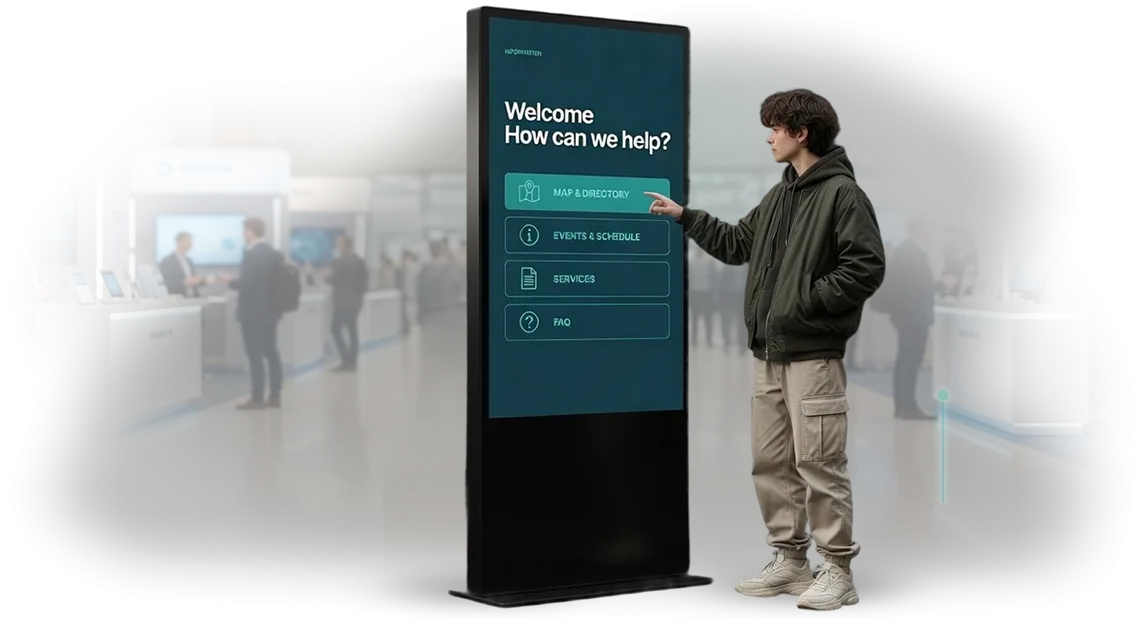
In the clinic lobby, the kiosk quickly becomes the entry point to the service: the patient immediately sees where to go and can book an appointment with the right specialist without wasting time at the reception desk. Instead of the usual queue — a couple of screen touches, and the route to the office is set.
For the customer, this means three things: fewer crowds in the corridors, calmer patients, and unburdened staff. The administrator stops repeating the same thing twenty times a day and handles truly important tasks instead of navigation.
Speed and order. The average time to find an office drops from long minutes of wandering to a few seconds. The kiosk shows the route through the clinic on a clear map, taking into account elevators, stairs, and layout features. The patient is not late for the appointment — so doctors' schedules don't shift.
Scheduling without the reception desk. The virtual concierge accepts a request for an available slot, records it in the schedule, and issues a ticket. This removes peak load from reception and eliminates the frustration of waiting.
If the needed specialist is busy, the kiosk offers an alternative without making the patient go back to the administrator.
Loyalty and data. A patient who quickly found their way and got to the appointment without stress comes back and recommends the clinic to acquaintances.
Meanwhile, the kiosk collects anonymized statistics: which services are in demand, at what hours visitor flow peaks, and which departments need additional booking windows. This data helps plan schedules and grow the clinic.
We are the team at our team— we have been making such kiosks for over ten years. We install them in hospitals and private clinics, configure them for specific tasks, and support them after launch. You get not a device but a ready-made system that works for your reputation and revenue.
Interactive Kiosk Formats for Hospitals and Clinics
In any clinic and hospital, the same patient questions repeat: where is the office, how to book an appointment, what is needed for a certificate. Answering them takes up administrators' and nurses' time, and visitors get lost in long corridors and queues. Interactive kiosks ease this load by taking over routine service scenarios.
We offer three formats for different tasks of a medical institution. They can be installed separately or combined into a single navigation and booking system.
| Format | Who it is for | What it gives the clinic |
|---|---|---|
| Reference kiosk | For patients and visitors who need to find an office, check the schedule, or get information about services | Reduces the flow of questions to staff, helps people navigate without assistance, makes navigation intuitive |
| Hospital info kiosk | For patients in the lobby and near reception who want to quickly book an appointment or get a ticket | Shortens reception queues, speeds up check-in, reduces the load on administrators |
| Virtual concierge | For patients with complex requests: booking appointments with several doctors, order of examinations, document processing | Relieves the call center and reception, provides answers at any time, raises the level of service |
The choice of format depends on the clinic's size and visitor flow. A small medical center only needs a reference kiosk, while a large hospital is better off with info kiosks in every waiting area plus a virtual concierge in the lobby. You get fast navigation, fewer queues, and more satisfied patients.
How the Project Goes: From Briefing to Launch
Any interactive kiosk project for a hospital or clinic starts not with code but with understanding the task. We need to know who will use the kiosk — patients, visitors, staff — and what specific problem it should solve: navigation, appointment booking, or getting certificates.
That's why at our teamwe define the implementation stages in advance, so that at each step you understand what is happening and what is required of you.
The typical journey looks like this:
- Brief and interview. We discuss tasks, constraints, and wishes. You need one responsible person who knows the institution's workflow.
- Analysis and prototype. We prepare the section structure and navigation scenarios. You see the logic before development and can make edits without extra costs.
- Design and content. We create layouts, texts, and visual style in line with the brand. At this stage, you approve the appearance.
- Development and preparation. We assemble the kiosk on professional equipment and configure the program to your scenarios and operating hours.
- Testing and launch. We conduct acceptance testing at your site, train the staff, and help with installation and the first days of operation.
- Post-launch support. We update content, monitor the kiosk remotely, and respond quickly to requests.
This sequence has been refined across dozens of medical projects and keeps everything under control: you know the timeline and content of each step in advance, and we are responsible for the result.
For each stage, you get a short report, and the final check is done together with your team. If needed, we adjust the logic and design before launch, not after — this saves time and money.
What Is Included in the Kiosk Solution Delivery
When a clinic orders an information kiosk, it is important to know the full scope of delivery in advance. We handle the project turnkey — from equipment selection to launch and support — so you don't spend time coordinating contractors.
The delivery package includes:
- Equipment and installation. A touchscreen kiosk in an anti-vandal housing, wall mount or floor stand, and connection to the clinic's power supply and network. Installation is done on site, and we verify operation before the acceptance certificate is signed.
- Design tailored to the task. Interface and housing styled to match the clinic's brand, with color coding for departments. Patients immediately understand where to go, even if they see the kiosk for the first time.
- Patient interface. A main screen with large buttons: "Book a doctor", "Schedule", "Get a ticket", "How to find the office". The scenarios are designed for people of all ages, including those who rarely use technology.
- Administrator panel. A simple personal account for staff: changing schedules, publishing announcements, managing reference information. Staff training takes no more than an hour.
- Documentation and procedures. Ready-made instructions for patients and staff, a daily power-on checklist, and a guide for replacing consumables.
- Staff training. A short training session for administrators and nurses: how to use the panel, what to do in an unusual situation, and how to quickly contact support.
- Warranty and support. Remote maintenance, software updates, and an engineer visit when needed. Average response time — within one business day.
As a result, you get a working kiosk with no hidden costs and clear contractor responsibility. All that's left is to plug it in — and patients can start using it.
Case Study: How an Information Kiosk Cut Waiting Time
In a private medical center, administrators spent up to a third of their working time on repeated questions: where is the office, how to book an appointment, what is the doctor's schedule.
Because of this, queues piled up at the desk, patients got annoyed, and staff couldn't get to complex cases.
We closed the flow of typical requests automatically — by installing a reference kiosk in the lobby. Patients choose a department themselves, see doctors' schedules, get the route to the office, and receive a queue number.
The administrator remains for questions that need a real person. The first minute of interaction with a patient stopped being routine.
Measurable Results
Implementing the kiosk at the Alfa-Med medical center changed the reception's work within two weeks.
Average registration time dropped from seven to two minutes, queues at peak hours became three times shorter, and administrators freed up about three hours a day for patient accompaniment.
Within three months, 85% of patients use the kiosk without staff assistance. This speeds up intake and reduces staff load — they are less distracted from their direct duties. The clinic's management got a smoother patient flow and predictable department workloads.
The case ended with a repeat order: the clinic installed kiosks in two more branches and connected an integration with the booking system so patients could reserve appointment times immediately.
The kiosk not only solved navigation but removed the most common source of queues — and now the staff practices medicine instead of repeating the same thing.
Which Interactive Kiosk Suits Your Visitors Best?
Choosing an interactive kiosk starts not with technical parameters but with your visitors and the tasks they come to solve. At the entrance to an outpatient clinic, in a hospital lobby, and near reception there are different audiences and different contexts.
That's why there is no universal "best" format; there is a format that works specifically in your institution.
An adult outpatient clinic is a flow of patients of different ages: older people need simple, clear screens with large elements, younger ones need speed and the ability to book a doctor without a queue.
In a children's hospital, the kiosk should engage the child while remaining convenient for the accompanying adult. Visitors with limited mobility need a comfortable height and accessible placement — we work through all these nuances before development starts.
Next, we look at functional tasks: electronic queue, navigation across buildings, doctors' schedules, issuing certificates, or paying for services.
For each task, we determine which interaction scenarios are needed and which format — a floor stand, a wall-mounted terminal, or a compact kiosk — provides maximum comfort.
Based on an analysis of your flow, layout, and typical visitor requests, we propose a specific solution and explain why it fits your needs. We rely on experience from completed medical projects — and this lets us not guess but hit expectations precisely.
In the end, visitors get fast navigation and self-service without queues and stress, and your administrators are freed from repetitive questions. Such a kiosk becomes part of your team — a virtual concierge that greets the guest and guides them forward.
Answers to Questions Most Often Asked Before Buying a Kiosk
Before buying a kiosk, clinic owners have similar questions: budget, reliability, and convenience for visitors. We answer briefly and without unnecessary technical details — only what matters for your decision.
How much does kiosk implementation cost?
The cost depends on the number of kiosks and the set of features. We lock in the cost estimate before we start and do not change it along the way. Staged payment is available to spread the budget load.
What about the warranty, and what if the kiosk breaks?
We provide an official warranty on the equipment and software. During the warranty period, maintenance is free: most issues are resolved remotely, and if an on-site visit is needed, we quickly replace the device so there is no downtime.
How is the interface and information updated?
Updates are done remotely without stopping the kiosk. You or we (as agreed) change schedules, price lists, and doctor contacts — it takes minutes and requires no special knowledge.
Can elderly visitors handle the kiosk?
The interface is designed with age-related needs in mind: large buttons, voice prompts, and clear navigation. If needed, the visitor can call an administrator, and we will train your staff to accompany patients.
How long does installation take?
A typical implementation takes a few days, including scenario setup, testing, and staff training. We work at times that suit the clinic so as not to interfere with patient appointments.
Let's Discuss Your Task and Offer a Solution for Your Processes
For hospitals and clinics, every patient question is staff time. Employees get distracted from work, queues form at reception, and visitors get nervous.
An interactive kiosk removes the routine: navigation, booking, and reference information — without an administrator's involvement.
We don't sell a "box" — we tailor a solution to your processes. During a kiosk consultation, we break down your tasks: which patient flows to unload, what information is needed, and how the kiosk fits into your current logistics.
We prepare a project calculation: timelines, stages, required equipment, and total cost of ownership.
What Is Included in the Project Calculation
- A video meeting and review of your situation: entry points, flows, and bottlenecks.
- A kiosk placement scheme and patient behavior scenarios at each stage.
- Recommendations on which features to order and which to skip — without overpaying.
- Design and copy recommendations so the kiosk is clear to any audience.
- A commercial proposal with the scope of work and implementation schedule.
- Integration with your booking system and doctors' schedules — if needed.
- Post-launch support: staff training and ongoing maintenance.
You can order a turnkey kiosk — with a clear result and no surprises at the start. Implementation takes from a few weeks; most of the time goes to your internal preparation.
Leave a request for a consultation — we'll discuss how to speed up navigation, reduce the load on reception, and make patients' visits more comfortable. We'll respond within one business day and prepare an initial project calculation.