




5 problems of children's development centers that a kiosk solves
In a children's development center, the impression is created in the first minutes: parents rush to enroll their child, find their way around the lobby, and not be late for class.
But they are often met with queues at the children's center, confused looks, and an administrator answering the same questions to the tenth person.
This is how typical problems of a children's center manifest: queues, inconvenient navigation for parents, overloaded staff, missed inquiries, and lost clients who silently leave and never come back.
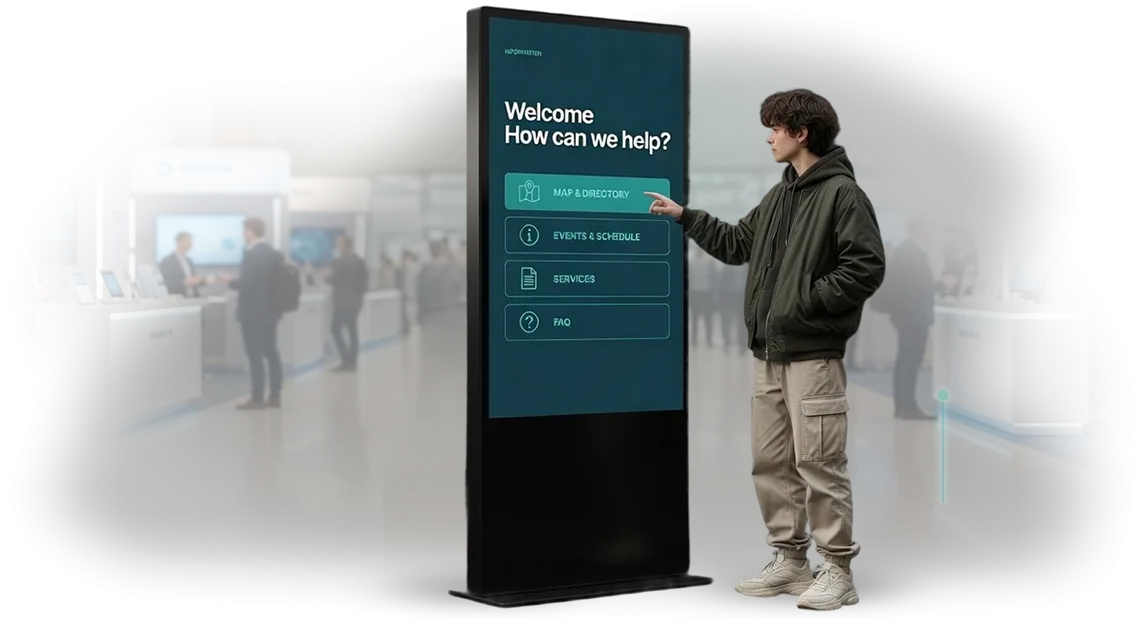
A kiosk solves the queue problem at a children's center. Parents themselves view the current schedule, choose a group, sign up for a trial class, and pay in a couple of taps — without waiting at the front desk.
The administrator stops being an information bureau and focuses on live communication with families, which leads to repeat enrollments.
Separately, the kiosk solves navigation for parents. Instead of questions like "where is your speech therapist?" or "where can I leave the stroller?", a visitor opens the center's map and sees the route to the classroom.
This removes stress in the first minutes of the visit — mom is calm, the child comfortably enters the environment.
The result is that the center stops losing clients over details. Parents get fast service, administrators get time for sales and consultations, and the owner gets systematic data on demand and interests.
An interactive kiosk for a children's center pays off not through the speed of a single touch, but through the fact that every new family stays for regular classes.
What an interactive kiosk gives your center: 5 key results
Parents choose a children's center based on their child's emotions and waiting comfort. An interactive kiosk is not just a screen, but a tool that improves service, collects data, and increases loyalty. Our team have implemented such solutions — here are 5 results that managers notice first.
-
Service without queues. Parents themselves sign up for classes and check the schedule without distracting the administrator. Staff are freed up for live communication.
-
Increased loyalty. The child sees a greeting and chooses a character — leaves with positive emotions. Parents remember the care and return, and loyalty reduces the cost of acquiring new clients.
-
Increased dwell time. Quizzes keep children engaged after classes — parents have time to explore additional services. More time in the center — more upsells and a higher average ticket.
-
Reputation of a modern center. A bright touchscreen kiosk becomes part of the interior and builds trust in the center. Parents photograph the screen and share on social media — this is free reach and reputation building.
-
Clear visitor data. The kiosk records which classes are chosen most often. The data helps make targeted mailings and personalized offers — this drives revenue growth.
Interactive kiosk formats: which one fits your task
The kiosk format should not be chosen "whichever looks nicer" but based on where it will work and what task it will solve. In a children's center, there are usually three scenarios: greeting guests in the lobby, navigation between floors, and quick class enrollment.
Each scenario has its own solution — and it pays off by relieving administrators and improving service quality.
Choose a format based on the usage scenario
| Format | Best suited for | What it gives your center |
|---|---|---|
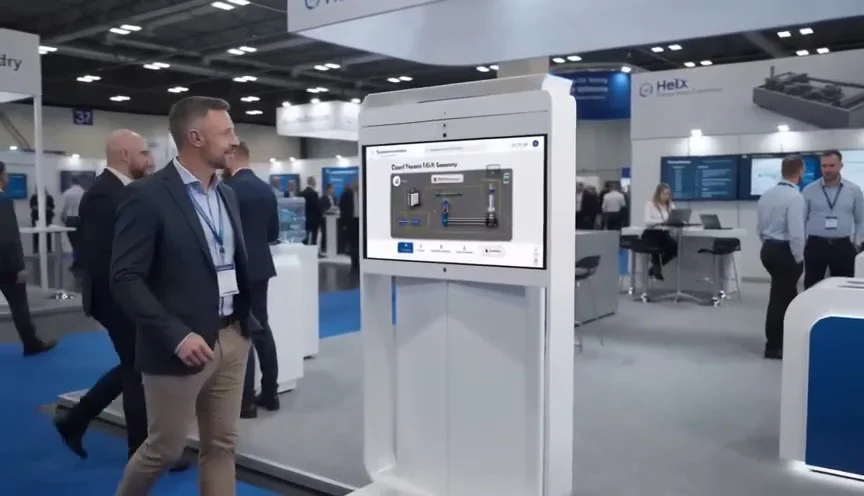
| Floor-standing kiosk with touchscreen | Lobby, waiting area: class enrollment, viewing schedule, payment and promotions | Attracts attention, reduces the queue to the administrator, parents explore programs on their own |
| Wall-mounted panel | Corridors, elevator lobbies, areas near classrooms: navigation, class schedules, announcements | Saves space, helps new visitors not get lost, works as a digital bulletin board |
| Virtual concierge | Entrance area: greeting guests, answering common questions, signing up for trial classes | Takes routine off the administrator, creates a wow effect, increases conversion from visitor to client |
All three formats run on professional equipment and connect to your accounting system. This means that enrollment and schedule data is always up to date, and the administrator sees the full picture in one window.
If you are unsure which format suits you, start with a floor-standing kiosk in the lobby and a virtual concierge at the entrance. This pair is chosen by centers that want to immediately close the main pain point: the queue at the administrator and frequent parent questions. Other formats can be added later — we easily scale the system as your center grows.
Project stages: how an interactive kiosk comes to life
Each kiosk goes through a clear path — from brief to launch. You participate at key points, we handle the technical part. This format helps evaluate timelines and budget in advance. Below are the stages of kiosk development for a children's center.
Kiosk development stages
- Kiosk brief. We discuss tasks: navigation, schedule, class enrollment. We record goals and timelines.
- Scenario and prototype. We show screen mockups, you see the navigation logic and make edits.
- Content and design. We fill the kiosk with your texts and schedule, helping make them clear for visitors.
- Development. We build the interactive program, show an intermediate version — you leave feedback.
- Testing. We check search and transitions, fix issues before installation.
- Kiosk launch. We connect the equipment, train administrators. The kiosk is ready.
- Kiosk maintenance. We update schedules and promotions, monitor performance. We help if something changes.
After the kiosk launch, you get a working tool, trained staff, and a clear point of contact with visitors. We stay in touch: we'll update the schedule, add a promotion, or fix navigation.
As a result, the kiosk doesn't become a "dead screen" but brings value to visitors and reduces the load on administrators.
Interactive kiosk delivery package: what you get
With an interactive kiosk, the customer gets not just "hardware with a screen" but a turnkey solution — from the first screensaver to the button that returns to the home screen.
Below is the full delivery scope: everything that goes into the project and what remains with you after launch.
What's included in the package
- Kiosk hardware — a touchscreen enclosure protected against damage and vandals. The optimal height and tilt angle are calculated so both children and adults can freely use the screen. All components are selected for 24/7 operation — without overheating or failures during peak hours.
- Kiosk software — an interface that requires no training. A child can choose sections on their own, and a parent can find the schedule, prices, or class enrollment in a couple of taps. The system runs reliably on professional equipment and doesn't "freeze" under peak load.
- Custom design — branding in the center's corporate style: your colors, logos, fonts, class photos. The kiosk looks like part of the interior, not a foreign device.
- Ready-made content and filling — we help structure information: club catalog, schedule, teachers, news, photo gallery, frequently asked questions. All you need to do is provide the materials — we'll handle the filling.
- Content management panel — you update schedules, prices, and news yourself without a programmer. Changes are published in minutes. A simple and intuitive interface that an administrator can handle without technical knowledge.
- Training and documentation — a short instruction for staff and a detailed administrator guide. We'll explain how to turn on the device, update information, and solve common issues.
- Kiosk warranty and technical support — official warranty on hardware and software. Russian-language support responds during business hours, with a response time of several hours. If something breaks, we'll help remotely or arrange repairs.
Why we take everything on ourselves
You don't need to separately order the enclosure, find a design contractor, or hunt for someone to "bring the screen to life".
The interactive kiosk delivery package is assembled so you get a working point of contact with visitors — and can focus on your tasks instead of equipment setup.
We'll also prepare instructions for staff and a reference card for the administrator, so employees quickly adopt the kiosk. All documentation is in Russian, without technical jargon.
On request, we can expand the package with additional options — for example, receipt printing, a card reader for class enrollment right at the stand, or integration with your accounting program. Tell us about your task — we'll offer an optimal configuration for your budget and needs.
Case study: how an interactive kiosk increased visitor satisfaction
How it started
The children's center "Razvivayka" faced a problem common to its industry: queues piled up at the administrator's desk during peak hours.
Parents waited 15–20 minutes to enroll, children started getting fussy, and the impression of the visit was spoiled before the class even began. The center's director saw service ratings dropping and some families not returning for repeat classes.
What changed
We proposed an interactive kiosk that took over the administrator's routine tasks: club enrollment, schedule reminders, navigation to classrooms, and issuing tokens for the play area.
Installation didn't require restructuring processes — the kiosk simply became a "digital concierge" next to the reception desk.
The results were noticeable within the first month. Queues halved: waiting time dropped from 15 to 5 minutes. Service satisfaction scores rose from 3.8 to 4.7 out of 5 by the end of the quarter.
And most importantly, the share of families who enrolled in the next class immediately after their first visit increased by a third.
The secret is that the kiosk doesn't replace live staff but frees them for truly important matters: consultations on child development, conversations with parents, and unusual situations.
For a children's center, this is a way to improve service quality without expanding staff and with minimal load on employees.
After three months of operation, the center ordered a second kiosk for the younger group — the administrators saw that parents were actively using self-service.
How to choose a kiosk format that solves your business challenges?
To avoid making a mistake with the format, don't start with a picture of a kiosk — start with the question: what business challenge should it solve?
In a children's development center, there are usually three such challenges: relieve administrators of the flow of calls and enrollments, help parents quickly navigate the schedule and services, and create an impression of a modern, friendly place for the child. The right kiosk format will depend on which of these pain points is strongest.
If administrators are drowning in "what do you offer?" questions and enrollments — you need a virtual concierge: an interactive directory with a list of classes, available slots, and the ability to leave an inquiry or sign up for a trial class.
If parents often get lost in the building or don't know what to choose — go with a format featuring navigation and age-based recommendations.
And if you want to keep a child occupied for 10–15 minutes while a class is running — an entertainment-education module with games and tasks: it both engages children and showcases the brand as modern. These are different scenarios that can be combined in a single device.
The kiosk budget determines not the quality of the solution but the number of scenarios you launch from day one. You can start with one key scenario — for example, class enrollment — and add navigation and game mode later, once the kiosk starts delivering value. This way you don't overpay for features that won't be used from the start.
It's important that two people can use the kiosk at once: a child gets large pictures and simple buttons, a parent gets a quick path to the schedule, prices, and enrollment.
That's why, when selecting a format, we look at the visitor's movement scenario in the lobby: free access, screen height, noise, and lighting. This is what determines whether the kiosk becomes a working tool or remains unnoticed in the corner.
The short answer: the right kiosk format is one that closes one main pain point of the center at the start and can evolve. If you've defined what the visitor should do — enroll, find a class, or keep a child occupied — we'll select a solution within your budget.
Frequently asked questions about interactive kiosks: honest answers
Before ordering an interactive kiosk, children's center owners have the same questions: won't the device break, who will maintain it, how to update content, and what about the warranty. We answer directly, as we've been doing at our team for over ten years.
What if the kiosk breaks down?
Breakdowns are rare: we use industrial components designed for long-term operation and provide a warranty on the equipment. If a problem occurs, we send a replacement or visit on site so the center doesn't stop.
Who will maintain the kiosk?
No technical training is needed for your staff. We remotely monitor the system's health, update software, and notify you about preventive maintenance. All you need to do is wipe the screen and restart the device per the instructions.
How do I update kiosk content?
You change class schedules, photos, and announcements yourself through a simple interface — without calling a programmer. Changes appear immediately. We handle the initial content and design.
Will children and parents manage the kiosk?
We design the interface for the audience: large buttons, hints, voice guidance. A child can sign up for a class on their own, and a parent can find the needed information in a minute. No special training for visitors is required.
What about warranty and support?
We provide an official warranty on hardware and work, as well as year-round technical support. You'll have a personal manager and clear response times — on average, we respond within one business day.
These are the main concerns we hear at meetings with children's center owners. If your question remains, book a consultation and we'll prepare an answer for your format.Order an interactive kiosk — start attracting more visitors
For a development center to be full, parents need to see you every day. An interactive kiosk is a tool that creates visibility and helps visitors quickly find the information they need. But for it to actually work, proper kiosk development tailored to your tasks is essential.
The first call is not an obligation but a way to try on the solution. During a short kiosk consultation, you'll understand how an interactive stand will fit into your space, what it can display, and how it will help you stand out from neighboring centers.
What you get after the first call:
- an analysis of your situation: where the kiosk will be placed, who will use it, what it should solve;
- cost and timeline calculation for kiosk development — with no hidden stages;
- design options that match your interior and brand style;
- recommendations on content structure: classes, teachers, schedule, reviews;
- a launch plan: from mockup to installation and setup;
- clear answers to questions about support and updates.
You can order a kiosk today — just leave an inquiry. We'll get in touch, clarify the details, and prepare a preliminary proposal. You'll learn which features will make the kiosk useful specifically for your visitors and be able to compare options.
Leave an inquiry — we'll help make parents stay longer and return more often. ---