


Kiosks for laboratories and diagnostic centers: patients never get lost
Morning in the lobby of a laboratory or diagnostic center is chaos. Patients arrive anxious and don’t know where to go, where to get their tests done, or how to book an ultrasound or MRI.
The reception desk turns into an information bureau: some people ask for directions, others want the schedule, and others need to reschedule their appointment. The queue grows, people are late for procedures, and administrators are exhausted.
Every such patient is a risk of losing a client. A person who waits fifteen minutes just to ask, “Where do I go?” remembers not the quality of the tests, but their own irritation. Negative impressions spread faster than test results, and no one wants to return to such a center.
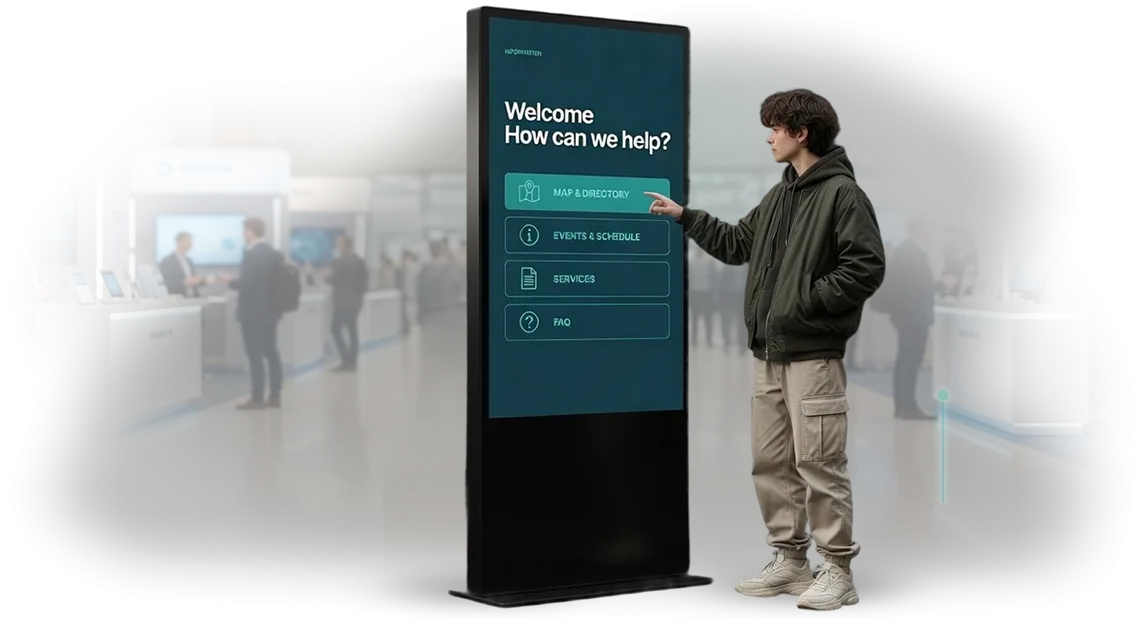
Interactive kiosks take this burden off the staff. Patients find the right room on a map, book tests in a couple of taps, and get a queue ticket — without an administrator, without waiting in line, and without stress. Information kiosks work nonstop and never get tired of repeating the same thing.
For the center, this means a less overloaded reception desk, fewer booking errors, and faster patient flow. People stop getting lost, arrive at procedures on time, and staff focus on truly important tasks. Throughput and trust in the clinic grow — and with them, the number of repeat visits.
We build kiosks for laboratories and diagnostic centers and solve exactly these problems — in-clinic navigation, test booking, and staff workload relief. We handle the full cycle: from scenarios to installation and support.
The patient doesn’t get lost, the staff isn’t distracted, and you get a calm lobby and loyal clients.
Benefits of an interactive kiosk: fewer queues, higher loyalty
In diagnostic centers and laboratories, queues at the registration desk are the main source of patient loss. An interactive kiosk solves this pain point: it processes a request in a minute, without making people wait in a live queue. As a result, queues shrink and tension in the lobby decreases.
Reception staff stop spending time re-entering passport data and referrals. They focus on complex questions and helping elderly visitors instead of monotonous routines. This is not just workload relief — it’s improved service quality.
Patients feel cared for: they choose their own time, confirm the appointment quickly, and the screen tells them which room to go to. This comfort directly drives loyalty: people return and recommend the laboratory to friends.
Automation during check-in eliminates "heard it wrong" errors: data enters the system accurately and immediately, without double entry. The administrator doesn’t need to repeat questions, and the patient doesn’t waste time on corrections. For the clinic, this means fewer complaints and more transparent appointment handling.
Finally, a kiosk is a visible element of a digital image. Modern equipment in the lobby speaks about the clinic’s level before a patient even talks to a doctor. Being tech-savvy is perceived as a guarantee of accurate testing and attention to detail.
The result is a whole set of business outcomes: faster service, freer staff, satisfied patients, and a modern image. These are the metrics that ultimately increase patient flow and revenue.
Kiosk formats: which one suits your clinic
Visitors come to a laboratory or diagnostic center with different tasks: some need to book a test, some are looking for a specific room, and some simply want to know when their turn will come.
A single "one-size-fits-all kiosk" rarely works well — the scenarios are too different. That’s why we select a format based on your center’s specific needs: from a compact booking kiosk to a full virtual concierge that guides patients at every step.
| Kiosk format | Who it suits | What it gives the clinic |
|---|---|---|
| Information kiosk | Small laboratories and offices that need navigation and service information | Reduces the load on administrators; visitors find answers to common questions on their own |
| Self-service booking kiosk | Centers with high patient flow and a busy appointment schedule | Patients choose the time and service themselves — without waiting at the reception desk |
| Electronic queue | Clinics with waiting times at multiple rooms | Order is visible on the screen; patients are less anxious, and staff work more calmly |
| Virtual concierge | Large diagnostic centers and laboratory departments | Helps build routes between floors, reminds patients about test preparation, and answers frequent questions — replacing part of the live administrator’s functions |
Choosing a format is not "which kiosk to buy" but how you want to organize patient flow. A properly selected scenario reduces queues, relieves staff, and increases loyalty: people appreciate not having to stand in an unclear crowd.
We will analyze your center for free and propose a format that solves your exact tasks — from a single terminal in the lobby to a network of virtual concierges across departments.
How the project works: stages from brief to launch
To help you control every stage and understand what is happening with the project, we have built a transparent process. We start with a discussion of your goals and end with a working kiosk backed by support. No gray areas — you always know what step the project is on and what you will get in the end.
- Brief and task discussion. We analyze how visitor flow works: where queues most often form, which services are ordered online, and what questions administrators are asked. Based on this, we define the scenarios the kiosk must handle.
- Kiosk prototype. We show a visual model of the future interface: screen structure, navigation logic, and steps for booking or receiving results. You see how the kiosk will work before installation — and can adjust important details.
- Design approval. We style the interface in the laboratory’s or center’s brand identity: colors, logo, fonts, and mood. The kiosk looks like part of the space, not a foreign machine, and it doesn’t make visitors uncomfortable.
- Project preparation and implementation. We prepare the hardware, software shell, and integrations with your internal systems. We don’t stop reception work — everything is configured in parallel with normal operations.
- Installation and setup. We install the kiosk in the right location, connect it to the network and booking systems, and test all scenarios end to end: appointment booking, ticket issuance, and result viewing. We test on real data, not in "ideal conditions."
- Administrator training. We show staff how the kiosk works, how to quickly resolve common situations, and what to do when a visitor needs help. Training takes one short session — without pulling employees away from their main duties.
- Kiosk launch and support. After launch, we stay in touch: we monitor performance, update scenarios when needed, add new services, or change reference information. This approach reduces the burden on staff and keeps the project implementation process manageable.
The result is that the kiosk starts working from day one and requires no technical knowledge from your team. You get a clear tool for visitors and confidence that there is a team that already knows the specifics of your center if questions arise.
What is included in the delivery package
When ordering a kiosk, it’s easy to picture just a touchscreen on a stand. In practice, this is a comprehensive turnkey solution: from the enclosure to trained staff, so the system works on installation day and doesn’t require technical knowledge from your employees.
Here is what is included in the delivery package:
-
Stand and protected screen — an enclosure built for heavy visitor traffic and resistant to external impacts. You don’t need to buy extra mounts, cables, or extension cords — everything is already connected and tested.
-
Interface design mockup — branding in your laboratory’s style: logo, corporate colors, and navigation logic. Patients immediately understand where to book a test, how to find the right room, and how to get results.
-
Virtual concierge software — a department map, doctor appointment booking, ready result output, and service reference information. The software is preconfigured for typical diagnostic center scenarios, so you don’t need to hire a separate developer.
-
Staff instructions — simple guides in plain language: how to turn on the kiosk, replace consumables, update doctor schedules, and what to do in an emergency. An administrator can figure it out without calling a technician.
-
Employee training — a short session with your team so administrators can confidently work with the system: add news, change schedules, and help patients.
-
Equipment warranty — official warranty and maintenance service. If something breaks, we resolve the issue quickly so the kiosk doesn’t sit idle in the lobby.
-
Installation and commissioning — our specialists deliver the kiosk, install it in the right location, connect it to the network, and check all operating scenarios before the acceptance certificate is signed.
-
Documentation — a complete package: certificates, device passport, and compliance certificates. Everything is transparent for accounting and regulatory bodies.
You get a complete solution with no hidden stages and no extra contractors. One responsible provider — from the first consultation to launch and ongoing support.
Case study: information kiosks in a clinic — results in numbers
In most laboratory centers, patient flow comes in waves: morning means a line at registration, midday means a lull. Administrators are overloaded with simple questions like “How do I make an appointment?” and “Where do I go?”, leaving no time for real patient help. This is a familiar pain point for clinic managers: costs rise and service suffers.
We solve this with information kiosks. For example, for a network of diagnostic centers MedLab, we launched a project: touchscreen kiosks in the lobby replaced part of the registrar’s functions.
Visitors choose the service themselves, see available time slots, get a ticket, and are directed to the right room. The kiosk immediately shows test preparation requirements and the route to the procedure room.
The results from the first three months speak for themselves. The load on the reception desk decreased by 40% — administrators shifted their focus to complex cases. Average booking time dropped from 12 to 3 minutes, and during peak hours the queue no longer exceeded 4 people.
The key metric — the share of successful sessions without staff involvement — stood at 87% of patients who completed their booking independently at the kiosk.
These numbers directly affect the clinic’s economics: fewer staff overtime hours, higher throughput, and no patient loss due to long waits. The share of repeat visits also grew — people are comfortable returning to a clear and predictable center.
The client received not just a stand with a screen, but a queue management tool that pays for itself.
The network is now scaling the solution to new branches, and we provide technical support and refine scenarios for new services. This confirms: a proper information kiosk is not an expense but an investment in service quality.
How to choose the kiosk format for your laboratory’s tasks?
Choosing a kiosk format starts with questions about your real needs: where it will be placed, how many people it must serve, and which systems it will work with.
The answers determine the equipment type, interface, and functionality — the kiosk must solve the tasks of your specific laboratory, not just be a "trendy screen" in the lobby.
First — space and location. In a small reception area, a compact wall-mounted kiosk saves space, while in a spacious lobby a floor-standing terminal with a large screen is more convenient.
It is important that the kiosk does not create new queues and is accessible to patients of all ages and physical abilities — this affects both screen height and navigation.
Second — patient flow and service list. If the kiosk handles doctor appointments, result delivery, payment, and information, you need a high-performance system with simple navigation.
For a small center, a basic scenario is enough: schedule, booking, and directions to the reception desk. The more scenarios there are, the more important it is to have clear working logic without confusing submenus.
Third — integration with your appointment system and laboratory information system. The kiosk should exchange data with your software: pull schedules, register patients, and record visits.
Deep integration reduces manual work for administrators and reduces errors, which speeds up service and increases patient loyalty.
These criteria are a basic framework for making a choice. We will help you pick the right format for your conditions: we’ll calculate the load, suggest a suitable configuration, and set up integration with your software. Leave a request — and we’ll prepare a custom solution specifically for your laboratory.
Frequently asked questions about implementing information kiosks
Implementing an information kiosk in a diagnostic center is a matter of trust: in technology, data, and stability. We have collected answers to the questions laboratory managers ask most often when deciding to automate navigation and information.
Below — about what will happen to the equipment in a year, how to update information without programmers, and whether integration with your laboratory system is required.
What if the kiosk breaks down?
The kiosk runs on professional equipment designed for 24/7 operation. All devices are covered by warranty, and if a repair is needed, we quickly replace the equipment or provide a replacement terminal.
Remote monitoring lets us track the kiosk’s status and prevent failures before they affect visitors.
Is it hard to update content?
Content management is handled through a simple admin panel — no developers needed. A center employee can upload new files, change the schedule, or update a route map in minutes.
Training takes no more than an hour, and access to changes can be restricted for different staff categories.
Do we need to connect the kiosk to the laboratory system?
It’s not required. The kiosk can work autonomously as an information terminal: schedule, test preparation rules, contacts.
If needed, integration with the laboratory information system is possible for showing results, booking appointments, or printing referrals — but all changes are coordinated with your security requirements.
Start with a consultation — get a cost estimate for your clinic
Let’s start with a short introduction: a kiosk in a laboratory or diagnostic center solves real problems — it reduces queues, relieves administrators, and helps patients quickly find the right room and book services.
But to make the system work at your speed and level of patient care, you need a clear plan. So we suggest starting with a free consultation — we’ll review your scenario and calculate the project cost.
Submitting a kiosk request is not an obligation; it’s a way to get a ready implementation plan. At the meeting, we’ll clarify what tasks the kiosk must handle: navigation, scheduling, booking, payment, or notification about ready test results.
Then we’ll recommend the right format — floor-standing, wall-mounted, or a counter kiosk — and show examples of solutions for similar clinics. You’ll see how the kiosk fits into your interior and patient logistics.
What you get at the consultation
- Scenario review — we’ll map the patient journey from entry to receiving results and identify points where a kiosk can save time.
- Format selection — enclosure design, screen size, installation location, and mounting option for your space.
- Examples and case studies — we’ll show how similar laboratories organized navigation and booking through a kiosk.
- Cost estimate — a transparent estimate for development, equipment, and launch with no hidden fees.
- Timeline assessment — we’ll name the stages and launch date based on your requirements.
- Content recommendations — we’ll suggest which sections and prompts your patients actually need.
All this information will stay with you in the form of a plan, even if you are not yet ready to launch the project. This lets you compare the proposal with other options and make a decision without rushing.
Leave a request for a free consultation — we’ll call you back within one business day, answer your questions, and prepare a cost estimate for your clinic. No obligations and no annoying calls: only value for your business and comfort for your patients.