


Residents of your residential complex waste time on routine questions
Residents of your residential complex waste time on routine questions.
Checking the administration's working hours, booking an appointment with the manager, learning about scheduled shutdowns, submitting meter readings, calling a technician — each such request requires a phone call or a visit to the office. During peak hours, this means a queue, and the wait for an answer is longer than they would like.
Management company staff spend hours on repetitive answers instead of dealing with matters that truly require human involvement. Calculations show: daily the management company receives dozens, and in a large complex, hundreds of repeated requests. The load grows, residents are unhappy, and employees burn out on routine.
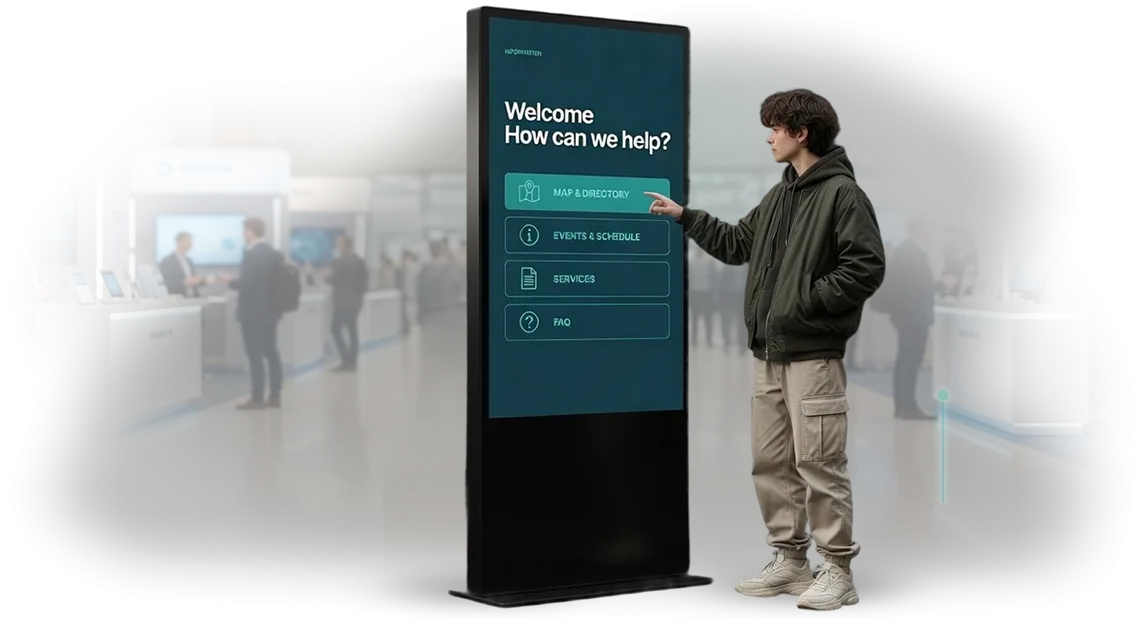
A virtual concierge and an information kiosk solve this problem systematically. They take on typical questions: issuing certificates, navigating the complex, information about events, and service contacts.
The management company unloads the phone line and office, and residents get an instant answer at any time of day — without calls and waiting.
We develop such solutions to meet the specific needs of a residential complex. First, we analyze real requests, then configure scenarios, install a kiosk in common areas, and connect a virtual concierge on the website.
Within the first weeks of operation, it is clear how the load on staff decreases and resident satisfaction grows. This is not just automation — it is a new service standard that makes your complex more comfortable.
What you get after implementing interactive kiosks
Implementing an interactive kiosk in a residential complex is not just installing a terminal in the lobby — it's a new level of service for residents. They get an instant answer to a standard request, and your management team gets time for truly important tasks.
The company our team develops such solutions with the specifics of your residential complex in mind, so every item in the list below works in practice.
Reducing staff workload
Concierge, administrator, and dispatcher stop answering the same questions: "where do I get a pass," "how to call a technician," "until what time is the pool open." The kiosk takes on up to 80% of such requests, freeing up staff time for live communication with residents and handling emergencies.
Quick access to information 24/7
The kiosk operates around the clock, so at any time residents can check the operating hours of infrastructure, book a doctor's appointment, pay for services, or leave a request with the management company.
Residents don't need to wait for an answer over the phone or go to the office — everything they need appears on the screen within seconds.
Increasing resident loyalty
Modern service in the entrance or lobby creates a sense of care from the management company. Residents appreciate when their time and comfort are taken into account: this directly affects satisfaction, reviews, and willingness to recommend your complex to friends.
The flow of conflict-related requests also decreases — most issues are resolved without human involvement.
Ready-made control tool
In your personal account, you see request statistics: what residents search for, at what time, which services are in demand. This helps you adjust the kiosk's content and make decisions about developing residential complex services based on facts, not guesses.
Implementation is carried out in stages: we analyze typical resident requests, design screen scenarios, launch a pilot, and hand over instructions to your staff. After launch, the kiosk requires no constant staff involvement — content updates are done remotely.
You get a measurable increase in service quality and lower team workload already in the first months of operation.
Interactive kiosk formats for residential complexes
Residents of modern residential complexes expect all services to work as quickly as the mobile apps on their smartphones. An interactive kiosk in the lobby covers most daily questions: from getting a certificate to booking a stroller room.
The main thing is to choose the format that matches the level and objectives of your specific residential complex.
| Format | For whom | What it gives residents and the management company |
|---|---|---|
| Virtual concierge | Residential complexes with high foot traffic that need to replace or unload the administrator's desk | Answers questions around the clock: taxi booking, service contacts, house rules, accepting repair requests |
| Information stand | Residential complexes with many guests, new residents, or tenants | A guide to the complex, navigation, important announcements, route map — all the necessary functionality in a couple of taps |
| Multimedia portal | Residential complexes with developed infrastructure and an active community | Event calendar, posters, bulletin board, news feed, booking of meeting rooms and sports zones |
In our practice, as in our team projects, the choice of format begins with analyzing residents' needs and the load on the administrator's desk.
For small complexes, an information stand is sufficient; for buildings with rentals and a constant flow of guests — a virtual concierge; and for premium class, multimedia portals with integration of all activities are often required.
We help formulate requirements, design screen logic, and implement a solution so that it pays off from the first month. Share the tasks of your residential complex — we will suggest the format that suits you.
How a project goes: from brief to launch
We've structured the process so that introducing a kiosk into your residential complex goes predictably and without stopping the management company's operations.
Below is a typical project path: from the first brief to a working system, with clear approval points and fixed stages.
-
Brief and task audit — You tell us what tasks the kiosk should solve: certificates for guests, navigation, submitting requests, payments. We clarify the specifics of the residential complex, the flows of residents, and visitors to propose the optimal format.
-
Scenario design — Based on the brief, we prepare the structure of the virtual concierge: sections, navigation, response logic. We coordinate it with you so that residents find what they need from the first screen — schedules, contacts, territory map.
-
Plan and estimate — You receive a clear work plan with stages and deadlines, without hidden tasks. We discuss the content composition and appoint responsible persons on your side.
-
Development and content — We create the interface and connect useful sections: maps, schedules, contacts, complex news. We upload current data, you see intermediate versions and make edits before final acceptance.
-
Testing and approval — We verify operation on real scenarios, fix errors, and train your staff in basic operations. This is the quality control stage before the kiosk meets its first users.
-
Launch and acceptance — We install the equipment, configure it remotely, and you accept the work. We provide a short manual for staff — how to restart the kiosk, change information, contact support.
-
Support and development — After launch, we stay in touch: we update data, add sections, and monitor stability. You can change content without involving a developer — through a simple panel or by writing to us.
This approach allows you to launch the kiosk on schedule and immediately get benefits for residents and guests — without lengthy approvals or technical surprises.
What is included in the supply and setup of the kiosk
The full package is not just a kiosk, but a turnkey solution that starts working on the day of launch. We take care of everything: from interface design to training your staff, so you don't waste time on technical details.
What is included in the supply:
- Adapted interface — we develop menu logic for your residential complex's tasks: navigation between buildings, management company contacts, service working hours, events for residents. Residents find what they need in a couple of taps.
- Software — a licensed platform that is already configured for your project and ready for content. You get access to a clear admin panel to change content yourself: posters, news, announcements.
- Installation and launch — we deliver, place the kiosk in the lobby or entrance group, connect it to the network, and check all scenarios. No hassle with contractors or on-site setup.
- Staff training — a short instruction for administrators and concierges: how to update information, add files, and resolve simple questions from residents.
- Warranty and support — 12 months of warranty on equipment and software. In the event of an issue, we connect remotely or visit the site so that the kiosk does not sit idle.
All this is included in the cost and is recorded in the contract — you get a transparent set of services without hidden surcharges. Setup usually takes no more than one or two weeks from the date of delivery.
After that, the kiosk operates autonomously, and you control it through a personal account and receive a report on popular functions.
Case study: how an interactive kiosk increased resident satisfaction
For the residential complex «Severny Park» (name changed at the client's request), we developed and implemented an interactive kiosk in the lobby. Residents often stood in line at the concierge for the same certificate: registration, meter readings, parking rules. During peak hours, the wait reached 15–20 minutes, and this created tension.
The kiosk took over 80% of typical requests: certificates, cleaning requests, reminders about scheduled shutdowns. Now a resident receives a document or answer in a couple of minutes at any time of day.
Implementation results
Six months later, we compared data before and after. The number of requests to the care service decreased by 40%, and the average time to obtain a certificate dropped from 15 to 2 minutes.
The share of residents satisfied with the service rose to 92% — as shown by an internal survey by the management company.
Testimonial
The head of the management company noted: "People stopped waiting, and we stopped answering the same questions. The kiosk has become a noticeable part of a comfortable environment, and we are already planning a second unit in a neighboring building."
For us, the main indicator is a repeat order. The management company returned a year later to expand the functionality to a mobile version for residents. This confirms: the kiosk solves a real problem and pays off by reducing staff workload and increasing loyalty.
How to choose the right kiosk format for your tasks?
Choosing a kiosk format starts not with the model but with the task: what should the terminal do in your residential complex?
For a small building, a reference screen with the management company's schedule and contacts is enough; for a large residential complex — navigation, appointment booking with specialists, and payment acceptance. This immediately narrows the choice by functionality and budget.
The second factor is the number of residents and flow intensity. If hundreds of people pass through the lobby every day, you need vandal-resistant housing and fast interface response.
In a building with 50–100 apartments, the load is lower, so a compact wall-mounted kiosk will do — it takes up less space and is easier to install. This is exactly how you select a format for real traffic.
The third point is lobby layout. A floor-standing kiosk is convenient in a spacious lobby: it is visible immediately and easy to approach with a stroller or bags. In a narrow hallway or when there is security, a wall-mounted panel is better — it doesn't block the passage.
Think about access to a power outlet and internet: if it's difficult to pull a cable, we choose models with a secure communication channel so you don't have to drill walls.
Finally, budget and goals. If you only need information about the complex and contacts, there is no point in overpaying for payment modules. If you want to reduce the load on the administrator, include the cost of support and updates.
When choosing a kiosk, the main thing is payback, not just having a screen in the lobby. Send us your floor plan and tasks — we will calculate the appropriate configuration and timelines.
Frequently asked questions about kiosk operation
Residents and the management company ask the same thing about the kiosk: will it freeze, who services it, how is information updated. We answer the main questions — about reliability, maintenance, and relevance of data.
How does the kiosk work without failures?
We use professional equipment designed for round-the-clock operation in high-traffic areas. Protection against voltage fluctuations and a vandal-resistant enclosure reduce the risk of breakdowns.
We monitor the condition of the kiosk remotely and react before a malfunction becomes noticeable to residents.
Who services the kiosk?
We take on servicing ourselves. We perform regular technical maintenance, update the built-in software, and make service visits upon request. We replace components at an agreed time — residents don't notice any pauses and continue to use the kiosk as usual.
How often is information updated?
We update information remotely without visiting the site. You send new files, we load them into the kiosk — this usually takes no more than an hour. Data relevance is always under control — residents don't have to encounter outdated information.
Will the kiosk fit our system?
We connect the kiosk to your infrastructure: intercom, passes, internal services. Integration through open formats allows data to be pulled automatically from accounting systems and doesn't require manual transfer — we will configure everything to match your processes.
Still have questions? Write to us — we will send a presentation and reply within a day.Discuss your project and get a cost estimate
To get an accurate cost estimate and understand how the kiosk will fit into your residential complex, you don't need to study technical details. Just leave a request — we'll ask the right questions ourselves, clarify the tasks, and propose a solution for your budget.
Here's what you get after contacting us:
- Consultation on usage scenarios — we will analyze which functions your residents really need: information service, booking an appointment with the manager, payment for services, navigation around the territory.
- Preliminary cost estimate — we will give a budget range without hidden fees and with scaling to several buildings in mind.
- Interface demonstration — we will show how the kiosk looks and works so you can assess its convenience for different audiences: from young residents to pensioners.
- Implementation plan with timelines — we will describe the stages: from design and approval to installation and launch, so you understand when the project will be ready.
- Contract with guarantees — we will fix the deadlines, scope of work, and support obligations to eliminate risks at every stage.
We have been working remotely for more than 10 years, so you can leave a request from anywhere. We reply within a business day and do not transfer contacts to third parties.
Leave a request for a consultation — we will discuss your residential complex, calculate the cost, and propose a solution that will increase resident loyalty and reduce the load on the management company.