


Why an electronic queue at GIBDD is not a luxury but a necessity
Every day, hundreds of people have to spend hours in live queues at GIBDD — for a single certificate or an appointment. This turns a visit into exhausting waiting, and for employees creates a constant stream of irritated visitors and complaints.
At the same time, a “live” queue gives no one certainty: it is unclear when the turn will come, whether the person will manage to get in today, or whether they will have to come back again.
In such a situation, the reputation of the agency suffers and the workload on staff grows. The administrator is distracted by endless questions like “when?” and “who is next?” instead of helping with documents.
The visitor leaves with a negative impression even if the service itself was provided quickly. The problem is not people — it is the absence of a system that organizes the flow and makes the process predictable.
An electronic queue changes the picture: the visitor makes an appointment at GIBDD in advance through a kiosk, receives a ticket and sees the approximate time of service. There is no longer a crowd at every window — people sit in the waiting area and approach only when invited.
For employees this is a calm work rhythm, and for management it is transparent load statistics and shorter queues without expanding staff.
At our team we develop kiosks for GIBDD that combine advance booking and an electronic queue in one solution. The system guides the visitor through the steps, helps choose a service and instantly prints a ticket.
Implementation takes a few days, and the effect is visible immediately: the flow is distributed evenly, waiting time is reduced, and complaints about queues are a thing of the past.
It is not a luxury — it is a basic standard of service that values the time of citizens and employees.
What you get from an electronic appointment system
An electronic appointment system turns the chaos of a live queue into a predictable process. Instead of a crowd at the windows — visitors arrive at the scheduled time, and employees work at a calm pace. This is the main advantage of electronic booking: you manage the flow rather than react to it.
The first thing you notice after implementation is the speed of service. The specialist sees in advance who is coming and why, prepares the necessary documents and spends noticeably less time on each person. Throughput increases without extra working hours, overtime or staff expansion.
Visit control also becomes complete. You see how many people registered, how many actually came, where peak loads occur, and which employees handle things faster. This data helps plan schedules, distribute workloads and make decisions based on facts rather than guesses.
Finally, visitor convenience is a reputation that works for you. People appreciate when they do not have to take time off work and sit in line for hours. They get an exact visit time, a reminder and a short wait — so they gladly return and recommend you to others.
In the end, the electronic appointment module for a GIBDD kiosk delivers what it is implemented for: predictable workloads, satisfied visitors and less stress for your employees every day.
Interactive kiosk formats for different tasks
A kiosk for GIBDD is not just a stand with a screen. The chosen format directly affects the speed of visitor service, staff workload and the convenience of working with an electronic queue.
A properly selected solution reduces queues even before visitors reach the office and relieves staff of routine questions.
| Kiosk format | For whom | What it gives the client |
|---|---|---|
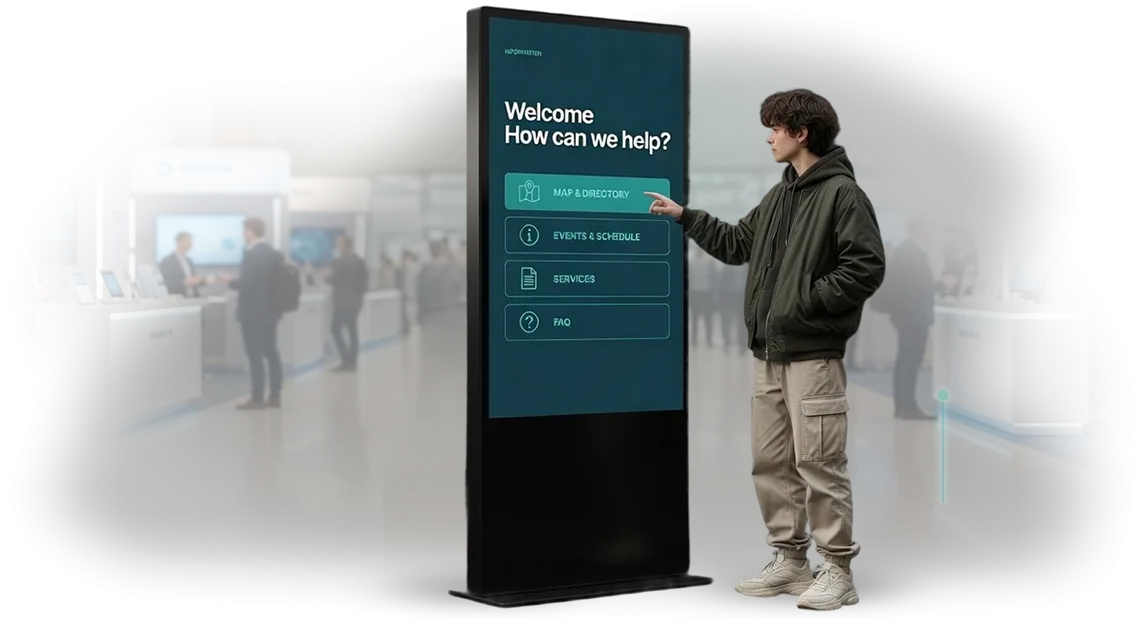
| Floor-standing touch kiosk | For waiting areas with a high visitor flow | Visitors choose the service themselves and receive a ticket without distracting the administrator. The electronic queue works without interruption. |
| Wall-mounted kiosk | For compact spaces where saving floor area matters | Mounted along the wall, it does not block walkways but still performs all electronic queue and ticket printing functions. |
| Kiosk with ticket printing | For departments with a live queue and appointment scheduling | Eliminates manual number dispensing, speeds up service and prevents errors in visitor tracking. |
| Kiosk with appointment scheduling | For GIBDD departments with advance citizen appointments | The visitor selects the date and time, and the system adds them to the electronic queue — peak load at the windows is reduced. |
If the requirements change — the same kiosk can combine several functions: tickets, booking and reference information. We develop software for your floor plan and visitor flows so that the system runs reliably and remains understandable for people of any age.
We will select the right format for your department and connect the electronic queue without downtime.
How we develop your kiosk: project stages
We structured the process so that at every stage you understand what is happening and what result you will get. No surprises: we agree on all decisions in advance and record timelines in the plan.
- Requirement analysis. We study your current processes: which GIBDD services are in demand, where queues form, what visitors need. Based on the results, we define the kiosk functionality and approve the technical specification with you.
- Mock-up approval. We create a visual prototype of the screens — how a visitor books, receives a ticket, selects a service. You see the logic of the future system and can make changes before development starts.
- Interface design. We style the kiosk to match your brand, using large buttons and clear prompts. The interface is designed for visitors of any age and skill level.
- Development and testing. We program the electronic queue and booking logic and connect the kiosk to your information systems. We run tests on real scenarios and peak loads — the kiosk works stably during rush hours.
- Launch and employee training. We install the kiosk, configure the equipment and run a trial launch. We train staff to manage the system and help visitors, including in unusual situations.
- Support and evolution. After launch, we monitor the kiosk, update the software and respond quickly to requests. If needed, we add new scenarios — for example, application status information.
This way you get a complete system with a predictable result and support at all stages.
What is included in the delivery of a ready-made solution
When you order a kiosk for GIBDD, it is important to understand exactly what you are getting. A ready-made solution is not just a device with software installed; it is a fully configured system that works from day one.
You do not waste time looking for contractors, buying additional equipment or dealing with integration issues.
We have assembled a package where all details are covered: from hardware to staff training. Below is the full composition, so you know exactly what you are paying for.
- Kiosk delivery package: hardware (enclosure, touchscreen, computer), cables and mounting elements — everything passes quality control and is ready for installation.
- Pre-installed electronic queue and booking software: integration with your database, configuration of GIBDD scenarios — appointment scheduling, ticket dispatching, visitor information.
- Employee training: we conduct instruction for administrators and operators, showing how to manage the queue, change schedules and work with reports.
- Manuals and documentation: clear guides on operation, configuration and maintenance — both printed and electronic.
- Software and hardware warranty: official commitments, free updates and technical support for the entire contract term.
- Fast launch: installation, connection and initial setup take one day — you get a working kiosk without lengthy approvals.
Every item has been tested in real projects in the public services sector. After handover, we do not disappear: we answer questions, update software and help in unusual situations.
Warranty commitments are written into the contract, so you are protected from downtime and unforeseen expenses.
You get a ready-made citizen service point that starts delivering value immediately after installation — without hidden stages or additional investments.
Case study: how we reduced wait time at a GIBDD office
The queue at a GIBDD office is the main source of tension. Visitors spend 40–60 minutes waiting, their plans are disrupted, and they get irritated. Employees are overloaded with the same questions, and the administrator cannot explain everything to everyone.
We took on the task of reducing wait time at a district office. We installed interactive kiosks with an electronic queue and booking to the right specialist. The system guides the visitor by itself: choose a service — get a ticket — arrive exactly on time. Employees stopped being distracted, and people stopped standing in crowds.
Results in the first months:
- Wait time dropped from 45 to 12 minutes.
- Throughput increased by a third — to 350 visitors per day.
- Conflicts at the information desk halved: visitors now find answers themselves on the screen.
The office manager noticed that staff stopped wasting time on repeated explanations and focused on their tasks. Visitors are more willing to book into the electronic queue again — no need to take time off work or wait for an unknown length of time.
This case is an example of the our team approach: we study the real flow and pain points, implement the solution, and measure the result. A few months later, the office ordered an upgrade — SMS appointment reminders — and no-show numbers fell by another quarter.
Want the same result? Tell us about your situation, and we will calculate how much the waiting time can be reduced in your specific case.
How to choose a kiosk format for your organization?
Choosing a kiosk format starts with tasks, not equipment. Assess the visitor flow: how many people per day, which operations — booking, getting a ticket, consultation?
For a busy GIBDD office, you need a floor-standing terminal with an electronic queue; for a small window, a wall-mounted panel with booking.
Selection criteria are not limited to functionality. Placement matters: floor area, traffic, accessibility for people with disabilities, and room design.
The floor-standing kiosk should be stable and vandal-resistant; the wall-mounted one should not block traffic and should be visible. These parameters affect visitor convenience and the durability of the solution.
The third criterion is individual requirements and compatibility with your processes. Each department has its own regulations: its own services, schedule, ticket settings.
We adapt the program to your electronic queue system or create an autonomous scenario, taking all wishes into account. That is why, before choosing a format, we define the functional and operating requirements together.
In short, the right format is defined by the triad “task — space — processes”. We help the client analyze these points, propose a configuration and handle development, delivery and setup. The result is a kiosk that reduces queues, relieves employees and increases visitor satisfaction.
Frequently asked questions about kiosk development for GIBDD
Before launching a kiosk at a GIBDD unit, the client usually has three main worries: timelines, breakdowns and data security. We answer them directly — without technical jargon.
What questions about development come up most often?
The most common questions are what is included in the project and whether functions can be changed after launch. We make the kiosk turnkey: we design the scenarios, interface and content, and the architecture allows content updates without stopping operation.
What if the kiosk breaks down?
Any equipment can fail, so we design protection against typical faults and remote condition monitoring in advance. During repairs we provide replacement equipment so the queue does not stop. The support policy is fixed in the contract.
How is visitor data security ensured?
The kiosk processes personal data, so access is restricted, and transmission is protected by encryption. Data is stored in accordance with legal requirements, and only authorized employees can access it. We update security regularly.
What are the implementation timelines? Will they be met?
A typical project takes two to four weeks: brief, mock-ups, development, testing, installation. Integration with an electronic queue system adds up to two weeks. Deadlines are fixed in the contract.
Ready to discuss your kiosk project?
Tell us about your task — we will advise which solution is right for your department. A kiosk for booking and an electronic queue at GIBDD helps reduce waiting, reduce staff workload and make the visit understandable for citizens.
We will discuss what functions are needed at the start and give you a sense of timelines and budget — free of charge.
After contacting us, you will receive:
- Expert consultation — we will analyze the visitor flow and current processes and propose a kiosk format for your department’s tasks.
- Free cost calculation — we will give you a budget and timeline range before work begins, with no hidden payments or “surprises” at the final stage.
- Preliminary development plan — a list of functions, implementation stages, and what is required from your side for integration.
- Assessment based on GIBDD experience — we will show examples of electronic queue and booking solutions already working in similar structures.
- Integration recommendations — how to connect the kiosk to your booking and electronic queue system so that employees start using it immediately.
- Readiness to start the project in 1-2 days — after the task is approved, we will begin development, and you will receive reports at every stage.
To order GIBDD kiosk development or simply get a consultation — leave a request on the website or call us. We will discuss the details, answer your questions and prepare a cost estimate. There are no obligations at this stage: only a useful analysis of your project.