


MFC Loses Visitors Due to Queues: How to Fix This?
Every day, hundreds of people come to the MFC, and everyone wants to resolve their issue quickly. But without a well-organized navigation and appointment system, the queue grows, visitors get nervous, and some leave without waiting.
For an MFC, this is not just unhappy faces — it is lost visitors, unfulfilled requests, and extra burden on staff who have to answer the same questions over and over.
The queue problem is solved not by adding more windows, but by properly organizing the flow. An electronic queue distributes visitors evenly, reduces peak load, and gives people a clear scenario: take a ticket, take a seat, wait for the invitation.
The appointment kiosk handles the routine — so staff focus on their work instead of explaining where to go.
Our team has been building such systems for MFCs for over 10 years. We design interfaces for visitors of different ages and skill levels: large text, prompts, a simple scenario.
As a result, the queue no longer scares people, and appointment takes less than a minute — this directly affects retaining visitor flow.
Reducing losses is the main effect. When a visitor sees that the process is under control, they stay and receive the service. The MFC maintains its service metrics, reduces complaints, and strengthens trust in its work.
An electronic queue with kiosks is not "just another screen" but a tool that turns chaos into a predictable process and relieves staff of stress.
We are ready to audit your current situation and show exactly how your visitor flow will change. Send us a request — we will provide a cost calculation based on your floor area and load, and propose a ready launch scenario.
What an Interactive Kiosk Gives Your Institution
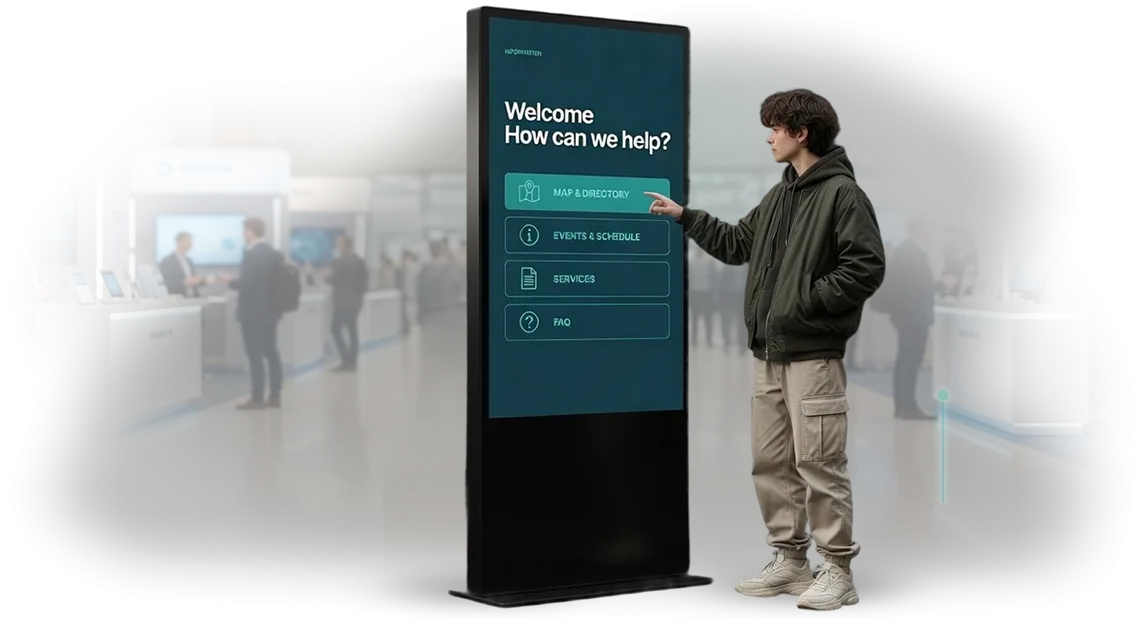
An interactive kiosk in an MFC is not just an appointment screen, but a tool that relieves staff and speeds up visitor service. Visitors appreciate independence: they can select a service, join the queue, or pay a fee without waiting at the counter.
Staff stop repeating the same information — they have more time for complex requests and consultations.
Here is what your institution gets after implementation:
- Service speed. Visitors register themselves and receive a ticket in 1–2 minutes. The queue moves faster, and peak hours stop being stressful for administrators.
- Convenience for visitors. The interface is clear even for first-time kiosk users: large buttons, prompts at every step. No need to stand in a physical queue — choose a convenient time and arrive at the scheduled moment.
- Reduced staff load. Employees are freed from routine operations: issuing tickets, explaining where to go. They handle only the issues that require personal involvement.
- Fewer errors and disputes. Data is entered by the visitor, so information appears in the system immediately and without distortion. Complaints about "I was booked to the wrong place" become fewer.
- Control and analytics. Management can see which services are in demand and when load is highest. This helps allocate resources and plan staff schedules.
We have been implementing kiosks for MFCs for over ten years and know how to make the solution run without failures and without constant intervention.
We select reliable hardware, configure the interface for your services, and take on support — you get a result, not "another project."
Kiosk Development Formats for Your MFC's Needs
Different tasks in an MFC require different solutions. An appointment-only kiosk takes up less space but does not address information needs. A universal terminal with payment is more convenient but costs more. An error in choosing the format leads to idle equipment and dissatisfied visitors.
We approach this not with a catalog, but with your MFC's specific task in mind. First, we analyze visitor flows, the number of windows, and peak loads; then we propose a format that pays off within the first weeks.
Kiosk Format Comparison
| Format | For what tasks | What it gives your MFC |
|---|---|---|
| Electronic appointment kiosk | Self-service appointment, window and time selection | Reduces administrator load, shortens queues |
| Information kiosk | Reference information about services, documents, working hours | Relieves staff, visitors find answers faster |
| Payment kiosk | Paying state fees and fines without visiting the cashier | Speeds up service, reduces cash collection |
| Combined kiosk | Appointment + information + payment in one device | Fully covers visitor needs at a single point |
We adapt each format to the interior, placement, and accessible environment requirements. The kiosk does not look like a foreign element — it fits into the MFC's navigation and is intuitive for people of any age.
After launch, you receive not just a device but a working service: information updates, operational monitoring, and usage analytics. Our engineers support kiosks throughout their entire service life — you handle citizen reception, not technology.
Development Stages: From Brief to Kiosk Launch
We work according to a transparent procedure so you understand what happens at every step and when you will receive the finished kiosk. Below are the main stages of a typical project: from the initial brief to launch and subsequent support. You always know what stage the work is at and what you will get as a result.
- Brief and task audit. We study your MFC: what services you provide, what queues occur, and where you plan to install kiosks. We define the goals: reduce waiting, relieve windows, make appointment more convenient.
- Scenario design. We think through the visitor journey: service selection, appointment with a specialist, ticket, reminder. We align the logic and structure so the kiosk is understandable even for first-time users.
- Design prototype and approval. We show what the interface will look like: large buttons, clear prompts, visual emphasis on important actions. You make edits before development begins — this saves time and money.
- Development and integration. We configure the kiosk to work with your electronic queue system: we connect schedules, services, specialists, and window load data. The interface is localized to your regulations.
- Testing on real scenarios. We check how the kiosk behaves under peak load, during communication failures, and with unusual visitor actions. We eliminate errors before launch.
- Installation, launch, and staff training. We install the equipment, configure it on site, and conduct a short training session for staff. You receive a working kiosk and a daily maintenance guide.
- Warranty support and development. We stay in touch after launch: we update scenarios, add services, and monitor operational stability. If MFC regulations change — we adapt the system to the new requirements.
Thanks to this process, you get a predictable result within agreed timelines, and the kiosk immediately solves your main task — reducing staff load and speeding up visitor service.
What Is Included in the Kiosk Delivery Package for Your Institution
When you order a kiosk for an MFC, you receive not just a device but a turnkey solution. We handle everything — from hardware selection to launch and staff training — so you do not have to coordinate multiple contractors.
The delivery package includes:
- A touchscreen information kiosk in a protected housing designed for intensive operation in waiting halls. The screen is resistant to damage and suitable for round-the-clock use.
- Electronic queue and appointment software: the visitor selects a service, sees current windows, and receives a ticket or appointment confirmation. The interface is intuitive even for those using such services for the first time.
- Integration with your appointment system and database. The kiosk automatically pulls information about services, staff, and available slots, eliminating manual duplication and administrator errors.
- Installation and configuration at your site: we set up the equipment, connect it, and test scenarios. We also customize the design to match the institution's brand style — splash screen, service list, contacts.
- Staff training for the MFC: administrators will be able to assist visitors, change schedules, and handle common situations without calling a specialist.
- Warranty and technical support: during the warranty period, we resolve issues remotely or with on-site visits according to the procedure, so the kiosk does not sit idle.
As a result, after launch you have a fully operational service: the kiosk reduces window load, shortens queues, and staff no longer need to explain several times how to reach the right specialist.
Case Study: How We Reduced the Queue in a Government Institution
Visitors to a government institution face the main barrier — a physical queue. People come with different questions, spend 30–40 minutes waiting, and some leave with negative impressions.
For an MFC this is critical: visitor dissatisfaction directly affects quality ratings and reputation.
We approached the task as flow management, not just installing terminals. We developed an electronic queue and appointment system based on interactive kiosks that directs the visitor to the right window without unnecessary questions or fuss.
Results in the first months of operation: average waiting time dropped nearly threefold, and the share of visitors who completed their visit without consulting a staff member exceeded half.
Self-service appointment via the kiosk took no more than a minute — people stopped crowding the lobby and patiently waiting at the information desk.
The key metric was not technical speed but the visitor's experience: time to receiving the service became predictable, and this directly affects satisfaction.
The share of positive feedback in post-visit surveys grew by 27 percentage points compared to the period before implementation. The institution's staff, in turn, stopped acting as "dispatchers" and focused on their direct duties.
Now the same approach is used in other branches of the network: it scales without losing quality — simply deploy the kiosks and configure the flow logic for the specific space.
MFCs gained not "another screen in the corner" but a manageable citizen reception process. The branch manager noted: "We stopped apologizing to visitors for waiting time — and that is the main indicator of a properly chosen solution."
Want to eliminate the queue in your institution the same way? We will conduct a free audit of your current visitor flow and show how much time and nerves your staff and clients will save.
Frequently Asked Questions About Interactive Kiosk Development
Clients ordering kiosks for MFCs rarely ask about the "internals" — they care about timelines, reliability, and what happens after launch. We have collected typical concerns and answer them directly and to the point.
How long does development and launch take?
A typical project takes 4–6 weeks from design approval. We cover interface design, assembly, software configuration, and live testing on a turnkey basis. If you need it urgently — we will discuss a separate schedule.
How reliable is such a kiosk and who services it?
We use professional hardware and proven software designed for round-the-clock operation and high loads. The design, installation, and software are covered by warranty. In case of a failure, we connect remotely for diagnostics and resolve the issue quickly.
Will the kiosk work with our electronic queue?
Yes — that is the key task. We configure integration with your appointment and electronic queue system so visitor and ticket data is pulled automatically and without delays. Before launch, we conduct joint testing on real scenarios.
Who will train staff to work with the kiosk?
We conduct training for administrators and hall staff: we show how to monitor statuses, change schedules, and quickly resolve common situations. A short reference guide is included so your team is not distracted from visitors.
What happens after launch — will you just disappear?
No. We sign a support agreement: regular updates, operational monitoring, and on-site visits if required. You can contact technical support at any time — for an MFC, stability matters every day, not just on launch day.
You will receive not just a "box with a screen" but a working tool that reduces operator load and speeds up visitor service. Have any questions? Ask them before the project starts, and we will show in advance how we will solve your task.Ready to Improve Your Institution's Efficiency?
When visitor flow grows at an MFC, every extra hour of waiting turns into lost time and nerves. Interactive kiosks with an electronic queue relieve administrators, speed up service, and make visits comfortable.
But how do you know if it is time for your MFC to implement such a system? Check yourself with a short checklist.
- During peak hours, a queue of 5+ people builds up at the registration desk, and visitors get nervous and leave.
- Staff spend minutes on each guest explaining where to go and which documents to prepare, even though this could be automated.
- You lack objective data: how many people come, which services are in demand, where bottlenecks form.
- Visitors get lost in corridors and waste time finding the right window or office.
- Staff are distracted from their work to direct people, answer the same questions, and resolve queue conflicts.
- You are planning expansion or staff optimization but rely on assumptions rather than numbers.
If you checked at least two items — interactive kiosks are a practical solution. They automatically issue tickets, invite visitors to the right window, provide directions, and collect statistics.
This reduces staff load, shortens average service time, and improves the efficiency of the entire institution.
Take the first step: leave a request on our website. We will consult for free, select the right option for your tasks, and provide an accurate cost calculation after audit.
You will receive a transparent estimate, timelines, and a launch plan — without hidden conditions or unnecessary details. Start with a short call or message, and in a few weeks your visitors will receive services faster and your staff will work more calmly.
How to Choose the Right Kiosk Format for Your Tasks?
Choosing a kiosk format starts not with technical specifications but with the tasks it needs to solve in your MFC. Think about what the visitor will do: get an electronic queue ticket, book an appointment, check the status of an application, or pay for a service.
This determines whether you need a compact wall-mounted device or a full floor-standing unit with additional functions.
In a corridor with high foot traffic, speed is key: a person should understand the interface and take a ticket in 30–40 seconds. In the waiting area, the scenario is more complex: you can offer booking for a specific time, printing a reminder, or a document readiness certificate.
So first describe two or three typical visitor scenarios — this will immediately narrow down the list of suitable formats.
Also consider the physical conditions: available floor space, installation height, and accessibility for elderly people and visitors with disabilities. If space is limited — consider a wall-mounted option; if access from all sides is needed — a floor-standing unit. We select the format for your premises and adapt the interface to your MFC's specific services.
Test the solution on real traffic: after launching one kiosk, see how visitors use it — whether they linger at the screen or confuse sections. Usage statistics will show whether you need a larger display, different menu logic, or additional sections. This is cheaper than redoing everything after full implementation.
The bottom line is simple: the format is determined by the tasks, the premises, and visitor behavior. During a consultation, we help the client formulate requirements, choose the kiosk type, and calculate the number of devices for your MFC. This reduces risks and saves budget — the result is predictable.