


Passport office without an electronic queue — clients leave for the MFC
Visitors are not willing to wait in a physical queue — especially when it comes to a passport office, where a single application takes 10–15 minutes, and the accumulating people create a tense atmosphere.
Every second potential client, seeing the chaos in the waiting area, silently turns around and goes to the nearest MFC, which already has an electronic queue and advance booking.
Losing visitors is not just dissatisfaction in reviews, but also directly lost revenue.
People who could not get to you today are likely to apply to another office, and winning them back will be difficult: the habit of working with a particular institution is formed from the first successful visit.
In addition, spontaneous queues overload employees — they have to be distracted by "who is last" questions and conflicts, instead of quickly serving applicants.
An electronic queue for the passport office solves this problem at the system level. The visitor takes a ticket, sees the exact waiting time, and calmly sits in a comfortable zone, while the administrator gets a manageable flow and control over the workload.
Advance booking via the internet or an infokiosk allows applicants to be distributed into time slots and eliminates peak hours, when as many people arrive in 15 minutes as during the whole day.
We have been implementing such solutions for over 10 years in organizations where losing even 5% of visitors due to queues means a significant blow to results.
We know how to make the transition to an electronic queue take days, not months, and fit into existing processes without painful restructuring. Queues at the MFC go away — and with them disappears the main reason to choose competitors.
What automating booking and the electronic queue provides
A physical queue in a passport office means nervous visitors, overloaded service windows, and reputational risks. People leave without a ticket, call with complaints, and employees spend time on explanations instead of working.
Automating booking and the electronic queue solves this problem systematically: the visitor flow stops being chaos that constantly has to be sorted out manually.
The main result is a reduction in queues during peak hours. The kiosk handles ticket issuance and distribution to windows, so service continues without pauses or downtime.
The visitor arrives at the appointed time or immediately gets to an available specialist, instead of standing at the door.
This directly increases the branch's throughput without increasing staff and reduces the load on employees — they focus on serving people rather than organizing the flow.
Convenience for visitors is the second key advantage. You can book in advance via the internet or right in the lobby on the kiosk, choosing a convenient time and the required service.
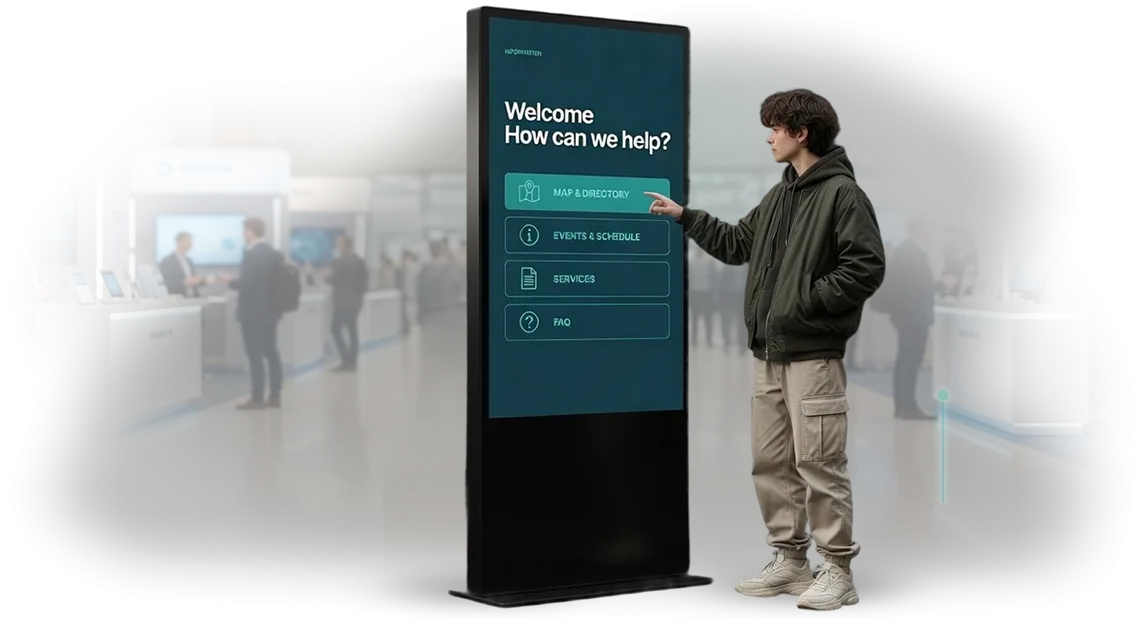
The screen is clear even for those who rarely use technology: large buttons, prompts, multiple languages. People spend less time and leave with a positive impression, not with a desire to write a negative review.
The branch's image is also worth mentioning. A modern kiosk and an electronic queue signal that the institution is keeping up with the times and respects citizens' time.
This strengthens trust, reduces tension in the hall, and simplifies the work of administrators, who no longer have to shout "next" or calm dissatisfied visitors.
In the end, automation is not just a replacement for a paper ticket, but a flow management tool. You see the real workload, plan staffing, control waiting times, and gradually remove the main pain point of any passport office — queues and waiting. Visitors, management, and employees themselves notice these changes.
Solution formats for the passport office: from kiosk to online booking
A passport office always has two intersecting visitor flows: those who came by appointment and those who decided to settle an issue on the spot. To prevent both from creating a queue at the windows, different service formats are needed.
The right combination of tools — an interactive kiosk, an advance booking terminal, and online booking — makes it possible to bring order with minimal staff involvement.
| Format | For whom | What it gives the client |
|---|---|---|
| Interactive kiosk for the passport office | Visitors without an appointment who need to quickly understand where to go and what documents to prepare | Electronic queue without administrator involvement, prompts on document requirements, fewer errors when submitting |
| Advance booking terminal | Those who want to plan their visit in advance but do not use the internet or a smartphone | Fixed time and service window in the common system, reduced physical queue, guaranteed service in the selected interval |
| Online booking | Residents who find it convenient to choose a time from their own device | Transparent schedule, time savings for visitors, even workload for staff |
All three formats complement each other and work within a single logic. A visitor books online — their slot is visible to the terminal. If someone arrives without a booking, the passport office kiosk issues an electronic queue ticket and directs them to the right window.
Implementation can be staged: start with a kiosk, then add a terminal, and only after that launch online booking. Elements already installed will not need to be replaced — the system adapts to increasing load and new formats.
How turnkey kiosk development and launch works
We understand that predictability and implementation timelines are critical for a passport office — the kiosk must start working by opening day, not "someday".
That is why the kiosk development process is divided into clear stages: you always know what is happening, who is responsible for what, and when the result will appear.
- Brief and audit — we meet, clarify visitor flow, the list of services, hall layout, and queue and booking requirements. We record goals, constraints, and key scenarios.
- Plan and commercial proposal — we prepare the kiosk implementation scheme, equipment and software composition, timelines, and cost. We align the solution within 2–3 business days, without "fluff" or hidden items.
- Interface mockup — we show what the screen will look like: large buttons, prompts, clear navigation for people of any age. You approve the appearance before work starts.
- Development and configuration — we assemble the kiosk, configure the electronic queue, service booking, ticket printing, and integration with your accounting system. At this stage, you see intermediate versions and can make changes.
- Testing and acceptance — we run "real life" scenarios: booking, calling, cancellation, repeat visits, and non-standard situations. We fix issues before launch, not after.
- Project launch and training — we install the kiosk on site, configure it for your schedule and premises, and train administrators and staff. We provide a short guide so they can work without constant questions.
- Support and development — we stay in touch: consultations, updates, and quick responses to requests. If needed, we add new services and change the logic without stopping operations.
This approach removes surprises: you know the implementation timeline and the cost of each stage in advance, rather than discovering problems on opening day.
Experience with projects for government institutions allows us to launch kiosks within 2–4 weeks, depending on the readiness of the hall and integrations. The result is a transparent project that you accept, not a "black box" with an unclear future.
What is included in the delivery: software and support
When you order an interactive kiosk for a passport office, you get not just a device, but a ready-made workflow. This is important because you do not have to assemble a solution from parts: software, equipment, setup, training — everything is already thought out for you.
The delivery package is assembled for your task and branch specifics, so the kiosk starts working from day one and does not require special knowledge from your team.
- Electronic queue and booking software: the visitor selects the service, books in with the right specialist, and receives a ticket.
- Interface adaptation for your passport office: your service names, your schedule, rules, and contacts — everything is shown on the screen.
- Integration with your queue management system or database: bookings are synchronized automatically, without manual transfer or errors.
- Installation and configuration of equipment: we deliver, connect, and check all scenarios, including ticket printing and non-standard situations.
- Staff training: a short training session for administrators and operators, plus guides and instructions for quick onboarding of new employees.
- Technical support for kiosks: remote monitoring, consultations, and on-site visits to resolve issues during working hours — up to 5 years.
- Software updates: expanded functionality, changes in legislation, and new services are included without additional payment.
As a result, you get a single package — no need to search for subcontractors or deal with disputes between software and hardware suppliers. If you have questions, one call is enough — we are responsible for the entire process, from initial setup to daily operation.
Training is conducted on your scenarios: employees immediately work with the real schedule and services of your passport office. That is how the kiosk becomes a working tool, not just "another machine in the corner".
Case study: how we cut waiting times at a branch in half
How it was
One passport office branch served up to 300 visitors daily. During peak hours, a queue formed at the windows, people waited for 35–40 minutes, and some left and booked another day. Employees spent time on manual coordination instead of accepting documents.
We installed an electronic queue kiosk with a clear touchscreen interface and integrated it with the employees' working system. Visitors select the required service themselves, receive a ticket, and wait for their call in a comfortable zone. Staff see the queue on the screen and call the next visitor with one click.
Implementation results
After a month of operation, we measured the results: the average waiting time dropped from 35 to 17 minutes — exactly half. The branch's throughput increased by 40%, and complaints about queues practically disappeared.
The head of the branch noted that employees stopped being distracted and are working more calmly.
The client also received load analytics: which services are requested most often, and on which days and hours more people arrive. Based on this data, the branch adjusted staff schedules — and peak hours stopped being a problem.
This case shows that the kiosk pays off not only by reducing waiting times, but also by creating calmer working conditions for staff.
Six months later, the client returned to us with a request to replicate the solution in two more branches — for us, that is the main indicator of the result.
How to choose a format for your branch?
The main guide when choosing is the visitor flow and the tasks the kiosk must solve. If a branch handles 50–100 people per day, a compact wall-mounted terminal for electronic queue registration is sufficient.
When the flow is 200 people or more, a floor-standing kiosk with a large screen and clear interface is more convenient — it is clearly visible from the entrance and does not create a crowd at the counter.
It is important to assess not only the average number of visitors, but also peak hours. In a passport office, the load is usually several times higher in the morning and at the end of the day.
That is exactly when the kiosk must work quickly: the visitor selects the service, gets a ticket, and goes to the waiting area. This takes the load off employees and reduces the physical queue.
Also pay attention to usage scenarios. If the kiosk is only needed for booking and issuing tickets, a simple model with basic functionality is sufficient.
If you plan to inform visitors about the required documents, show readiness status, or accept applications for re-issue, it is better to choose a format with an extended screen and convenient navigation.
We help you decide before launch: we analyze visitor flow, the specifics of the premises, and the branch's tasks, then suggest the optimal configuration.
We will tell you how many kiosks you need, where to place them, and how to organize the electronic queue so that visitors do not stand in physical queues and employees are not distracted from their work.
Frequently asked questions about installing kiosks in branches
Before launching kiosks in a passport office, managers most often worry about three things: whether the equipment will fail in the middle of a working day, what happens with the warranty, and how quickly the software will adapt to existing processes. We answer these questions right away so that the decision is made without unnecessary concerns.
What is the warranty on the kiosk?
We provide an official warranty on the equipment and all implementation work. After launch, we stay in touch: we help with maintenance, resolve issues promptly, and replace components. You do not need a separate specialist on staff.
Is the equipment reliable?
We use professional kiosks designed for continuous operation in high-traffic areas. The construction withstands intensive use, and remote monitoring detects anomalies in advance.
How long does development take?
A typical project takes about a month from brief to launch. If the kiosk needs to be connected to an electronic queue or booking system, we clarify the timelines after a short audit, but usually keep to the same timeframe.
Can the software be adapted to our processes?
Yes, adaptation is a standard part of the work. We configure scenarios to fit your regulations: the list of services, booking procedure, data entry form, and integration with your accounting system. The interface is clear to visitors of any age, so the load on employees is reduced.
We have been implementing such solutions for more than ten years and know how to resolve these concerns at the planning stage. If your case is non-standard, let us discuss the details.Submit a request for the development of a kiosk for your branch
Fill in the form on this page — and within one business day, we will get back to you with a project estimate. Then all that remains is to agree on the details and start development, while we handle everything from concept to installation and setup.
After you submit your request, you receive:
- Personal consultation — we analyze your task, advise which kiosk functions your branch actually needs, and answer integration questions.
- Project estimate within 1–2 days — we calculate the cost and timeline for your budget, without hidden fees or unexpected surcharges.
- Individual proposal — we design the kiosk menu structure based on your services, branch workload, and visitor flow.
- Equipment recommendations — we select the enclosure, screen, and components that fit your premises and will last for years.
- Interface sample before work starts — we show what the booking and electronic queue screen will look like, so you can see the final result in advance.
- Clear implementation plan — timelines at every stage, a list of people responsible, and a launch schedule: you control the process instead of "swimming in the fog".
Submitting a development request does not obligate you in any way. We will assess the project free of charge, offer 2–3 implementation options, and show how the kiosk will pay for itself by reducing the load on staff.
Even if you decide to postpone the start, you will still have a clear estimate and an implementation plan.
Send us a request now — and tomorrow you will have a concrete proposal in hand, not generic words.