


Is your polyclinic losing patients because of queues?
Patients don't like waiting. Every minute spent in a live queue at a polyclinic is a minute of frustration, after which a person may change their mind and go to a paid clinic. That is what patient loss looks like — often unnoticed in the daily grind.
Queues at a polyclinic destroy loyalty, generate negative reviews, and make people look for another place to receive treatment.
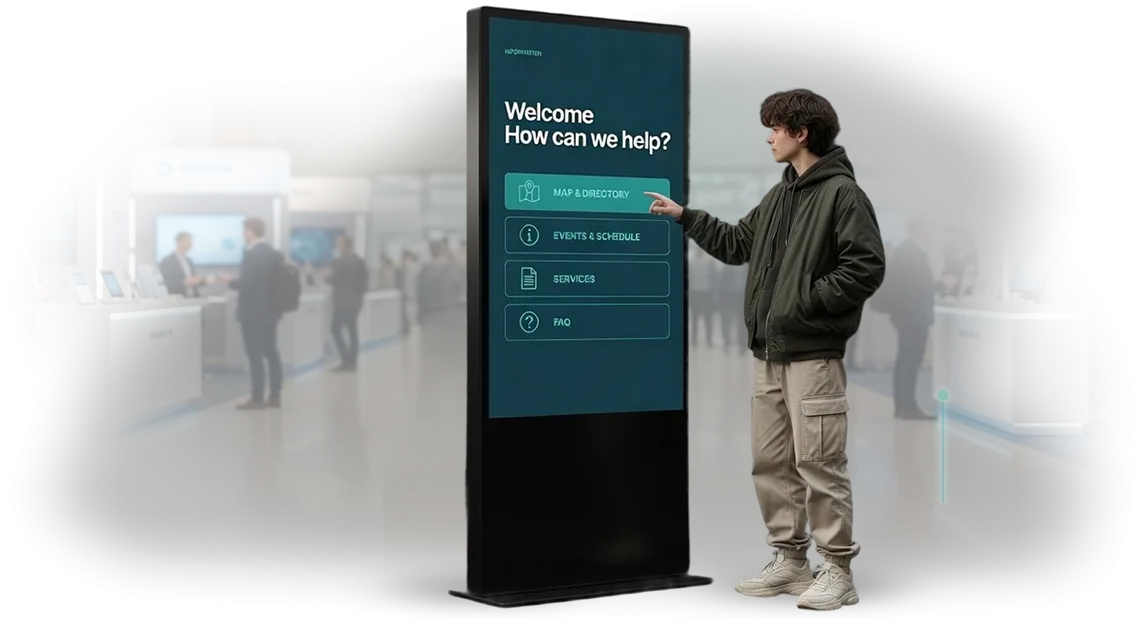
An electronic queue and appointment booking through a convenient kiosk change the visitor's mood from the very first seconds. The patient sees their number, understands when they'll be called, and doesn't sit in anxious anticipation.
Older people also easily master this format — a clear screen guides them through every step. The administrator is freed from repeated explanations and handles genuinely complex requests.
For a polyclinic, this isn't just comfort but measurable benefit: fewer crowds in the lobby, higher throughput in examination rooms, lower staff workload. Patients arrive on time rather than two hours early and get to the doctor faster.
As a result, the risk of losing patients decreases, and the facility becomes attractive in the eyes of local residents.
We help polyclinics implement such solutions without stress for staff and visitors. We configure the electronic queue based on your schedule specifics and real patient flows, train staff, and provide support after launch.
This turns your polyclinic into a place people return to and recommend — which directly impacts patient inflow and the facility's reputation.
What a modern kiosk gives patients and staff
Patients don't like queues — that's the main source of irritation in any polyclinic. A person arrives not for treatment but to stand at the registration desk, wastes time, and leaves with negative feelings.
A modern kiosk removes this pain point: booking takes a couple of minutes without an administrator's involvement, and the visitor flow stops getting stuck at a single point.
The patient gets the most important thing — an appointment without a queue at a convenient time, an electronic ticket immediately in hand, and a clear call to the examination room. Paper cards, searching for one's name on lists, and repeat visits due to confusion disappear.
Waiting becomes predictable, and the visit becomes transparent. This is exactly what builds loyalty: a person returns to a place where their time is respected and recommends the clinic to acquaintances.
Staff also find the kiosk makes their work easier.
Registration clerks stop playing the role of an information desk: the system takes over a portion of bookings and reschedules, the workload on the counter drops, and manual entry errors disappear — the ticket is generated automatically.
Employees direct the freed-up time toward elderly patients and complex questions instead of repetitive routine.
For management, implementation delivers a measurable effect: reduced waiting time during peak hours, more bookings without phone calls and extra visits, and transparent data on doctor and examination room occupancy.
The kiosk works like a tireless employee — it doesn't get tired, doesn't get distracted, and stays equally attentive to every visitor at any time of day.
Information kiosk formats for different tasks
Polyclinic patients arrive with different tasks: some need to book an appointment, some need to check the schedule, and some are simply looking for the right examination room.
One universal kiosk rarely handles all scenarios equally well — which is why we select a format based on the specific patient entry point and the task they need to solve in 30–60 seconds.
Below is a comparison table of the main formats we implement in polyclinics. It will help you understand which kiosk to place in the lobby, which one by the registration desk, and which one in corridors or waiting areas.
| Kiosk format | Where to place it | What it gives the polyclinic |
|---|---|---|
| Touchscreen navigation kiosk | Lobby, entrance area | Patients find the examination room themselves using a map and doctor list, without creating a queue to the administrator. Staff spend less time giving directions |
| Self-appointment kiosk | Near the registration desk, in the waiting area | Relieves the registration window: patients choose a doctor and time themselves and receive a ticket or phone confirmation. Queues get shorter |
| Schedule information panel | Corridors, halls near examination rooms, waiting area | Always up-to-date doctor schedules, changes and cancellations visible immediately. Patients are less often late and ask less "when is the doctor available?" |
| Hybrid kiosk "appointment + electronic queue ticket" | Registration desk, adult and pediatric departments | One machine handles both booking and live-queue ticket issuance. A universal solution if space doesn't allow multiple kiosks |
If you don't know which format suits your polyclinic, send us your floor plan and a description of patient flows. We'll recommend the kiosk layout and suggest a configuration that will take the load off the registration desk and speed up service.
Stages of setting up an electronic queue and appointment system
Implementing an electronic queue in a polyclinic isn't just installing a kiosk in the lobby. The process affects doctor schedules, registration desk operations, and the daily patient flow.
We run the project through a clear algorithm so you always know what's already been done and what comes next.
How the work proceeds
-
Brief and needs analysis — we meet with you, gather requirements: which services are included in electronic booking, how patient flows are organized, which scenarios are needed — from a simple ticket to booking a specific specialist.
-
Facility audit — we look at where the kiosk is best placed so it doesn't create queues at the entrance and is convenient for patients of all ages. We account for the distance to the registration desk, power outlet locations, and traffic.
-
Implementation plan — we define timelines, stages, and responsible parties. You get a clear schedule: when the prototype will be ready, when configuration happens, when testing and launch occur. No vague "it'll be ready sometime."
-
System setup for your polyclinic — we load the schedules for doctors, rooms, and services. We configure booking scenarios: self-booking, referrals, follow-up appointments, and priority categories. The kiosk automatically guides the patient to the next step.
-
Testing on real scenarios — we check how the system behaves during the morning rush, when booking a week ahead, and when a patient enters data inaccurately. We fix all rough edges before the kiosk sees its first real visitor.
-
Staff training — administrators and registration staff receive concise instructions and practice: how to open a shift, review bookings, and redirect patients. We train in a way that leaves staff with no questions on their very first working day.
-
Launch and support — we switch the kiosk to operational mode, monitor it in the first days, and stay in touch. If needed, we adjust schedules, update scenarios, and answer staff questions — remotely or on-site.
As a result, you get not just an installed kiosk, but a working appointment system, a trained registration team, and a minimum of manual interventions. After that, it's just support and further development if you want to add new scenarios or services.
What's included in the delivery and setup package
When you order an interactive kiosk for your polyclinic, you get not just a device but a complete turnkey solution.
We take on the entire cycle: from equipment selection to staff training and warranty service — all you need to do is offer your patients a convenient way to book a doctor's appointment.
Here's what's included in the delivery and setup package:
- Touchscreen kiosk with a vandal-resistant enclosure built for heavy use in the lobby. The device is designed to take up minimal space and require no constant supervision.
- Electronic queue software with doctor appointment booking functionality. Patients select a specialist, see available time slots, and receive a ticket — without going to the registration desk.
- Schedule configuration and integration with your medical system. We'll connect the kiosk to your existing doctor and room directories so the data is always current.
- Installation, commissioning, and testing. We place the equipment in a convenient spot for patients, verify server connectivity, and only then hand the kiosk over for operation.
- Staff training. We'll show administrators and registration clerks how to manage the queue, change schedules, and handle typical situations — without calling an engineer.
- Warranty service and technical support. The kiosk operates during the polyclinic's working hours, and in case of a failure, our specialists connect remotely or come in to replace equipment.
- Regular software updates. We keep improving the system in line with changes in healthcare operations and regulations, so the solution doesn't become outdated.
This package turns a kiosk purchase into a predictable process: you get clear timelines, a well-defined scope of work, and clearly assigned responsibility. No hidden stages — only what works and benefits patients.
Case study: reducing queues in a polyclinic by 60%
For a medical facility, queues mean direct losses: dissatisfied patients, overloaded administrators, and the risk of losing visitors to a neighboring clinic.
The problem is especially acute during peak hours, when appointment booking breaks down and some patients arrive without a ticket and head to the registration desk to check the schedule.
We closed this scenario for a city polyclinic with a flow of about 800 visitors per day — the project was named "Healthy Queue". Interactive kiosks took over doctor appointment booking, electronic ticket issuance, and follow-up booking after appointments.
Patients choose a specialist themselves, see available time slots, and get a ticket with the examination room number — without a conversation with the administrator.
Results in numbers
Within the first month, the average waiting time for an appointment decreased by 60%. Booking at the kiosk takes less than a minute — compared to five to seven minutes at the counter — and 70% of follow-up visits are arranged independently. Patients stopped crowding the lobby, and peak hours are no longer stressful for staff.
The freed-up administrators were redirected to tasks that can't be automated: handling subsidized prescriptions, routing complex patients, and providing personal consultations. Management noted that complaints about waiting noticeably decreased, and the visitor flow grew.
The key point is that we didn't impose a template — we configured the kiosk around the specific polyclinic's processes. The interface was adapted for elderly patients, booking was integrated with the medical system, and error scenarios were fine-tuned.
Today the clinic is rolling the solution out to all its branches — the best proof that registration desk automation pays off.
How to choose the right kiosk format for your needs?
Choosing a kiosk for a polyclinic isn't buying a "box with a screen" — it's a decision that must fit into the patient flow and relieve the registration desk.
There's no universal option: what works well in a small outpatient clinic can create queues in a large diagnostic center, and overloaded functionality will only confuse elderly visitors.
So first, it's worth defining which tasks you want to solve: reduce queue wait times, set up self-booking for doctor appointments, relieve administrators, or simply inform patients.
The main criterion for selecting a format is the intensity and structure of the flow.
In the morning on weekdays, the main patient influx arrives at the polyclinic, and the kiosk must handle peak load without delays: if the queue at the screen grows, the whole point of automation is lost.
Facilities with busy schedules and large visitor numbers need touchscreen stations with multiple work scenarios — for example, a separate mode for booking and a separate mode for ticket issuance.
In small examination rooms or pre-triage areas, a compact wall-mounted kiosk with basic functions is enough, so it doesn't take up useful floor space.
It's also important to consider the specifics of your patients. If many of them are elderly, the interface must be as simple as possible, with large buttons and step-by-step prompts.
If the polyclinic also serves paying patients, you may need an additional payment or service selection function.
It's at the format selection stage that we help clients see all usage scenarios: where it's most convenient to place the kiosk, what actions it should support, and how this will affect staff operations.
We provide a free consultation: we analyze your floor plan, patient flow, current registration desk processes, and select the optimal kiosk configuration.
This isn't just a "get a bigger model" recommendation — we propose a solution tailored to your individual requirements, taking into account the budget and growth prospects.
When we're done, you get a clear outline: which kiosk you need, where to place it, which functions to include, and how it will integrate with your existing electronic queue or appointment system.
Choosing the right format eliminates unnecessary expenses and the disappointment of poor automation. A kiosk selected for your real tasks pays off by reducing the load on the registration desk, shortening queues, and improving patient satisfaction.
Contact us — we'll help you make a choice that works for your polyclinic, not just stands in the lobby.
Answering frequently asked questions and concerns
Implementing a kiosk brings changes to an established process, and questions arise from both administration and patients. Most often, concerns relate to reliability, data security, ease of use for elderly people, and post-launch support. We address the main fears — briefly and based on our experience with medical facility projects.
How reliable is the kiosk, and are patient data protected?
We use professional equipment built for intensive work during peak hours — it doesn't overheat or freeze. Personal data is transmitted within the secure perimeter of your system and is not stored on the device, so outsiders can't gain access.
Built-in self-diagnostics reports issues in advance, and remote diagnostics restores operation quickly.
Will elderly patients be able to book independently?
The interface is built around large buttons and prompts: booking a doctor, getting a ticket, and checking the schedule take two or three taps.
The scenario for elderly people is simplified to a minimum, so a short assistance session with an administrator in the first few days is enough. Experience shows that within a week, most patients book independently.
How quickly will implementation happen, and do staff need training?
Launch takes a few days: we configure the scenarios for your polyclinic and hand the kiosk over for operation. Staff only need a brief on-site briefing — we show how the system works and how to help patients. Materials remain with you for training new employees.
Who will support the kiosk after launch?
We stay in touch: technical support monitors the kiosk's condition remotely, helps with schedule changes, and updates scenarios. You don't need to understand technical details — just reach out, and we'll resolve the issue. Warranty service and response procedures are documented in the contract.
Order kiosk development and implementation today
Want to order a kiosk for your polyclinic? Start with a simple request. On the day of contact, we'll provide a free consultation on usage scenarios, calculate the cost, and propose a solution tailored to your patient flow and space. You'll get a concrete plan, not general words.
From there, the process follows a clear schedule, and you control every stage:
- Request and free consultation — we clarify your tasks, visitor numbers, and lobby specifics.
- Cost calculation and commercial proposal — we lock in the budget without hidden charges.
- Contract and design approval — you approve the kiosk's appearance and feature set.
- Development, testing, and configuration — we prepare doctor appointment booking, the electronic queue, and the required services.
- Delivery, installation, and launch — we set up the kiosk and connect it to your network.
- Staff training and support — your employees confidently work with the system, and patients receive guidance from the start.
This procedure eliminates chaos while allowing the kiosk to launch within a tight timeframe. Within just a few weeks, you see the first electronic bookings, shorter queues at the registration desk, and a calmer atmosphere in the lobby.
To help you get value sooner, we'll configure the doctor schedules and integration with your website for free with your order. Submit a request — we'll prepare the estimate and answer all questions within one business day. You can order a kiosk by phone or through the form on this page.