


Queues at the Registration Chamber: How to Solve the Problem
Every day, dozens of visitors waste time in physical queues at the registration chamber. People arrive without an appointment, don’t know which window to approach, and end up creating a crush that annoys both visitors and staff.
The result is increased staff workload, conflicts arise, and the organization gains a reputation as a place you need to arrive at “with several hours to spare.”
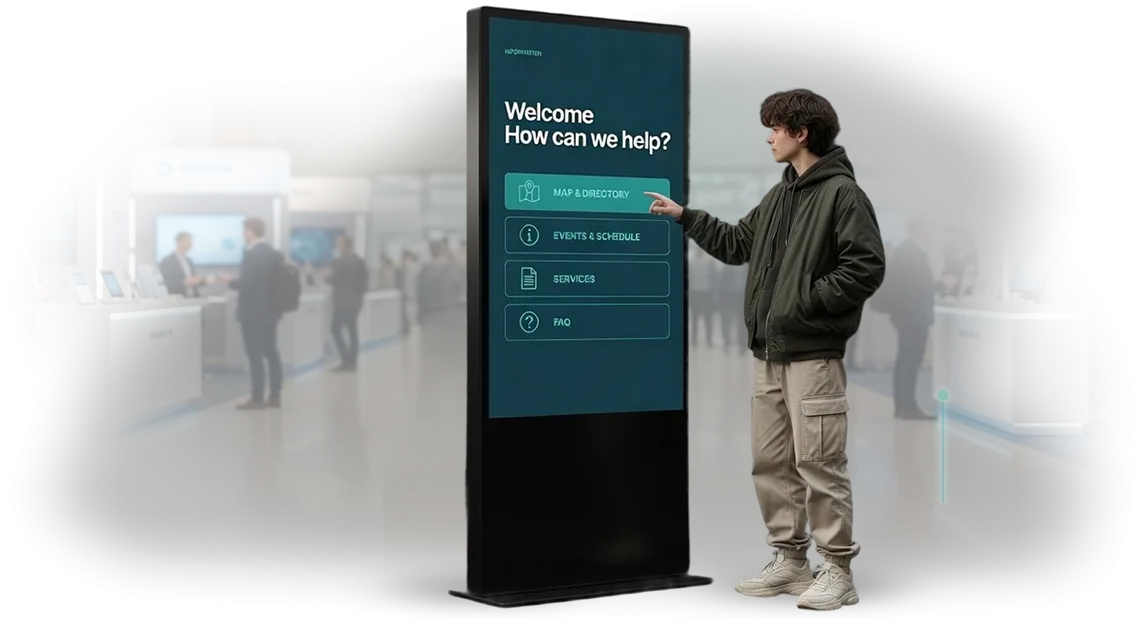
An interactive kiosk with an electronic queue solves this problem at its root: the visitor immediately enters a clear system rather than a chaotic crowd. Booking an appointment takes less than a minute, the system issues a ticket and directs the person to the correct office.
This removes the need for staff to be distracted by “who is last” questions and lets them focus on their core work.
Implementing a kiosk is not just replacing a “live” queue with an electronic one—it’s a comprehensive improvement of the service experience. Visitors see transparent order, understand the waiting time, and stop worrying.
Staff work at a steady pace, and the manager gets a manageable process instead of daily “firefighting.”
The result is a predictable flow of visitors, fewer conflicts and complaints, and greater loyalty from people who use the chamber’s services. A kiosk pays off not only through comfort, but also through the order that is established from the very first day of operation.
Benefits for Visitors and Your Institution
Queues at the registration chamber are a major source of stress for both visitors and your staff. People waste time waiting, and staff are forced to spend resources on repetitive questions instead of substantive work.
An interactive kiosk removes this tension: it takes over routine operations and turns a chaotic flow into a clear process.
For the visitor, the kiosk offers speed and predictability. The person independently selects the required service from the menu, receives a ticket, and sees the real waiting time.
Instead of anxious standing in a live queue, there is calm waiting with knowledge of when their number will be called. This reduces the number of conflicts and makes the visit to the institution comfortable, directly improving satisfaction and positive reviews.
Staff get the key benefit—freed-up time to work on applications and consultations rather than managing the crowd.
The system itself directs visitors to the correct window and records the queue, so specialists no longer get distracted by “who is last” and concentrate on their direct duties. Productivity grows without increasing staff, and the team atmosphere becomes calmer.
For the institution, it’s a step toward true digitalization. You get not just a terminal but a manageable tool: you see hourly load, understand which services are in demand, and can plan work based on data rather than guesswork.
A transparent process increases trust in the institution, and modern equipment builds the image of an organization that keeps up with the times.
Implementing a kiosk pays for itself through reduced downtime and lower staff workload, and visitors develop a habit of coming specifically to you—because here it’s fast, clear, and respectful of their time.
Kiosk Formats for Your Needs
In the waiting area or at the entrance, each kiosk format serves its purpose: one organizes the visitor flow, another eases staff workload, and a third helps people find their way without assistance.
If layout and purpose are thought through in advance, the electronic queue ceases to be a source of stress—it becomes a clear service for people.
Compare typical scenarios—depending on your floor plan, visitor volume, and list of services, one format or a combination may suit you.
| Format | For whom and where | What it offers the customer |
|---|---|---|
| Electronic queue kiosk | Visitors in the lobby or at the entrance, arriving without an appointment during peak hours | Eliminates crowding: the person takes a ticket and waits calmly, the flow becomes even |
| Appointment display board | Staff and visitors in the waiting area awaiting a call to the window | Removes “who is next” questions, shows the window number and appointment time—staff stop getting distracted |
| Touchscreen kiosk | Self-service area for those who want to book or get a certificate without a conversation | Relieves staff: the visitor chooses a service, pays the fee, and receives confirmation by email |
| Info kiosk | Entrance area and navigation points for all visitors | Answers “where to go” questions, shows a map, the list of required documents, and waiting duration—the administrator doesn’t have to repeat the same information |
Most often, registration chambers combine an info kiosk at the entrance and an electronic queue kiosk in the waiting area, with display boards mounted above the counters.
We will analyze your flows free of charge, advise which formats will reduce queues in your case, and prepare a cost estimate.
Project Stages: From Brief to Launch
We work in stages so you can see the result at each step and make adjustments in time. Below is the typical path a kiosk takes from first inquiry to installation in the lobby of a registration chamber.
-
Briefing and task analysis. We define which services should be available to visitors, how queues and bookings are organized, and what data staff need. The output is a clear technical specification agreed with your team.
-
Assigning the layout and operation logic. We prepare a screen prototype: what the main menu looks like, how to choose a service, book with a specialist, or get a ticket. You see the interface before development starts and adjust it to your style and tasks.
-
Kiosk development and configuration. We build the system around your services, working hours, and ticket issuance rules. The solution connects to your accounting system or works standalone if needed—without extra costs for process reengineering.
-
Testing visitor scenarios. We check the path from the first screen touch to receiving a ticket: service selection, booking, printing. We find and fix any inconvenience, so people don’t get lost at the kiosk on launch day.
-
Launch and staff training. We install the equipment and check settings and connectivity in your lobby. We conduct brief administrator training: how to open a shift, view load, and quickly resolve common visitor questions.
-
Post-launch support. We stay in touch: update the list of services, add new scenarios, help with load reports. The kiosk runs reliably, and you focus on your tasks rather than the technology.
Delivery Package: Everything You Need to Work
You receive a complete turnkey solution—from the kiosk casing to staff training. There is no need to purchase, coordinate, or refine anything: we deliver, install, connect to your electronic queue, and the kiosk starts working on launch day. All that’s left for you is to welcome visitors without queues and unnecessary questions.
Here’s what’s included in the package:
- Touchscreen kiosk in a vandal-proof casing — stylish equipment that withstands a constant flow of visitors and is not afraid of accidental damage. Suitable for installation in the lobby of a registration chamber, a multifunctional center, or another high-traffic location.
- Software with an intuitive interface — the visitor selects a service, books a specialist, and receives a ticket. Large buttons and on-screen prompts reduce staff workload: employees don’t have to explain the same thing ten times.
- Integration with the electronic queue — the kiosk becomes a full part of your system: booking data immediately enters the common queue, and the visitor is invited to the appropriate window. No double bookings or lost tickets.
- Turnkey installation, connection, and configuration — our specialists will install the kiosk, run cables, configure the software, and check connectivity with your system. You won’t need to find contractors or deal with technical details.
- Training for your staff — a brief orientation for administrators and employees: how to manage the queue, change schedules, and add services. Any of your employees will master it in one day.
- Technical support and warranty service — if something goes wrong, you won’t be left alone with the problem. We’ll help remotely during business hours and, if necessary, arrive on site promptly.
- Instructions and operating procedures — simple handouts for visitors and staff so the kiosk is used as effectively as possible from day one.
The result is a transparent package with no hidden fees. You know in advance what you’re getting and understand how it will affect service speed and visitor comfort within the first week.
Case Study: Kiosk Implementation at a Registration Chamber
The registration chamber lacked staff during peak load: the windows operated nonstop, but the queue still stretched to 20-30 minutes.
Visitors were anxious, some applications remained unprocessed, and administrators spent time on repetitive questions like “where to go” and “when is my turn.”
We installed an information kiosk with electronic queue and self-booking modules. The visitor selects the service, gets a ticket, or books a convenient time—without consulting an administrator. Staff see the queue in the system and aren’t distracted by manual lists.
Numbers After Launch
After a month of operation, we measured the effect. Average waiting time dropped from 25 to 10 minutes, and 9 out of 10 visitors complete their applications through the kiosk independently.
Service speed at the windows increased by 40%—operators process more applications per shift, and peak load no longer creates a queue in the lobby.
The effectiveness assessment also confirmed a qualitative shift: the number of complaints about waiting nearly halved, and staff switched from routine tasks to complex citizen requests.
Following the project, the client ordered a second kiosk for a neighboring branch—the best confirmation that the solution pays off.
our team accompanied the project from process audit to launch and staff training. We work remotely, so timelines don’t depend on the facility’s location—we take on tasks across the country.
How to Choose a Kiosk Format for Your Task?
The kiosk format is always selected for a specific task, and no universal solution exists.
At a registration chamber, visitors come for different services: some need to book an appointment, others need a ticket for the electronic queue, and some want to check the status of submitted documents.
These scenarios determine which kiosk is needed—a compact booking stand, a ticket-printing terminal, or a self-service area.
When selecting a format, it’s important to consider the requirements for the kiosk: visitor flow, floor space, and the audience’s level of preparedness.
If hundreds of people pass through the kiosk daily, the interface must be simple: large buttons, prompts at every step, and the ability to complete an operation in one or two minutes. The kiosk should not create a queue, but on the contrary—relieve staff and reduce waiting time.
We help you decide on the format at the consultation stage and don’t offer template solutions. First, we analyze which services are most in demand, how many windows are in the hall, and what the flow is during peak hours.
Then we propose an optimal configuration: the number of kiosks, stand placement, electronic queue and booking scenarios, as well as integration options with your queue management system.
The main criterion is that the kiosk solves the client’s task: it speeds up service, reduces staff workload, and makes services clear.
If you need help choosing a format, send us a description of your task—we’ll prepare recommendations and calculate a solution for your registration chamber.
Frequently Asked Questions About Kiosks and Electronic Queues
Before purchasing a kiosk and electronic queue, clients ask the same questions: who will service the equipment, how to train employees, and what about warranty and data security. We address the most common concerns so you understand what you get at each stage.
What to do if the kiosk breaks down?
We take responsibility for repair and maintenance of the kiosks for the entire term of cooperation. Upon a request, we visit within the timeframe specified in the contract, and before that we help restore operation remotely. Spare parts and equipment are always in stock, so downtime is minimal.
Will staff be able to handle the new system?
Staff training is included in the project: we conduct an orientation at your site and show how to work with the booking and queue system. Employees receive simple handouts, and the administrator gets access to the control panel. After a few days, operations run as usual.
What guarantees do you provide?
We provide an official warranty on the equipment and software. The contract specifies response times for requests and the procedure for replacing parts. If the problem can’t be solved remotely, an engineer comes to the site.
How secure is visitor data?
All information is stored on servers with restricted access and transmitted over secure channels. We differentiate staff roles so that only authorized personnel can see personal data. The system complies with personal data handling requirements.
Book a Free Consultation
What You’ll Get After Your Inquiry
An inquiry is not just “give us a call”—it’s the start of working through your task. We analyze how the kiosk should work in your registration chamber: which services visitors order most often, where queues form, and how bookings should be entered into your internal system.
Within one business day, we get back to you with an action plan and cost estimate. We offer 2-3 solution options for different budgets and loads—from a basic electronic queue kiosk to a full-featured terminal with bookings for all specialists. You make the choice, and we handle the turnkey implementation.
- Preliminary cost and timeline estimate before work begins
- Selection of equipment and configuration for your tasks and premises
- Demonstration of scenarios: document-based booking, queue ticket, status check
- Technical specifications and integration plan with your booking system
- Support at all stages: from production to launch and staff training
- Warranty and support after launch—the kiosk keeps running without interruptions
No “we’ll see later” and no hidden terms: we fix the scope of work, timelines, and cost in the contract before the project starts. After your inquiry, you get a concrete plan, not general words.
A kiosk at a registration chamber pays off not only through service speed. Visitors see a modern service, worry less in queues, and are more willing to return—this reduces staff workload and increases loyalty.
Leave a request—within 5-7 days we’ll prepare a solution that will reduce queues at your registration chamber and simplify booking for visitors.