



Insurance Company Loses Clients Due to Queues — We Solve the Problem
A client comes into the insurance office to resolve an important issue — and runs into a live queue and paper tickets. No one likes to wait: the person gets nervous, is late for work, and thinks the company doesn’t value their time. Next time, they’ll choose another company — one where the service is more convenient.
For the insurer, this means losing not just one client but a whole chain: one dissatisfied person tells acquaintances, and the reputation suffers.
At the same time, the market is competitive, and the winner is the one who removes friction at the entrance — from the first minute of the visit.
While the visitor stands in line, their impression of the company is already ruined, and after many minutes of waiting, even a high-quality consultation won’t restore a positive attitude.
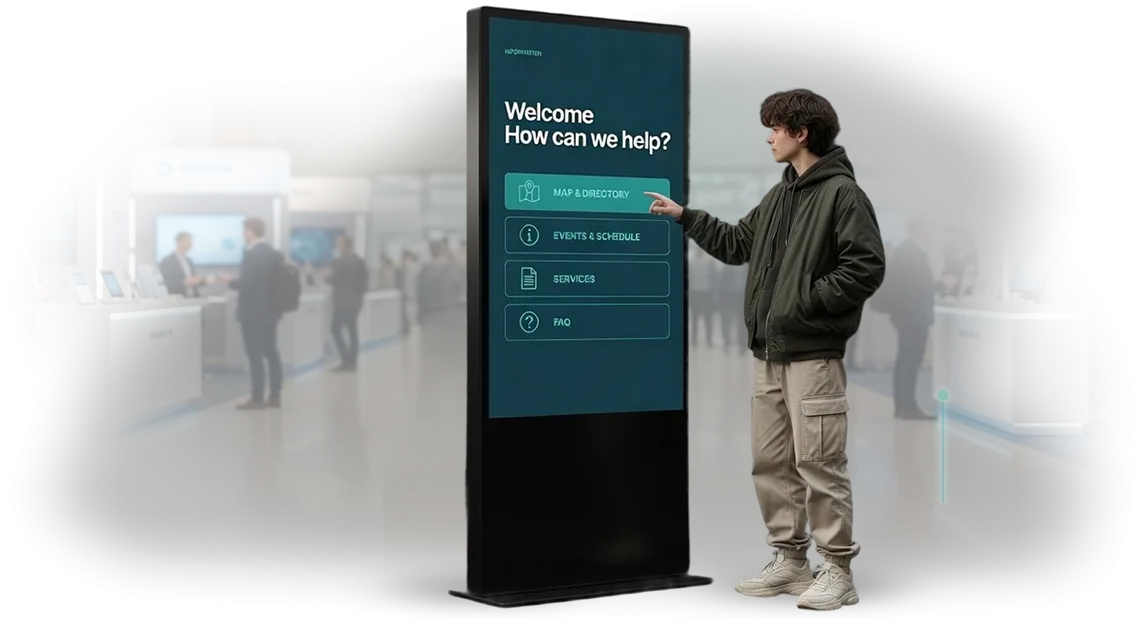
An electronic queue kiosk changes the scenario from “I wasted my time” to “everything is organized here.” The guest selects a service and a specialist on the screen, receives a number, and sees how long the wait will be. This removes the main irritant — uncertainty — and turns waiting into a manageable process.
For an insurance company, this is also a way to solve internal tasks: the flow of clients is distributed evenly, the load on employees is reduced, and data on peak hours helps with shift planning.
The kiosk for the office looks modern, shortens the time spent on manual check-in, and reduces the risk of conflicts at the counter. The core of the system — an electronic queue and clear service scheduling — works simply and reliably, without failures on the busiest day.
The client gets not just a terminal in the corner, but a tool that manages the flow and increases loyalty.
We develop the kiosk to suit the insurance service: the necessary services on the main screen, clear navigation, integration with the internal system — everything to reduce waiting time and remove chaos from the office. The result is stable operation even at peak hours and a client who comes back again.
What an Interactive Kiosk Offers Visitors and Your Business
An interactive kiosk in an insurance company’s office solves several tasks at once: speeds up service, relieves staff, and makes the service more convenient for clients. Below are the key benefits for your business.
Service Speed
Visitors to an insurance office value their time and don’t want to spend it in queues. Using a kiosk, a client can book an appointment in a couple of minutes, choose a convenient time, and get a ticket without the involvement of an administrator.
Operators stop being distracted by simple requests — service speeds up, and the office’s throughput increases.
Improved Service
The interactive kiosk takes over routine tasks: registration, product selection, document verification, and visit reminders. The client sees that the company cares about their comfort — this increases loyalty and confidence in choosing the insurer.
The service becomes predictable and modern, which distinguishes you and motivates visitors to return.
Reduced Staff Workload
Employees are freed from repetitive operations and deal with truly complex client issues. Less routine work means less stress and higher-quality consultations. Managers can reallocate resources without expanding the team.
Automated Scheduling
The system itself generates the appointment schedule, accepts requests, and sends out confirmations. This eliminates double bookings and scheduling conflicts. Data on visits goes into the accounting system — the manager sees office occupancy and adjusts the work plan.
Kiosk Formats for an Insurance Company’s Needs
In an insurance company, clients face queues and lose time even before talking to a specialist. Some come for a policy, others for a claim payment, and others simply want a consultation.
When all these flows mix together in the lobby, service slows down, and visitors leave dissatisfied.
A properly chosen kiosk format solves this problem: it distributes the flow, reduces waiting, and turns the lobby into a clear, understandable space. We develop three standard formats that cover all insurance company scenarios — from the initial visit to waiting for a specialist.
| Format | Who it is for | What it gives the client |
|---|---|---|
| Electronic queue stand | Visitors with urgent matters: claims, certificates, consultations | Takes a ticket within a minute, sees the actual waiting time, and knows the window number in advance. The queue moves predictably |
| Specialist appointment kiosk | Clients with planned visits: policy issuance, complex products, documents | Chooses a convenient time and the right department without calling a call center. The visit is faster because the specialist is already prepared |
| Multimedia showcase | Clients in the waiting area | Learns about the company’s products and promotions while waiting for the appointment. The showcase relieves tension in the queue and increases brand recognition |
These formats are easy to combine: the stand at the entrance directs the flow, the appointment kiosk handles planned visits, and the showcase keeps guests occupied during peak load minutes.
The system runs on professional equipment, so the client gets a stable result without failures even on days with maximum visitor flow.
How We Implement a Kiosk: 6 Steps Without Chaos
We have structured the process so that you always understand what is happening and when the result will appear. At every stage, you receive clear documents, plans, and deadlines — without technical routine or unexpected delays. Below are the 6 steps of kiosk implementation in an insurance company.
-
Brief and task analysis. We record exactly what the kiosk must do: electronic queue, specialist appointment booking, ticket issuance, policy payment. We align the functionality with your business processes and visitor flow.
-
Prototype and user scenario. We show a mock-up of the future screens and the operating logic: how a client selects a service, joins a queue, or books an appointment. You see this before development begins and can make changes.
-
Design and structure approval. We adapt the interface to the company’s corporate style, clear service names, large buttons, and prompts for all ages. You approve the ready screens before development proceeds.
-
Development and connection to your system. We set up data transfer for queues, tickets, and booked clients. We work on professional equipment, so you get a stable result without failures during peak hours.
-
Testing and staff training. We check all scenarios with real load: several people at the same time, different services, client errors. We teach your employees to configure the kiosk and resolve minor issues without calling an engineer.
-
Launch and support. We install the kiosk, launch it in pilot mode, and monitor the first days of operation. We stay in touch for quick support and fine-tuning. Then — monthly usage analytics and suggestions for improvement.
What Is Included in Kiosk Supply and Setup
We take on the full cycle — from equipment delivery to the moment the kiosk starts receiving its first clients. You don’t need to hire contractors, deal with settings, or write instructions: everything required for launch and stable operation is already included in the project. No hidden stages and no additional payments — you get a working “turnkey” system.
Here is what is included in the delivery and setup of the kiosk:
-
Installation and connection of equipment. We will deliver it, install it in the lobby, and connect the kiosk to power and the network. It will blend into the interior and be ready to work from day one.
-
Software setup for your services. We will adjust the interface to your list of insurance products, add policy descriptions, rates, and office contacts. The client immediately sees exactly what your company needs.
-
Integration with your accounting system. We will set up data exchange so that requests and bookings from the kiosk automatically reach your specialists. No manual data transfers or lost requests.
-
Printing of tickets and memos. We will set up the issuance of a ticket with a queue number or a short product memo. The visitor leaves with a clear document in hand, not with the question “what next?”
-
Launch of the electronic queue. We will enable a live queue scenario with a call to the client at the service window. Your employees see who is next and can work faster.
-
Staff training. We will conduct a short practical workshop for administrators and managers: how to meet a client at the kiosk, handle a typical situation, and quickly understand the settings. Training takes no more than an hour and doesn’t take people away from work for long.
After launch, we don’t disappear — support is active for the entire period of cooperation. On request, we will check the kiosk’s operation, update the software when rates change, and help with any questions that arise in daily work. You get not just a device, but a reliable assistant for receiving clients.
Case Study: Insurance Company Branch Cuts Waiting Time by 3 Times
At one branch of the insurance company Garant, clients spent 40–50 minutes in line during peak hours. Operators worked at their limit, and some applications never made it to submission — people left for another office or to competitors. Management was looking for a way to ease the load on staff and retain the client base.
We installed an information kiosk with an electronic queue and specialist appointment booking. The visitor selects a service on the touchscreen — and receives a ticket with a number and an estimated waiting time.
The system distributes the flow to the right windows, and operators see who is coming and with what question.
In the first month of the kiosk’s operation, the average waiting time dropped by 3 times — from 45 to 15 minutes. The load on operators decreased: visitors now receive part of the routine certificates and consultations through the screen, without distracting staff. The number of clients served grew by a third without expanding the team or changing the schedule.
After the pilot launch in one department, the client rolled out the solution to all branches in the network. A year later, they returned with a request for further development: we added advance online booking through the kiosk.
Now policy issuance takes less time than on the website, and repeat visits by appointment create almost no queues.
How to Choose the Right Kiosk Format for Your Office?
Choosing a kiosk starts not with the device model, but with the question: what exactly should happen in your office.
In an insurance company, the visitor flow is almost never even — in the morning there is a queue in the claims settlement area, in the afternoon a peak in MTPL policies, and in the evening product consultations.
There is no universal “ideal” kiosk, but there is a format that adapts to your logistics, not the other way around.
The first reference point is the area and layout. If the office is compact and the entire space is visible, a compact floor stand with a touchscreen is better suited: it doesn’t overload the interior and doesn’t create a sense of a barrier between the client and the employee.
For spacious branches with clear separation of service zones, a stationary terminal with thermal ticket printing is more reasonable — it takes over the routine and frees staff for complex questions.
The second criterion is the usage scenario. If the kiosk is needed only for the electronic queue, the appointment functionality can be simplified to a minimum: the client selects a service, gets a ticket, and goes to the waiting area.
If you also plan to relieve the service windows for both appointments and certificates, pay attention to a model with document scanning and visit time selection. This is especially relevant for branches that work with contracts and claims.
The third point is integration with your current appointment system. The kiosk should not live “its own life” but should be an extension of the existing process: pull up current services, synchronize windows, and transmit data into statistics. Otherwise, you’ll get a nice terminal that creates additional manual work for the administrator.
Finally, the possibility of future expansion is important. An insurance office gains new products over time: additional services appear, rates change, and service areas expand. The right choice is a kiosk that can be adapted to new tasks without replacing equipment.
If you’re not sure which format suits your particular branch, invite us for a free consultation. We’ll look at the layout, client flow, and current appointment processes, and then recommend a specific model with a workload calculation. This way, you can make a decision based on facts, not assumptions.
Common Concerns Before Ordering: Addressing the Main Fears
The biggest concern before ordering kiosks is usually this: will the new service channel turn into a headache? Let’s calmly and practically address the most common doubts — without technical details, only what affects your work and your clients.
It’s important to understand: an interactive kiosk is not an experiment, but proven practice for insurance companies.
We’ve been installing such solutions in various organizations for 10+ years and know how to ensure that technology helps employees rather than creating extra problems.
What happens if the kiosk breaks down during peak load?
A breakdown on the busiest day is a painful scenario, so we address it in advance. You receive a warranty on the equipment and software, as well as a fast replacement procedure: if necessary, an engineer comes to the site or connects remotely. Everything continues to work for clients, even if one component fails.
Who needs kiosks when almost everything can be done online?
Online scheduling solves part of the tasks, but it doesn’t replace a personal visit: clients come for consultations, documents, and contracts.
The kiosk takes on the standard “entry” flow — booking an appointment with an insurance advisor, selecting a service, and queuing for the right department.
As a result, employees aren’t distracted by repeated questions, and the office serves more visitors without additional staff.
Can the kiosk handle the crowd of people and won’t it freeze?
Our architecture is designed for business load: several dozen people per hour under a standard usage scenario. Of course, overloads can happen, but the system is tested at peak values before launch.
You get a stable configuration that doesn’t slow down on days of high demand, such as the beginning of the month or after rate updates.
Who will maintain and update the system?
We stay in touch after launch — this is part of the service. The software is updated remotely, without your involvement, and clear scheduled maintenance is provided for equipment.
If a question arises, you contact our support service — it responds under the contract and does not leave the task unresolved.
Submit a Request — We’ll Calculate a Project for Your Insurance Company
Submit a request, and we’ll analyze for free how client appointments are currently organized in your insurance company: where visitors are lost, how much time is spent on processing, and which operations can be automated.
Based on the analysis, we’ll prepare an implementation plan for an interactive kiosk and offer a project cost tailored to your specifics — without template solutions or hidden extra charges.
The calculation will take one business day. You’ll receive specific figures on timelines, equipment composition, and results: how much time the kiosk will save at each service stage, and what will reduce the load on front-office employees.
After your inquiry, you receive:
- Free analysis of the current appointment and client service process — we’ll identify bottlenecks and growth areas.
- A clear implementation plan — which kiosk functions solve your specific tasks: self-service booking, ticket issuance, policy payments, document acceptance.
- A transparent cost estimate — we fix the scope of work, deadlines, and price in the contract.
- Recommendations for integration with your accounting system — the kiosk will become part of your IT architecture, not a separate “island.”
- Examples of solutions for insurance companies — we’ll show how similar projects accelerated service and improved client satisfaction.
Submit a request — we’ll call you back within one business day, answer your questions, and prepare an estimate specifically for your insurance company.