



How Training Centers Lose Clients Without an Electronic Queue
A training center greets visitors at the registration desk, and it is here that the decision is made whether they become students.
If a line of five to seven people forms at the desk, some visitors turn around and leave — it is easier for them to find another center where they can be signed up quickly.
Each such departure is not just a lost client, but money already invested in the advertising you paid for to attract that person.
Client loss due to queues is especially noticeable during peak hours: in the morning, evening, and during group enrollment periods.
The administrator physically cannot keep up with answering calls, consulting, and entering data — the pace of work drops, visitors get nervous, and staff burn out.
At the same time, the chaos in scheduling leads to double bookings, forgotten visits, and empty seats in classes even when there were people willing to sign up.
Without an electronic queue in a training center, the entire process relies on memory and notebooks.
Someone arrives without an appointment, someone mixed up the time, someone didn't wait for a consultation at all — and at the end of the month, the manager sees under-enrolled groups and struggles to understand where the failure occurred.
This is not the staff's fault: manual record-keeping simply is not designed for the flow of visitors.
The result is the same: marketing brings people in, and the reception desk loses them. The solution is a visitor registration kiosk that handles the flow, eliminates queues, and provides clean statistics for every inquiry. This is what we implement, and below we will show how it works.
What a Registration Kiosk Gives Administrators and Visitors at a Training Center
Visitors to a training center do not like to wait, and the administrator drowns in routine questions like "when is enrollment?", "who's next?", "is there an opening?".
A registration kiosk removes this burden: guests independently choose a convenient time, and staff stop being dispatchers and return to their direct responsibilities.
Order and Control for the Administrator
The kiosk handles all the mechanics of registration — from selecting a service to confirming the visit. The administrator sees the current picture of availability in real time, can free up or add slots, and knows in advance how many people will come.
This eliminates the chaos of paper journals and double bookings that previously created conflicts and dissatisfaction.
The system automatically collects data on attendance, peak hours, and popular services. The manager doesn't need to gather reports manually — all statistics are available in the control panel.
Based on this, it is easier to plan schedules, distribute staff workload, and make decisions about changing operating hours.
Speed and Comfort for Guests
The kiosk reduces waiting time to just a few minutes. The visitor walks up, selects the desired program, gets a ticket or confirmation — and goes about their business instead of standing in a live queue.
This is especially valuable during peak hours when several groups arrive at once: the process remains calm and predictable.
For guests, this is also freedom: they decide what time to book rather than adjusting to the single available option the administrator names.
The interface is simple and understandable even for those encountering a kiosk for the first time — no training or prompts from staff are required.
As a result, queues are reduced, satisfaction grows, and the training center's image as a modern, client-oriented organization improves. The kiosk pays for itself through staff time savings and increased throughput — without expanding the team.
Kiosk Formats: Floor-Standing, Wall-Mounted, and Mobile
A kiosk in a training center handles three daily tasks: course registration, electronic queue, and navigation to classrooms. But the installation location dictates the format — what works well in a lobby will get in the way in a narrow corridor.
That's why we offer three information kiosk formats, each suited to its own layout and visitor flow. The choice of format directly affects how quickly a student gets the needed information and reaches their classroom.
All formats run on a single software platform, so schedules, registration, and queue are synchronized in real time. The comparison below will help you choose the solution for your training center's needs.
| Format | When to choose it | What the training center gets |
|---|---|---|
| Floor-standing kiosk | Lobby, waiting area, high student flow | Course registration without queuing at the administrator, floor-by-floor navigation, fewer lost inquiries |
| Wall-mounted kiosk | Narrow corridors, spaces near classrooms, limited space | Quick schedule lookups, printing of registration confirmations, relief for the administrator's desk |
| Mobile stand | Open house days, exhibitions, temporary registration points | Flexibility — the device can be easily moved to where the audience gathers and collect inquiries in a single flow |
The formats don't compete with each other — they are often combined: a floor-standing unit in the lobby for registration, a wall-mounted unit in the corridor for information, and a mobile stand for temporary events.
We'll help set priorities and propose a scheme that relieves staff and speeds up service for students. We handle delivery, setup, and support — all you have to do is use the result.
Kiosk Launch Stages: From Brief to Staff Preparation
Launching an electronic queue in a training center is a clear six-step path, where at each step you see a concrete result rather than a "box waiting for its first launch." We start with a brief, agree on the interface before development begins, and finish with a working kiosk plus trained staff.
How Kiosk Implementation Proceeds
- Brief and flow analysis. We discuss how registration and class attendance currently work, where queues build up, and which services are most in demand. We record the tasks the kiosk needs to solve specifically for your center.
- Interface approval. Before the development stage, we show screen mockups. You see how a visitor will register, make changes — and only after approval do we move on to kiosk implementation.
- Electronic queue setup. We connect course schedules, groups, and the list of services to proven tools. The system itself distributes visitors across time slots, taking the load off the administrator and reducing waiting.
- Test run. We check real scenarios: visitor-side registration, check-in for a class, rescheduling a visit. We eliminate everything that prevents a person from quickly getting the service they need.
- Staff training. We train administrators and instructors: queue management, schedule changes, non-standard situations. Staff work confidently from day one and don't see the kiosk as extra burden.
- Launch and support. We accompany the kiosk's go-live and stay in touch after project delivery. You're never left alone with the technology — any questions are resolved promptly.
The entire project runs through agreed stages with fixed checkpoints. In the end, you get a kiosk that truly relieves staff and employees ready to work in the new system from day one.
What's Included in Delivery: Interface, Instructions, and Support
When you order a kiosk for a training center, you get not just a device with software, but a package you can hand over to staff and forget about constant oversight.
Our goal is that within a few days of installation, the kiosk works without your involvement: registering visitors, issuing queue tickets, and helping people navigate the schedule. The delivery includes everything needed for launch and daily operation:
- Interface for training center scenarios: electronic queue at the registration desk, course and consultation registration, navigation to classrooms and class schedules.
- Administrator panel: you can change schedules, add courses, adjust the list of services and specialist appointment times yourself — without contacting developers.
- Staff instructions: simple guides for startup, daily maintenance, and typical situations (replacing printer paper, restarting, reconnecting).
- Employee training: a short session with your administrators, after which they confidently work with the kiosk and the control panel.
- Technical support: a dedicated communication channel, remote diagnostics, and assistance during the business day. In urgent cases, we connect and resolve the issue faster.
- Equipment and software warranty: during the warranty period, we fix issues and update the system free of charge.
Case Study: How a Registration Kiosk Relieved College Administrators
At one college, by the start of the admissions campaign, administrators were literally drowning in a flood of applicants: dozens of calls, queues in the corridor, and repeated questions like "what documents?", "where do I go?", "when are results?".
Each staff member handled up to a hundred inquiries a day — while their core work, processing paperwork, was on pause. The director decided to automate registration and navigation, and we installed an interactive kiosk with an electronic queue.
The kiosk took over three routine tasks: scheduling appointments with administrators, issuing tickets in queue order, and providing reference information about exam schedules.
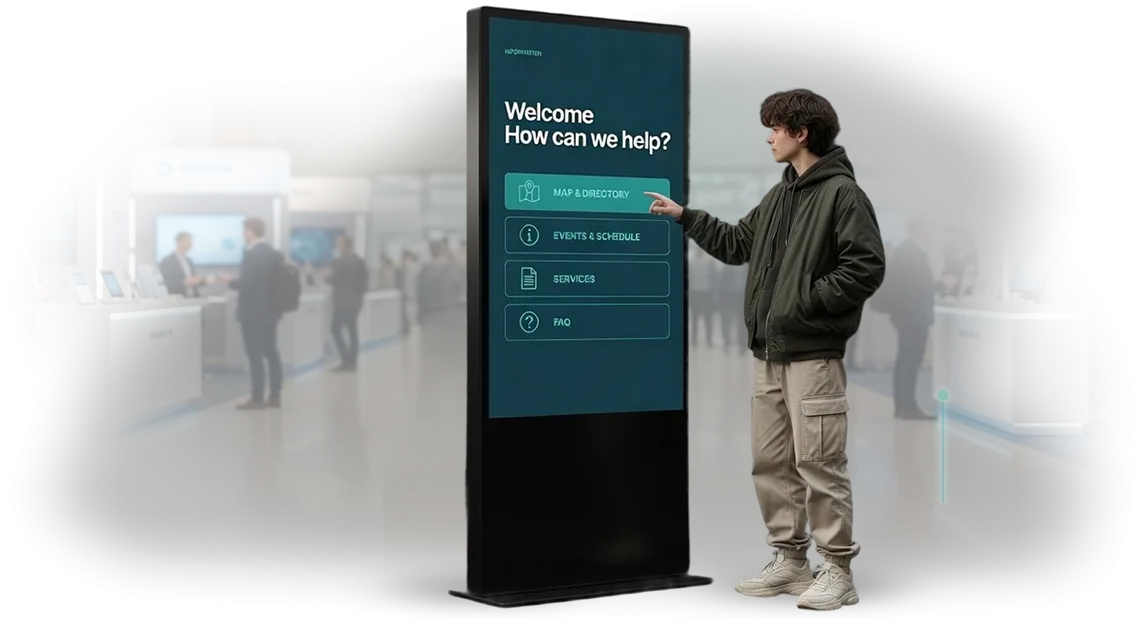
An applicant at the entrance selects the needed service on the touchscreen, receives a ticket, and sees on the monitor when their number will be called.
In effect, the administrator's role was reduced to confirming the application at the window — staff stopped being distracted by every "what's next?".
Results showed themselves within the first month. Average waiting time in the queue dropped from 25–30 minutes to 5–7, and administrators began processing twice as many applications without overtime.
A particularly pleasant bonus was the statistics: the college management now sees the real workload by hour and day and understands when additional reception windows are needed.
Applicants themselves noted that the process became transparent — no more crowding at the door or figuring out who was next.
After the successful implementation, Perspektiva College ordered two more kiosks for its branches. The main argument for the repeat order was not so much the technology, but the staff's peace of mind and visitor satisfaction.
The kiosk paid off not only in time saved, but also in reducing conflict situations at the reception desk.
If your training center faces a similar load on administrators — this example shows that the solution is easy to scale to any set of services, from consultation bookings to issuing certificates.
We take on scenario development, queue setup, and staff training so that within a week the reception area runs without overload.
How to Choose a Kiosk Format When Requirements Are Non-Standard?
Every training center has its own specifics: unusual layout, multiple buildings, a special class schedule, or an uncommon list of services.
In such conditions, a standard kiosk from a catalog often doesn't fit — attempts to force a ready-made solution onto your tasks lead to staff continuing to handle records manually while visitors get lost in queues. Instead of choosing from offered models, it's better to start from the center's actual processes.
We always begin with an analysis of the situation: how visitors enter the building, what questions they ask the administrator most often, how course registration works.
This helps determine whether you need one universal kiosk, several compact self-registration stations, or a combination of electronic queue and information kiosk.
This scenario planning isn't a redundant step — it's a way to avoid expensive mistakes later, once the solution is already in place.
The flexibility of an individual approach doesn't mean building everything from scratch or inflating the budget.
We configure proven modules to match the logic of your educational institution: electronic queue, appointments with the administrator, class schedule, course information.
Staff master the system in one day, and visitors start using the kiosk without prompts — this is visible immediately in shorter queues and reduced load at the front desk.
This format is chosen not for "non-standardness for its own sake," but when you want a working tool that saves time and nerves for everyone involved.
If you don't know which option suits your center, send us a description of your tasks, and we'll recommend the optimal solution, taking all constraints and wishes into account. It's a win-win path: you get a reliable result without spending extra on what you don't need.
Addressing Concerns: Kiosk Operation and Data Security
A kiosk in a training center is not just a device, but part of your daily operations: student registration, queue, schedule. It's understandable that any failure or data loss causes concern.
We build the system to work predictably even on peak days, and all records remain under your control.
Below are answers to the questions training center managers ask most often before starting a project.
What if the kiosk breaks down or freezes?
Hardware can indeed fail — that's inevitable. But we design the kiosk so that a failure doesn't stop your operations. If the device stops responding, simply restart it using the button on the unit — the system will recover automatically.
Registration and queue data is stored on the server side, not just on the kiosk itself. So even with a complete equipment replacement, information won't be lost.
At the same time, we provide support: during setup, we define staff procedures, and if needed, we help with replacing and configuring a new device.
How secure is visitor data and registration records?
All information is transmitted over a secure connection and stored in your database. We don't use third-party cloud services without your consent — only authorized personnel have access to the system, based on permissions and roles.
The training center sets its own rules: who can view the list of registered visitors, how long visit history is retained, and what data is visible on the kiosk screen. This ensures compliance with personal data requirements and maintains your clients' trust.
No information enters the public domain even if the screen breaks — the device doesn't store local copies of the database.
What happens to the electronic queue if the kiosk goes down during peak registration?
We've built in an emergency scenario: the administrator can accept registrations from their own workstation in the same system, and the queue continues to be served on the main server. Visitors don't lose their places, and you don't lose the flow of inquiries.
If the kiosk is temporarily unavailable, you can enable a "live queue" mode — the administrator will call the next visitors manually or through a separate internal interface. This prevents chaos while allowing you to keep collecting client data.
You'll receive a working system with clear instructions and support at every stage — from launch to daily operation. The kiosk's reliable operation and data integrity are part of our agreement.Submit a Request for a Custom Kiosk for Your Organization
Submit a request for kiosk development — we'll show you how an interactive terminal can simplify registration, navigation, and information delivery at your training center.
It's free and puts you under no obligation: first we discuss your tasks, then we prepare a proposal with an exact timeline and cost.
We work with training centers of all sizes — from small courses to networks with multiple branches. That's why our development accounts for your specifics: class schedules, appointments with instructors, and information about events. The kiosk becomes part of your system, not a standalone device.
What you get after contacting us:
- A free consultation on kiosk use cases in the educational process.
- An audit of current registration and navigation processes — we'll point out where the terminal will deliver maximum impact.
- Cost and timeline estimate tailored to your budget — no hidden fees.
- An interface prototype before development begins — you'll see in advance what the system will look like.
- Support at every stage: from planning to launch and staff training.
- Post-launch support and refinement after delivery — the kiosk grows alongside your needs.
To receive a proposal, fill out the form on the page or call us. We'll respond within one business day, clarify the details, and begin preparation. Developing a kiosk for your organization is a clear process that we lead from idea to a working terminal.