


Why VR Rehabilitation Fails to Deliver Results Without the Right Kiosk
VR rehabilitation delivers impressive results, but only when a patient actually makes it to a session and returns for more.
In real-world practice, centers face a different reality: even the most advanced equipment sits idle because patients get lost at the very entrance — in queues, in an awkward interface, in fear of unfamiliar technology.
Patient motivation is the main factor in rehabilitation success.
The harder it is to start a session, the faster the desire to continue fades: elderly people are wary of headsets and headphones, people recovering from injuries quickly tire of waiting, and staff spend time on explanations instead of working.
As a result, the course is interrupted, recovery metrics decline, and technology investments fail to pay off.
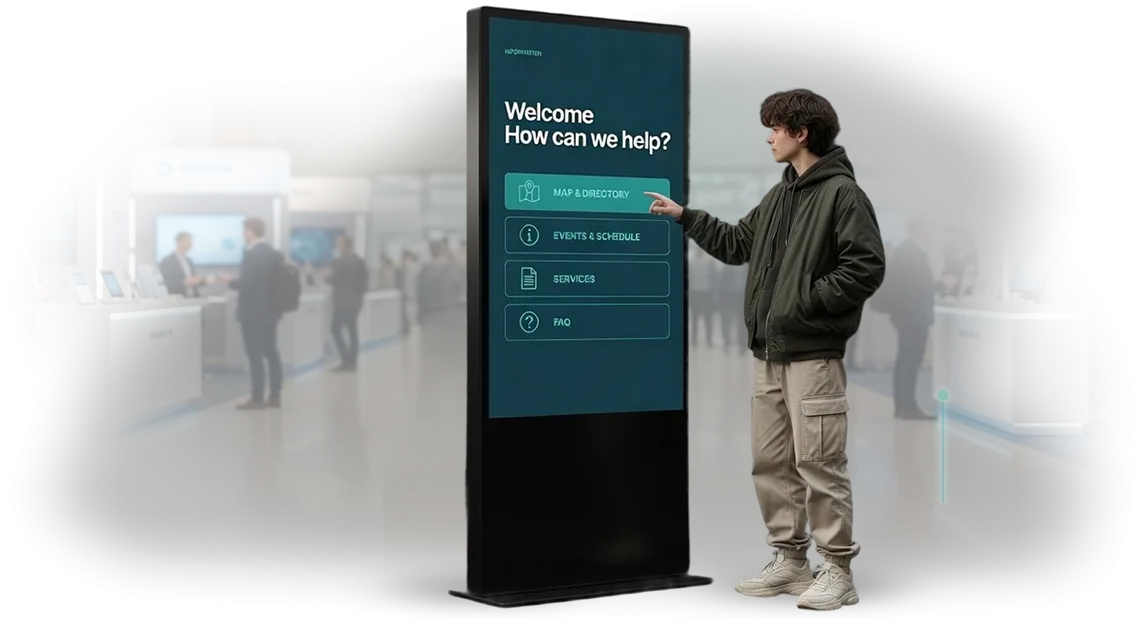
An interactive kiosk solves this problem before the patient even puts on a VR headset.
It greets the person in a language they understand, guides them through the steps — registration, program selection, a short instruction — and accompanies them right up to the moment of immersion.
The kiosk takes over the routine: registration, reminders, session start, and post-session feedback.
For a rehabilitation center, this means a predictable patient flow and less strain on staff. Employees focus on recovery rather than administration, and from the very first minute the patient feels the process is organized around them.
This is how VR rehabilitation stops being a “zone for the brave” and becomes a natural part of treatment.
We design interactive kiosks that turn the entrance into VR rehabilitation into a simple, motivating step — from the first touch of the screen to the end of the session.
We draw on experience from dozens of projects for medical and rehabilitation facilities and know what makes the process convenient for different patient groups.
What an Interactive Kiosk Gives a Rehabilitation Center
An interactive kiosk turns a clinic lobby from a waiting area into the control panel of a digital rehabilitation center. Patients choose their own program, watch exercise videos, find the right room, and book an appointment — without queuing at the front desk.
This reduces the load on staff, and visitors feel cared for and experience modern service from the very first minutes.
Engagement begins before treatment starts. VR rehabilitation often frightens people because it is unfamiliar, and the kiosk explains what virtual reality is, how a session goes, and what results it delivers.
The patient arrives prepared, worries less, and follows the doctor’s recommendations more closely. In this way, the digital interface works toward the therapeutic outcome, not just toward informing.
Autonomy benefits the clinic: fewer calls to the reception desk, fewer booking errors, and the current schedule is always in front of the patient.
The kiosk handles routine questions — “where is the gym,” “when is the next session,” “how do I pay.” Staff spend time with patients instead of repeating the same answers ten times over. This is a direct saving of time and an improvement in service quality.
A well-designed kiosk is part of the clinic’s brand. It shapes the impression of a tech-forward, reliable medical center that thinks about comfort.
Recognizable style, calm navigation, and clear scenarios make the clinic stand out from competitors, and even patients who simply came for a certificate notice the readiness for digital medicine.
In the end, the kiosk pays off not only through convenience but also through reputation. The center looks modern, patients return through referrals, and internal processes become more transparent.
This is not just another screen in the hallway — it is a working tool that improves the patient experience and strengthens the clinic’s position as a leader in VR rehabilitation.
VR Rehabilitation Formats for Your Center’s Needs
Every center works under its own conditions: one sees 30 patients a day, another sees 80, and a third has a rehabilitation hall combined with an exercise therapy room. That is why the VR rehabilitation format must match the patient flow, floor area, and clinical objectives.
We select and configure a solution for the specific center — from a compact stand to a full-scale hall with several zones.
Below is a comparison table of kiosk and VR space formats. It will help you choose an option that fits your workload and space.
Format Comparison
| Format | Who it is for | What it gives the client |
|---|---|---|
| Stationary kiosk | A small center with a dedicated room | Maximum throughput per shift: the patient selects their own program, the doctor monitors results. Compact, with no reconfiguration needed |
| Mobile platform | A center where rooms are used for different purposes | One system moves between rooms and is not tied to a fixed point. Suitable for mobile rehabilitation and work with bedridden patients |
| Multisensory hall | A large center with a flow of 50 or more patients per day | Several patients train simultaneously — the load is distributed, doctors run group and individual sessions. Equipment is used constantly, with minimal downtime |
After the format is chosen, we design VR rehabilitation scenarios for your patient profiles — from motor recovery to cognitive training. All programs adapt to the rehabilitation plan and report on progress so you can see each patient’s development.
How the Project Works: From Brief to Kiosk Launch
We operate along a transparent route where you see every intermediate result and can influence the course of the project. No “black boxes”: first we define the tasks, then we approve the mockup, and only then do we start production. This approach eliminates rework at the final stage and helps deliver the kiosk exactly on time.
- Brief and technical specification. We discuss who will use the kiosk and which scenarios matter. The result is a clear document with tasks, the screen structure, and acceptance criteria.
- Project plan and implementation stages. We break the work into phases with dates and a list of what you receive at each point. You know in advance when the prototype appears, when the test version is ready, and when launch is scheduled.
- Design and mockup approval. We create the interface according to your brand and usage logic. You review the mockup, make edits — and only after your “okay” does development begin.
- Development and assembly. We build the application, assemble the enclosure, and configure the equipment. At this stage, we keep you informed at key milestones so there are no surprises at the finish.
- Testing and kiosk launch. We test all scenarios on the actual device, install it in the right location, upload content, and launch. You receive a fully working turnkey kiosk.
- Staff training. We conduct a short instruction session: how to update information on the screen, how to handle common guest questions, and what to do in an emergency.
- Ongoing support. We stay in touch after launch: update materials on request, monitor system stability, and help whenever questions arise.
What Is Included in the Interactive Kiosk Delivery
You order a kiosk for VR rehabilitation and receive a turnkey solution: the enclosure, configured software, trained staff, and support. We handle integration so the system works from day one — no self-assembly or hunting for subcontractors.
The standard delivery includes:
- An enclosure with a touchscreen and space for VR equipment: sturdy, ergonomic, and safe for patients.
- Rehabilitation software: preinstalled and configured for your scenarios and patient profiles.
- An adapted interface: large elements and simple controls — patients manage without staff assistance.
- A set of instructions: for administrators, medical staff, and patients, with operation reference guides.
- Staff training: a hands-on session at your site — employees confidently start sessions and resolve common issues.
- Warranty and support: an official warranty on hardware and software, communication channels, and a response policy.
Each item can be adapted to your space and objectives. You receive the documentation, access credentials, and trained staff — all that remains is to plug in the kiosk and start working.
Case Study: A Center Increased Patient Engagement in Its VR Program
Patients were missing sessions, motivation was dropping, and doctors could not see progress — a familiar pain point in rehabilitation centers.
Staff had to manually remind patients about exercises and persuade them to return to the program, while some patients simply dropped out of the course entirely. This wasted both specialist time and treatment effectiveness.
We solved the problem with an interactive kiosk featuring a VR program. The patient chooses their own scenario, sees their progress, and receives feedback after each session.
The technology — Unity and professional hardware — stays behind the scenes: the user sees a clear interface and a game, not complex internals.
The project’s results were visible from the first month: the number of sessions grew by 40%, and 92% of patients left positive feedback on the VR program. People began coming to sessions without reminders and were more willing to complete the full course.
How the Kiosk Was Implemented
At the Harmony rehabilitation center, the kiosk was installed in the waiting area. The patient walks up, selects a scenario, puts on the headset, and completes the session, while the results are saved automatically — the doctor sees the progress. For the patient, it is a game with clear goals; for the clinic, it is a process control tool.
What This Gave the Center
Equipment utilization increased, staff stopped spending time calling patients, and engagement improved. After two months, the client ordered a similar solution for their second department — the best indicator of satisfaction with the project.
Addressing Common Concerns Before You Order
Before ordering a VR kiosk for rehabilitation, doubts arise: Is it safe? Will the staff manage? Who handles technical issues? Will the solution fit your methodology? Here are our short answers.
Is VR rehabilitation safe for patients?
Yes, if the session is designed properly. We limit immersion time, control exercise intensity, and build in pauses between tasks. The patient can stop or exit the session at any moment — every scenario is tested for comfort and safety.
Will the staff have to accompany the patient at all times?
No. The kiosk guides the patient step by step: prompts appear on the screen to show what to do next. Staff only need to start the program and help put on the headset. Training takes one or two sessions, after which the team works independently.
What about technical support after launch?
We stay in touch and respond to requests during the business day. Most issues we resolve remotely: we diagnose the system, update scenarios, and advise on operations. There is no need to involve your IT department — we handle everything required.
Can the kiosk be adapted to our rehabilitation methodology?
Absolutely. We take your exercises and protocols, transfer them into VR, and configure session duration and load levels. The kiosk complements your methodology rather than replacing it.
Get an Interactive Kiosk Plan for Your Program
Leave a request for a kiosk — and we will prepare a plan that makes it clear what to do next. No abstract promises: you will receive a cost calculation, launch timelines, and a solution presentation tailored to your VR rehabilitation program.
You will also understand how the kiosk fits into your specialists’ workflow and what results you can expect from the very first stage.
What the plan will include:
- A cost calculation for your format — no hidden items, you see exactly what you are paying for.
- Launch timelines by stage: from concept approval to installation and configuration.
- A presentation of formats: scenario options for VR rehabilitation that suit your audience.
- An equipment list with justification — what is needed for stable operation and why.
- A description of the user scenario: how the patient interacts with the kiosk and what results you see.
- Recommendations for integration into your process: where to place it, how to support it, how to measure impact.
This is not just a commercial proposal — it is a working document. Based on it, you can approve the budget internally, discuss it with your team, and make a decision without additional meetings.
We work remotely across the CIS, so we will send the plan within two business days after a short conversation. If you are satisfied, we move on to implementation; if not, you still keep useful material for future projects.
How to Choose the Right Format for Your Rehabilitation Goal?
The main question when choosing an interactive kiosk format is not “which equipment is better” but rather “what rehabilitation goal are we solving.” The same kiosk with different content can motivate a patient to do daily exercises, teach correct movement technique, or provide the doctor with clear progress statistics.
Therefore, the right selection logic always goes from the clinical goal to the interface and scenario, not the other way around.
If the goal is fine motor skill recovery, you need a touchscreen with tasks that require precise, smooth finger movements. If the focus is coordination and balance, a floor projection with body position tracking is more effective.
And when the aim is to restore the patient’s confidence in movement after an injury, immersive 3D scenarios work best — the person performs exercises in a virtual environment and sees their results in a game-like form.
Equipment selection also depends on the goal: a stationary kiosk suits a lobby or exercise therapy room, while a mobile stand is better for wards and outreach work. It is important that the system easily adapts to different patient heights, ages, and mobility levels.
At this stage, we help you choose not the “most expensive” option, but the one that will deliver measurable progress in your specific department.
Our specialists start by auditing your rehabilitation programs and patient flows, then propose scenarios for specific disease groups. After a pilot launch, we adjust the interface and exercise intensity, and the doctor receives simple progress reports. This approach shortens implementation time and increases staff trust in the technology.
The key to selection is not a catalog of options but a clear chain: “diagnosis → exercise → interface → result.” We take that logic as the foundation and design a kiosk that becomes a doctor’s working tool and a patient’s motivator — without paying extra for unnecessary features.