

Visitors Ignore Your Booth: An Interactive iOS Kiosk Saves the Day
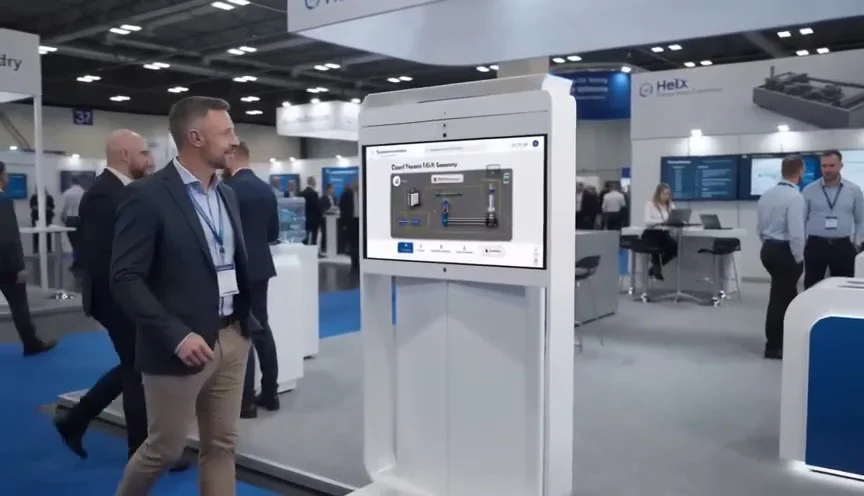
Visitors walk past your booth in a few seconds — without even glancing at the screen or taking a brochure.
Brand managers have invested in the design, printed materials, and booth staff, but the visitor doesn’t stop: they have no interest in looking at a static image, and approaching a consultant with questions is often awkward.
As a result, countless efforts spent on renting and preparing the space turn into empty traffic without dialogue.
An exhibition or conference is expensive, and every minute a guest spends at your venue is a potential contact with your brand.
If that contact doesn’t happen, both brand awareness and lead generation suffer: a week after the event, visitors only remember the spectacular booths where something was happening.
Passive observation doesn’t work — engagement works, when a person presses buttons, chooses, plays, and leaves their data.
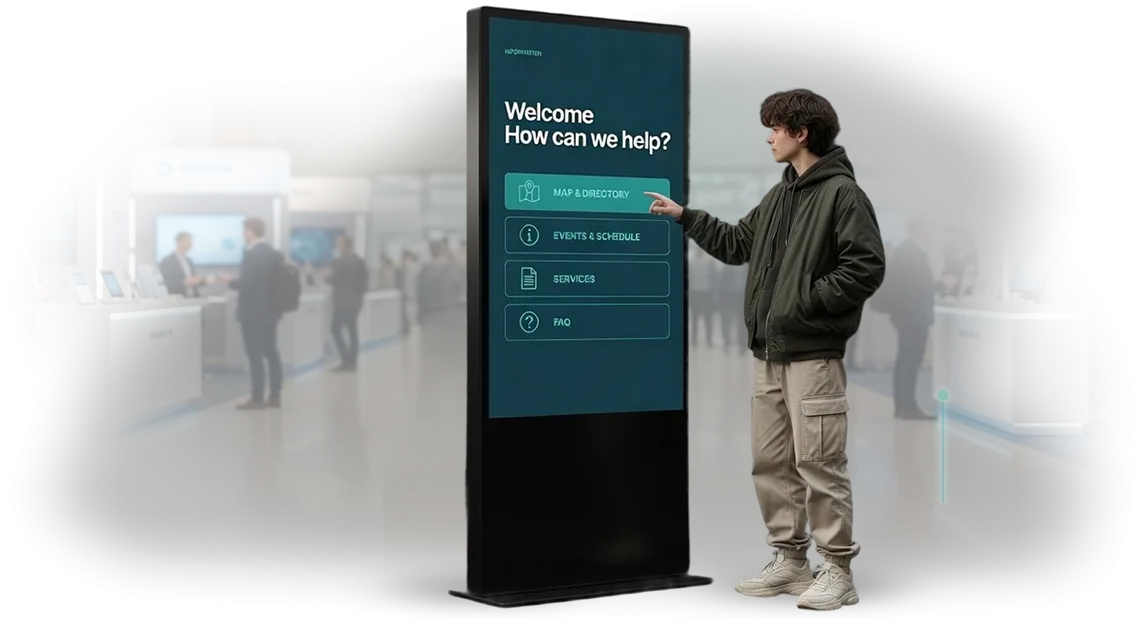
An interactive iOS kiosk solves this: it attracts attention with a bright interface and offers the guest a simple action — take a quiz, assemble a virtual product, or get a personal recommendation.
This format removes the barrier to talking to a consultant and also collects contacts and interests in a structured way. The guest gets an emotional experience and value; you get a measurable result instead of vague impressions.
We’ve been solving this pain for a long time: we design kiosks on professional equipment and iOS so they fit into the logic of your booth rather than look like an alien gadget.
In the end, you get a tool that really holds guests’ attention, starts conversations, and generates leads — without needing to dig into technical details. All that’s left is to choose an interaction scenario; we take care of the rest.
Benefits of an Interactive Kiosk for Your Event
Guests at any event quickly tire of similar booths and paper brochures. An interactive kiosk changes that perception: instead of passive viewing, people get involved in a game or quiz, which sparks genuine interest and a desire to learn about the product.
That’s why zones with such terminals attract queues even at business forums, where it’s usually hard to hold the audience’s attention.
Guest Emotions Are Your Main Result
When a visitor chooses the scenario on the screen themselves, they remember not the booth but the experience. A few minutes of interacting with the kiosk leave a stronger impression than an hour of talking with a promoter.
An engaged guest is more willing to share their impressions on social media and return to your brand — this drives awareness without additional advertising spend.
A Brand That’s Impossible to Miss
A bright touch screen with animation and corporate styling sets your space apart from competitors. The kiosk becomes a point of attraction and a natural backdrop for photos guests post on their accounts. This puts your brand into personal recommendations — the most trusted channel.
Leads Without Effort From Your Team
The kiosk collects contacts on its own: business cards, phone, email — in exchange for useful content, a promo code, or a chance to enter a raffle. You get a database of interested people who have already shown engagement.
Meanwhile, managers aren’t distracted by manual data collection — all forms are automatically entered into the system.
Relieving Your Staff
The terminal answers common questions by showing information in a visual format. Your staff can focus only on complex and important tasks instead of repeating themselves for the hundredth time.
This saves your team’s energy and reduces the risk of errors in conveying information about your product.
Interactive Kiosk Formats: Which One to Choose
The choice of interactive kiosk format directly affects how visitors interact with your service.
A touch terminal at the counter helps people quickly find the information they need; a floor-standing kiosk draws attention to the product; an outdoor structure works around the clock.
It’s important that the format matches the goals of the touchpoint: navigation, catalog, presentation, or booking.
We develop turnkey kiosks for shopping centers, museums, clinics, restaurants, and offices. For each project, we select the hardware and interface for touch control, including iOS — it provides familiar gestures, smooth scrolling, and fast response. Below is a comparison of popular formats.
Comparison of Kiosk Formats
| Format | For Whom | What It Gives the Customer |
|---|---|---|
| Touch terminal (wall-mounted, tabletop) | Shops, salons, reception desks | Product and service catalog without waiting, quick information search, staff relief |
| Floor-standing kiosk | Shopping centers, museums, exhibitions | Attracts attention from a distance, convenient for exploring large volumes of information, enhances brand image |
| Outdoor kiosk | Gas stations, bus stops, entrance areas | 24/7 operation in any weather, self-service navigation and information around the clock |
| Interactive table | Restaurants, showrooms, business centers | Shared use by guests, visual demonstration of menus or layouts |
If you’re not sure which format is right, send us your brief. We’ll select the optimal option for your space and budget and show you how the kiosk will fit into your touchpoint.
iOS Kiosk Development Stages: From Brief to Launch
For a client, developing an iOS kiosk looks like a black box: it’s unclear what happens between the idea and a working terminal. That’s why we built the process as a series of short stages with checkpoints. You always know what’s going on and can influence the outcome without delaying the schedule.
-
Brief and immersion in the task. We define the kiosk’s goals, audience, and use scenarios. The output is a feature list and recommendations for what best solves your business task.
-
Plan and prototype. We prepare the screen structure and navigation logic. You see how a visitor will move through the menu even before any code is written — this removes most questions at the start.
-
Design concept and approval. We develop the visual style for your brand: colors, fonts, element placement. Programming begins after your approval.
-
Development and assembly. We build the iOS app, connect the required services, and configure the terminal. You get a predictable timeline and stable kiosk operation in a public space.
-
Testing and launch. We check navigation, response speed, content updates, and failure behavior. We fix any issues and install the kiosk in the desired location: lobby, exhibition, shopping center.
-
Support and growth. After launch, we stay in touch: update materials, add features, and monitor stability. The kiosk becomes a tool that works for your business and pays for itself.
This structure is also possible on other platforms, but iOS in particular delivers predictable behavior across all devices and easy content management. For you, the key is a clear process, transparent timelines, and a result that doesn’t require constant attention.
What’s Included in the Kiosk Delivery: Client Package
You get not just a program, but a turnkey solution that can be immediately installed on the terminal and used in your operations. The package includes everything needed to make the kiosk work from day one and not require deep technical knowledge from your team.
- App for the iOS terminal. Adapted for touch control, runs stably in 24/7 mode, and doesn’t slow down even with extended use.
- Design mockups and brand identity. Interface design in your brand’s colors and style — from screensaver to buttons — so the kiosk looks like a natural part of the space.
- Integrations with your systems. We connect the kiosk to the product database, event calendar, CRM, or analytics service — the data on screen is always up to date and requires no manual updates.
- Installation and setup on hardware. We bring, mount, and launch the kiosk at your venue ourselves and test all scenarios.
- Staff training and instructions. We give a short training for employees and provide clear cheat sheets: how to power on, replace content, and what to do in an emergency.
- Content administration. We set up a convenient admin panel through which your marketing team can change promotions, catalog items, and news themselves, without programmers.
- Warranty and technical support. One year of free support: if something goes wrong, we resolve it; consultations and updates are covered by the contract.
- Documentation and source materials. We hand over the full package: connection diagrams, equipment list, logins, and access details — so you remain the full owner of the solution.
As a result, the client gets a working tool that increases visitor loyalty and relieves staff. You don’t need to hire a separate developer or get into technical details — just install the kiosk and start using it.
Example: How an iOS Kiosk Boosted Guest Engagement
Guests arrive at the cinema early, but in the lobby they stare at their phones — the atmosphere is lost, and the cafe and merch stands sit idle. The cinema chain Premiera faced this directly: regular posters and information desks couldn’t hold anyone’s attention.
We installed interactive iOS-based kiosks in three halls with a quiz about new releases and personal movie selections. In a minute, a guest can find out what to watch and receive a popcorn coupon — turning the wait into part of the experience.
What Changed
The average time spent at the kiosk grew from 40 seconds to two and a half minutes — guests aren’t just looking, they’re interacting. In the first month, the kiosks collected 12,000 sessions, and 45% of users returned to the screen on their next visit.
Most importantly, repeat ticket orders through the kiosk tripled because guests remembered the recommended movies.
An additional effect was social media. Every third guest took a photo of the quiz result screen, giving the cinema free reach on premiere day.
Client Testimonial
“The kiosks became a form of entertainment on their own, not just an information point. Guests spend more time at them than at the popcorn bar, and managers have stopped being tied up at the info desk. We ordered five more terminals for nearby venues.”
After the launch, we received a repeat order to expand the network — this time for cinemas in another city. This confirms that the right interactive mechanics pay off through engagement and loyalty, not one-off promotions.
What If I Need a Kiosk on Another Platform?
If your business has settled on iOS, that’s a reliable foundation: these devices run stably in 24/7 mode and don’t fail at the most critical moment. For you, that means less downtime and calm guests, rather than waiting for a reboot.
But alternatives to iOS exist, and we work with them too. If your company has adopted a standard for different hardware, has already purchased terminals, or the integration requires a specific system — we’ll build the kiosk for it.
That could be Android, a web version for browsers, or a cross-platform solution that runs on different devices. The client gets the same set of features: menu, catalog, forms, navigation — without being locked to one platform.
Why do we often recommend iOS specifically? It’s predictable for long unattended operation: fewer surprises with updates and external modules, fewer risks at the venue.
But ultimately, the platform isn’t chosen by technology — it’s chosen by your task: where the kiosk will be, who will use it, what it should do. The solution is matched to that.
For other platforms, the development timeline may be slightly longer — interface adaptation and stability testing on your hardware add extra time. This isn’t an obstacle but a stage we build into the plan ahead of time.
Before work starts, you get an accurate timeline estimate and a clear understanding of the result you’ll get in your scenario.
If you’re not sure which platform is optimal, describe your case: event format, number of guests, required features. We’ll suggest an option with minimal risk and on the right timeline. You get a working kiosk, not a conversation about technology.
FAQ About Interactive Kiosk Development and Warranties
Clients most often ask: what if it breaks, how do we update content, and how long until launch. We work with iOS tablets — we provide warranties and support after delivery.
What happens if the kiosk breaks down?
Every project comes with a warranty. Within the warranty period, we fix issues free of charge, including an engineer’s visit, and resolve software questions remotely — usually within one business day.
After the warranty expires, you can sign a support contract. This includes scheduled checks, preventive maintenance, and replacement of components — the kiosk keeps working without downtime.
How do we update content: prices, promotions, news?
You get a convenient admin panel. An employee without technical training can change texts, photos, videos, and price lists in minutes. The update goes live immediately, and the kiosk automatically picks up the changes.
If you have a network of kiosks, the update goes out to all devices simultaneously — no need to visit each terminal.
What are the development timelines?
A typical project takes two to four weeks after the mockup and content are approved. The timeline depends on the number of screens, menu structure, and the need for integration with your existing software.
We set milestones and control dates in the project plan — you see progress and know when the kiosk will be ready to launch.
Order iOS Kiosk App Development
When you need a kiosk for a specific event or launch, there’s no time for lengthy negotiations. Ordering iOS app development is often postponed because it’s unclear where to start and how long it will take.
We remove that uncertainty: you submit a request, and after a short conversation, you get a clear picture of the project.
After you contact us, you get:
- Expert consultation — we help you frame the task so the kiosk solves your business problem: attracts attention, reduces queues, gathers contacts.
- Prepared brief — we ask the right questions and capture all details, from scenarios to design. This eliminates edits at later stages.
- Transparent estimate — we provide timelines and cost before work begins, with no hidden payments or “surprises” along the way.
- Prototype before development — you see what the interface will look like and can make changes when it costs the least.
- Launch and training — we install the app, test it, and show your team how to manage the kiosk and update content.
- Post-release support — we stay in touch, quickly respond to feedback, and help with new features.
This approach takes away the fear of ordering the wrong thing. You control every stage and understand what you’re paying for.
Submit a request for iOS kiosk app development — we’ll send a brief, give you a consultation, and prepare a proposal for your task. We’ll start with a short call and show you an action plan the very next day.