

Tired of Frozen Kiosks? Switching to Linux Will Solve the Problem
A frozen screen at peak hours isn't just a technical failure — it's lost customers and a damaged reputation. A visitor doesn't care who's to blame — the hardware, the system, or weak power supply; they simply walk over to a competitor, and you get negative reviews. Every minute of interactive kiosk downtime is direct losses and a ruined marketing campaign.
For decades, we've watched business owners struggle with this pain: investments are made in equipment, content is ready, the hardware is powerful — but the terminal still glitches and requires constant administrator supervision.
The problem usually isn't the components but an unstable environment that can't handle round-the-clock load.
The solution we deliver is switching to Linux. It's an operating system that has been running on servers and ATMs for decades without reboots, unlike classic desktop platforms.
By moving your kiosk to Linux, you eliminate 90% of the causes of "endless spinning icons" and "blue screens," getting a fault-tolerant tool that works 24/7.
Stable terminal operation is achieved through a lightweight architecture: the system consumes fewer resources, isn't distracted by background updates, and doesn't overload the processor.
This provides predictable interface response speed — the guest gets information instantly, and you don't have to pay for downtime and repeat visits from unhappy users. As a result, the interactive kiosk turns into a reliable sales channel rather than a headache.
What an Interactive Kiosk Will Do for Your Business
Guest Engagement
An interactive kiosk turns a visitor from an observer into a participant. Instead of a static stand or paper brochure, a person chooses what to look at and where to tap — this holds attention much longer.
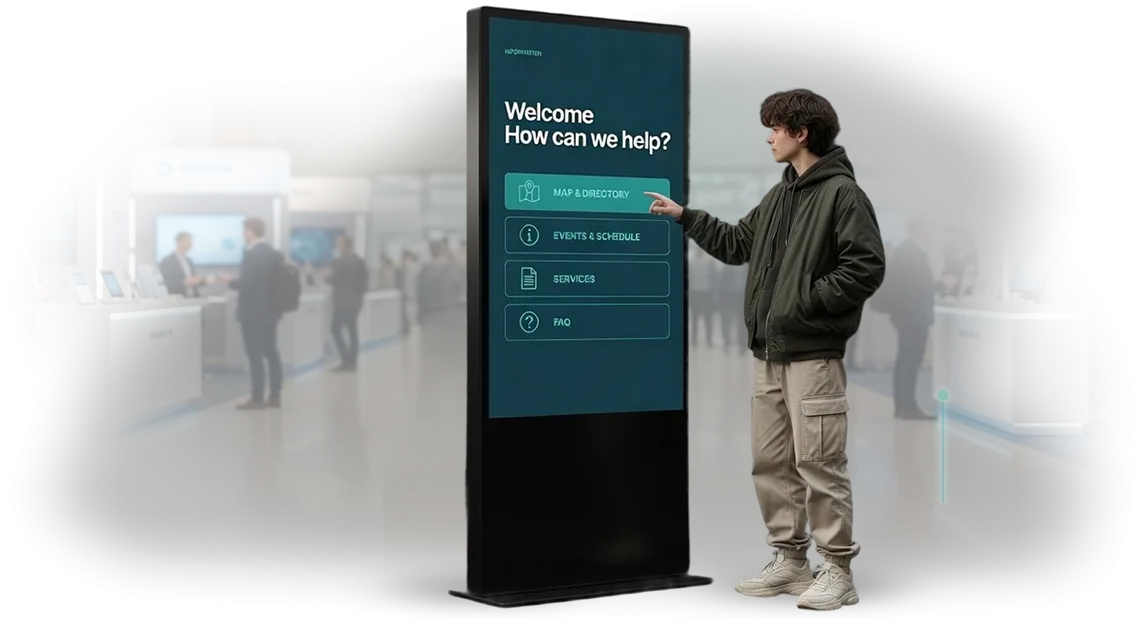
This is what a touch terminal's effectiveness looks like: live interaction with the audience instead of passive viewing.
Guests are more likely to remember a brand they've "played" or "worked" with on screen. Such an experience builds more trust and a desire to come back again.
Brand Recognition Growth
A bright interactive screen attracts attention by itself and creates photo opportunities. Visitors capture the experience on their phones and share it on social media — that's extra reach at zero advertising cost. Each such post works like a personal recommendation.
The advantage of an information kiosk is that it strengthens the brand's association with modernity and high-tech. Company our team helps build this image through a well-designed interface and interaction scenarios.
Lead Collection
A kiosk can be more than just a showcase — it can be a data collection tool: leaving a request, subscribing to a newsletter, getting a promo code. You receive a ready-made database of interested customers with consent to communicate — that's the foundation of repeat sales.
Unlike paper surveys, the terminal doesn't require manual entry and doesn't lose sheets. Contacts go straight into your CRM in structured form, with no manager time needed for processing.
Staff Savings
One kiosk answers common questions, provides information about products and services, and helps place an order — without an employee's involvement. This reduces staff workload and minimizes "human factor" errors.
For the company, this means lower costs for frontline staff and the ability to reassign people to more complex tasks. The kiosk pays for itself through savings and additional sales at high-traffic locations.
Kiosk Formats on Linux for Any Task
Choosing a kiosk format is a decision that affects visitor convenience and the effectiveness of your point of contact.
One business needs a noticeable floor-standing information terminal, another needs a compact wall-mounted kiosk for navigation, a third needs an embedded solution.
At our team we select the right form factor for each specific task, so every type of touch kiosk delivers maximum value.
| Format | Who It's For | What It Gives the Customer |
|---|---|---|
| Floor-standing information terminal | Shopping malls, exhibitions, showrooms | Visible from a distance, attracts attention, and easily handles visitor flow |
| Wall-mounted kiosk for navigation | Museums, offices, clinics, government institutions | Saves space in walkways and lobbies; information materials are always in view |
| Embedded touch kiosk | Cafés, banks, partner zones | Blends naturally into the interior, doesn't look bulky, and doesn't obstruct movement |
All options — from floor-standing terminals to wall-mounted kiosks — run on the stable Linux platform. This provides reliability, protection against failures, and flexibility: you can easily update content, change screen logic, and add new features without replacing equipment.
You don't have to think about licenses or compatibility with other software — the system simply does its job.
We help you choose the right format, design the enclosure, and structure the screen logic so the kiosk solves measurable goals: reducing queues, guiding visitors, presenting products, collecting contacts.
In the end, you get not just a stand with a screen but a full-fledged customer communication channel.
How Turnkey Kiosk Development Works
We follow a transparent process: you always know where the project stands, what's already done, and what comes next. No "black boxes" — just clear steps, timelines, and a result you approve.
-
Brief and task immersion. We study your audience, goals, and kiosk usage scenarios. We define what features you need — from catalog and navigation to payments and surveys.
-
Scenario and structure design. We work out the screen logic: what a person sees first, how quickly they find what they need, what actions they take. You get a clear blueprint of the future terminal.
-
Design and prototype. We create an interface in your brand style. At this stage, you can already see how the kiosk will look and interact with visitors.
-
Application development. We build the system on the reliable Linux platform — this ensures stable operation without failures or freezes. We prepare the kiosk for any load: from a dozen touches to thousands per day.
-
Testing and debugging. We verify all scenarios on real hardware: touches, updates, reboots, behavior during network outages. We fix issues before the terminal reaches your customers.
-
Launch and training. We install the kiosk at your site, set up remote management, and brief your staff. You get a working turnkey system — no need to dive into technical details.
-
Support and evolution. We stay in touch after launch: updating content, adding features, monitoring stability. The kiosk grows with your business instead of becoming a frozen artifact.
Timelines depend on scenario complexity, but we usually give realistic estimates on the first call. You always know when the terminal will be ready and stay in control of every stage.
What's Included in Kiosk Delivery
A kiosk is not just a touchscreen with software — it's a full-fledged point of interaction with your customers. That's why we handle the entire cycle: from design and hardware selection to installation and staff training. You receive a ready-to-work tool, not a box of components to assemble and configure yourself.
The standard delivery package includes:
- Thought-out construction and industrial-grade hardware built for round-the-clock operation in high-traffic locations.
- Pre-installed Linux-based software. It's a reliable, fault-tolerant system that doesn't require expensive licenses and runs without failures.
- A clear interface designed for your tasks: catalog, navigation, booking, questionnaire — everything your customers need.
- Screen design and content loading in your brand style. Up-to-date promotions, catalogs, news — you can always refresh the information.
- Delivery and on-site installation. We install the kiosk at the right spot, connect it, and test all operating scenarios.
- Training for your staff. We conduct a briefing: how to replace content, set schedules, and handle common situations.
- Ongoing support and technical assistance after launch. We monitor system health, update software, and help with any questions.
This approach eliminates the hassle of hunting for multiple contractors and coordinating between them. All work and responsibility live in one place, with delivery terms fixed in the contract. You know in advance what you're getting and can forecast the launch timeline.
Case Study: How a Kiosk Doubled Guest Engagement
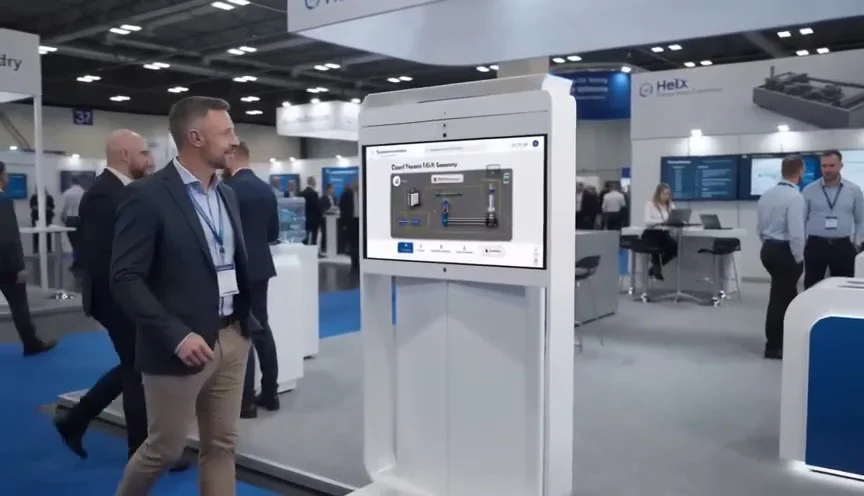
At one industry exhibition, organizer "City Events" faced a typical pain point: guests were walking past booths while a queue formed at the registration desk.
We proposed deploying a Linux-based interactive kiosk that combined navigation, the event program, and contact collection.
The terminal quickly changed visitor behavior: average time at the booth grew from one and a half to three minutes, and the kiosk handled up to 400 interactions per shift.
People explored the program, marked interesting sessions, and left requests — live staff remained only for complex questions.
The interactive terminal's results exceeded expectations. Within a month, the organizer received three times more leads than with paper forms, and the repeat order for the next season was placed before the current one even ended.
Managers noted that guests became more deliberate in choosing events, and staff stopped answering repetitive questions.
This successful kiosk project shows: a terminal is not just a "screen with a menu" but a tool for managing attention and building a quality audience.
This kiosk implementation case easily transfers to another venue: we measure session counts, viewing depth, completed forms, and conversion to requests — these are the numbers that help justify budget and forecast team workload.
If you face a similar challenge — let's discuss how to adapt this scenario to your venue. We'll show the calculations, offer options, and deliver a turnkey project with guaranteed results.
How to Choose the Right Kiosk Format?
Choosing an interactive kiosk format isn't about appearance — it's about where and how customers will interact with it. Dimensions, housing type, and mounting method all depend on the location and usage scenario.
If you choose correctly, the terminal will work for your goal every day: helping customers, relieving staff, and delivering measurable results.
A floor-standing kiosk is the solution for high-traffic areas with active visitor flow. It's stable, visible from afar, and doesn't require additional furniture or a counter.
This format works well in shopping malls, business center lobbies, and exhibitions — places where people approach on their own, explore information, and spend a few minutes at the screen.
The floor-standing enclosure allows for a large display, a comfortable viewing angle, and built-in peripheral equipment.
A wall-mounted kiosk is chosen when compactness and space savings matter. It mounts on the wall and doesn't block walkways, making it ideal for narrow corridors, entrance zones, elevator lobbies, and small rooms.
Such terminals are often used for short interactions: checking status, booking, navigation, or payment. They let you create a self-service point even where there's no room for a full stand — while retaining all the functions of a complete kiosk.
An embedded option is the answer when the terminal must become part of the interior or existing furniture. The kiosk is built into a reception desk, information panel, retail furniture, or a niche.
This approach preserves the space's style without cluttering it with extra structures. Embedded kiosks are chosen by hotels, clinics, museums, and retail stores — places where design and clean integration matter more than the look of a standalone device.
The main selection criterion isn't size or price but the user journey. Think about how much time a person spends at the terminal, whether they want to sit, stand, or walk past, whether they need a large screen for exploring information or just a quick tap.
Also assess operating conditions: humidity, outdoor placement, usage intensity. Our experience shows: a properly chosen format reduces requests to staff and increases the share of completed target actions.
If you're unsure — we'll help you pick a kiosk for your task, suggest the optimal option, and refine it to fit your space if needed.
Frequently Asked Questions About Kiosks and Their Implementation
When thinking about kiosk implementation, customers often ask the same questions: how difficult is it to install, how do you ensure security, how do you update content, and what about the warranty. Here are concise answers to the main concerns.
Is it hard to install a kiosk and get it running?
No, we handle installation ourselves. We set up the terminal, connect it to your network, and verify everything on site. All you have to do is power on the kiosk and start using it. Launch typically takes one to two days, including testing.
How protected is the kiosk against hacking and tampering?
A Linux-based kiosk runs in a locked-down mode: visitors see only your application and cannot access system settings or open external websites. We include protection against reboots and unauthorized access.
For most tasks, this is sufficient — the terminal operates autonomously without constant supervision.
How do I update content: prices, promotions, news?
Content updates are done remotely through a simple control panel. You change texts, images, and files in minutes — the kiosk picks up changes automatically. This is convenient when information changes frequently: promotions, menus, schedules, or company news.
What about warranty and support after launch?
We provide a warranty on both hardware and software and support the kiosk after deployment. If questions arise, our support team is available. If needed, we take the terminal in for maintenance or replace components to keep operations running.
Discuss Your Kiosk Project Today
One call — and you'll find out how much the kiosk costs, what the timelines are, and what's needed for launch. We provide free consulting on terminals, calculate the project for your tasks, and propose a solution that will pay for itself.
We build kiosks on Linux — a stable, secure platform — so the terminal runs without failures even under heavy load.
During the discussion, details emerge that save your budget: where the kiosk will stand, who uses it, which information matters most. So you get not an abstract price range but a precise estimate and a clear work plan.
We work remotely across the entire country — we'll schedule a call at your convenience, show examples, and answer questions.
At the consultation, you'll receive:
- A kiosk cost calculation tailored to your tasks and location.
- Hardware configuration selection: screen, enclosure, size — without unnecessary options.
- Scenario recommendations: catalog, navigation, questionnaire, client booking.
- Assessment of development and launch timelines for the terminal.
- A free interface sketch in your style.
- Solution examples for your industry and your customers.
Fill out the form or call — the free kiosk consultation and cost calculation are completely non-binding. We'll discuss your task, suggest options, and show how the kiosk can start delivering value in the first month.
You can order a kiosk right after the first conversation — everything else is quick and transparent.