

Customers Leave Without Getting Help: The Cost of Slow Service
Every visitor who cannot find the right department or waits for an answer to a simple question is a potentially lost customer.
In shopping malls, clinics, and business centers, weak navigation directly reduces revenue: a person who spends ten minutes searching for an office is unlikely to return.
A solution based on Ubuntu lets you deploy interactive kiosks and navigation terminals that run without failures — the visitor gets an answer instantly, and you keep the customer.
When information is outdated and only employees understand the building layout, guests get frustrated and switch to competitors. Administration gets distracted by explanations, and negative reviews appear. Every such situation is a lost deal and a blow to your reputation.
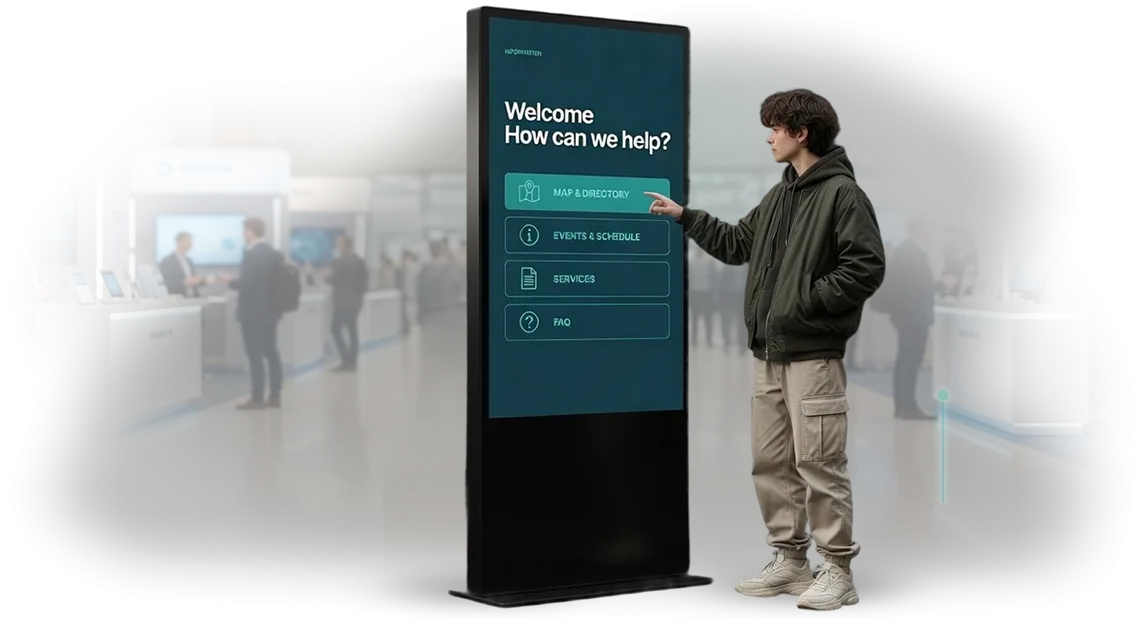
An interactive Ubuntu kiosk solves this problem. The navigation terminal shows the route to the desired location, travel time, and available services — elevators, cafes, ATMs — in seconds. The system requires no staff involvement, and the interface is clear to any visitor. Customer service becomes fast and predictable.
Improved service increases loyalty and the frequency of repeat visits. A guest who easily found the right store returns and recommends you to others.
The kiosk pays for itself through higher satisfaction, reduced staff workload, and a larger average ticket — shoppers spend their time buying, not searching.
What an Interactive Kiosk Delivers to Business: 5 Measurable Results
An interactive kiosk is not just a device but a growth point for your business. The benefits of a kiosk show up in five measurable results, each of which affects profit and visitor loyalty.
Increased visitor loyalty. Self-service access to information and services creates a positive experience. A satisfied customer returns more often and recommends the company to friends — repeat visits boost revenue without advertising costs.
Higher average ticket. The kiosk suggests related products and services based on the customer's choice. A relevant recommendation increases the purchase amount, directly impacting sales growth.
Reduced staff workload. Automating navigation, catalogs, and requests frees employees for face-to-face communication and complex tasks. Lines shrink, service speed increases, and working hours are used more efficiently.
Analytics collection. Every visitor action leaves anonymized data about preferences. This data helps adjust assortment and marketing based on facts rather than assumptions.
Image of an innovative company. A modern kiosk in your lobby or office is a visible sign of brand sophistication. It strengthens partner trust, sets the company apart from competitors, and creates a contemporary image in customers' eyes.
Interactive Kiosk Formats on Ubuntu for Your Task
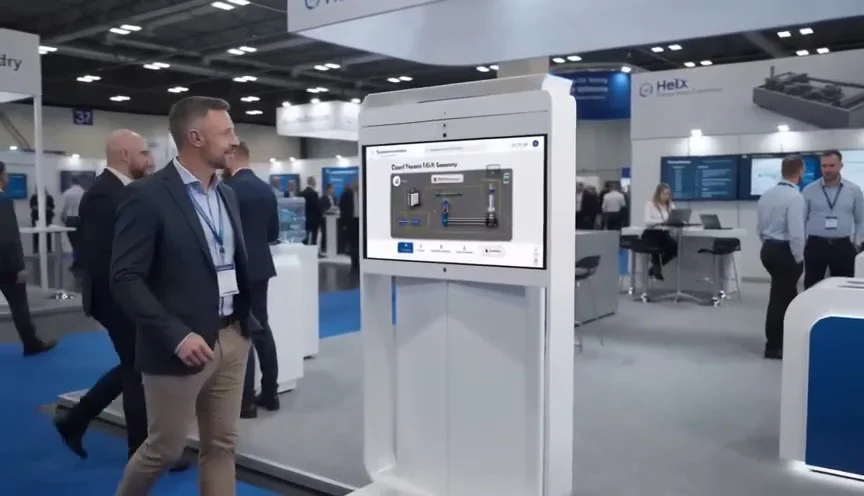
The kiosk format determines how visitors interact with your content. Floor-standing units attract attention in the lobby, wall-mounted units save space, and wall-side kiosks serve as a familiar information desk.
We adapt a single Ubuntu application to any enclosure — you get one management system and equally stable operation across all locations.
| Format | Who It's For | What It Gives the Customer |
|---|---|---|
| Floor-standing kiosk | Shopping malls, museums, exhibition booths | High visibility, engagement in foot traffic, convenient for people with limited mobility |
| Wall-mounted terminal | Narrow corridors, elevator lobbies, clinics, and offices | Saves floor space, quick access to information, secure installation |
| Wall-side kiosk | Hotels, banks, government institutions | Relieves staff, strengthens image, clear visitor flow |
For each format we design the scenario: from maps and schedules to service booking. Ubuntu delivers predictable application performance across different devices — no surprises during updates and quick remote setup.
That's why the format is chosen by task, not by appearance. If visitors need to find answers themselves, a wall-mounted terminal works. If you need an impressive entry into your brand space, choose a floor-standing unit.
Send us a floor plan and describe the customer journey — we'll propose a solution with a clear budget and timeline.
How We Develop an Ubuntu Kiosk: 6 Project Stages
Kiosk development is not about "installing an enclosure and a screen" — it's a working tool that solves business tasks. So you understand from the start what is happening and when you will get the result, we have built a transparent six-stage process.
-
Brief and scenarios. We clarify who will use the kiosk, what questions they ask, and what data you want to collect. The result is a clear technical specification you can work with.
-
Interface prototype. We show the menu structure and screen logic: how a visitor reaches the needed information in a couple of taps. You see the future kiosk before programming even begins.
-
Design approval. We adapt the look to your brand and prepare mockups of all screens. Once you approve, assembly begins.
-
Development and testing. We build the kiosk on the stable Ubuntu platform: auto-start, crash protection, fast response to user actions. We test everything on real hardware.
-
Installation and launch. We deliver the terminal to your site, mount it, connect it, and load the content. On launch day the kiosk works without surprises.
-
Training and support. We teach your team to update information and manage the kiosk. We stay in touch: consultations, updates, and prompt fixes.
You get not a "box with a screen" but a controlled process: from idea to a working terminal and post-launch support.
What's Included in the Delivery: A Kit for Long-Term Stable Operation
We put together the delivery as a ready-to-work solution: you get not scattered hardware and files but an assembled kiosk you can install in your lobby and start using on the day of installation.
The kit includes everything — from the enclosure and screen to preinstalled software and staff training.
The standard delivery includes:
- Kiosk hardware — enclosure, touchscreen, and industrial-grade computer. Selected for your task: price, foot traffic, installation location.
- Software — the Ubuntu operating system and a preloaded application with the interface we approved at the design stage. No extra settings: turn it on and start working.
- Design mockups — adaptation of your brand identity: wallpapers, color schemes, typography, icons. The kiosk looks like part of the brand, not like a foreign box.
- Installation and commissioning — we deliver, install in the right location, connect, and test all scenarios. On installation day the kiosk is ready to welcome visitors.
- Staff training — a short guide for administrators and frontline employees: how to turn the kiosk on, change schedules, and resolve common issues. No need to hire a dedicated specialist.
- Manual and documentation — a clear operating guide, maintenance schedule, and support contacts by phone and messenger.
- Warranty service — component replacement and remote diagnostics for the entire warranty period. Common failures are resolved without an engineer's visit.
This kit saves you from five contractors: design, hardware, development, installation, and training — one point of responsibility and one contract. You pay for the result, not for coordinating vendors.
Case Study: How a Kiosk Helped a Mall Chain Increase Satisfied Visitors
The Meridian shopping mall chain asked for our help: visitors constantly got lost in the maze of galleries, and the information desk was overloaded.
During peak hours, lines formed at the administrator, people wasted time finding the department they needed, and it spoiled the shopping experience.
How We Helped
Instead of paper signs, we suggested installing interactive navigation kiosks. Visitors select the store, cafe, or parking they need on the screen — the kiosk builds a clear route on the mall map.
The system runs on the stable Ubuntu platform, and professional equipment withstands heavy use throughout the entire business day. Setup took a few weeks, and we trained administrators to update information quickly.
Results for the Mall Chain
Within a month of launch, the load on the information desk dropped by a third: staff could devote more attention to guests who genuinely needed help instead of answering the same routine questions.
The average time to find a store fell by 40% — visitors locate their destination faster and spend more time shopping rather than searching.
During major sales events, the kiosks handled up to 1,500 requests per day without failures or freezes. The chain's director noted: "Guests have become calmer and find their way around more confidently, and staff have been freed up for more important tasks.
We got a measurable result and satisfied visitors." Six months later, the client returned to install similar kiosks in two more shopping malls — the best proof that the project was a success.
If your business has a similar challenge, our kiosks can relieve staff, speed up navigation, and increase customer loyalty. Let's discuss your situation and propose a solution.
Addressing Your Concerns: What If the Kiosk Breaks or Disappoints?
It is understandable that before ordering you ask the direct question: what if the terminal freezes in the middle of a big event? That is a fair concern — the kiosk works unattended, and its stability shapes guests' impressions.
That is why we address reliability upfront: we build kiosks on the proven Ubuntu platform, offer a warranty, provide terminal repair, and train your team in simple recovery actions.
What if the kiosk breaks down during an event?
Any equipment can be damaged, but we minimize the risk. We use the mature Ubuntu platform and industrial components, and before shipping we run hours of load testing. If a failure does occur, most issues are resolved with a restart in a couple of minutes — no programmer needed.
How quickly will you repair the terminal?
On-site terminal repair or equipment replacement is carried out under the contract — timelines are fixed and depend on the region. For remote projects there is a hotline: an engineer connects to the kiosk remotely and often resolves the issue without traveling to the site.
What about the kiosk warranty?
The kiosk warranty covers equipment and work. During the warranty period we restore functionality free of charge, and if a part cannot be repaired, we replace it. You pay once and get stable operation with no hidden fees.
We build projects so the kiosk is as reliable as a cash register: predictable, maintainable, and understandable to staff. If you still have doubts — ask them before we start, and we will put the commitments in the contract.Order Kiosk Development: What You'll Get in a Week
You have decided to order a kiosk for your office, store, or exhibition — and you do not want to wait for months. We work on a tight schedule: from consultation to a working prototype usually takes no more than a week.
During this time you get:
- Kiosk consultation — we define the tasks, audience, and installation location so the terminal works toward your result.
- Project estimate — a clear work plan and an accurate cost estimate, with no hidden charges or surprises along the way.
- Interface design mockup — large buttons, readable fonts, and easy navigation for visitors of any age.
- Working prototype on professional equipment — you can test the kiosk before launch and make adjustments.
- Content management system — you change texts, images, and promotions on the screen yourself, without a developer.
- Documentation and staff guide — a complete package so employees quickly master the kiosk and handle common questions.
Each stage takes one or two days, and you always see the intermediate result. By the end of the week you will have a full-fledged information terminal ready to install in your facility and connect to the network.
Contact us for a consultation — we will discuss your project, give a preliminary assessment, and start work. In seven days the kiosk will start delivering value to your customers and business.
How to Choose the Right Kiosk Format for Your Task?
The kiosk format is not about screen size — it is about the scenario: who will use the terminal, where it stands, and what task it solves in 30–60 seconds.
A floor-standing kiosk in a high-traffic lobby is one thing; a compact wall-mounted panel at the entrance to a meeting room is another. This determines the design, the interface, and even how often the terminal needs maintenance.
The simplest approach is to start with the installation location. In areas with queues — reception, exhibition booths, waiting zones — a floor-standing kiosk works well: it is visible, does not block foot traffic, and is designed for quick touch interaction, even with gloves.
For office navigation or product catalogs at the front desk, a wall-mounted terminal is enough: it saves space and is always within reach.
The second criterion is scenario complexity. If visitors just need to find an office or join a waiting list, one or two screens with large buttons are enough.
When the task is broader — product selection by parameters, checking application status, submitting a request with data entry — you need a well-thought-out interface with multiple steps and the ability to go back.
For such scenarios, we select the optimal screen size so text reads at arm's length and instructions are clear to an unprepared person.
The third consideration is integration with your processes. The terminal can display current data from your system, accept requests and route them to the right department, and collect interaction statistics.
What matters here is not the "hardware inside" but reliability and predictability: we work on Ubuntu, so the system is stable, easy to update, and requires no constant intervention.
If you are unsure which format fits — send us a description of the task, installation location, and expected visitor flow. We will propose an option that fits your space and suits your customers, not just "a kiosk with a screen."