

Customers Get Lost Without Navigation? The Solution — WebOS
A visitor who cannot find the right department or the right information does not wait — they leave. Research has long confirmed: after spending more than a minute searching, a person loses patience, and along with it, their purchase is lost.
Interactive kiosks solve this problem by acting as a polite and tireless consultant available to every visitor at the right moment.
A WebOS-based solution is a reliable platform for information and navigation kiosks where stability and response speed matter.
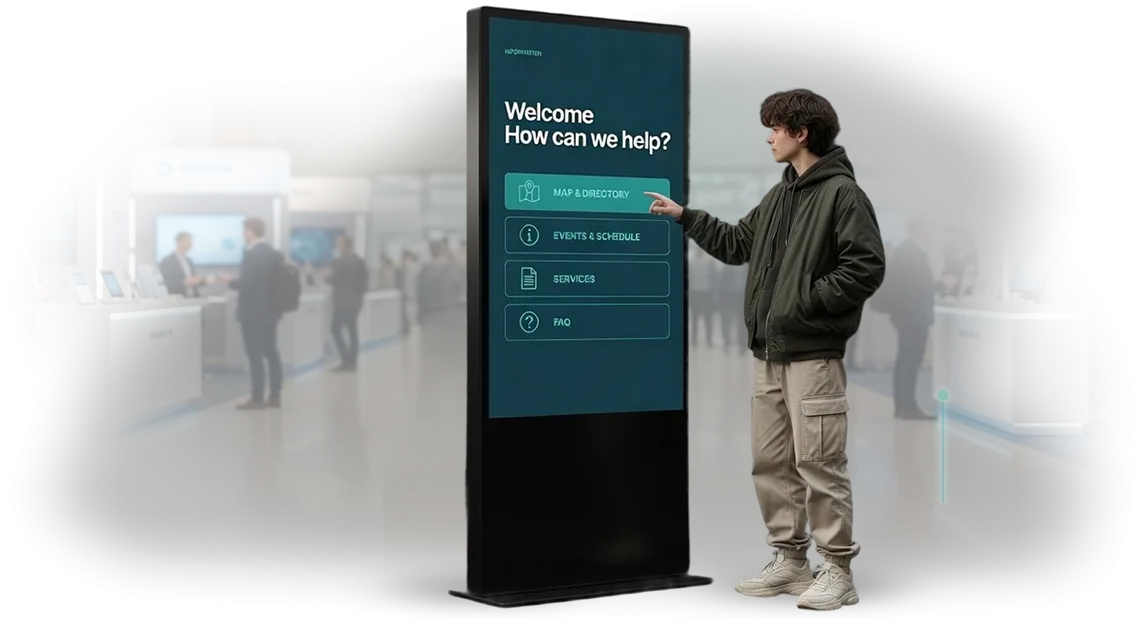
The visitor gets instant navigation, up-to-date information about services, the event schedule, or a product catalog — without downloading apps and without training.
For your business, this is not just an electronic display but another sales tool: the kiosk shows the way while offering additional suggestions along the route.
WebOS as a development platform gives you flexibility that is hard to achieve with closed proprietary systems. Content updates happen quickly and without downtime — you change promotions, prices, or the floor map in minutes, not days.
You get exactly the interaction scenario your audience needs: from a simple directional sign to a full-fledged catalog with self-pickup.
Visitor behavior data adds extra value. You see which sections are in demand, where guests linger, and where navigation underperforms. These insights help improve floor logistics and position products and services based on actual customer routes.
We have been developing such kiosks for over ten years and understand well how to turn a technically complex solution into a simple and understandable tool for people. We take care of everything: from interface design to launch and maintenance.
Tell us about your task, and we will propose an architecture that saves your visitors' time and increases revenue.
What an Interactive Kiosk Delivers: Attention, Leads, Image
An interactive kiosk is three results in one point: retaining guest attention, collecting useful contacts, and strengthening the brand. Unlike a static sign or a brochure stand, the kiosk itself engages a person in a dialogue and turns simple interest into a concrete action.
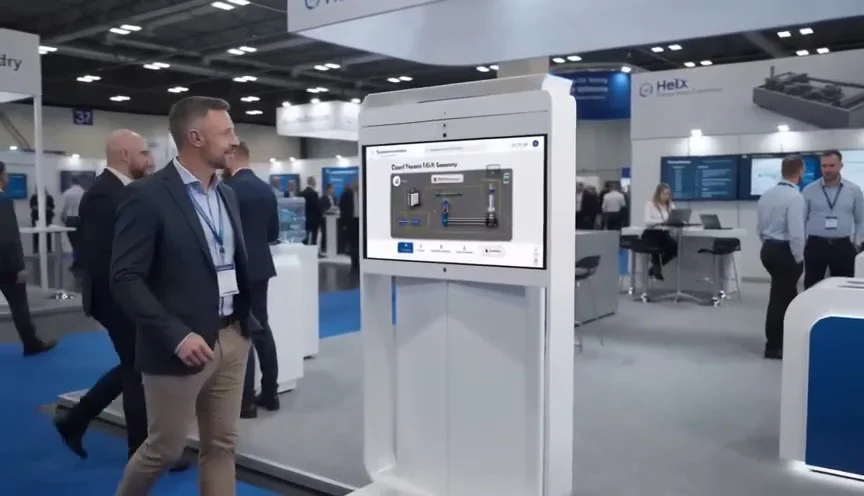
Guest engagement begins the moment a person approaches the screen. Usually, a visitor spends a few minutes at the kiosk: browsing the catalog, playing, configuring a product, or answering questions.
During this time, they get to study the offer more deeply than in a minute of conversation with a consultant and receive an emotion they associate with your brand.
Lead collection happens naturally. A person willingly leaves their contact to receive a promo code, a gift, or a personalized recommendation. This replaces paper forms and surveys: data enters the system immediately, without manual entry errors and with the guest's permission. Marketing gets a database of interested people ready for the next touchpoints.
Finally, image. A kiosk running on WebOS is perceived as a modern solution: the client sees that you keep pace with audience expectations.
Even after the event, the device remains in memory as an element of non-standard service — which means your company is remembered more strongly.
Together, these three advantages pay for the investment and deliver a measurable effect: higher activity, more contacts, and a lasting association with innovation.
Kiosk Formats: Floor Stand, Wall Panel, Terminal — Which to Choose?
The same interface works differently in an office lobby, a cafe, or outdoors. The kiosk format determines how a visitor interacts with it: whether they approach it freely, whether they can use it quickly, and how comfortably it fits into the space. A wrong choice means lost touchpoints, queues, and unused opportunities.
We work on the WebOS platform, which behaves equally reliably in a touch stand and a wall panel. But first, we select the hardware configuration based on the task, the premises, and the guest scenario. Below is a short comparison of the three main formats.
| Format | For Whom | What It Gives the Client |
|---|---|---|
| Floor stand | Lobbies, exhibition areas, high-traffic locations | Attracts attention, sets the tone, allows a large-screen display and custom brand design for the housing |
| Wall panel | Stores, cafes, narrow corridors, and meeting rooms | Saves usable floor space, does not block passage, easily integrates into the interior and mounts on existing walls |
| Floor terminal | Registration, navigation, appointment booking, payments | Focused on quick action: durable housing, protected screen, and convenient height for touch interaction |
Choosing the format is not only about appearance. The floor stand solves the task of attracting attention and highlighting the brand. The wall panel offers compactness and accessibility in a limited space. The floor terminal handles intensive use without downtime.
We will select the hardware configuration and adapt the interface to it so guests do not have to think about how to use the kiosk — they simply reach their goal.
If you are unsure, we will send recommendations for your premises and scenario. Describe your task, and we will suggest the right format based on guest flows, installation location, and required functions. We will also plan how the kiosk can be scaled as the number of users grows.
Kiosk Application Development on WebOS: Stages
We have structured the process so that you understand what happens at each step and when the kiosk will go live. With 10+ years of experience and dozens of launched projects, the stages are refined to a predictable result.
At the core is WebOS: a stable platform that does not require constant intervention and works for years without failures in public places.
A Transparent Process from Brief to Launch
- Brief and goals. You tell us what the kiosk should do: catalog, booking, payment, questionnaire. We define the goals and target audience and propose usage scenarios.
- Prototype and approval. We show the screen structure and navigation logic. You see how a visitor will interact with the kiosk and make adjustments before development begins.
- Interface design. We adapt the screens for touch control: large elements, clear labels, quick actions. We take your brand style into account so the kiosk looks like part of your space.
- Development and internal testing. We build the application and test the scenarios: from the first touch to the completion of the operation. We eliminate freezes, connection errors, and edge cases before your clients see them.
- Testing on real hardware. We install the application on the kiosk and verify operation with the screen, printer, reader, and other peripheral devices. You receive a test report.
- Launch and training. We deploy the system at your site, configure auto-updates and remote control. We show your team how to manage content and quickly resolve minor issues.
- Support and evolution. We stay in touch after launch: update content, add features, and monitor stability. If something changes in your business, the kiosk changes with you.
At each stage, you receive a clear deliverable for approval: first a prototype, then a design, then a working version. No surprises at the end — only a predictable launch and a kiosk that brings value from day one.
What Is Included in the Interactive Kiosk Turnkey Package
When you order an interactive kiosk, you get a complete turnkey solution: from application development to installation and staff training. You do not need to coordinate multiple contractors — we are responsible for the whole package.
The delivery package includes:
- Kiosk application tailored to your tasks: catalog, navigation, surveys, promo games.
- Hardware: touch display, durable housing, controller, mounting fixtures.
- Design project and housing branding in your corporate style.
- Installation, connection, and testing at your site.
- Staff training on using the kiosk and managing content.
- Technical support, warranty, and backup.
The scope of work includes adapting the application to your business processes: integration with your accounting system and configuring employee access rights. You will be able to update information independently through a convenient control panel — without involving programmers.
We conduct staff training at your site or remotely. After launch, we stay in touch: we help update content, add new features, and promptly resolve any issues that arise.
All terms are fixed in the contract — the delivery scope, timelines, cost, and support obligations. You know the result in advance and control every stage.
Case Study: A WebOS Kiosk Paid Off in 3 Months
After discussing the task with the head of a furniture store chain, we understood: the main goal was to give customers the ability to find their way and submit a request without a manager's help.
We developed a WebOS application for touch kiosks: product showcase, quick cost calculation, and a request for a free measurement. The terminal became a digital consultant that works without breaks. We designed the interface so that even a new visitor could figure it out in ten seconds.
Results After Three Months
Terminals were installed at two locations of the chain. In the first month, every fourth visitor used the kiosk, and by the end of the quarter, the share of interactions grew to a third of the total traffic.
The conversion to requests rose from 8% to 16% — almost twice as much as consultants at the counters collected over the same period. The terminal handled more than three thousand requests in a quarter.
The average ticket of customers who came after a kiosk request was 20% higher than that of unplanned traffic. Managers stopped answering repeated questions — product, price, and promotion information was already on the screen.
We measured results for each kiosk separately and adjusted the logic based on the most frequent questions.
Payback occurred at the end of the third month. Six months later, the client ordered six more kiosks for new stores. Customer return and project expansion are the best indicators that the solution works.
How to Choose a Kiosk Format That Will Pay Off?
Start with two questions: who exactly will use the kiosk and what task it should solve every day.
If it is a point of sale, you need checkout speed and payment reliability; if it is navigation in a mall or business center, you need easy search and a map; if it is a waiting area, you need an entertainment scenario that holds attention.
A “do-everything” format usually loses: the broader the functionality, the more complex the interface and the higher the development and support cost.
The second criterion is payback. Calculate not the kiosk price, but the time in which it will return the investment: faster service, reduced staff load, higher average ticket, additional revenue from advertising or services.
If the kiosk shortens queues and replaces at least one employee, it pays off in a few months. If it works as an advertising platform, income becomes regular and predictable.
The third point is the update scenario. Business changes, and the kiosk must change with it.
Choose a platform that allows you to remotely update menus, prices, promo materials, and even completely change the operating scenario — without an engineer visiting the site and without stopping the kiosk.
This directly affects the cost of ownership: the fewer manual operations, the lower operating expenses.
Finally, evaluate analytics. A kiosk that does not tell you which sections are viewed more often, where visitors get “stuck,” and which scenarios lead to a purchase is money down the drain.
Customizable statistics on the number of sessions, interaction depth, and conversion to the target action turn the kiosk from a cost item into a source of data for sales growth.
We help you select the right configuration for your tasks and budget, and after launch we show the numbers the kiosk actually influences.
Frequently Asked Questions About Kiosk Development and Support
We have collected answers to the questions that most often arise before a project starts. Short and to the point: about timelines, compatibility with existing hardware, maintenance, and warranties. We address typical concerns so you can make a decision without uncertainty.
How long does kiosk development take?
A standard project takes from two to six weeks — depending on the set of features and the number of screens. We fix the timelines in the contract and show intermediate results at each stage. You know in advance when the kiosk will be ready and start delivering value.
Can I use existing equipment?
Yes, in most cases you do not need to buy new devices. We work with most models, including WebOS kiosks — we first check compatibility for free, then adapt the system. If the equipment is already in use, just tell us the model — we will advise what is needed.
Who will maintain the kiosk after launch?
We offer support packages: operation monitoring, content updates, backup, and operator assistance. Your employees receive clear instructions, and in case of any failure, we quickly connect remotely. The kiosk keeps working without downtime.
What guarantees do you provide?
The contract we sign specifies the scope of work, timelines, and area of responsibility. Throughout the entire warranty period, we fix errors caused by us free of charge and update the system within the agreed terms. You are protected from unexpected expenses.
Still have questions — we will tell you more about each stage and help calculate timelines and cost for your task. Book a short consultation — we will discuss the details of your kiosk.Order Interactive Kiosk Development on WebOS
Submitting a request for a WebOS kiosk is easier than it seems: you do not need to understand technical details or control every stage. We take on the entire journey — from the first consultation to launch and support.
You get a working interactive terminal that solves business tasks: it speeds up service, increases brand awareness, and reduces the load on staff.
How the WebOS Kiosk Order Works
- You submit a request or call — we consult for free, answer questions, and help define your tasks.
- We calculate the cost and timeline for your scenario: number of locations, functionality, design, integrations.
- We agree on the prototype and design mockup — you see how the kiosk will look and how users will interact with it.
- We develop the WebOS application and configure remote management and content updates.
- We test on real hardware, install and launch the kiosk, and train your employees.
- After launch, we stay in touch: technical support and refinements as your tasks grow.
All work is done remotely, so you can order a kiosk for any location — from a store to an exhibition stand. It does not matter where the terminal is physically located: setup and control happen online, and you get a stable system that runs without failures.
The first step is a free consultation: we discuss your task and suggest the most effective way to solve it.
Order interactive kiosk development on WebOS today — we will respond within one business day, prepare a cost estimate, and offer a solution that will pay off through faster service and increased sales.