



Why Patients Leave Dermatology Clinics: The Queue Problem
In dermatology clinics, patients come with a skin problem and expect quick results. But instead, they face long queues in the clinic, have to adapt to the doctor's schedule, and waste time on phone calls to book an appointment.
This situation is a direct path to losing patients: people look for another clinic or postpone treatment altogether.
Losing even a few patients a week noticeably hits revenue. And a dissatisfied patient shares their experience with friends and leaves negative reviews — this reduces the flow of new inquiries.
In the end, the clinic pays twice: for the doctor's unused time and for the reputation it then has to restore.
The root of the problem is often not the quality of services but the way appointment booking is organized. Patients need transparency: what times are free, how long they have to wait, how to change a visit. When this information is unavailable, people lose trust even before the appointment.
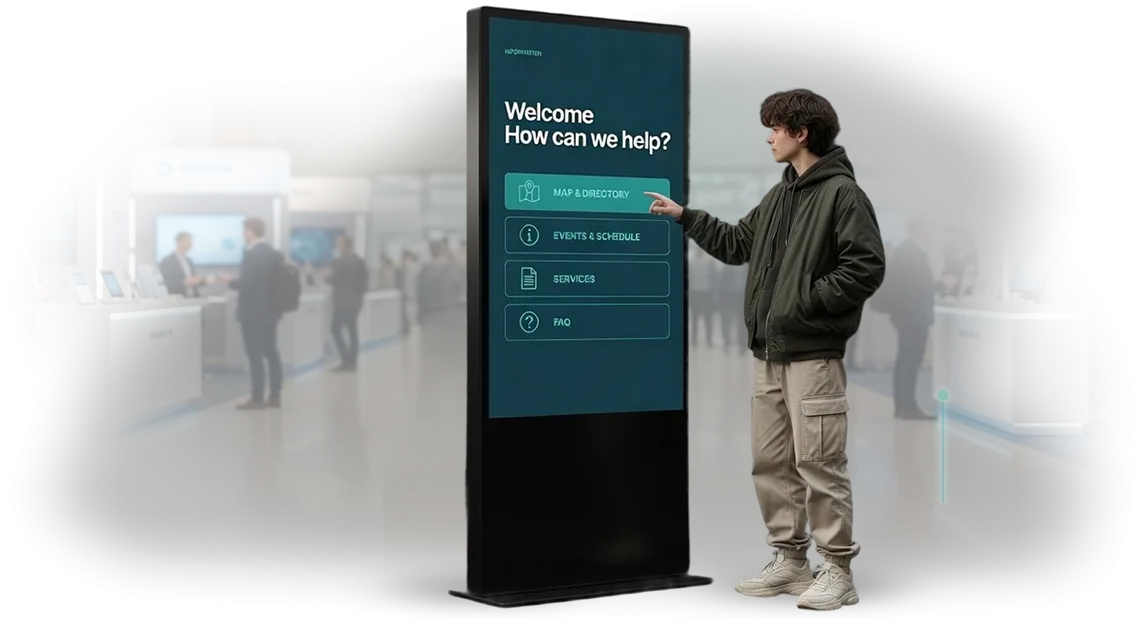
The solution is interactive information kiosks that automate booking, navigation, and information. Such terminals reduce queues in the clinic and remove unnecessary contact with the administrator.
Patients choose a convenient time themselves, and the clinic gets a tool for retaining clients and building a denser schedule.
We help dermatology clinics implement this system without stopping their operations. Our project experience shows that after launch, waiting times drop several-fold and the share of returning patients grows. That is the result that pays off the investment.
What an Interactive Kiosk Gives the Clinic and Its Guests
Self-service in a dermatology clinic starts from the first minute of the visit: patients check themselves in, fill out standard questionnaires and consent forms, and choose a convenient way to be contacted.
This lifts routine work from the administrator and reduces time at the reception desk. Instead of standing in line and filling out paperwork, the patient immediately gets into the rhythm of the visit, and the clinic receives clean electronic data without extra retyping.
Shorter waiting times directly affect loyalty. When patients see that they are not being made to sit in the corridor because of a lost card or a busy administrator, they take a doctor's delay more calmly and are more willing to come back.
The kiosk handles the stream of repeat questions and registration — reception staff can devote attention to complex situations and personal requests instead of copying passport data.
Relieving the administrator is also protection against errors. In manual mode, it is easy to miss a phone number, mix up a surname, or lose a form. The kiosk checks required fields and prompts when something is incomplete, so only correct data enters the system. This saves time at checkout, for analytics, and on callbacks.
Loyalty is built from small things: patients manage the process themselves, do not feel like supplicants, and do not have to repeat their complaints three times to different staff members.
An interactive kiosk gives a sense of a modern, technology-driven clinic where people are taken care of even before the appointment. After a visit, these patients are more likely to recommend the clinic to acquaintances and are more willing to book repeat procedures.
For a dermatology clinic, the kiosk becomes a silent employee that works without breaks, does not get tired, and always remembers what to ask the patient.
Implementation takes a few days, and the effect is visible in the first week: fewer queues, calmer administrators, higher visit satisfaction.
Information Kiosk Formats for the Clinic
Let's look at the main formats of kiosks for a dermatology clinic — floor-standing, wall-mounted, and with ticket printing. The choice depends on the zone where patients will interact with the device and on the task: navigation, queue, or information.
| Format | For which zone | What it gives the clinic |
|---|---|---|
| Floor-standing kiosk | Lobby, reception area | Greets the patient, helps them get oriented, shows services and books appointments, reducing the load on the administrator |
| Wall-mounted terminal | Corridors, narrow passages | Saves space, quickly displays doctor schedules and useful reminders, and directs the patient to the right office |
| Kiosk with ticket printing | Registration desk, waiting area | Organizes an electronic queue, prints a ticket, removes the crowd at the counter, and speeds up service |
This division helps avoid overpaying for unnecessary options and prevents inconvenience for patients. A floor-standing kiosk works well in a spacious lobby, a wall-mounted terminal in corridors where every centimeter counts, and a ticket-printing kiosk where queues usually form.
We will help you choose a format that fits your clinic's layout and configure scenarios for your tasks — from a simple schedule to booking a procedure. Patients get an understandable service, and your staff gets less routine.
How the Project Works: From Brief to Launch
To keep you confident about timelines and results, we divide the project into clear stages. Each stage ends with a concrete result that you see and approve. No "black box" — only transparent work.
- Kiosk brief. We capture the clinic's goals: which services and promotions to show, which patient questions to cover, how the kiosk will fit into the lobby and the administrator's desk.
- Planning and prototype. We think through the screen structure and navigation logic: the patient should quickly find the right service or book an appointment. At this stage, we define the timeline and scope of work.
- Design approval. We present a design concept tied to the clinic's brand. You make edits before the work goes into production — this keeps the risk of rework minimal.
- Implementation and content. We build the kiosk on professional equipment and load your texts, prices, photos, and contacts. We structure all content so the patient never gets lost.
- Testing and launch. We check the scenarios: searching for a service, viewing information, booking an appointment. Then we install the kiosk in the clinic, train the administrators, and launch it.
- Support and updates. We update information, add new services, and monitor stable operation. If something changes, you simply send us the edits, and we make them without downtime.
The outcome is a predictable project with no surprises. At every stage, you see the intermediate result and understand what you will get in the end. We have refined this approach across dozens of projects for clinics and other industries.
What's Included in the Interactive Kiosk Delivery
When a clinic orders an interactive kiosk, it is important to understand: you are getting a ready-made, turnkey solution, not a set of devices to assemble and configure yourself. We take on the entire journey — from design concept to launch and staff training.
As a result, the kiosk works from day one and solves specific tasks: reduces queues at the registration desk, gives patients up-to-date information, and increases appointment bookings.
The standard delivery package includes:
- Kiosk equipment. Touch panel, enclosure, system unit, and all necessary components — already assembled and configured. Just connect the kiosk to power and the network, and it is ready to work.
- Design concept and branding. The kiosk's appearance is developed to match the clinic's style: brand colors, logo, and clear navigation for patients of any age.
- Software. An interface for booking an appointment with a dermatologist, viewing services, and information about specialists. Content can be updated without developers — through a simple control panel.
- Staff instructions. Short guides on powering on, daily maintenance, and typical situations. The administrator does not need to understand the technology — just follow the step-by-step guide.
- Employee training. A practical course for administrators and doctors: how to work with the kiosk, help patients, change schedules, and track bookings.
- Technical support. Remote monitoring of equipment status, software updates, and support. If a question comes up — you are never left alone with the technology.
Each item covers a specific clinic task: the equipment works reliably, content is always current, staff quickly learn the new processes, and patients get a modern service.
Installation, commissioning, and setup are also included in the delivery — all you need is to allocate space and provide access to a power outlet.
In the end, you get not just a kiosk but a working booking tool that reduces the load on administrators and improves service quality. We handle everything else — from the first consultation to warranty service.
Case Study: Dermatology Clinic Cuts Waiting Time in Half
For a dermatology clinic, patient time is reputation and money. Queues at the registration desk, phone calls, and administrators asking patients to repeat information made some visitors leave for a neighboring clinic.
The management decided to relieve the staff and speed up appointments by installing interactive kiosks instead of a traditional counter.
We conducted an audit and deployed the solution on our platform in three weeks. Patients choose a service themselves, see an available doctor, and book a convenient time — without an administrator. The kiosk pulls data from the clinic's system and immediately prints a ticket.
The results speak for themselves. The average wait time for an appointment dropped by half — from 22 to 11 minutes. The share of initial bookings made through the kiosk reached a third, and repeat visits grew noticeably. Administrators switched to live consultations, and peak-hour queues disappeared.
What changed for the clinic
- Queues at the registration desk stopped being a problem during peak hours.
- Staff spend 40% less time on manual booking.
- Patient satisfaction increased according to an internal survey.
- The clinic gained a new booking channel without expanding the call center.
The project was delivered by our team — we took on scenario setup, integration with the internal system, and staff training. Two months later, the clinic ordered a second unit for its branch, and then expanded the functionality to issue referrals.
The case confirms that the kiosk reduces the load on administrators and increases patient loyalty. The scenario is easily adaptable to a specific clinic — from the size of the waiting area to the list of services.
How to Choose a Kiosk Format for Your Clinic's Task?
The kiosk format is not a technical question — it is a matter of patient convenience and staff workload. For a dermatology clinic, the choice comes down to three parameters: floor space, patient flow, and budget.
Describe them to us, and we will propose an option that fits your specific situation, not the "market average."
Let us start with the floor space. In a spacious reception and waiting area, a floor-standing kiosk looks comfortable — it is visible, handles registration, and books appointments.
If the corridors are narrow and there is little room near the entrance, a wall-mounted or compact option is better: it takes up minimal space and does not block the passage of patients.
Next is patient flow. Count how many people pass through the clinic per day and during peak hours. With a dense flow, the kiosk must quickly move patients through registration, specialist selection, and the pre-appointment questionnaire.
For a small clinic, one unit is enough; for a network or a busy branch, several are needed so queues do not form.
Budget also plays a role in choosing the format, but it does not mean "the more expensive, the better." We will propose a configuration for your task: sometimes a larger screen is needed, and sometimes a practical base model in a reliable enclosure is enough.
We will also calculate how the kiosk will relieve the administrator and speed up patient processing — this pays for the investment.
The bottom line is simple: send us the floor plan of the location where the kiosk is planned, plus the approximate patient flow.
At the free consultation, we will recommend a format, explain why it suits your clinic, and show how the kiosk will fit into the daily work of your staff.
Common Clinic Concerns About Kiosks and Answers
When a dermatology clinic considers installing a touchscreen kiosk, managers have the same questions: will there be downtime, how protected is patient data, and will the staff have to be retrained. We answer these concerns — and explain how we address each risk in practice.
Is the kiosk reliable?
The kiosk is built on industrial components designed for high loads — like ATMs in bank branches. Before installation, each unit undergoes testing, and we resolve most malfunctions remotely, without waiting for an engineer to visit. So patients will not see any downtime.
Is patient data secure?
Medical data is protected at the level of banking systems: all transmitted information is encrypted, and only authorized employees get access to records.
We design the system in compliance with personal data handling requirements, so both the clinic and its patients can rest easy.
Will the staff handle the new equipment?
The kiosk interface is designed so that an administrator can master it in one day. Before the launch, we come to the clinic, train employees on real scenarios, and leave a clear reference guide. If questions arise later, support provides answers within one business day.
What about technical support after the launch?
After the launch, we do not leave the clinic alone with the kiosk. Support works daily — by phone or via a personal account, and most requests are resolved remotely within an hour. If equipment replacement is needed, we deliver a new unit and install it at an agreed time.
Request a Kiosk Consultation
Every dermatology clinic faces the same situation: patients do not want to wait at the administrator's desk to learn about services, prices, or book an appointment. If information is not available in a couple of touches, some visitors simply go to competitors.
An interactive kiosk solves this problem even before a conversation with the administrator: the patient finds what they need themselves, sees current prices, and leaves a request without creating a queue.
We will calculate for free which kiosk and with which functionality will pay off in your clinic. You do not need to understand the technology — just leave a request, and we will select a solution for your tasks, lobby area, and patient flow.
What you will get after your request
- Free kiosk cost calculation for your clinic — without hidden surcharges or imposed options.
- Scenario selection: appointment booking, office navigation, service catalog, patient reviews — only what you need.
- Launch timeline estimate: from approval to a working kiosk in the lobby.
- Recommendations on content and placement, so the kiosk brings value instead of gathering dust in a corner.
- Solution examples for dermatology clinics — see how it works for others.
- No-obligation specialist consultation: you order nothing until you see the calculation.
Leave a request for a kiosk consultation — we will call back within one business day, answer your questions, and prepare an individual calculation.
That way, you will understand how much time the kiosk saves your administrators and how many additional bookings it brings to the clinic.