


Why Outdated Kiosks Hinder the Development of Utility Companies
Outdated kiosks are not just technology that has become morally obsolete. They mean daily queues, irritated visitors, and employees repeating the same information ten times instead of handling real tasks.
For utility companies, this situation results in a loss of trust: a person arrives with a specific question, and instead of quick help, they get a frozen screen or an endless search for the right section in a confusing menu.
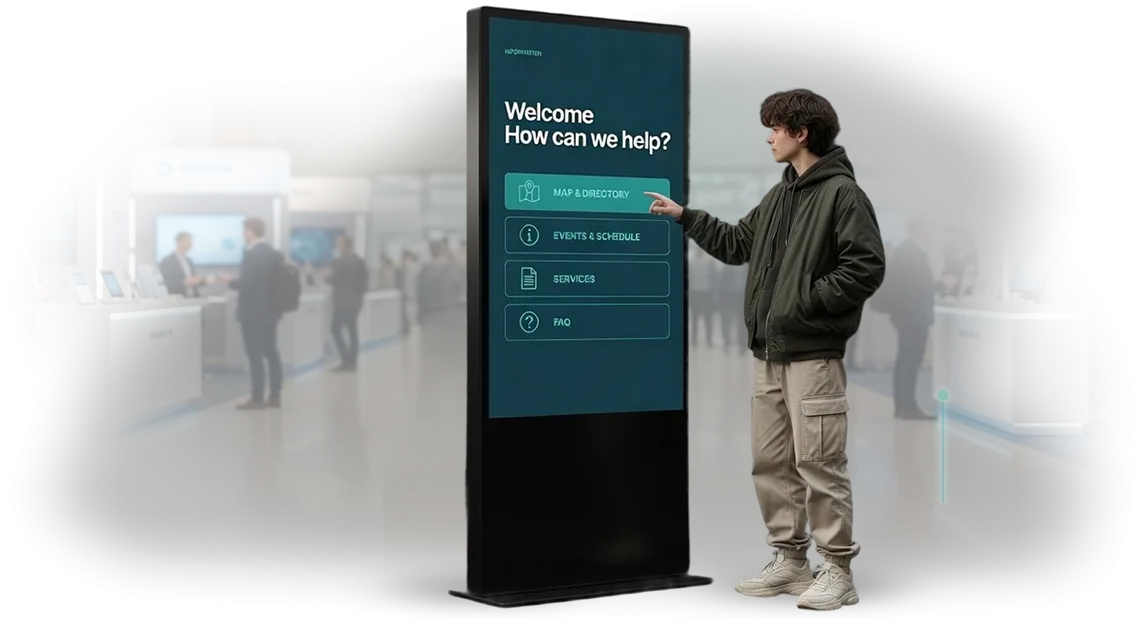
A modern interactive kiosk solves these problems at the customer experience level. Visitors themselves, without staff assistance, find the service they need, book an appointment, get a certificate, or pay a bill.
Customer service speeds up, the load on employees decreases, and queues disappear. At the same time, the company begins to look modern and reliable in the eyes of residents—this affects reputation and the level of trust in the entire organization.
The transition to new solutions pays off not only through improved service. Optimizing a utility company’s operations delivers measurable results: less time spent serving one visitor, lower load on cash desks and information desks, and fewer conflicts and complaints. Kiosk usage analytics shows which services are in demand and helps plan the work of departments.
We develop interactive kiosks specifically for such tasks—with a well-designed interface that is understandable to people of different ages, and with a process that integrates into the company’s current workflow without downtime.
As a result, your visitors stop standing in queues, and employees focus on what truly requires human involvement.
What a Modern Interactive Kiosk Brings to Your Utility Company
Visitors to utility companies most often come with simple questions: check charges, submit meter readings, book an appointment, or pay for a service. Each such visit means time in line, waiting at the window, and distracting a specialist from more complex tasks.
A modern interactive kiosk takes over routine operations and allows you to serve the flow of people without delays, even at peak hours.
Service speed increases because visitors themselves select the required service on the screen and receive information in a couple of minutes. Employees stop repeating the same answers dozens of times, so they can focus on issues that truly require personal involvement.
Queues shorten, the atmosphere becomes calmer, and the company stops being associated with long waits.
A kiosk is also a tool for increasing brand recognition. A neat touch terminal with a logo and corporate identity creates the impression of a modern, customer-oriented organization.
Visitors see that the company is adopting convenient technologies, and this strengthens trust while also reducing the load on the call center and in-person reception.
Data collection deserves special mention. The kiosk records which services are in demand most often, at what hours more visitors arrive, and where difficulties arise.
This information helps distribute staff workload more accurately, adjust work schedules, and make decisions based on real requests rather than guesswork.
In the end, an interactive kiosk solves several tasks at once: it accelerates service, relieves staff, strengthens the company’s image, and provides useful analytics.
It is not just an information screen, but a full-fledged tool that begins to pay off from the first weeks of operation.
Kiosk Formats for Utility Companies
The right kiosk format determines how conveniently residents can get a certificate, pay for services, or book an appointment, and how long the equipment will last without repairs.
Floor-standing, wall-mounted, and outdoor models cover different tasks: a lobby with a constant flow of people is one thing, a small corridor or an area in front of the building is another. Both the installation budget and future maintenance costs depend on the chosen configuration.
| Kiosk format | Which tasks and spaces it suits | What it gives the company |
|---|---|---|
| Floor-standing kiosk | Lobbies, vestibules, waiting areas with high visitor traffic | Sturdy structure, large touchscreen, convenience for people of different heights — fewer queues at service windows |
| Wall-mounted kiosk | Small rooms, corridors, areas with limited space | Saves space, mounts on the wall, quick access to information without a separate stand |
| Outdoor kiosk | Bus stops, residential areas, entrance groups | Operates in any weather, protected enclosure, access to services without visiting the office |
All variants can be built as a touchscreen kiosk—touch control is understandable even to those who do not use computers. This removes the barrier for older people and makes service self-sufficient.
What to consider when choosing a format:
- Assess visitor flow: a floor-standing kiosk can handle high load, while a wall-mounted one suits on-demand information.
- Determine the installation location: an outdoor kiosk requires a reinforced enclosure and moisture protection; for indoor use, a standard version is sufficient.
- Take into account available space: a floor-standing model occupies floor area, while a wall-mounted one does not block passage or clutter the lobby.
- Plan the scenarios: a touchscreen kiosk with a large screen is convenient for navigation, payments, appointment booking, and viewing schedules.
We will select a kiosk format for your space and tasks, prepare the equipment, and configure the interface. All you have to do is place the kiosk and upload the information.
Stages of Interactive Kiosk Development
A transparent development process spares the client from surprises: you know the stages, timelines, and results at each step in advance. For a utility company, this means a predictable budget and confidence that the kiosk will truly help residents and reduce the load on staff.
- Kiosk brief — we discuss tasks, usage scenarios, and installation locations. We record the requirements in a document and prepare a transparent cost estimate to avoid hidden expenses.
- Interface mockup — we show the screen structure, texts, and navigation logic. You evaluate the future kiosk through a visitor’s eyes before development starts, rather than by general words.
- Approval and revisions — we make changes to the mockup at an early stage. This saves time and money because revisions before development cost significantly less than after.
- Development — we create an interactive system taking into account your regulations and the specifics of a touchscreen. At each stage, we send a readiness report so you can see what is happening.
- Testing — we check all key scenarios: service search, navigation, ticket printing, contactless payment. We eliminate issues before residents encounter the kiosk.
- Kiosk launch — we install the equipment at the site, configure and activate the system. You receive a working turnkey kiosk, and your employees receive a short instruction.
- Kiosk support — we monitor operation, update content and data, and refine functions based on interim results. The client can always contact us for help and get a quick response.
What Is Included in Kiosk Delivery
When ordering a kiosk for a utility company, you receive a ready-made turnkey solution—with equipment, configured software, and technical support. You do not need to look for subcontractors or delve into details: we handle all stages of delivery.
Standard kiosk delivery includes:
- Kiosk hardware — a touch terminal in a vandal-resistant enclosure protected from dust, moisture, and mechanical damage. The enclosure is suitable for both outdoor installation and high-traffic indoor spaces.
- Software — an HTML5 web application with a simple interface that updates without stopping operation. We adapt it to common tasks: submitting meter readings, paying for services, booking appointments, and obtaining certificates.
- Installation and connection — an engineer’s visit, installation of the kiosk at the desired location, and network and power configuration. You do not deal with technical details—the kiosk simply starts working.
- Employee training — a short briefing on operation, filling information sections, and typical situations. Plus an operating guide for your staff.
- Warranty and support — an official warranty on hardware and software. Throughout the entire service life, you can contact our support team; we resolve issues promptly and provide updates.
Kiosk delivery is truly turnkey: from approval to the first customer takes several weeks. The warranty and technical support protect you from downtime and unforeseen expenses.
Case Study: How We Implemented Kiosks for Gorvodokanal
Visitors to utility companies often waste time in queues—submitting meter readings, ordering a certificate, or checking charges. Each such visit requires an operator, and on peak days this is stressful for both clients and employees.
We encountered this during the implementation of kiosks for Gorvodokanal and solved the task at the level of visitors’ most frequent needs.
What We Did
Instead of expanding service windows, we installed touchscreen kiosks with an interactive application: service selection, data entry, and obtaining a ticket or receipt. The system provides prompts, so a person can manage without an operator. Employees remained for complex questions, while routine tasks moved to the kiosks.
Project Results
After launch, service time decreased by 40%—visitors complete basic operations in 2–3 minutes instead of 7–10. Satisfaction increased: people note that they no longer need to wait or explain the same thing several times. For the company, this means less load on staff and order during peak hours.
The project did not end with the first deployment: management ordered expansion to other branches and added meter reading submission through the same kiosks. A year later, the kiosks handled about a third of all inquiries, and the queue in the office shrank by half. That is what the result looks like when the interface is designed around real visitor scenarios.
Frequently Asked Questions About Kiosk Development
Before launching a project, clients ask the same questions: timelines, warranty, maintenance, content updates, and cost. We answer the main concerns—so you can make a decision calmly and without risk.
How long does it take to create a kiosk?
A typical project takes two to four weeks. The timeline depends on the scope and integrations. At the start, we set a plan with dates—you see the stages and control the process.
What does the warranty include?
The warranty on the software and hardware is specified in the contract. If there is a problem, we take the request and fix it free of charge. This is standard for our projects.
How is maintenance handled after launch?
We offer support: remote monitoring, information updates, and backups. You do not need to dive into the technology—everything works according to procedure, and you get stable service.
Is it difficult to change information on the kiosk?
No. Updates are done through a simple admin panel: you change text, news, and schedules in a couple of minutes. You can also enable automatic loading from your systems—then content is always fresh.
What does the cost depend on?
The price depends on the number of screens, design, functions, and integrations. We review the task in detail during a consultation and send a transparent cost estimate—without hidden payments.
Get a Modern Solution for Your Utility Company
Ordering a kiosk for a utility company means not just installing a terminal, but relieving the dispatch service and giving residents a clear information channel.
Payments, meter readings, outage schedules, and reference information—all of this is available in one device without queues or phone calls.
We take on the entire cycle: from idea to launch. You submit a request—you receive a cost estimate, a consultation on functionality, and a preliminary implementation plan.
No unnecessary approvals: you immediately see how the kiosk will fit into your infrastructure and what load it will remove from employees.
What You Get When You Contact Us
- Cost estimate tailored to your tasks—without hidden payments or imposed options.
- Consultation on usage scenarios: payments, appointments, information, surveys.
- Interface demonstration on a real touchscreen—before signing the contract.
- Preliminary installation and launch plan taking into account the specifics of your space and communications.
- Support at all stages: from design to warranty service.
- Training your employees on simple actions—uploading data, replacing consumables.
Submit a request on the website—a manager will contact you within one business day, answer your questions, and prepare an individual offer. It is free and non-binding.
A modern kiosk is an investment in the company’s reputation and residents’ comfort, which pays off through reduced staff load and increased user satisfaction.
Make sure the solution truly fits your company: request a cost estimate and a demonstration right now.
How to Choose the Right Kiosk Format?
The question of kiosk format is not a question of design, but of efficiency. The same enclosure can be convenient for short inquiries and unsuitable for accepting payments.
Therefore, selecting a kiosk starts with tasks: checking rates, submitting readings, paying for services, or working with queues. For a utility company, this approach is especially important: the kiosk must quickly pay off and be understandable to different visitors. Screen size, enclosure type, and installation method depend on the selected tasks.
The premises are no less important. A floor-standing kiosk suits a high-traffic lobby, while a compact wall-mounted panel suits a small reception area. Outdoor locations require a protected, heated enclosure; brightly lit halls require an anti-glare screen.
We take these details into account when choosing a kiosk so that the equipment works reliably and does not require frequent maintenance.
We help you decide on the format even before development: we study visitor flow, usage scenarios, and space limitations. We offer two or three options with different budgets and explain the pros and cons of each.
After your decision, we design the interface and software for the chosen configuration, rather than adapting a universal solution at the cost of convenience.
Choosing the right kiosk saves budget and shortens launch timelines. It immediately gives visitors convenient service and employees fewer routine questions. Come for a consultation—we will choose a format for your tasks and space so that the project pays off from the first weeks.