


MFCs Lose Visitors Due to Queues and Navigation
MFC visitors come for a specific result — to quickly get a certificate or service. But more often than not, they're met with long queues and confusing corridors.
Every minute of waiting is irritation that carries over into how the entire center is rated, even if the staff perform flawlessly.
Navigation is a separate pain point. A new visitor doesn't know which window to go to, what documents to prepare, or where the copier or payment terminal is.
As a result, they stop operators with questions, distract them from their core duties, get lost between floors, and create additional crowds in areas where people shouldn't be.
On a monthly scale, this means dozens of negative reviews, missed service targets, and increased strain on every staff member. People start choosing alternative channels or put off their visit — which means a portion of planned applications is simply lost. The problem isn't the staff; it's the lack of a clear self-navigation and flow management system.
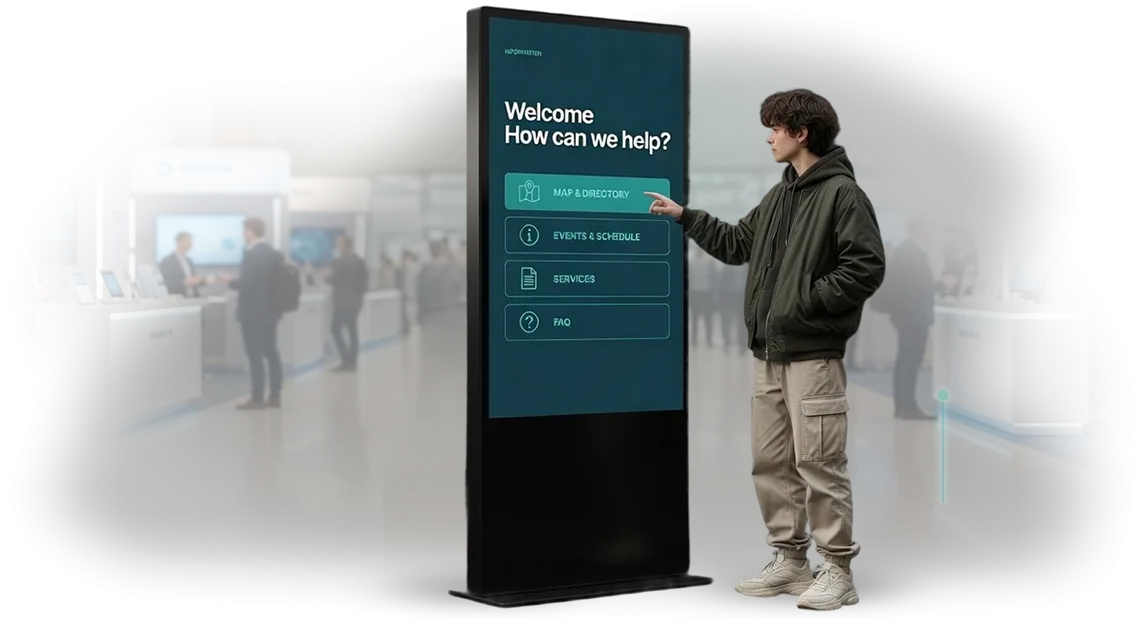
Interactive kiosks address both tasks: they help visitors find their way around services on their own, join the electronic queue, and get directions to the right window or office.
This relieves staff, shortens time spent in the center, and turns the visit into a predictable process instead of chaotic waiting. These are exactly the solutions we design and implement for MFCs — turnkey, tailored to the specifics of each center and its visitors.
What an Interactive Kiosk Gives Visitors and Administration
An interactive kiosk in an MFC is not just an information panel but a full-fledged tool that changes the service logic. For visitors, it turns a trip to the center from tiresome waiting into a fast, clear process.
Instead of asking the administrator where to go, a person gets precise routing: a list of services, required documents, appointment time, and window number. All of this is available on screen in an intuitive form, so the visit takes less time and stress levels drop.
For the administration, the kiosk relieves staff of routine questions and repetitive operations. Employees stop repeating the same information and focus on services that truly require personal involvement.
As a result, queues shrink, the MFC's throughput increases, and service quality rises because each visitor gets help exactly when it's actually needed.
The kiosk works without breaks or days off, accepts applications, issues electronic queue tickets, and helps people find their way around the building.
Visitors can plan their visit on their own, and the administration gains the ability to distribute visitor flows and window loads more flexibly.
Another important benefit is analytics. The kiosk collects anonymized data on which services are in demand, when more visitors arrive, and how long processing takes.
Based on this data, MFC administration can adjust staff schedules, open additional windows during peak hours, and promptly inform citizens about changes. This turns the kiosk from a passive directory into a tool for managing and optimizing processes.
Interactive Kiosk Formats for MFCs
In a multifunctional center, every square meter and every minute of a visitor's time counts. The flow, the queue, and people's impression of government services depend on how conveniently navigation and appointment scheduling are organized.
A touchscreen kiosk solves this problem, but it's important to choose the right format — for your lobby, visitor volume, and operating scenarios.
| Kiosk format | Who it's for | What it gives the client |
|---|---|---|
| Floor-standing touchscreen kiosk | Spacious lobbies with high traffic | Withstands the queue, accessible from all sides, quickly issues a ticket or books a service |
| Wall-mounted kiosk | Narrow corridors and waiting areas | Saves floor space, always visible, suitable for certificates and payments |
| Desktop touch panel | Administrator workstations | Helps staff process an application together with the visitor and find information faster |
| Mobile stand on wheels | Temporary points, mobile reception | Relocated in a minute, organizes an electronic queue anywhere |
How do you know which format you need? For peak loads, a floor-standing kiosk with a dedicated ticket-issuing screen is optimal. If floor space is limited — a wall-mounted panel; for consultation zones, a desktop option is more practical.
We visit your site, study visitor routes, and select a configuration tailored to your hall's specifics.
Formats can be combined so navigation works in every zone: one kiosk at the entrance, another near the stairs, and a desktop panel at the administrator's station. This reduces staff workload and shortens queues.
In the end, visitors find the right window or book an appointment on their own without extra questions — and you get a calm operating rhythm and satisfied citizens.
How Kiosk Development and Implementation Work
Implementing a kiosk in an MFC is not just installing a device. We structure the process so that you understand what's happening at every stage, keep deadlines under control, and get a solution that reduces staff workload and speeds up visitor service.
-
Gathering requirements and analyzing visitor flows. We study which services are requested most often, where queues form, and what experience different age groups have.
You gain an understanding of what functionality your MFC actually needs — without unnecessary spending on options you don't need.
-
Designing the logic and scenarios. We create a section structure and navigation that's clear even to those seeing a touchscreen for the first time.
Every menu item guides the visitor along the shortest path: from selecting a service to receiving a ticket or the needed information.
-
Mockup and approval. We show the future interface on screen. You see how the kiosk will look and make edits in advance, before development starts. This saves time and eliminates rework at the final stage.
-
Building the solution and filling it with content. We develop the software and connect it to your data — for example, the electronic queue or the service database. We populate the kiosk with up-to-date information visitors need right now.
-
Testing and debugging. We test scenarios for usability and response speed: from the first touch to getting the result. We fix shortcomings so visitors don't run into errors or waste time.
-
Installation, launch, and staff training. We mount the equipment, configure it, and connect it to the network. In parallel, we train staff: how to help visitors, how to quickly resolve minor issues, and where to turn in case of malfunctions.
-
Support and development. We support the project after launch: we monitor operations, update information, and make changes when services or regulations change. The kiosk remains a relevant tool, not just a device "for one day."
Deadlines are fixed in the contract before work begins — a typical project takes two to four weeks. At every stage, you get an intermediate result and understand what comes next.
This turns kiosk implementation into a manageable process with a predictable outcome: convenient service for visitors and less routine for your staff.
What's Included in the Interactive Kiosk Delivery
You receive a ready-made turnkey solution: the enclosure, design, software, and ongoing support. You don't need to assemble contractors piece by piece — the entire package goes through a single provider responsible for the result.
What's included in the delivery
- Equipment and enclosure — a vandal-resistant touchscreen kiosk built to withstand intensive use in the MFC waiting area. Ventilation, dust and moisture protection, and a comfortable screen angle for people of different heights and ages have all been considered.
- Software — a web application that starts quickly and is clear to visitors from the first screen. The interface is designed around your services: booking an appointment with a specialist, checking application status, getting a certificate, and displaying current news and regulatory documents.
- Design and branding — application of the logo, corporate colors, and hall navigation diagrams. The kiosk looks like part of your space rather than an "alien" device, and immediately inspires trust.
- Installation, configuration, and launch — we deliver, install, and connect it to the network and your internal services. We check the scenarios on site and show staff how to manage content.
- Administrator training — a short session for staff: how to update the schedule, add information, and quickly change an on-screen message. Usually an hour is enough for an employee to confidently work with the kiosk.
- Support and warranty — service support, remote monitoring of equipment health, and software updates. If something happens, you call us — we resolve the issue without lengthy downtime.
This package covers the MFC's core task — reducing staff workload and shortening queues. Visitors get the information they need on their own, bypassing direct interaction with a service officer, while staff handle matters that truly require human involvement.
Case Study: How a Kiosk Cut Service Time
We implemented interactive kiosks in the My Documents multifunctional center network — and the queue stopped being visitors' main complaint. Before the project, the average wait time for a ticket was 25 minutes, and up to 40 during peak hours.
After the kiosks launched, residents spend 1–2 minutes booking, and consultants are no longer distracted by mechanical operations and process complex requests faster.
What changed for visitors
The main effect: average service time dropped from 25 to 7 minutes, and in-hall queues shrank by nearly 60%. The kiosks took over initial booking, issuing status certificates, and preliminary document checks.
Previously, every second visitor approached the window "just to ask"; now the terminal handles these questions without staff involvement.
The satisfaction metric improved: the share of visitors rating their experience "excellent" grew by a third.
At the same time, the load on administrators decreased — they now deal only with genuinely complex situations rather than explaining how to fill out an application.
Why it worked
We didn't just install terminals — we rethought the service logic: the kiosk tells visitors which department they need, what documents to prepare, and what the current wait time is.
The interface is designed for people of any age — large buttons, clear prompts, no unnecessary steps. In the first month of operation, every third MFC booking went through the kiosk, and after six months that share reached 70%.
The client received a ready-made tool that pays for itself through staff time savings and throughput. The network is now planning to roll out the solution to other branches — and this confirms to us that the kiosk has become not an extra expense but a point of service growth.
How to Choose the Right Kiosk Format?
Choosing a kiosk format starts not with equipment specifications but with your MFC's goals.
Before looking at the enclosure or screen, define what exactly the kiosk should do: help book an appointment, issue certificates, accept payments, or simply navigate visitors around the hall. The type of construction, the set of options, and the final cost all depend on this.
The second important criterion is flow intensity and installation location. For a lobby with high traffic, a floor-standing touchscreen kiosk with a large screen and a protected enclosure that can handle round-the-clock operation is a good fit.
If space is limited and the kiosk is needed for quick information, it's wiser to choose a compact wall-mounted model that doesn't take up useful floor area or get in visitors' way.
Pay attention to accessibility requirements. A kiosk in a government institution must be convenient for everyone, including people with disabilities: adjustable height, a clear interface with large buttons, and the possibility of voice guidance.
This isn't only a legal requirement but also a matter of reputation: the easier it is for a visitor to resolve their issue, the higher their satisfaction and the lower the staff workload.
Integration with your infrastructure is no less important. The kiosk must work correctly with the electronic queue system, specialist schedules, and databases so that visitors receive up-to-date information. If you plan to accept payments, include a card module.
We'll help you determine the optimal configuration that covers current needs and leaves room for growth without overpaying for unnecessary functions.
A properly chosen format is a balance between convenience, cost, and service life. Our engineers will analyze your branch's specifics, visitor numbers, and typical scenarios, then propose a solution that will work for years.
You get a kiosk that solves your MFC's specific tasks, not a universal template that requires constant refinements.
Frequently Asked Questions About Touchscreen Kiosks
Before ordering a touchscreen kiosk for an MFC, managers have the same doubts: will the equipment handle visitor flow, how safe is it, and who will be responsible if something goes wrong.
Below we address the most common questions — so you can see that we've already thought through all the risks for you.
Are touchscreen kiosks safe for personal data?
Yes. Access to information is protected at the server architecture level, and the kiosk itself works only with the data needed for a specific service. No data is stored on the device after the session ends — this eliminates leaks in case of physical access to the equipment.
For additional protection, we configure encryption of data transmission channels and restrict staff access rights. You get a solution that passes an internal security audit and doesn't conflict with regulatory requirements.
What happens if the kiosk breaks down?
We provide a warranty on the entire installation, as well as a service agreement with fixed response times. In most cases, faults are resolved remotely — it takes just a few minutes.
If parts need to be replaced, our team arrives on a schedule agreed with you so the MFC's work doesn't stop.
We select components in advance that withstand intensive use, so unscheduled downtime is rare. And if force majeure does happen, we have a backup equipment pool for rapid restoration of operations.
Will the kiosk withstand constant load in the MFC hall?
Kiosks are designed for a 24/7 operating cycle: the enclosure is resistant to scratches and impacts, and the touchscreen is rated for millions of touches. Even at peak times, when a queue forms behind the device, it operates without failures or freezes.
We additionally install a monitoring system: it warns about overheating, power issues, or component wear before a visitor notices anything. You get stable service, not just "hardware on warranty."
Who is responsible for maintenance and updates?
We take that on. The contract specifies the maintenance schedule: planned inspections, software and content updates, and replacement of consumables. You don't need to search for a contractor — one responsible partner handles everything.
If necessary, we train your staff in basic check procedures, but the full support cycle remains with us. This way you save time and nerves, and the kiosk is always ready to receive visitors.
If you still have questions about a specific use case — write to us, and we'll suggest a solution for your MFC's tasks.Order Interactive Kiosk Development
Ordering interactive kiosk development means getting not just a device but a tool that reduces staff workload and speeds up visitor service. For MFCs, this means shorter queues; for commercial zones, it means higher conversion and brand awareness.
Tell us about your task — and we'll offer a solution for your processes. After your inquiry, you'll receive:
- A free consultation — we'll review which kiosk scenarios are relevant for you: booking, certificates, payments, navigation, or service presentation.
- A cost and timeline estimate — within one business day, we'll prepare a transparent estimate with no hidden surcharges or stretched deadlines.
- An interface prototype — we'll show how a visitor will interact with the screen before the main development even starts.
- Touchscreen adaptation — we'll account for ergonomics and how people perceive information: large buttons, a clear structure, and fast scenarios.
- Integration with your systems — we'll connect the kiosk to your database, CRM, or service portal so information is always current.
- Testing on real scenarios — we'll check performance, operation under peak loads, and usability for different age groups of visitors.
- Launch and support — we'll help deploy the kiosk, train your staff, and stay in touch after the project is delivered.
We've already developed interactive kiosks for MFCs and commercial facilities, so we understand the specifics of these tasks "from the inside": it's important that the interface is clear even to a person seeing a touch terminal for the first time.
We take on the entire cycle — from idea to launch — and you get a predictable result within the agreed timeframe.
Leave a request — and we'll contact you to discuss the project details and propose a solution that fits your business. Kiosk development starts with one simple step. Take it right now.