


Shopping malls lose visitors due to complex navigation
Shoppers come to a mall to buy, but often waste time finding the right store. Complex navigation, confusing transitions, and a lack of clear signs make people frustrated — and sometimes they leave without buying anything.
Every such case means lost revenue and lower loyalty: an unhappy guest is unlikely to return or recommend the center to friends.
The problem shows up in numbers too: the longer a person searches for a department, the less time and money they spend on the actual purchase. As a result, both tenants and the mall itself suffer — traffic drops, reviews get worse, and visitor retention becomes harder.
This is especially noticeable on weekends, when foot traffic peaks and navigation can't keep up with the load.
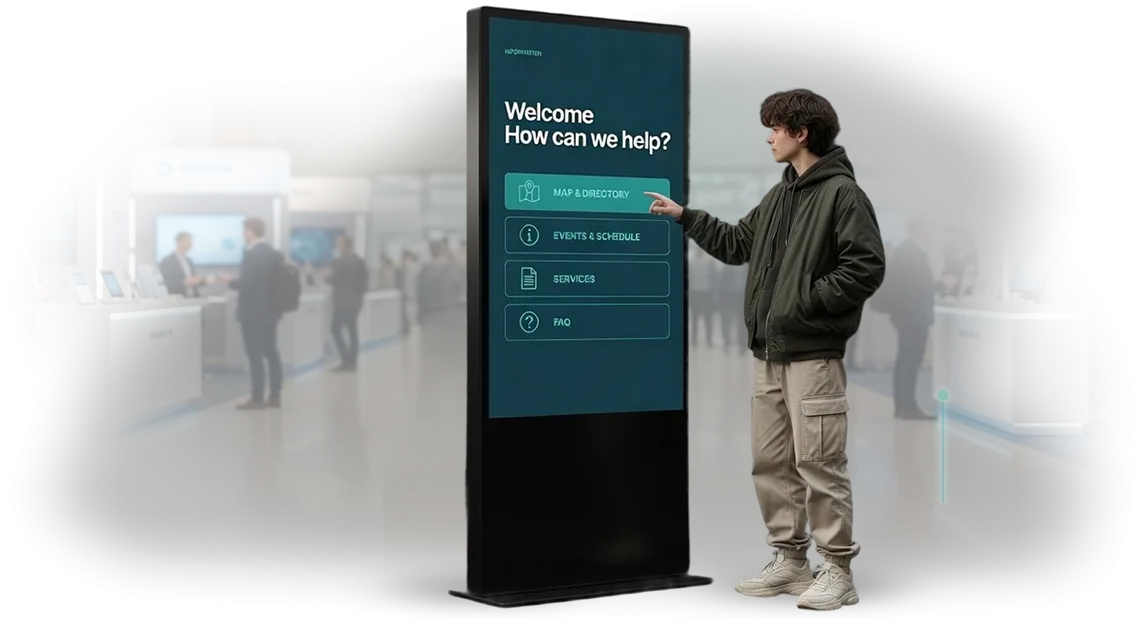
Interactive kiosks solve this need: visitors find the right store in seconds, see the route, and discover additional offers. This turns mall navigation from a source of stress into a tool for retaining guests and increasing sales.
We help implement such solutions — quickly, with a guaranteed result and a focus on visitor convenience.
What an interactive kiosk will bring to your business
An interactive kiosk in a shopping mall is not just a screen near the entrance, but a working tool that solves several tasks at once.
Visitors get fast navigation and answers to questions, tenants get an additional sales channel, and the management company gets a clear picture of guest behavior. Check how a kiosk covers each of these needs.
The first benefit is higher engagement and longer dwell time. Instead of searching for a store or wandering the lobby, a guest builds a route in a couple of touches and learns about current promotions and events.
The longer a person stays in the center, the higher the chance of impulse purchases — a direct contribution to tenant revenue and overall footfall.
The second is increased sales. The kiosk shows storefronts, current discounts, and specials visitors might have missed. It works like a virtual promoter: recommends, suggests, guides.
This is especially effective during holidays and sales, when foot traffic peaks and every additional store visit delivers measurable results.
The third is effortless analytics. The system records which sections are searched most often, which product categories attract interest, and what times of day activity is highest.
This anonymized data helps the management company make decisions on layout, tenant mix, and advertising campaigns. You stop relying on guesswork and start seeing an objective picture.
The fourth is reducing staff workload. The information desk and administrators no longer need to answer dozens of routine questions like «where is...», «what time does... close».
Employees focus on more complex tasks and quality service, while guests get instant answers without queues or waiting.
If at least three of these points matter to your shopping mall, the kiosk will pay for itself within the first months.
It increases visitor loyalty, makes the venue modern and tech-forward, and most importantly brings measurable business value: more time in the center, more purchases, more data for growth.
Interactive kiosk formats for shopping malls
In a shopping mall, one and the same kiosk cannot equally handle navigation, ads, and entertainment — each zone has its own tasks and its own foot traffic.
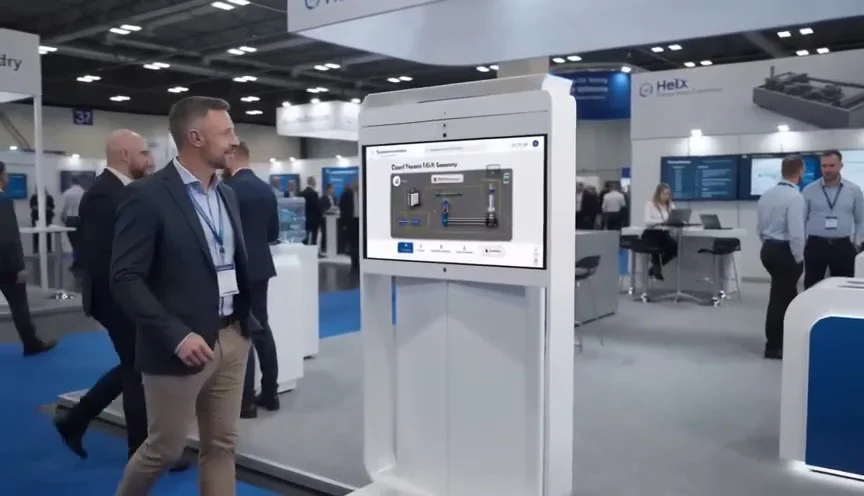
That's why we select a format for each specific location: a touch-screen stand at the entrance, a wall-mounted kiosk near elevators, or a floor screen in the atrium. This lets you avoid overpaying for unnecessary features and get results exactly where they matter.
Below are the typical formats we use in shopping malls. In every case, the client gets a clear system: visitors quickly find the right store, and tenants get an additional communication channel.
| Format | For whom | What it gives the client |
|---|---|---|
| Touch-screen stand | Malls, tenants | Floor navigation, store and promotion catalog, increased dwell time |
| Wall-mounted kiosk | Narrow corridors, elevator zones | Compact placement without using floor space, quick department search |
| Floor screen | Entrance area, atrium | Attention grabbing, event advertising, interactive games for visitors |
The choice of format directly affects the budget, but we help find the optimal solution for your space and objectives. If you need to quickly solve navigation — a touch-screen stand will work.
If preserving foot traffic in a narrow corridor is important — choose a wall-mounted kiosk. If the goal is to create a wow effect and gather guests around a display — go with a floor screen.
We handle the entire cycle: equipment selection, interface development, and launch. Before installation, we calculate how quickly the kiosk will pay off through increased dwell time and repeat visits — and only then propose a specific solution.
How kiosk development for your venue works
The kiosk development process is designed so you always understand what stage the project is at, what is happening, and when the result will come.
We work with shopping malls directly, so we immediately take into account the specifics of your location, visitor flow, and tenant needs.
- Brief and project approval. We collect the input: who visits the mall, what tasks the kiosk should solve — navigation, promotions, tenant catalog. We define goals and success criteria and agree on a development roadmap.
- Prototype and scenario. We show the screen structure and navigation logic. You see how a visitor will find a store or learn about events before the design phase even starts — this reduces the risk of rework.
- Design mockup. We design the interface in the style of your brand and interior. We agree on colors, fonts, and element placement so the kiosk looks natural in the mall space.
- Development and integration. We build the functionality: map, search, event listings, ad banners. We connect it to your data — tenant database, news, promotion feed. After that, you can make all content changes yourself.
- Testing and kiosk launch. We test scenarios on the actual device, install the kiosk in high-traffic areas, and train your team. The launch happens without missed deadlines and without disrupting mall operations.
- Maintenance and support. We stay in touch: update content, fix issues, add new sections. The kiosk keeps working stably, and you receive a usage report.
Thanks to this process, every stage of kiosk development for a shopping mall is covered by agreements and clear deliverables. You don't worry about technical details — only about improving the visitor experience and increasing tenant reach.
What is included in the interactive kiosk package
When you order an interactive kiosk, it's important to know exactly what you receive. We put together a turnkey package — no «surprises» or last-minute charges for half the items.
The package includes everything the kiosk needs to work from day one: from the housing to training materials for staff.
Full delivery set
- Equipment: a touch-screen kiosk with a housing that matches your mall's design. We mount, connect, and test it on site — no need to find third-party installers.
- Kiosk interface: adaptive design for touch control, large buttons, and clear navigation. A visitor figures it out in 10 seconds without prompts.
- Information content: we upload your floor plans, store list, promotions, and events. Content is laid out to fit the screen format — nothing «drifts» or gets cropped.
- Admin panel: you change banners, add news, and update working hours yourself without a programmer. Staff training is included.
- Documentation: operating manual, warranty certificate, and maintenance schedule. Transparent terms — you know what happens to the kiosk in a year.
What this gives you
You get a working tool for increasing visitor loyalty: fewer questions to the information desk, more time for guests to explore tenants and promotions. All equipment is tested for stability — the kiosk works even during peak hours.
Content updates take minutes, not days: if needed, our specialist can help remotely with settings. In short, the package fully covers the mall's navigation and promo needs — all that's left is to use the result.
Case study: how a kiosk paid off in a shopping mall
A shopping mall earns from rent and turnover, so every minute a guest spends converts into money. But large spaces often confuse visitors: they search for stores, waste time, and leave without buying.
An interactive kiosk solves this problem by turning navigation into a tool that guides guests to storefronts and introduces them to promotions.
We built such a kiosk for TRC «Gallery» — a center with a daily flow of over 10,000 people. We installed touch-screen panels in high-traffic areas: at the main entrance, at the transition between floors, and near the food court.
Instead of a static map, we proposed a scenario that takes interests into account: the guest chooses a category, sees a list of stores, gets a route, and current discounts. At the end of the session, a promo code appears on the screen — it can be used at the checkout.
The first-quarter numbers showed that the kiosk became a full-fledged point of sale. Average time at the screen — 2 minutes 10 seconds; each kiosk records about 5,000 sessions per month.
12% of visitors used promo codes from the screen, and tenants who participated in the campaigns saw an 8% revenue increase. These metrics became the basis for calculating the project payback.
The kiosk paid for itself in four months, and the client decided to expand the project: we added a route planner with personal preferences and integration with the loyalty program. We continue to support the system, update content, and add scenarios at tenants' request.
This turns the kiosk from a one-time solution into a permanent communication channel and a source of additional revenue.
How to choose a kiosk format for your task?
The kiosk choice question arises before the purchase: which format suits your shopping mall, where you can save money, and where you shouldn't. The answer determines whether the kiosk becomes a working tool or an expensive decoration. So it's better to start the format selection from a business task, not from a catalog of options.
The main reference point is what the kiosk should do for visitors and tenants. If you need navigation by floor and store, a compact stand with a clear map is appropriate. If you show catalogs, promotions, and mall news, choose a full-screen format with large images.
For service booking, ticket issuing, or payment, you'll need extended functionality, but visually it will still be the same neat kiosk that visitors are used to.
Expert tip: before choosing a format, determine who exactly will use the kiosk. Families with children, elderly people, young visitors — each audience has its own habits. Screen height, touch button size, and interface complexity depend on this.
The good news is that we make almost all kiosks for a specific shopping mall, so you won't have to adapt the format to a pre-built housing.
Another point is how often the information on screen changes. If content is updated once a week, a simple solution with file upload is enough. If promotions, events, and new tenants appear every day, you need a format with fast remote updates.
Such a kiosk won't require a staff visit and will always show current data, which increases visitor trust.
A free format selection from our team closes this question before the budget discussion. We come to your site or request the floor plan, study traffic, entry points, and movement logic.
As a result, you get a recommendation: which kiosk type will solve your task at the lowest cost, and which option would be excessive. This lets you choose a kiosk confidently, based on results rather than marketing.
Frequently asked questions about interactive kiosks
Mall owners often have doubts: is a kiosk hard to manage, how reliable is it, and who will service it. We answer these questions — without technical details, only about your benefit.
Do I need a dedicated employee to manage the kiosk?
No. You manage content through a simple admin panel: change promotions, banners, catalogs. This doesn't require a programmer, and if needed, we can update information remotely — even while the kiosk is operating on the floor.
What happens if the kiosk breaks down?
We use equipment designed for 24/7 operation in high-traffic areas. In case of a failure, we perform quick diagnostics and replacement so the kiosk doesn't sit idle. Your mall gets warranty and service support with a fixed response time.
Who is responsible for maintenance?
We are. We monitor the condition remotely, carry out preventive maintenance, and repair when necessary. Staff only need to turn the kiosk on and occasionally wipe the screen. We handle the rest, so you don't think about technical details.
Can the content be changed quickly for events?
Yes, you update information yourself: announcements, holiday promotions, tenant offers. It takes minutes and requires no approvals. The kiosk becomes a flexible marketing tool that quickly adapts to events in your complex.
Let's discuss your interactive kiosk project?
We invite you to talk: tell us about your mall's goals — we'll advise on how an interactive kiosk can improve navigation, increase visitor loyalty, and offload administrators.
A free consultation takes 20–30 minutes, after which you'll receive a project estimate with timelines and budget (cost calculated after audit, no arbitrary fixed prices).
What you get by ordering a kiosk from us:
- a clear plan: format, scenarios, content — before work starts;
- a fixed estimate: the price doesn't change during the process;
- a realistic schedule: stages and dates on the calendar;
- an interface prototype in your brand and mall style;
- help with content and integration with your services;
- testing in conditions close to real operation;
- technical support after launch and staff training.
We work remotely across the country and have been designing touch-screen solutions for retail and public spaces for over 10 years. Start the conversation with a simple question — we'll clarify the details, offer options, and show examples of similar projects.
Leave a request or call us — we'll discuss your task, answer questions, and prepare a project estimate within one business day. You can order a kiosk right now, and the free consultation is non-binding: you'll get an expert assessment and an action plan.