


Passengers Get Lost in the Bustle of Stations and Leave Without Buying Anything
A railway station is a place where people are both in a hurry and waiting. A passenger needs to quickly find their bearings: locate the exit, ticket office, platform, restroom, café.
When there is no clear navigation, people waste time on futile searching, get stressed, miss their trains, and leave without buying anything.
Lost customers at a station are not visible in reports, but they are real. A passenger who could not find the shop or café they needed will not make a special trip back — they will simply walk past.
Tenants lose revenue, the station loses its appeal for new outlets, and the passenger takes away a negative experience, remembering the station as a place where it is impossible to get anything done.
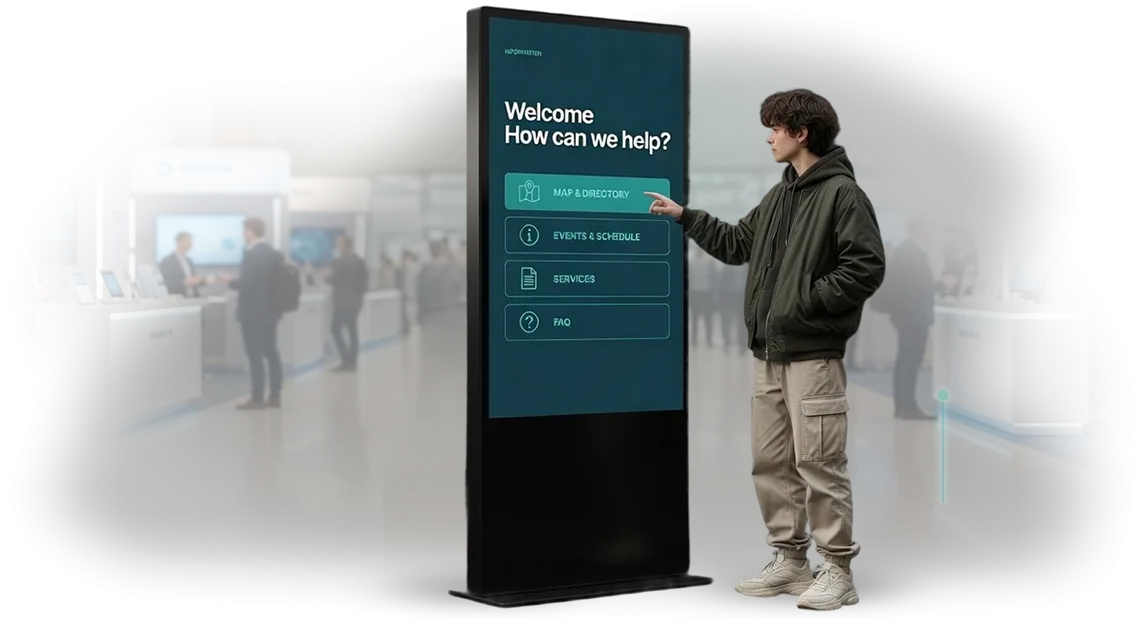
The solution is an interactive kiosk for the station. It provides clear passenger navigation with a map, schedule, and service search.
The kiosk itself suggests a safe route, shows the time until the train, and offers passengers a chance to buy coffee, grab a snack, or stop by a shop along the way. This turns the station into a space where passengers have time for everything.
Improving station service is not just an screen with a map. It is a system that helps passengers make decisions: where to go, how much time they have, what is nearby.
Exactly these decisions increase rental revenue and pay for themselves through a higher average transaction value and repeat visits.
We develop such kiosks and their web applications. We handle everything — from interface design to launch and support — so your passengers stop getting lost and start buying.
Increase Passenger Loyalty and Revenue from Each Kiosk
Passengers at a station value speed and predictability. When there is no need to look for an information window or stand in line, satisfaction rises and complaints drop.
An interactive kiosk handles routine questions — schedules, routes, station services — and responds in seconds.
The workload on staff decreases: information desk and ticket office employees stop repeating the same information dozens of times and focus on genuinely complex tasks. This is immediately visible in service speed and a calmer atmosphere during peak hours.
The kiosk also works around the clock, even when the desk is closed — passengers get help at any hour.
The kiosk becomes an additional sales channel. Its screen can display offers for taxis, cafés, insurance, excursions, or paid station services. Every passenger who uses the kiosk is potential revenue that once slipped away. Neat, unobtrusive offers are perceived as care, not advertising.
We work with professional equipment and well-tuned tools, so the kiosks do not freeze or lose data. The client gets a stable service that is easy to update remotely: schedules, prices, and promotions change without an on-site visit. Kiosk analytics show what passengers actually need and help improve station service.
The result is increased loyalty: passengers come back and recommend the station to others, while the administration gets a tool that pays for itself through operational savings and new sales. It is an investment in comfort and revenue at the same time.
Interactive Kiosk Formats for Implementation
A station passenger is always in a hurry and rarely wants to queue at the information desk — it is easier to figure things out independently.
The kiosk’s job is to provide an instant answer at the right point along the way: how to reach the platform, where the luggage storage is, when the next train departs.
But one and the same structure does not suit the waiting hall, the entrance, or the ticket area: each location has its own task and its own flow of people.
That is why we offer several format options for different station zones and usage scenarios. Below is a comparison by key parameters to help you choose the optimal configuration for your facility.
| Kiosk format | Where it is placed | For whom and for what task | What it gives the customer |
|---|---|---|---|
| Floor-standing (freestanding) | Entrance area, central hall | For all passenger categories — station navigation, train search, information services | Withstands high traffic, visible from afar, reduces workload for information desk staff |
| Wall-mounted (compact) | Near ticket offices, in waiting areas, by elevators | For targeted requests — schedule, flight delays, platform map | Does not take up usable floor space, serves as an additional orientation point in narrow spaces |
| Waiting-hall kiosk | Along boarding areas, at the exit to the platform | For passengers with luggage and children — large font, simple buttons, quick answers | Reduces lines at the information desk, improves waiting comfort, relieves staff |
| Mobile stand | Adapter for an existing stand, temporary zones | For events, seasonal flows, temporary navigation points | Flexible placement, quick launch without construction work, ability to change location |
Each format runs on a single platform — which means schedules, maps, and announcements are synchronized across all station devices. You get current information at any point without double updates.
Combine formats: a floor-standing kiosk at the entrance plus wall-mounted units in the waiting hall — and passengers feel cared for throughout their journey.
We will help you choose a configuration for your traffic and budget — just describe your tasks and we will propose the optimal scheme.
How We Build a Kiosk for Your Task
To ensure the kiosk really reduces the load on the information desk and speeds up passengers — rather than simply standing in the hall — we follow a transparent process. You see what happens at each stage, control deadlines, and understand in advance what result you will get.
- Brief and task analysis — we dive into the specifics of your station: we study passenger flow, typical questions, and peak hours. We define the menu structure and logic so that the kiosk matches your exact scenarios.
- Prototype and approval — we show how passengers will find what they need in 2–3 touches. You see the future interface before development starts and can make changes without rework at later stages.
- Design and content — we adapt the look to the station’s brand identity and prepare clear texts and hints. We take into account readability from a distance and usability for different ages.
- Development and testing — we assemble the kiosk on professional equipment and test all scenarios: schedule search, ticket purchase, indoor navigation, help request. We fix everything that could cause difficulty before launch.
- Launch and training — we install the kiosk at the right spot in the hall, configure it for specific conditions, and train station staff to quickly assist passengers when needed.
- Support and analytics — we monitor stability and update schedules and reference information. On request, we provide a report: how many passengers used the kiosk, which sections are most popular, and where they linger.
This approach eliminates surprises during implementation: you get a working tool within the agreed time frame and understand its effectiveness in numbers. At each stage, a dedicated manager is assigned to you — they answer questions and coordinate intermediate results.
What Is Included in the Delivery of a Ready-Made Solution
When you order a ready-made solution for a station, it is important to understand what is included in the kiosk delivery package.
We have put the package together so that you do not have to buy or finish anything else: a turnkey interactive kiosk is equipment, configuration, content, and support in a single contract.
- Equipment and installation — a touch terminal with a vandal-resistant enclosure, mounting, network connection, and installation in your facility. No hassle of searching for contractors.
- Passenger interface — schedule, routes, station map, services, and answers to frequently asked questions. All in a consistent style with clear navigation.
- Content management panel — your staff can change announcements, tariffs, or urgent messages themselves, without programmers or extra approvals.
- Staff training — a short practical course on how to use the kiosk and update information. Questions can be asked after launch.
- Documentation and instructions — clear guides for staff and those who service the terminal. Everything to keep operations running smoothly.
- Warranty and support — covering equipment and work, with fast response to requests. If needed, we provide remote assistance or visit the site.
- Integration with your systems — if necessary, we connect the kiosk to live schedule data or the station’s internal services.
Case Study: Navigation Kiosk at One of Russia’s Railway Stations
Passengers at a station are a flow of people with different goals: some need a ticket, some need access to the platform, some need a café.
During peak hours, conventional navigation stops working: signs get lost in the crowd, and information desk staff physically cannot respond to everyone. The result is delays, queues, and dissatisfied passengers who remember the station that way.
We solved this problem for one of the RZD stations: we developed interactive navigation kiosks that independently show the way.
The passenger selects the desired facility — luggage storage, waiting room, ticket office, or platform exit — and sees the route on a map along with the current timetable.
Implementation Results
Measurements after launch showed measurable benefits: the average time to find a target destination was cut in half, and the share of passengers who find their way independently grew to 78%. The load on the information area dropped by a third, freeing staff for more complex questions.
In the first months of operation, the kiosks processed more than half a million requests — almost a thousand passengers a day who no longer wasted time in queues.
For the station owner, this means not only passenger loyalty but also lower costs for printing navigation materials and supporting staff. Seeing this effect, the client extended the support contract and plans to install kiosks at other stations.
What This Means for Your Project
Navigation kiosks are a working tool that relieves staff and improves the impression of the facility. We apply the same approach to stations of any complexity: we adapt the logic, flow accounting, and design to your infrastructure and tasks.
If you need a similarly measurable result — let’s discuss your facility and calculate which metrics should become your targets.
How to Choose a Kiosk Format for Your Station’s Needs?
Choosing a kiosk for a station starts not with screen specifications but with two questions: what passenger flow moves through the station and what tasks the kiosk must solve. Information navigation, ticket sales, schedules, and platform exits — each scenario has its own format. Understand what passengers ask about most and where queues form — that will be your starting point.
We can distinguish three types of interactive kiosks: floor-standing units for busy halls, wall-mounted panels for corridors and ticket areas, and compact tables for suburban stations.
A floor-standing kiosk is visible from afar and relieves the information window; a wall-mounted panel solves a narrow task — a schedule or station map; a compact device saves space and answers simple questions.
For outdoor locations, we use protected enclosures — the device is not afraid of dust, moisture, or temperature fluctuations.
Budget is the second guideline. With a limited budget, start with one or two universal kiosks near the main entrance, where traffic is strongest, and measure the load. Then add locations in stages. This spreads the costs and avoids overpaying for unnecessary features.
Choosing a kiosk is a trade-off between coverage, service speed, and cost. Ticket sales kiosks relieve the ticket office, navigation stands relieve the waiting hall, and a compact information terminal relieves a suburban pavilion.
We select a configuration for your passenger flow and budget so that the kiosk pays off from the first days: fewer queues, staff handling non-standard tasks, passengers getting tickets and routes faster.
Answers to Frequently Asked Questions About Kiosks
When choosing an information kiosk, clients are most often concerned about one thing: how the device will behave in daily operation and who will be responsible if something goes wrong.
We answer the main questions honestly and without fine print — so that you can make a decision with complete clarity.
What is the service life of an information kiosk and what does the warranty cover?
We assemble kiosks using professional equipment designed for round-the-clock operation in public spaces. The standard warranty covers the enclosure, touch panel, and built-in software.
During the warranty period, all repairs and part replacements are on our side, as stated in the contract.
What happens if the kiosk breaks down at the busiest moment?
The station’s throughput capacity should not depend on a single device. We build in remote monitoring: we see most faults before visitors notice them.
If intervention is still needed, we specify response time and recovery time in the contract — you always know what service to expect.
Will we be able to update information without developers?
Yes. You get a simple admin panel through which a manager can change schedules, announcements, advertising banners, and route maps themselves. The update takes a few minutes and is applied to all kiosks immediately — without technical specialists or extra approvals.
Will the kiosk fit our interior and the specifics of the premises?
We supply kiosks in different enclosures, sizes, and color schemes — from sleek stands to compact wall-mounted panels.
Before production, we take into account corridor widths, passenger flow, and anti-vandalism requirements, so the kiosk does not clash with the architecture and does not obstruct movement.
Is it possible to expand the kiosk’s functionality after launch?
We initially design the system with room to grow. Later, the same kiosks can be upgraded with ticket sales, document printing, video communication with a dispatcher, or a service payment module — without replacing hardware or stopping existing screens.
If you did not find the answer to your question, send it through the feedback form — an engineer will contact you and analyze your situation. We always come with a concrete solution, not general words.Get a Consultation for Your Station
A railway station handles thousands of passengers every day, and every minute spent waiting at the ticket office or information desk is lost time and a risk of reduced loyalty.
An interactive kiosk solves this problem: the passenger finds the right platform, schedule, or service themselves, and your staff only deal with genuinely complex requests.
Wehave been developing such turnkey solutions for more than ten years: from scenarios to launch and support. Leave a request — get a consultation on kiosks and a quick cost estimate for an interactive kiosk tailored to your station.
We will show you how to speed up passenger service and reduce staff workload without losing quality.
What you get when you contact us:
- Individual adaptation of the project to your station: screen sizes, placement locations, and an interface that accounts for the specifics of your passenger flow.
- Developed scenarios: station navigation, train schedules, ticket services, service information — from simple to complex.
- Clear timeline estimate: from layout approval to launch, so you know the stages and dates in advance.
- Examples for transport facilities and recommendations on choosing kiosk formats — stationary, floor-standing, or built-in.
- Post-launch support: content updates, remote monitoring, and training for your staff.
- A transparent work plan without hidden stages — you always understand what is happening and what you are paying for.
To order a kiosk for your station, simply leave your contact details — we will call you back within one business day, clarify your tasks, and prepare an estimate.
This is not binding: you will receive a solution that fits your specific facility and can calmly compare it with other offers.