


Self service kiosk library: how to bring readers back
Bringing readers back to the library means removing what drives them away. Peak-hour queues, a strict lending schedule, the need to fit into the librarian's working window—all of this makes a person choose an e-book instead of visiting the library.
A library self-service kiosk solves exactly this problem: readers return and borrow books on their own in a minute, without waiting or unnecessary formalities.
We have installed such kiosks in city and university libraries, and the results are immediate.
Reader service time drops by 60–70%, peak-hour queues disappear completely, and attendance grows because the kiosk works even when the library is formally closed—through a return box or in the lobby.
From the library director's point of view, it also relieves staff: librarians stop doing mechanical work and focus on helping readers, events, and recommendations.
Simply put, the kiosk creates a service that respects visitors' time—and that is a reason to come back again and again.
If you notice that queues are driving readers away, we have already solved this problem: we configure the kiosk to your library management system, train the staff, and launch the solution in 4–6 weeks. This way the library stops losing visitors because of inconvenient service.
What the library gains from a self-service kiosk
Libraries today face the same contradiction: readers want to get books quickly, while staff have to spend time on routine operations—finding a copy, checking it out, processing returns. During peak hours this creates queues and makes visitors leave empty-handed. As a result, both satisfaction and total circulation drop.
The self-service kiosk removes this bottleneck. Readers independently find a book by barcode, check it out, and return it—everything takes less than a minute instead of five to seven minutes at the desk.
The librarian stops being a “cashier” and returns to the real role: helping select literature, working with new arrivals, and running events.
Fast service directly affects attendance. The kiosk can be placed in the lobby or even at the entrance so readers can return and pick up books at any time without waiting for the lending desk to open. This is especially convenient for students and working people with little time.
The simpler the process, the more often people return to the library and the more willingly they recommend it to friends.
By relieving staff, the kiosk helps direct effort where it is most useful. Employees have more time to work more effectively with readers, maintain the catalog, and participate in educational projects.
This strengthens the library’s image as a modern cultural center rather than just a book distribution point.
In the end, the library gains measurable benefits: increased circulation, shorter queues, and more meaningful staff workload.
Our team has already implemented such solutions for city and university libraries—we design a kiosk around your processes, configure integration with the library management system, and provide support after launch.
Kiosk formats: from counter to floor-standing terminal
There is no single universal kiosk that suits both a small district library and a large university campus equally well.
In one place, the priority is to relieve staff at the circulation desk; in another, to help visitors quickly find the right department; and in yet another, to organize library registration without a queue.
Therefore, a library kiosk should be chosen according to the specific task and space. We design and build several formats—from compact wall-mounted panels to stationary floor-standing kiosks.
Each one fits into the interior and starts working immediately: catalog search, book renewal, navigation, fine payment, and event registration.
Main formats
| Format | For whom | What the customer gets |
|---|---|---|
| Wall-mounted kiosk | Libraries with limited space, entrance area or lobby | Saves space, works as an electronic catalog and information desk: readers find books themselves without distracting staff. |
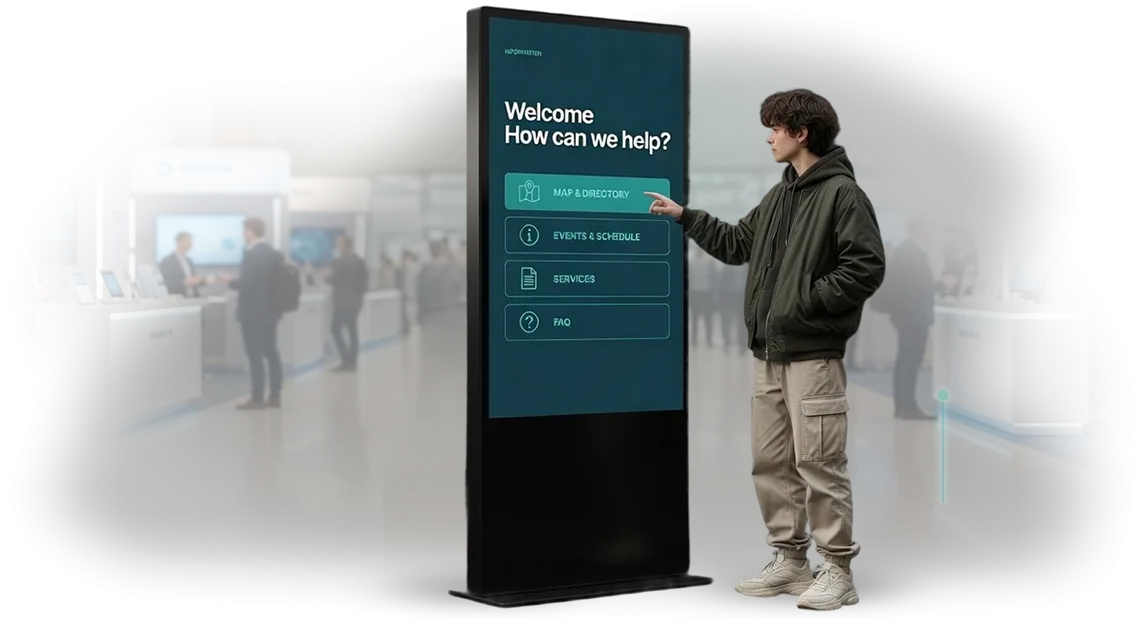
| Floor-standing kiosk | Spacious lobbies, vestibules, high-traffic areas | Helps visitors find their way: map, schedule, event poster, popular new arrivals. Reduces the flow of questions to librarians. |
| Self-service counter | Libraries with active lending, peak hours after school or work | Readers return and borrow books themselves using an electronic library card, while staff handle consultations and collection development. |
This is not just a “screen on the wall” but scenario planning: where a person enters, how much time they are willing to wait, which operations they should perform themselves.
We will recommend the optimal format at the briefing stage and build a kiosk that fits your budget and space.
How kiosk development works: 6 steps
We have been through dozens of library launches and built a process that saves your time. Below are six stages: from the kiosk brief to support. You always know what is happening and control every step.
Kiosk development stages
-
Kiosk brief. We dive into the library's tasks: what we automate, who will use it, which scenarios matter. We record goals and success criteria.
-
Prototype and design. We show how the kiosk looks and works on screen. You see the menu and navigation in advance and make edits before development starts—this is faster and cheaper.
-
Scenario approval. Together with librarians, we work through reader actions: book search, renewal, fine payment, ticket printing. Every step is clear even to a first-time visitor.
-
Development and configuration. We connect the kiosk to the electronic catalog and the library management system, and test with real data. The interface is adapted to your corporate style.
-
Launch and training. We install the kiosk, set up the equipment, and conduct a short staff training. During the first days of operation, we stay in touch and support the librarians.
-
Kiosk support. We monitor stability, update the interface and features, and add new scenarios as the library grows. You get a working kiosk without downtime.
What is included in a turnkey kiosk delivery
We take on the entire cycle—from equipment selection to launch and support. You do not need to find suppliers, coordinate installation, or deal with technical details: the kiosk arrives ready to work and immediately registers visitors.
What you get in the package:
- Kiosk equipment — a durable enclosure and touchscreen built for intensive use in public spaces. Inside is a fault-tolerant computer module that requires little maintenance.
- Software — an interface adapted to library scenarios: catalog search, book reservation and renewal, fine payment, surveys, and polls.
- Branding — we style the enclosure and screen in the library's colors and design, upload event posters and announcements.
- Installation and configuration — our engineers install the kiosk in the right location, connect it to the internet and library system, and test all scenarios. You receive a launch protocol.
- Staff training — a short briefing for employees: how to help visitors, update content, and solve common issues.
- Kiosk warranty and support — maintenance, free consultations, and fast component replacement in case of failure.
This package eliminates downtime and unnecessary coordination: everything works as a single integrated system, and when a question arises, you contact one place—us. As a result, the kiosk pays off from the first day by saving visitors' time and relieving library staff.
Case study: self service kiosk library in a library
In libraries, the main problem is not a lack of books but queues and staff routine. A reader comes for a specific book and spends 10–15 minutes waiting for checkout. Some people simply leave.
The self-service kiosk (self service kiosk library) solves exactly this pain point: it lends and receives books without staff involvement, while librarians focus on selecting literature and running events.
Implementation results
For Chekhov Central Library, we developed and launched a self-service kiosk. Readers began returning and borrowing books on their own—now 70% of all transactions happen this way. Queues at the desk disappeared, and librarians stopped scanning barcodes. In the first three months, book circulation grew by 30%, and repeat visits by 25%.
During peak hours, the kiosk serves up to 40 readers an hour—a person walks up, selects a book on the screen, pays a fine or renews a loan, and all of it takes less than a minute. Readers who once left empty-handed because of the queue now come back.
The library valued the effect so much that it ordered two more kiosks for the children's and reading rooms.
We calculate the result simply: the kiosk paid for itself in four months thanks to increased circulation and reduced staff workload. Plus, the library gained statistics: which books are borrowed more often, when peak load occurs—and now it plans acquisitions more accurately.
If you want the same result, we will share implementation details and show how much time the kiosk will save your readers.
How to choose a kiosk for your library’s needs?
The answer is simple: start with the library's tasks, not the terminal's specifications. A library kiosk should speed up specific operations—book checkout and return, reader registration, payment acceptance, and collection navigation.
So first decide which processes you want to move to self-service: this will narrow down the suitable models and save budget.
When choosing a kiosk, evaluate three things: who will use it, where it will be placed, and which library management system it must work with.
Readers of different ages, a high-traffic lobby, a children's zone, or an outdoor area—these determine the dimensions, enclosure durability, and screen design.
These kiosk requirements matter not as technical details but as conditions under which a reader can easily and safely perform an operation independently.
We help you choose a kiosk without overpaying: we analyze visitor flow, the most frequent staff requests, and readers' readiness for self-service.
Then we design not just a terminal but a scenario: the reader finds a book, checks it out to their library card, and returns it through the return slot, while staff see the changes in their familiar library system.
Do not chase the most “universal” machine—an expensive terminal with many options often pays off worse than a compact solution for two or three tasks.
We will advise which options are critical and which you can skip without losing convenience, and we will create an interface with large labels and hints so that both regular readers and newcomers can use it easily.
In the end, you get not a “kiosk for the sake of a kiosk” but a working tool that relieves librarians, reduces queues, and improves service accessibility. We will help at every stage—from task analysis to launch and ongoing support. Leave a request, and within a couple of days we will offer a suitable option for your library.
Frequently asked questions about self-service kiosks
We have collected answers to frequently asked questions about self-service kiosks: timelines, budget, and how readers and staff will perceive the change. If your question is not on the list, ask us directly—we will share details for your situation.
How long does kiosk implementation take?
A typical project takes 2–4 weeks from brief to launch. If integration with your automated library system is required, the timeline extends to six weeks. Before work begins, we approve a schedule with milestones so you know exactly when the kiosk will start saving staff time.
How much does a self-service kiosk for a library cost?
The cost depends on the configuration: a basic model for book checkout and return is one solution, while one with fine payment, receipt printing, or deep integration with your database is another.
We do not quote prices out of thin air: after a short brief, we prepare an estimate and offer an option that fits the library's budget.
Is it hard for readers and staff to get used to the kiosk?
The kiosk is designed for people of all ages: large buttons, clear hints, and language selection. Most readers check out a book on their own on the first try.
We provide staff with a short training session and hand over instructions—adjustment usually takes two or three days, and after that only process control remains.
Who maintains the kiosk?
We take on technical support and remote monitoring of the device. We process requests within the business day, and in case of failure we provide a replacement kiosk for the duration of repairs—readers continue using the library without interruption.
Order kiosk development for your library
Ordering kiosk development for a library is not buying a piece of “hardware” but launching a service that works for visitors and staff. We take on the entire path: from the brief and scenarios to installation and staff training. You receive a ready-made turnkey solution without needing to understand technical details.
Stages of work
- Application and brief. You describe the library's tasks: navigation, reader registration, payment for services, and information. We clarify the details and offer a solution that fits your budget.
- Scenario design. We think through how visitors will interact with the kiosk: simple steps, large buttons, clear hints—so that both children and elderly people can use it.
- Development and content. We create the interface, connect the catalog, schedule, poster, and library map. You see the prototype in advance and make edits.
- Approval and launch. We install the kiosk, set up the equipment, and check all scenarios. We conduct a short training session for librarians.
- Support and development. We update content, add new features, and monitor stable operation. You are never left alone with the technology.
What the service includes
- Analysis of your library's needs and those of its visitors.
- Interface design adapted to different age groups.
- Integration with the electronic catalog and reader registration system.
- Remote management setup: you change posters and announcements yourself.
- Staff training and a clear user guide.
- Equipment warranty and technical support after launch.
We have already launched similar projects in libraries and cultural centers—every kiosk pays for itself by relieving staff and improving service quality. Leave a request, and we will prepare a proposal for your library within two business days.