

Self-service vending machine: how to stop losing customers and sales
Every day without automation, you lose customers who leave because of queues and waiting. At peak hours, the checkout can’t handle the flow, shoppers get irritated—and go to competitors who already have a self-service vending machine.
This is not a matter of convenience; it’s a direct loss of revenue that is hard to notice until you calculate the missed sales.
The second problem is dependence on staff and the human factor. A cashier can make a mistake, slow down a customer with lengthy processing, get distracted, or fail to manage the flow. Each such case means an unhappy customer and a lost checkout.
Sales automation removes these risks and helps you sell where you previously simply couldn’t keep up.
When you install a self-service kiosk, the economics of your location change: the customer serves themselves, without staff involvement. Purchase speed increases, customers stop getting frustrated, and you generate additional sales even during the busiest hours. Staff workload drops, so employees can focus on what really matters—caring for customers.
Our team has been designing and launching such solutions for years for businesses that value revenue and customer loyalty. We handle the entire journey—from idea to a working self-service kiosk that starts generating profit in the first months after launch. Instead of lost customers and peak-hour chaos, you get stable sales and peace of mind.
What you get from the kiosk: 5 measurable benefits
A vending self-service kiosk is a standalone point of sale that works without breaks or vacations. It accepts orders, processes payment, and dispenses the purchase without staff, so revenue grows without expanding your team.
The first measurable benefit is growth in the number of purchases. The kiosk serves a customer in minutes, doesn’t make them wait for a free employee, and doesn’t lose orders at peak times—this gives up to 20–30% more revenue with the same visitor flow.
The second benefit is an increase in the average check. At the moment of payment, the kiosk offers to add related items, and the purchase total grows. The same technique raises the average check by 10–15%.
The third benefit is service automation. The kiosk handles order intake, payment, and sending the order to the kitchen, removing routine tasks and errors. Staff stay focused on guests, and management becomes simpler.
The fourth benefit is customer loyalty. The kiosk remembers preferences, offers personalized discounts, and gives bonuses for repeat visits, so regulars come back more often.
The fifth benefit is sales control. Every transaction is recorded automatically, and you see exact revenue numbers, popular items, and conversion rates. This makes it easy to adjust the menu and pricing quickly.
All five benefits are connected: more orders, higher check, less staff load, loyal customers, and clear analytics. We launch the kiosk turnkey and support it after opening—you get a working sales channel without technical details.
Kiosk formats: choose what fits your task
The same kiosk is not equally suitable for a store, a business center lobby, or an outdoor area. The enclosure format determines how long it will last, how convenient it is for visitors, and how much space it takes.
We match the design to your location: we help assess foot traffic, area, and operating conditions so the kiosk works without surprises. Below are the basic options.
| Kiosk format | Where to install | What it gives the customer |
|---|---|---|
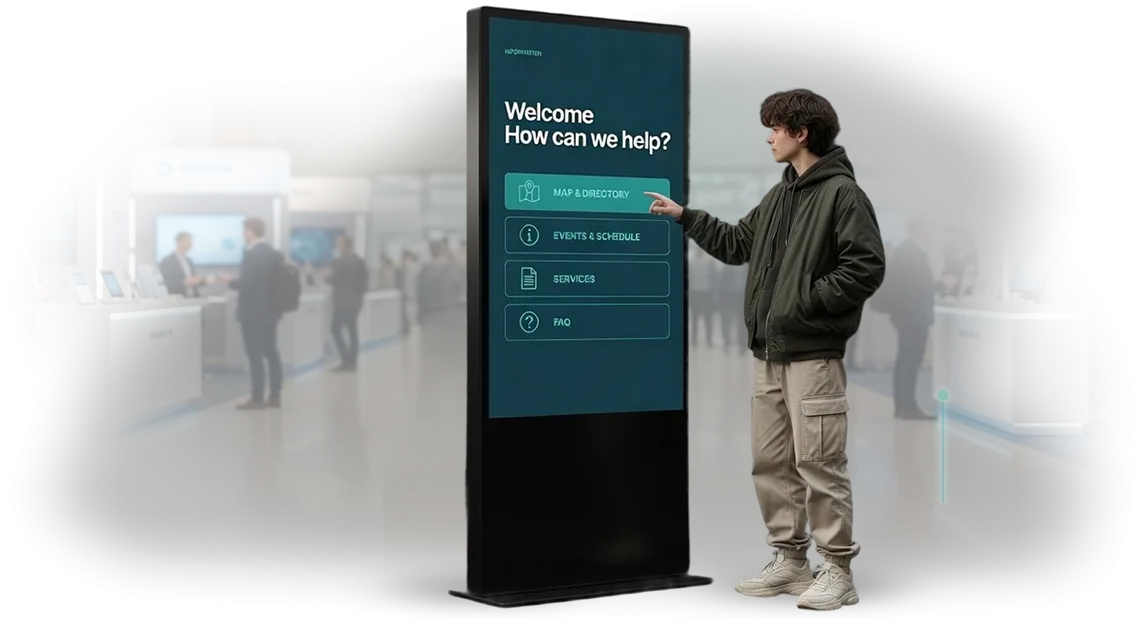
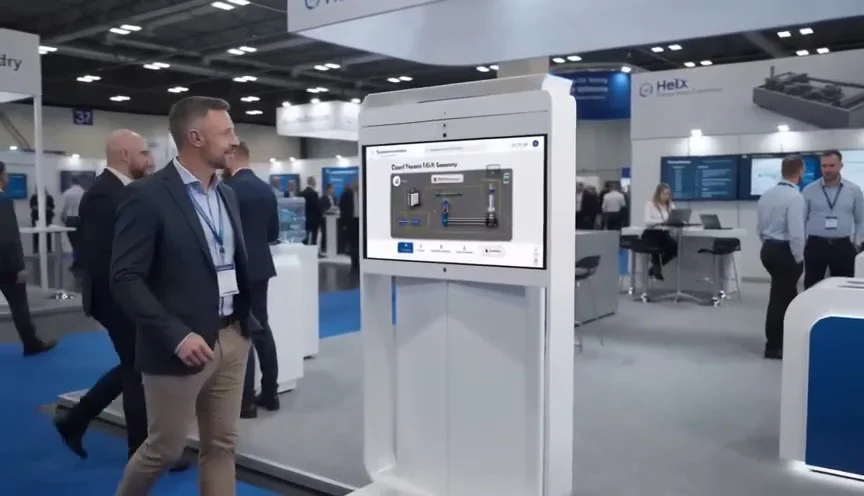
| Floor-standing kiosk | Shopping malls, stores, lobbies, exhibition areas | Maximum visibility, comfortable height for any visitor, ability to add additional equipment |
| Tabletop kiosk | Checkout areas, information desks, small retail points | Saves space, fast launch, minimal investment |
| Outdoor kiosk | Entrance areas, parks, gas stations, stadiums | Works in any weather and is protected from vandals—suitable for 24/7 use |
The choice of format also affects payback speed: the tabletop version is quicker to install and cheaper, the floor-standing version provides more reach and attention, and the outdoor version extends the operating hours of your location.
We calculate these options together with you before development starts—so you pay for the functionality you actually need.
How the project works: 6 clear steps
We know that launching a new kiosk is an investment, and the main risk for you is uncertainty. That’s why we built a transparent six-step process: you always see what stage the project is at and when the result will appear.
- Brief and analysis. We capture the kiosk’s goals, your audience, and operating scenarios. We agree on timelines and budget so you understand the scope of investment.
- Design and engineering. We select the housing, screen, and construction to fit the task—and how the kiosk will integrate into your space. We prepare the visual concept and menu structure.
- Mockup and prototype. We present an interactive prototype with real texts. You see how a customer interacts with the kiosk and make edits before production begins.
- Production and development. We manufacture the housing and develop software in parallel, shortening timelines. We provide progress reports weekly—no surprises.
- Testing and configuration. We check load resistance, failure scenarios, and print or video quality. We fix issues before the first visitor sees the kiosk.
- Launch and support. We deliver, install, train staff, and stay in touch. Warranty and maintenance are included in the contract, with minimal downtime for your business.
This approach reduces risk and saves your time. You get a working kiosk within the agreed timeframe and with clear accountability at every stage.
What is included in kiosk supply and setup
You receive not just a device, but a ready-made customer service point. We handle the entire path—from housing selection to launch and support, so you don’t need to coordinate multiple contractors. The supply includes:
- Housing and screen — durable housing, anti-vandal options, and a touchscreen tailored to your tasks. Fewer breakdowns and more comfort for customers.
- Software and configuration — we install the operating system, interface, and remote management system. The kiosk works immediately after power-on, with no technical involvement on your side.
- Integrations with your systems — we connect catalog, order accounting, card and mobile payments, and notifications. The kiosk becomes part of your business processes.
- Launch and staff training — we carry out on-site commissioning, train employees, and provide clear instructions.
- Warranty and support — official warranty on the housing, screen, and software, health monitoring, and fast replacement of components. We resolve issues under the contract without unnecessary approvals.
This approach protects you from hidden costs: you know in advance what you are paying for, and you get a kiosk that pays off through round-the-clock operation and stable service for visitors.
Case study: kiosk paid for itself in 4 months and increased average check by 28%
Coffee chain Kofeyny Den came to us with a familiar pain point: during the lunch rush a queue formed at the checkout, some guests left without waiting, and the average check dropped because cashiers were rushing. They needed to relieve staff pressure and increase revenue without expanding the space.
We proposed interactive self-service kiosks—designed specifically for their menu and ordering scenario. The customer chooses items independently, sees the total amount, and pays by card, while the order goes straight to the kitchen. The whole process takes less than a minute and doesn’t require staff assistance.
The results speak for themselves: the kiosk paid for itself in 4 months—six months ahead of plan. The average check grew by 28%, and 65% of orders during peak hours go through self-service.
In the first two weeks, more than three thousand orders were placed through the kiosks, and queues shortened threefold.
For the owner, this means revenue growth without additional investment in staff. Employees stopped being distracted by payment processing and focused on guests—service quality increased, and the share of repeat orders rose by 12%. The kiosk continues to operate and generate profit.
This kiosk case is a clear example of how properly designed self-service returns investment and solves business challenges. If you want a similar result—tell us about your format, and we’ll calculate the kiosk payback for your location.
How to choose the right format for your task?
Start the selection not with specifications, but with the task: what should a visitor do at the kiosk in 30 seconds?
Pay for an order, receive an item, book a service, or navigate the space—each scenario suits a different format, and a mistake at this stage costs more than the kiosk itself.
That’s why the first step is a location and process audit: how many people pass by, when peak load occurs, and what assortment and payment methods are needed.
If the main priority is purchase speed, we choose a compact kiosk with a payment module; for dispensing items of different sizes—modular racks; for navigation and information—touch panels.
To simply inform visitors, a panel with a map and contacts is enough—why overpay for a payment module?
In parallel, we calculate the economics: launch budget, maintenance, and payback period. Usually, a kiosk pays off through a higher average check and staff savings, but exact figures depend on traffic and your margin, so we provide the calculation before the start, not after.
To fit your budget, we can arrange purchase, lease, or a combined option—this reduces risks at the outset.
A properly selected format is a kiosk that doesn’t require constant supervision: it handles peak loads, is intuitive for customers without training, and is easy to update. If you need more functionality after launch, we’ll refine the scenario without replacing the equipment.
You don’t need to understand the technology: just describe your task, and we’ll handle kiosk selection, design, installation, and support.
Write to us—we’ll provide a free consultation and offer one or two suitable formats with a payback calculation so you can make a decision without risk.
FAQ: what happens after launch and if something breaks
Launching a kiosk is just the beginning. We address the main concerns: breakdowns, software issues, staff training, and technical support. Here’s how it works in practice.
What does the kiosk warranty cover?
Warranty covers the equipment and software. If a component fails—we repair or replace it at our expense. Engineers monitor the kiosk remotely and often detect a problem before the customer does. Support is already included in the contract; no fee is charged for requests.
Who services the kiosk after launch?
We handle kiosk maintenance: software updates, preventive maintenance, and replacement of consumables. Staff training takes a couple of hours—refilling, cash collection, and restarting. For complex cases, there is a support line.
What happens if the kiosk breaks?
The kiosk sends a fault signal automatically. Response time is fixed in the contract—usually two business hours. If downtime is not your fault, we compensate for the lost revenue. This removes the main fear of vending business.
Can the software be updated quickly?
Yes. If the assortment, prices, or promotions change—we update remotely, often the same day. The kiosk keeps working, and sales don’t stop.
This approach removes the “what if” fear—you run your business, not the technology. We stay in touch even after launch.Get a turnkey kiosk and support at every stage
Submitting a kiosk order request means getting not just a calculation, but a roadmap for the entire project. We work as one team: you handle the business goals, and we handle the technical implementation and launch.
After the first contact, you receive a transparent work plan and understand when the kiosk will start generating revenue.
How work proceeds after your request
- You leave a request—within two days we provide a free kiosk cost calculation and propose the optimal configuration.
- We agree on the technical specification, and kiosk development begins: we select the housing, screen, and software for your niche.
- We produce and assemble the turnkey kiosk, and configure all scenarios—payment acceptance, product dispensing, and integrations with your accounting system.
- We run testing and train your employees: how to replace consumables, refill the terminal, and resolve standard issues.
- We launch the kiosk into operation and hand over all documentation, then support you—updates, technical assistance, and preventive maintenance.
What you receive immediately after contacting us
- Free consultation and kiosk cost calculation within 2 days.
- A timeline proposal that fits your budget and seasonality.
- Recommendations on model, installation location, and assortment.
- Examples of our solutions for similar tasks and their payback.
- A dedicated manager who guides the project from request to launch.
- Price fixed in the contract—no hidden payments at any stage.
Call us or leave a request on the page—by tomorrow you’ll know what your future kiosk looks like and how much it can bring. We’ll take care of the rest.