


Clients Leave When the Kiosk Isn't Connected to Booking Systems
An interactive kiosk should speed up guest service, but without a connection to the booking system it becomes another point of stress.
A guest booked a table or a service in advance, and the kiosk “doesn't recognize” them — the reservation isn't pulled up, and the data has to be searched manually. Instead of fast check-in, there's a pause, questions to staff, and wasted time.
Every such delay affects the entire flow of visitors. The queue stops behind one guest, wait times grow, and by the time the person reaches the counter, they are already irritated.
Some guests don't wait at all — they leave, and along with them, they take repeat visits, positive reviews, and referrals. For the business, this means direct losses: lower revenue, worse reputation, and fewer loyal customers.
The problem isn't the kiosk itself, but the fact that it works separately from your accounting system. Data isn't synchronized; information has to be entered manually or double-checked against paper records.
This leads to errors: a booking can be lost, a freed-up slot doesn't become available, and the guest ends up in an awkward situation. Automation that should simplify processes actually creates new complications.
We solve this problem comprehensively: we set up the interactive kiosk so that it directly exchanges data with your booking system.
The guest sees their reservation as soon as they approach the screen, staff don't have to ask again and search for information, and queues stop growing. The result is faster service, satisfied visitors, and fewer lost bookings.
What Changes for Business After Kiosk Integration
After integrating the kiosk with the booking system, the business gets not just a new entry point, but measurable changes in key metrics. The first thing clients notice is the speed of service.
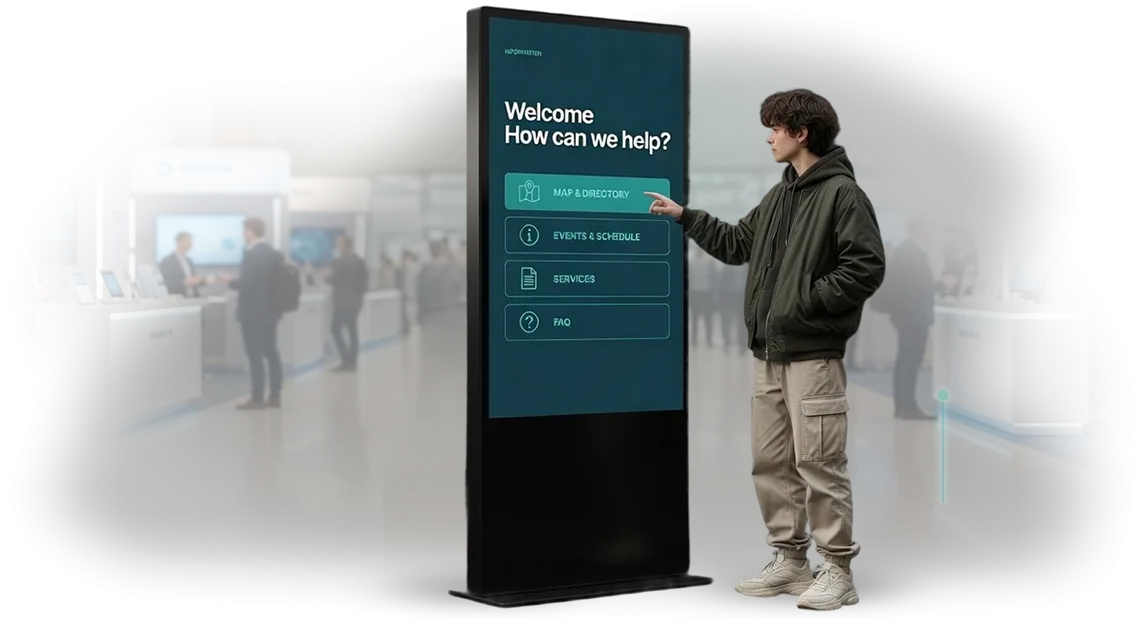
The guest no longer stands in line to see an administrator or waits for an answer over the phone: they choose the date, time, and service themselves in a few screen taps.
This cuts the time per booking several times over, which means you accept more requests during the same peak hours.
The second effect is growth in repeat visits. The kiosk remembers the client, suggests convenient slots, and reminds about upcoming visits via SMS or messenger. A person comes back not because you called them, but because it's convenient.
The booking system connected to the kiosk automatically offers additional services or future visits — so you increase the average check without extra effort from staff.
The third benefit is fewer staff errors. Manual data entry always carries the risk of typos, time confusion, or losing a request. The kiosk removes the human factor: the client enters the data themselves, the system verifies it, and immediately confirms the booking.
As a result, the number of conflicts at the reception desk, dissatisfied guests, and losses from incorrectly processed records decreases.
For the business owner, this means stable occupancy, less overhead on request handling, and a calm working team. And also a tidy customer database that can be used for newsletters and loyalty programs.
In the end, integrating the kiosk with the booking system pays off through three factors: faster service, growth in repeat sales, and fewer errors.
Each one directly affects revenue and reputation, so the decision to integrate is an investment in the predictability of the business.
Formats for Integrating the Kiosk with Booking Systems
Clients are tired of waiting in line, and your employees are tired of spending time manually checking records.
Integrating the kiosk with your booking systems solves this immediately: the guest confirms the visit themselves, sees the status, and pays — while you get accurate data without errors.
We break down three integration formats, from basic verification to full synchronization with the accounting system.
| Format | For whom | What it gives the client |
|---|---|---|
| Booking verification | Hotels, clinics, service centers | The guest enters a booking number or shows a QR code — the status is verified in seconds, and the registration desk stops being a bottleneck |
| Schedule synchronization | Salons, coworking spaces, training centers | The kiosk shows the current schedule and allows immediate booking of an available slot — fewer no-shows and double bookings |
| Full integration with the accounting system | Large complexes, concert and sports venues, medical centers | Data on bookings, clients, and services automatically enters your database — reports are generated by themselves, manual entry disappears |
All three formats work with popular online booking services and accounting programs — you won't need to change the tools you already use. We'll choose the right option, configure the kiosk for your processes, and train your staff with a short session.
Project Stages: From Brief to Kiosk Launch
An interactive kiosk with booking is not just a screen. To make the system accept requests and avoid failures during peak hours, you need to think through user scenarios, integration, and launch.
We've split the project into stages with clear timelines and checkpoints — you always know when the result will be ready.
- Brief. We gather requirements, study how booking currently works, and identify bottlenecks. You get a structured description of the task.
- Plan and approval. We fix the scope of work, timelines, and approval points. You see the full project picture and understand when and what is needed from you.
- Interface design. We create the logic of screens and user scenarios: service selection, time selection, booking confirmation. We show mockups before launch — changes are made at the shore, without rework.
- Integration with the booking system. We configure data exchange between the kiosk and your system: we check slot availability, reservation, and cancellations. A test environment helps avoid failures on launch day.
- Kiosk launch. We install the equipment, test it under real conditions, and train the staff. Guests start booking on launch day.
- Support. We stay in touch after launch: we monitor stability, update scenarios, and refine features for new tasks.
This approach removes uncertainty: timelines are fixed in the plan, and each step ends with a result. By the time the kiosk launches, your team is ready to work with the new point of contact, and guests get a convenient service without queues.
What's Included in the Delivery: A Package for Your Business
You're not ordering “hardware” — you're ordering a ready-made solution that immediately goes into operation.
That's why the delivery package includes everything needed for the kiosk to work from the first day and organically connect to your booking system — without additional investments or a long setup process by your team.
The standard package includes:
- Configured interactive scenarios for your tasks — appointment, payment, receiving information, feedback. The guest goes from touching the screen to a completed confirmation independently.
- A ready-made connection to the booking system — current slots, available spaces, and confirmations are pulled in automatically, so visitors always see an up-to-date picture, and you do less manual work.
- Administration and content management — you change promotions, service descriptions, and prices yourself in a simple interface, without involving developers.
- Staff training — we conduct an orientation session for administrators and operators so they can confidently work with the kiosk from day one and help guests when needed.
- Clear instructions and regulations — a user guide, a launch checklist, and typical actions for non-standard situations. Everything a staff member needs to handle the system without stress.
- Warranty support and maintenance after launch — we stay in touch, answer questions, and help if something goes wrong.
Such a package covers the main task: the kiosk becomes a full-fledged employee that takes orders and relieves your people. We handle the technical side, setup, and integration — you get a working tool, not a box of parts with an instruction manual.
Case Study: How a Kiosk with Integration Cut Queues at an Event
Organizers of a large forum faced a familiar pain: before the start, there was a line at the entrance, guests were nervous, and presentations started late. Hundreds of bookings had to be checked manually, and each participant took several minutes. This created chaos and a negative impression before the first talk even began.
We proposed a solution: interactive kiosks were placed at the registration desk, connected to the booking system. A guest scans a barcode or says their last name — the kiosk itself finds the booking, marks attendance, and prints a badge.
No paper lists, no administrators rushing around, and all visitor data enters the system automatically.
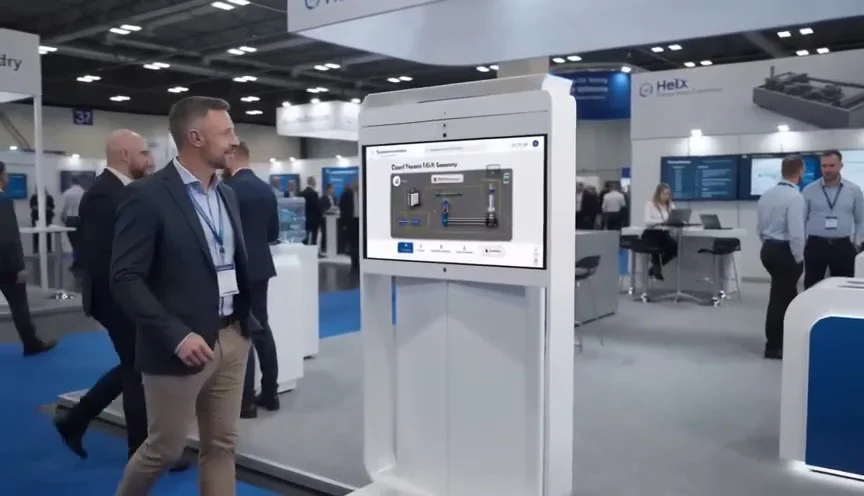
The case for the Digital Industry Forum showed immediate results. With a flow of 1,500 guests over two hours, the average check-in time dropped to 15 seconds — the organizers managed to start the program on time.
The queues at the entrance disappeared, and an administrator was needed only for rare non-standard situations. The organizers received an accurate report of how many participants actually arrived and at what time — this helped adjust the logistics for the second day.
The main things the clients noted were the calm atmosphere at the entrance and full control over the process. After the first day, they asked to keep the kiosks for the entire event, and then ordered the same setup for their next events.
A one-off project turned into a permanent tool that saves guests' time and takes the load off the staff.
What to Do If the Kiosk Isn't Working or the Integration Has Failed?
If the kiosk isn't working or the integration has failed, you are not left alone with the problem. We design kiosks so that even if equipment or integration fails, you don't lose a single booking.
You have a support phone number and a response procedure. The integrations work with a data buffer: if the booking system is unavailable, the kiosk continues to accept requests, stores them, and sends them once the connection is restored. Guests see no difference, and no bookings are lost.
If a problem occurs, support responds within the working day, and for urgent cases there is an on-duty specialist. First, we restore the kiosk's operation, then we sort out the cause — the point of contact with clients sits idle for a minimum amount of time, not days.
After the system is restored, we reconcile requests with the log, fix discrepancies, and send you a report.
The warranty for the work is specified in the contract, including fixing integration failures and adapting to changes in your booking systems. If the vendor changed the interface, we'll set everything up again.
What happens if the kiosk breaks on the day of an event?
An urgent protocol is activated: the on-duty specialist connects remotely and, if necessary, goes to the site. While the kiosk is being restored, requests are accepted through a backup form on a tablet — the data enters the same booking system, and losses are excluded.
Submit a Request — We'll Prepare a Solution for Your Task
Integrating a kiosk with a booking system seems complicated until it's broken down into clear steps. We remove that complexity: you describe the task in free form, and then we move through a transparent process — from request to launch.
After submitting a request, you get:
- Request — you describe the task in your own words or schedule a call if it's easier to discuss details by voice.
- Clarifying details — we ask questions about visitor flow, the working scenario, and the connection to your booking system.
- Solution estimate — we prepare a cost estimate, scope of work, and timelines without hidden items or unexpected surcharges.
- Consultation — we review the options: a new kiosk, rental, or upgrading already installed equipment.
- Project start — we fix the plan, assign those responsible, and begin the work according to the agreed schedule.
- Support after launch — we stay in touch, helping with setup and further improvements.
You don't need to understand technical details or prepare documentation. It's enough to describe what should work — we'll prepare the solution and the estimate ourselves and show them before the work begins.
Submit a request right now — by the next business day, you'll receive an answer with a solution option and a cost estimate. If the launch is needed quickly, mention it in the comment to your request: we'll speed up the process without losing quality.