


Integrating a Kiosk with Electronic Queue Systems
A kiosk that registers visitors but has no connection to an electronic queue only creates the illusion of convenience. Guests still stand in a physical line, the number ticket does not work, and staff manually cross-check lists and reassure unhappy customers.
As a result, an interactive kiosk turns into an expensive toy rather than a tool that actually speeds up service.
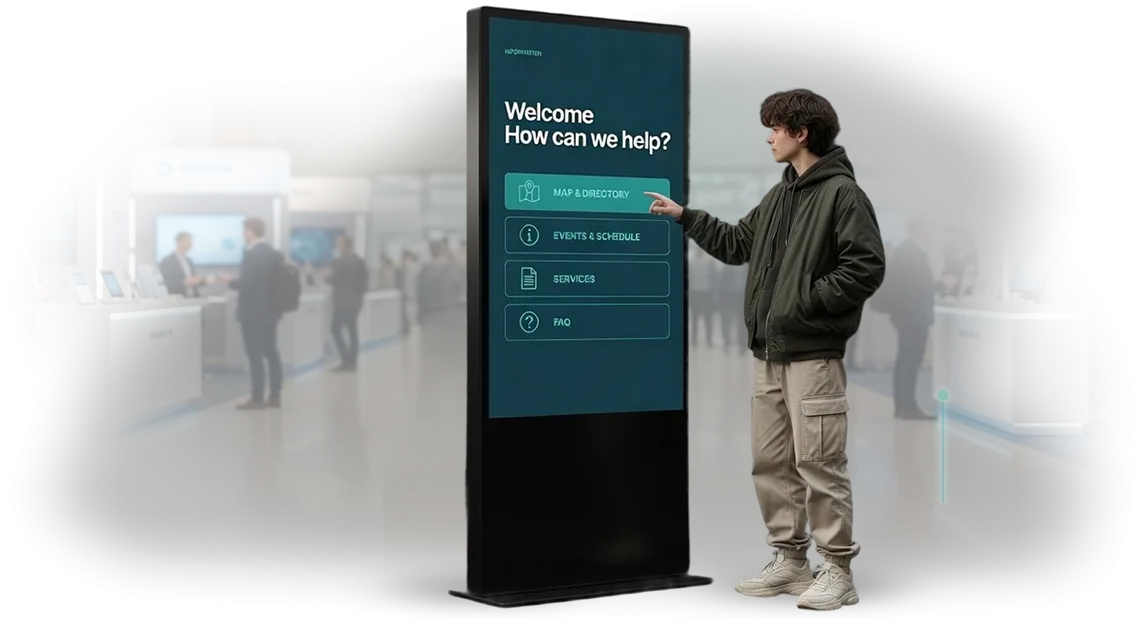
Integrating the kiosk with an electronic queue system changes the picture completely. The visitor receives a ticket with their number, sees the call status on the screen, and the system itself directs them to the right window or office.
This eases the administrator’s workload, eliminates “who is next” arguments, and makes the process transparent for everyone.
For business, this solution means shorter queues and higher throughput without extra staff. People stop crowding the counter, the waiting area becomes calmer: the guest knows when their turn will come and does not bother staff with questions. And the time previously spent on manual coordination can be redirected toward service quality.
In addition, the kiosk actively works in the waiting area: it suggests which documents are needed, which services are available, and invites visitors by voice or text.
This way, the electronic queue and the interactive kiosk form a single circuit that saves time for both the client and your team.
We take care of configuring the entire setup: we connect the kiosk to your system, design scenarios, and verify performance under real load. As a result, you get predictable service without queues and chaos, and visitors remember the comfort and return again.
What Integration Changes for Visitors and Business
Integrating the kiosk with an electronic queue system is not just a technical convenience — it is measurable growth in key indicators. Below are 5 effects you will see in numbers after implementation.
-
Shorter waiting time. Visitors join the queue in 30 seconds, without spending time at the administrator’s counter. Average waiting time drops by 20–30% — this is confirmed by our implementations in MFCs and clinics.
-
Higher visitor satisfaction. When there is no chaos or confusion in lines, people rate the service higher. In integration projects, the share of positive ratings grows by 15–20%, and the number of complaints about waiting falls dramatically.
-
Automated registration. The kiosk itself records the visit, selects the service, and sends the data to the system. Human error is eliminated — administrators no longer need to repeat questions and enter data manually.
-
Stronger loyalty. Clients who go through the process without stress return more often. Repeat visits in such organizations increase by up to 25%, and word of mouth brings new visitors without advertising costs.
-
Kiosk efficiency. One kiosk takes on up to 70% of the administrator’s routine operations. Staff focus on live questions and complex cases instead of paperwork — the load on the counter noticeably decreases.
These are not promises but average figures from our practice: at our team we measure the effect after every implementation. Want to know what integration could do for your visitor flow? Give us a call — we will calculate the potential in one conversation.
Electronic Queue Integration Formats: Built for Your Workflow
Every kiosk in an institution solves a specific task: sometimes you simply need to register visitors, sometimes you need to show information and issue a ticket right away.
There is no universal “one-size-fits-all” connection, so it is important to choose an integration format that matches the logic of your branch.
The key criterion is not technical complexity but visitor behavior. If a person is already standing in a live queue, they need a fast self-service ticket. If they came for a certificate or consultation, they first need navigation and then the electronic queue. Below are typical scenarios we implement.
Kiosk Connection Formats
| Integration format | Who it is for | What it gives clients |
|---|---|---|
| Ticket issuance only | Branches with heavy visitor flow | Self-service ticket in 15–20 seconds, relieving the administrator at the entrance |
| Information kiosk + ticket | MFCs, clinics, banks | Visitors find the right department or service on their own and immediately get a ticket to the right specialist |
| Kiosk as part of the electronic queue | Institutions with multiple windows and rooms | Even distribution of traffic — the ticket assigns the room and waiting time |
| Two kiosks working together | Buildings with two entrances or a large hall | A single queue without confusion at different entry points |
We choose the format together with you during the briefing stage: we look at the layout, the number of visitors during peak hours, and typical requests. After that, the kiosk works as a full participant in the system, not as a standalone device.
For most branches, the second format is optimal — it combines navigation and ticket issuance, so visitors do not ask staff unnecessary questions. Other formats are connected when the visitor flow and physical layout justify them.
If you are unsure which option suits you, send us a floor plan and describe your visitor flow — we will suggest what will bring the most benefit. Interface adaptation and scenario setup take from three to five working days, including a test run on your side.
How the Project Works: 6 Steps from Brief to Launch
A kiosk integration project with an electronic queue system should not turn into an unpredictable story with lengthy approvals. We built a six-stage process — it is transparent and clear: you always know the project stage and what you will receive at the end. Below is each step, from the brief to post-launch support.
- You receive a kiosk brief: we discuss what tasks the kiosk must solve, where it will be placed, what visitor flows it should handle, and how it should interact with the electronic queue. We record all requirements and deadlines so nothing gets lost.
- Solution approval. We propose the optimal format — hardware, interface design, and queue workflow logic. You see a mockup and integration diagram and can make edits before development begins. No unnecessary costs — it is immediately clear what is included in the project.
- Integration development and setup. We program the kiosk logic, connect it to your electronic queue system, and configure scenarios: registration, ticket, call to the window. We conduct internal testing so that everything works reliably from the start.
- Testing on real scenarios. Together with you, we check the kiosk under conditions close to daily operation: how quickly visitors get tickets, how multiple windows behave, what happens in case of failure. We prepare instructions and short staff training.
- Kiosk launch. We install the equipment at your location, verify all scenarios, and sign the acceptance certificate. You receive a working kiosk on time and can use it immediately.
- Post-launch support. We do not disappear after installation: the team stays available to answer questions, update content, and improve features if your queue processes change or new tasks appear.
What Is Included in the Delivery: Complete Set of Results
After integrating the kiosk with the electronic queue system, you receive not a “code file” but a complete working set. It documents exactly how the kiosk receives visitors, how it connects to the queue, and who is responsible for what.
This allows you to launch the location without lengthy setup and verify results with a clear checklist.
The Complete Set
- Delivery package — an inventory of hardware and software, a list of components with their purpose, and the connection order.
- Kiosk workflow diagram — a visual flowchart of the visitor route: from choosing a service to receiving a ticket and being called to the window.
- Staff instructions — step-by-step actions for normal operation and unusual situations: ticket failures, restart, schedule changes.
- Staff training — a short practical session for administrators and operators: how to manage the queue, add services, and view statistics.
- Acceptance documents — certificates and test protocols confirming that the integration is complete and the kiosk works correctly.
- Roles and access — a table of accounts with permissions: who can change settings and who can only view the queue and reports.
- Support plan — communication channels, response times, update and backup procedures.
This set removes dependence on a single contractor: even if the responsible employee leaves, you still have documentation and a trained team.
You get a transparent result that can be verified at handover, used in daily operations, and scaled to other branches without re-integration.
Case Study: MFC Reduces Visitor Waiting Time by a Third
MFC visitors come for dozens of services, and most arrive without an appointment. If the queue is managed manually, people wait a long time, staff enter data with errors, and windows are unevenly loaded. As a result, both visitors and staff suffer, and management lacks accurate numbers for decisions.
We solved this pain point by integrating interactive kiosks with the electronic queue system.
In one regional center, our team configured data exchange between the kiosk and the queue: visitors select a service on screen, receive a ticket, and their request immediately enters the central system — without administrator involvement and without duplicate data entry.
What Changed After Launch
Average waiting time dropped by a third — from fifteen to ten minutes. People no longer crowd the counter, traffic is distributed evenly, and the queue became predictable for both visitors and staff.
Data accuracy increased to 98%: requests are not lost, tickets are not duplicated, and window statistics reflect the real picture. The manager can see which services are more popular and when additional staff are needed — and makes decisions based on facts.
As a result, the kiosk’s efficiency became evident: the number of visitors served per day increased, complaints decreased, and staff stopped working in emergency mode.
After a successful pilot, the client expanded the integration to five more branches — the best proof that the solution pays off and works in daily operation.
Common Concerns Before Ordering and Our Guarantees
Before ordering, clients usually ask three questions: will the electronic queue break down, will the kiosk fail on the busiest day, and will staff need retraining. That is why we structure our work so that you get not a “box with a screen” but a well-organized process.
Integration with your electronic queue system happens without stopping service. First, we set up a test mode at one window, then we move the load to the others.
The kiosk and the queue server communicate through proven mechanisms — ticket number, window status, and waiting time always match.
Most concerns are about stability. We address the main worry in one block.
What happens if the connection between the kiosk and the electronic queue goes down?
The kiosk continues issuing tickets, saves operations locally, and automatically synchronizes once the connection is restored. We also set up monitoring — you will receive an alert before visitors notice anything unusual.
We have experience integrating with queue systems: from Qmatic to industry-specific solutions. That is why we connect to your system using a clear algorithm and build in a reliability margin.
How to Choose an Integration Format for Your Organization’s Needs?
The choice of integration format depends not on technical preferences but on your organization’s objectives.
A kiosk can simply issue tickets, register visitors for a service, guide them to the right office, or accept payments — and each scenario has its own connection scheme to the electronic queue.
To avoid overpaying and get a system that truly accelerates service, evaluate three parameters: how many visitors pass through daily, what service scenarios are used, and whether management needs load analytics. Below is a quick-reference table for independent selection.
| Your organization’s situation | Which integration format suits you | What you get |
|---|---|---|
| Up to 100 visitors per day, one or two windows, ticket issuance needed | Basic kiosk: ticket is printed on its own, registration automatically enters the queue | Fast launch, minimal investment, order without an administrator |
| Several services, visitor flow of 300+ people, frequent queues | Full kiosk integration with the electronic queue: the request goes into the central system, which routes it to an available window | Shorter queues, balanced staff workload |
| Management needs data on waiting time and window load | Integration with an analytics module: kiosk and queue exchange data | Transparent operational picture, a basis for management decisions |
| An electronic queue system already exists and should not be replaced | Kiosk adaptation to existing software | Budget savings, familiar processes preserved |
| A network of branches or several service points | Unified integration format replicated across all locations | Consistent quality standards, scaling without extra development |
How to choose a kiosk in the end? Start not with the hardware model but with the question: “What task should it solve?” If you only need tickets, a simple solution is enough.
If you need to manage traffic and see results, full integration with the electronic queue is the right choice.
Our specialists help select an interactive kiosk for your task as early as the briefing stage: they audit processes, propose a connection format, and show how the system will work with your scenarios. This prevents paying for unnecessary features and avoids post-launch modifications.
Get an Integration Estimate and Launch Plan in 2 Days
Integrating a kiosk with an electronic queue system is not just connecting devices — it is optimizing the process for visitors and staff. We ensure that the transition to the new setup does not slow down operations or require technical details from you. Over the years, we have carried out dozens of such projects, so we know the typical bottlenecks.
Leave a request and receive a project estimate and launch plan within two days. You won’t need to look for anything else: we will gather information, propose a solution, and show how it will work specifically for your case.
What you get:
- Integration request — you describe the task, and we select a solution that matches your format and client flow.
- Scenario consultation: we review how visitors will register, get tickets, and call a specialist.
- Project estimate in 2 days: we set timelines, scope of work, equipment, and areas of responsibility.
- Launch plan: a step-by-step schedule with dates, a responsible person at each stage, and checkpoints for you.
- Approval and start: after your confirmation, we reserve resources and are ready to begin within a few days.
- Training and support: we show staff all work scenarios and stay available after launch.
In the end, you get not a report but a ready-made route from request to working kiosk. The electronic queue integration will happen without stopping service, and you will know in advance what resources are needed and when results will arrive.
Leave your request on this page — within two days we will send the estimate and launch plan. Then we start the project and keep you informed at every stage.