

Kiosks with ticketing management systems: a business solution
Long queues at ticket offices are not just irritated visitors, but also direct revenue losses. Every person who walks away without getting a ticket means lost profit and a damaged impression of your brand.
The problem is especially acute during peak hours, when the load on a single ticket office increases several times over and guests waste time instead of using your services.
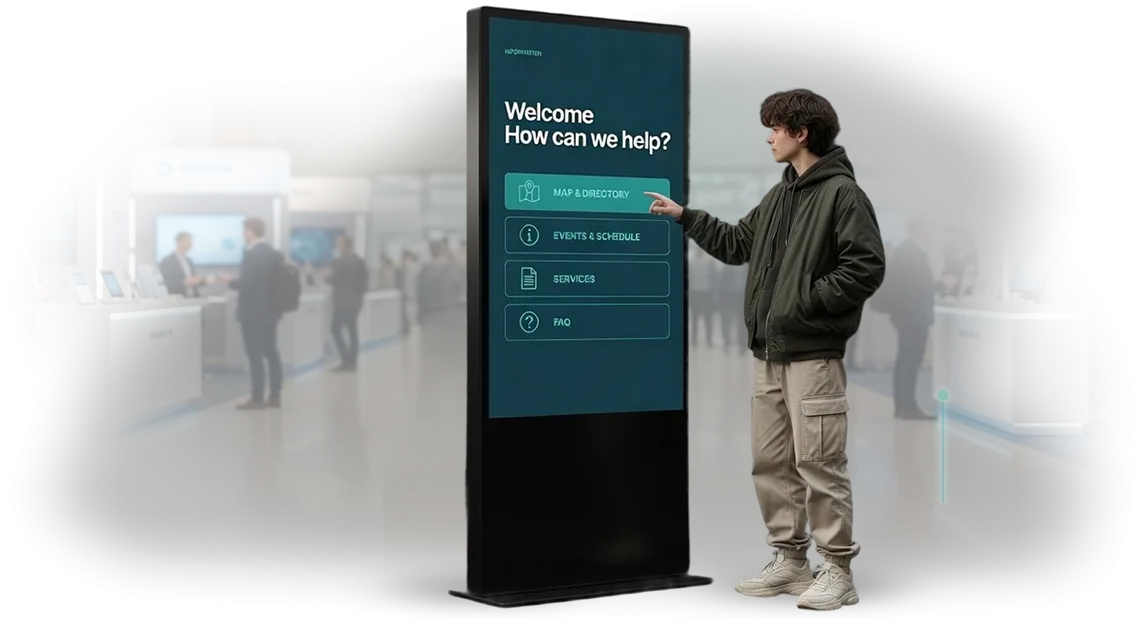
Interactive kiosks integrated with ticketing management systems solve this problem. The guest independently selects a service, pays, and receives a ticket within a minute — without a cashier and without standing in line.
Kiosks handle routine operations, while staff shift their focus to resolving non-standard requests and helping those who genuinely need assistance.
For business, this means increased throughput and a steady flow of customers even on the busiest days. Ticketing management systems synchronize all points of sale: kiosks automatically pull up current rates, session schedules, and seat availability.
Visitors see accurate real-time information, and you eliminate "human factor" errors in ticket sales.
Kiosks become a fully-fledged part of your infrastructure, not standalone devices. Ticket automation frees up resources, speeds up service, and makes the purchasing process predictable.
Implementing this combination pays off through increased ticket sales and reduced workload for ticket office staff — you get more satisfied guests and fewer operational headaches.
How a kiosk with a ticketing system speeds up guest service
Service speed
Guests don't like queues — long waits ruin the impression even of a good event. An interactive kiosk linked to a ticketing system issues a ticket or pass within seconds: the guest selects a service, pays, and receives confirmation without an administrator's involvement.
As a result, the flow of visitors moves faster, and your staff focus on truly important matters instead of routine processing. This reduces the workload on personnel and cuts guest waiting time several times over.
Round-the-clock operation
A kiosk doesn't get tired, doesn't take breaks, and doesn't wait for the end of the workday.
If your venue operates around the clock or you're hosting an event across different time zones, guests can buy a ticket or register at any moment — even when the administrator's desk is already closed.
This is convenient both for those who arrive early and for those who stay after the main program. You extend service hours without additional staffing costs.
Business analytics
Every interaction with a kiosk becomes data: which services are in demand, when peak hours occur, how often guests return. This statistics reveal the real sales picture and support decisions — from operating hours to the range of services.
You no longer need to compile reports manually or guess what visitors like. The system accumulates the information itself, and you use it to improve service and plan ahead.
Higher average ticket value and loyalty
A kiosk can offer additional options: express entry, a guided tour, a souvenir, or a special offer. This increases the average ticket value — guests are more willing to accept an upsell when they see a personalized recommendation right at the moment of purchase.
And a fast, simple process creates a positive impression, so visitors come back and recommend you to their acquaintances. Loyalty grows not because of discounts, but because of the comfort you provide.
Kiosk formats: comparison and choosing for your task
Let's start with the main point: a self-service kiosk is not a "box with a screen" but a tool that must match your sales or service scenario.
A well-chosen format speeds up the queue, reduces staff workload, and increases the average ticket value — a poor choice adds problems for both guests and administrators.
We work with four basic formats. Below is a comparison to help you choose equipment for your task rather than "by eye."
Format comparison table: what to choose and why
| Kiosk format | Who it suits | What it gives the customer |
|---|---|---|
| Freestanding floor-standing | Train stations, shopping centers, clinics, government institutions — venues with high foot traffic | Resistance to heavy use, round-the-clock operation, fast queue service |
| Tabletop | Ticket offices, administrator desks, small points of sale | Space savings, mobility, quick start without installation work |
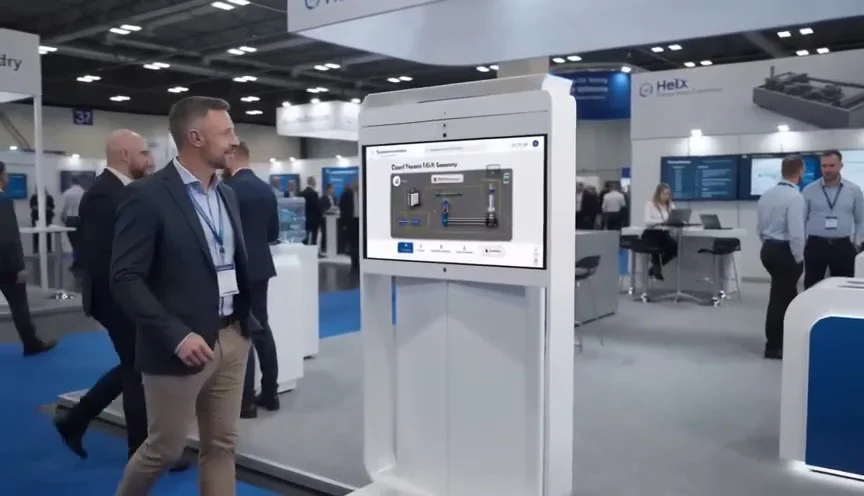
| Touchscreen stand (floor-standing) | Museums, exhibitions, showrooms, event venues | Attracts attention, creates a "wow effect," works as a navigation element |
| Built-in / recessed | Banks, sales offices, reception areas | Neatly fits into the interior, protected from dust and mechanical damage |
If your priority is ease of launch and budget, go with the tabletop option: it requires no construction work and is connected within an hour. For high foot traffic and outdoor use — choose a floor-standing unit with a protected enclosure.
And if the presentation aspect and media appeal matter, a touchscreen stand pays off through visitor engagement and additional social media reach.
At the same time, we adapt any of the formats to your task: from design and anti-vandal coating to integration with your ticketing management system. Just outline the scenario — and we'll propose a solution with specific parameters, timelines, and budget.
How the project proceeds: from brief to launch
The project follows a transparent schedule: you always know what's happening and when the result will be ready. We take care of the entire journey — from the initial brief to launch and ongoing support — so you don't have to coordinate contractors or dig into technical details.
-
Brief and objectives. You tell us about the event, format, visitor flow, and integration requirements with the ticketing management system. We record the goals and success criteria — what the kiosk should do and what value it should bring to your business.
-
Analysis and prototype. We study the logic of your ticket office or ticket operator, propose guest behavior scenarios, kiosk placement schemes, and screen structures. You receive a prototype and approve it — no surprises at the development stage.
-
Development and configuration. We create the design, interface, and software. We set up data exchange with your ticketing system: sales, verification, cancellations, reporting. At this stage, you see intermediate results and make edits.
-
Testing. We test the kiosk against real scenarios: purchase, refund, connection failure, peak load on the event day. We make sure the system won't let you down at the most critical moment.
-
Launch and training. We install the kiosk at the venue, connect it to your system, and put it into operation. We provide a brief staff training: how to replace the paper roll, reboot the kiosk, and pull reports.
-
Post-launch support. We stay in touch: we monitor operation, update software, and respond quickly to requests. If an unusual situation arises — we'll resolve it before it affects guests.
This sequence helps meet deadlines and avoid downtime: each stage ends with a clear result. And integration with the ticketing system is verified before the event opens — you get a working kiosk from day one.
What's included in the delivery of an interactive kiosk
When you order an interactive kiosk, you get not just a device but a ready-made solution for working with visitors. We put the package together so that after installation you can launch the kiosk immediately and not get distracted by technical details.
- Kiosk hardware — enclosures with anti-vandal construction, a touchscreen, and a built-in computer designed for round-the-clock operation. You won't need to buy anything separately or search for compatible components.
- Preinstalled software — our platform with a configured interface is already loaded onto the kiosk. We handle integration with your ticketing management system, so the kiosk works with your data from day one: sells tickets, accepts payments, shows the schedule.
- Screen design mockups — we style all pages in your corporate identity and adapt them for different usage scenarios. The screen attracts guests' attention and looks like part of your brand, not a separate technical device.
- Operating documentation — we provide simple instructions: how to turn it on, how to replace consumables, how to resolve typical issues. Staff can figure it out without calling in specialists.
- Staff training — we conduct in-person or remote training for your team. We explain how to manage the kiosk, monitor supplies, upload new data, and act in unusual situations.
- Installation and commissioning — our engineers visit the site, install the kiosk, connect it to the network and your systems, and verify all functionality. You get a working device without needing to hire contractors.
- Warranty and technical support — all kiosks include warranty service. Our team is available by phone and remotely, and visits the site when necessary. If the kiosk fails, we'll resolve the issue as quickly as possible.
In essence, you get a turnkey solution: from installation to staff training and ongoing support. We can adjust the package to your business specifics — add payment modules, printing, electronic queueing, or other functions. Everything needed for a fast launch and stable operation is already included in the delivery.
Case study: sales growth after kiosk implementation
The organizers of a large themed exhibition faced a pain typical for the events business: during peak hours, the queue at the ticket offices stretched to 20–30 minutes.
Every tenth visitor turned around and left without getting a ticket — while complaints about the long wait multiplied on social media. As a result, the exhibition was losing up to a quarter of its potential revenue, and managers had to compile sales reports manually.
We proposed installing an interactive kiosk and connecting it to their ticketing management system. The guest selects the required ticket type, applies a promo code, pays by card, and receives a pass — without a cashier.
The kiosk is synchronized with the ticketing system, so all sales data automatically flows into reports, and staff gain time to handle more complex issues.
The effect was noticeable on the very first day. The average purchase time at the ticket office dropped from five minutes to thirty seconds, and ticket sales grew by 35% compared with the previous exhibition — and that was without any additional ad spend.
The exhibition gained transparent statistics on attendance by hour and ticket category, enabling better planning for the next season.
The exhibition director summarized the result: «We stopped losing people in queues and finally saw live sales analytics. The kiosk paid for itself within a week, and visitors praise the convenience of entry. We've already ordered two more kiosks for future events.»
This case clearly demonstrates: a kiosk integrated with a ticketing system is not just a cashier replacement, but a revenue growth tool. By removing the main bottleneck in sales, we helped the organizers increase income and win back satisfied guests. The format easily scales to museums, parks, conferences, and other venues with visitor traffic.
How to choose a kiosk format for your event?
Choosing a kiosk format is not a matter of taste but a calculation for a specific event. To avoid overpaying or losing guests in line, just check three parameters: visitor numbers, budget, and time until launch.
These determine how many stations to install, what type of equipment to choose, and how deep the integration needs to be configured.
Start with attendance. If you expect up to 200 guests per hour, one or two compact floor-standing kiosks are sufficient. For flows of 500 people or more, it makes more sense to set up several registration points or mobile stations — that eliminates queues.
The key point is that the kiosk is linked to your ticketing management system: the guest registers, receives a ticket, and you see occupancy in real time.
Budget determines not only equipment rental but also the scope of custom work. Basic configuration — loading guest lists, printing passes — takes a couple of days. If you need a custom enclosure design or multiple interface languages, allocate more resources. The investment pays off through faster throughput and reduced staff workload.
Timelines are the third constraint. Ready-made kiosks are configured in 5–7 days. A custom enclosure or complex booking logic will require two to three weeks.
That's why we fix the event date and work backward from it: we propose a format we can produce, deliver, and test before the opening.
The conclusion is simple: a kiosk that fits your task is one that processes the required number of guests, fits the budget, and makes it in time. Send us your event parameters — we'll calculate the optimal configuration within one day, without unnecessary options or hidden work.
Frequently asked questions about kiosks and integration
We understand: buying a kiosk is not about hardware, it's about confidence. What happens if the equipment fails? How quickly will integration with ticketing management systems start delivering value? And who is responsible for uninterrupted operation on the busiest day? Below are answers to the questions clients most often ask before launch.
What happens if the kiosk breaks down in the middle of an event?
Every kiosk comes with a warranty and a service contract: in the event of a breakdown, we handle the repair ourselves and deliver a replacement unit within 1–2 days. Downtime is reduced to zero — your guests won't even notice the failure.
How quickly will an interactive kiosk pay off?
A kiosk replaces 1–2 staff members at the ticket office or information desk and speeds up service by 2–3 times. At high-traffic events, the investment pays off within 1–2 events, and at a permanent location — within several months thanks to repeat visits and additional sales.
Do I need to buy separate support?
Support is already included in the base contract. We remotely monitor the kiosk, update software, and refresh content on your request. You focus on business tasks, and the technical side is on us.
How secure is integration with ticketing management systems?
All data is transmitted over a secure connection, and access to kiosk management is strictly limited. You get a closed environment protected from external interference — visitors' ticket data and sales reports remain confidential.
What else do people ask about kiosks?
Most often they ask about launch timelines (2 to 4 weeks), the possibility of renting for an event, and adaptation to custom design. We'll answer any question at a consultation — just write to us.
Order turnkey kiosk development
When you order a kiosk on a turnkey basis, you get not just a terminal but a ready-made sales tool that starts working from day one. We take on the entire process: from developing visitor interaction scenarios to connecting your ticketing system.
You don't need to understand technical details — you get a solution that increases revenue and reduces staff workload.
After the kiosk goes live, the business gets measurable results: a higher average ticket value through additional services, shorter queues at ticket offices, and accurate demand analytics.
Guests appreciate the speed and convenience — this directly affects loyalty and the number of repeat visits.
What you get after launch
- Higher sales through automatic prompts, additional services, and convenient payment methods.
- Guest loyalty — visitors get through faster, don't stand in queues, and receive personalized offers.
- Full statistics on sales, sessions, and customer behavior — data is visible in your personal account.
- Integration with your ticketing system — tickets, bookings, and reports are pulled automatically.
- Maintenance and support — we support the project after launch and handle the technical side.
- Guaranteed on-time launch — you know the readiness date in advance and don't depend on your internal IT team.
We work remotely across the entire country and have been helping museums, parks, and entertainment centers increase revenue with interactive kiosks for over 10 years.
To get started, just describe your task — we'll then propose a solution, calculate the economics, and show how the project will pay off.
Order turnkey kiosk development — and within a few weeks your visitors will be buying faster, while you gain transparent statistics and sales growth. Submit a request to get a cost calculation for your format and ticketing system.