

A Kiosk Without Content Management System Integration Loses Visitors
Visitors come to a shopping mall, clinic, or museum to get an answer within seconds: where the department they need is, what promotions are active, how to find the exit.
If an information kiosk is not connected to a content management system, old data remains frozen in it forever.
Within a couple of weeks, the interactive kiosk stops being a helper and starts to annoy — the visitor cannot find what they need, wastes time, and goes to the staff desk, while the business loses reach and revenue.
Outdated kiosks are also hidden operational losses. Updating content in each kiosk manually is slow and unreliable: somewhere a file is forgotten to be replaced, somewhere different data is entered at different locations.
As a result, in one hall a visitor sees an active promotion, in another — an already cancelled one, and trust in the brand drops. Campaigns launch late, managers have to control each location individually, and every such failure means lost revenue.
The solution is to connect every interactive kiosk to a single content management system. Then content updates in the kiosk happen centrally, at the right time, and without staff involvement.
We design and set up such integration: data is pulled automatically from your website, internal price database, or schedule, and all edits are made in one window. This takes minutes, not days.
After that, the information kiosk always shows up-to-date prices, schedules, routes, and news. The visitor gets an accurate answer in seconds, is more likely to return, and recommends you to others.
We not only launch the system but also continue supporting it so the connection to content works reliably and the kiosk does not become outdated along with the information.
What Changes After Integrating Your Kiosk with Your Content
When the kiosk is connected to your content management system, it stops being a static display and becomes part of the workflow. Updating data — whether it is a promotion, news, or the price of a service — takes minutes, not days.
This removes the main pain point: "the information became outdated before we even printed it."
| What changes | How it looks | Business benefit |
|---|---|---|
| Fast kiosk updates | Edits are made in the system and appear on screen immediately | No downtime or costs for sending out a specialist |
| Content management without a programmer | A marketer or office manager changes materials independently | Speed of reaction to market changes |
| Always fresh materials | Promotions, events, and product information are current at any moment | Customers see accurate data, fewer disappointments |
| Increased engagement | Content adapts to the time of day and visitor requests | More interactions and higher conversion to purchase |
Integrating your kiosk with your content management system pays off within the first weeks: you stop checking accuracy manually and get a tool that works to attract attention.
For the company, this is time savings and increased customer loyalty — customers appreciate when information does not mislead.
Below are answers to frequently asked questions about how integration goes and what support will be needed after launch.
Interactive Kiosk Formats for Different Tasks
Choosing a kiosk format starts not with design but with how exactly visitors will use the information.
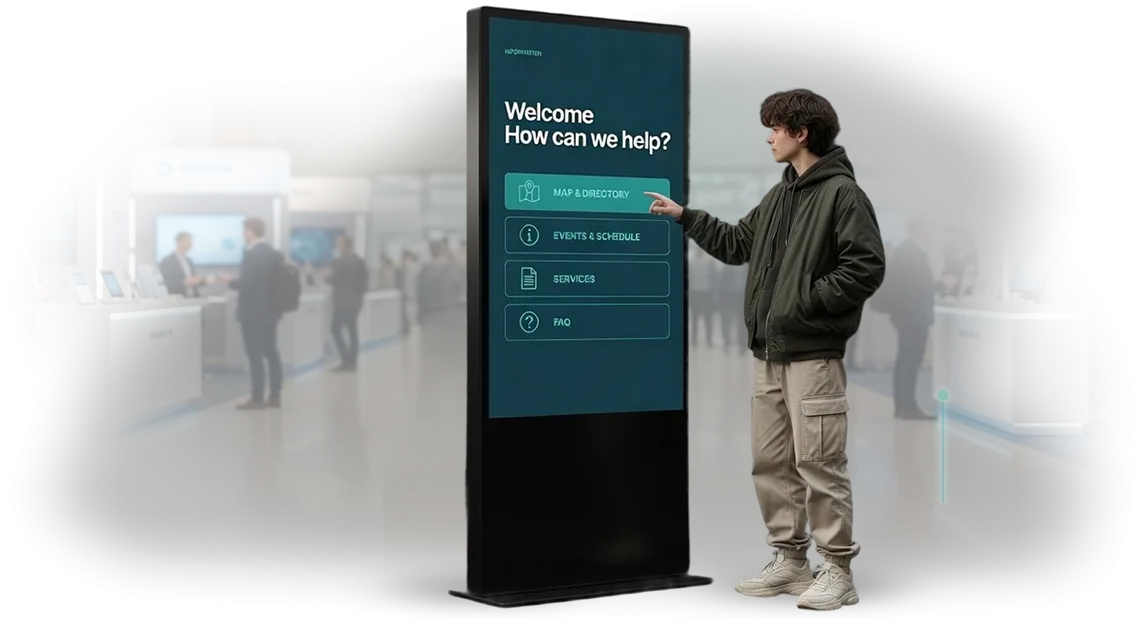
A floor-standing kiosk is convenient for quick reference and navigation, a wall-mounted one for places with queues and limited space, and a touch table for collaborative exploration of materials.
At the same time, any format connects to your content management system: changes are made once and appear instantly on all screens.
| Format | Who it is for | What it gives the customer |
|---|---|---|
| Floor-standing kiosk | Shopping malls, museums, train stations, exhibition halls | Stable construction under high foot traffic, quick access to catalogs, maps, and reference information |
| Wall-mounted kiosk | Clinics, offices, educational institutions, lobbies | Space saving, information in the waiting area, appointment scheduling with a specialist, timetables, visitor surveys |
| Touch table | Showrooms, presentation zones, impulse-format museums | Collaborative content exploration, impressive product demonstrations, interactive catalogs in a live format |
Whichever option you choose, administration is set up through the content management system: you update texts, images, promotions, and schedules yourself without a contractor.
This removes the dependence on a developer and reduces response time to changes — content appears on the kiosk online immediately after publication.
If you are unsure about the format, start with the task: the visitor journey, the number of simultaneous users, and the available space.
We will suggest the optimal solution and plan the zones so the kiosk works toward results — draws attention, speeds up service, and increases loyalty to your brand.
How We Launch a Project: From Brief to Ready Kiosk
A turnkey kiosk launch is a process in which you always understand what is happening and when the result will come. We have structured the kiosk launch stages so you see only the key points: brief, plan, finished kiosk. Everything else is our job, including integration with your content management system.
-
Kiosk brief — we discuss goals, audience, and scenarios. We determine what to show and how often to update. You get a clear understanding of what the kiosk should provide to your customer.
-
Plan and estimate — we set timelines, stages, and areas of responsibility. You see the cost and launch date before work begins, with no hidden "surprises."
-
Prototype and structure — we agree on the screen layout and navigation logic. We set up the connection to your content management system so materials can be changed without a developer.
-
Project implementation — we develop the design and logic, connect the content. We test the kiosk at your site so it works stably all day.
-
Turnkey kiosk launch — we install the equipment, upload content, and train your team. You get a working kiosk and simple instructions.
-
Post-launch support — we handle content updates and quick response to any questions. You always know who to contact and do not distract your employees.
What Is Included in Kiosk Delivery and Setup
When you order a kiosk from us, you get a ready-made turnkey solution — from the enclosure to the first power-on. Below is the delivery contents so you clearly understand what is included in the cost and what you will get in the end.
-
Delivery package — we will deliver and install everything needed: enclosure, touch screen, system unit, power supply, and mounting hardware. We will connect everything, check that it works on site, and only then hand the kiosk over for operation.
-
Interface design — we will develop a clear and recognizable on-screen interface in your brand style: menu structure, buttons, fonts, colors. We will coordinate each stage with you so visitors can easily find the information they need without staff assistance.
-
Kiosk setup — we will install and configure the software, upload your materials, and define operating scenarios for different situations. We will set up protection against failures and accidental user actions so the kiosk runs stably even during peak hours.
-
Content management system integration — we will connect the kiosk to your content management system so you can update information remotely, without a contractor.
Changed a promotion, added a new page, or replaced an image — all this is done in a couple of clicks in a familiar interface.
-
Staff training — we will conduct brief training for administrators and frontline employees: how to turn the kiosk on and off, update content, export statistics, and resolve common issues. We will provide clear instructions that will always be at hand.
-
Warranty and support — we will provide a warranty on equipment and software and set up a support channel for prompt issue resolution. You will not be left alone with the technology after the project is completed.
We take on all stages — from design to launch and after-sales support. As a result, you get a working kiosk, a trained team, and an understandable content management system — with no hidden work or surprises.
Case Study: How a Kiosk Brought Visitors Back Within a Month
Let us share a real case study: the contemporary art museum "Signal" approached us. Visitors went through the exhibition in an hour, took photos, but did not return. The management wanted the visit to be memorable and to give people a reason to come again.
We installed two interactive kiosks — at the entrance and in the lobby.
They featured an exhibition map, exhibit stories, and a "personal route": the visitor selected topics of interest, the kiosk remembered the choice, and at the exit suggested a scenario for the next visit.
The museum's content managers themselves changed the program, news, and quiz questions through a simple management system. Updates did not require involving programmers or waiting for us.
Project Results
Within a month, visits increased. Metrics showed: 62% of guests used the kiosk, the average time at the screen was 4 minutes, and most importantly — 23% of visitors returned within a month. Before that, there were almost no repeat visits.
Why did it work? The kiosk provided a personal experience, and the content management system made it possible to quickly update the "hooks": new questions, quizzes, special offers. Visitors return not for the hardware but for the fresh experience the kiosk announces.
Today we use this approach in galleries, shopping malls, and exhibitions. We handle the launch, staff training, and technical support — the client gets growth in repeat visits without diving into technical details.
What If the Kiosk Breaks Down or Needs Modifications?
A kiosk breakdown is not a reason to panic if you have a responsible contractor nearby. We include a warranty on equipment and software, so you get a working service rather than just a device.
Project support is active for the entire service life: remote monitoring, preventive maintenance, and response to emergencies. This reduces the risks of downtime and event disruption.
If the kiosk freezes or content does not load, a remote connection is enough — a specialist will restore operation in 15-20 minutes. The failure will remain invisible to your visitors. When kiosk repair is needed, we bring a backup device or replace the module on site.
Spare parts are stocked for all our projects, so you will not have to wait for delivery from abroad.
The kiosk warranty is at least 12 months and covers hardware, software, and content management system integration. Modifications do not stop the device: adding a section, changing logic, or embedding a visitor survey can be done at any time according to an agreed plan. As a result, the system grows with your business instead of becoming obsolete.
Frequently asked questions:
What if the kiosk breaks on the day of the event?
For such cases, replacement with a backup kiosk is provided. If the failure is software-related, we resolve it remotely within half an hour. You do not need to understand the technology — just call an engineer, and we take care of the rest.
What is the warranty on the kiosk?
The standard term is 12 months from launch. This includes free repair, component replacement, and software updates. If you wish, we extend support into the second and third years — you get the same response speed as in the first month.
Can the kiosk be modified after launch?
Yes. Adding new sections, changing the design, or connecting an integration with your accounting system can be done without downtime. You send a request, we assess the timeline and cost, and after approval we make the changes — remotely or with an engineer visiting on site.
Order Kiosk Development for Your Task
To order kiosk development, you do not need to be a technical specialist or understand the equipment. It is enough to describe the task — we will take care of the rest.
Submitting a kiosk request takes a couple of minutes, and then you receive a clear plan, timeline, and project estimate.
Here is how the work will look after you contact us:
- We clarify the scenario: where the kiosk will be located, who will use it, and what it should do — sell, inform, collect contacts, or entertain.
- We select the format for the task: floor-standing or wall-mounted, with a large screen or compact — taking into account the space and visitor flow.
- We calculate the project by timeline, scope of work, and cost — with no hidden payments or "surprises" during approval.
- We prepare an interface prototype so you can see the operating logic and make edits before production starts.
- We integrate the kiosk with your content management systems — after that, you will be able to change materials without a programmer.
- We hand over the kiosk turnkey: setup, testing, staff training, warranty on equipment and software.
Ordering kiosk development means getting a ready-made solution rather than a list of tasks. We support the project from brief to launch and stay in touch afterward: content updates, modifications, technical support — all in one window.
Submit a kiosk request through the form or a messenger. Within a business day, we will ask clarifying questions, suggest the appropriate format, and send a preliminary project estimate. After that — the decision is yours.