



A kiosk without integration with the patient management system — queues and errors
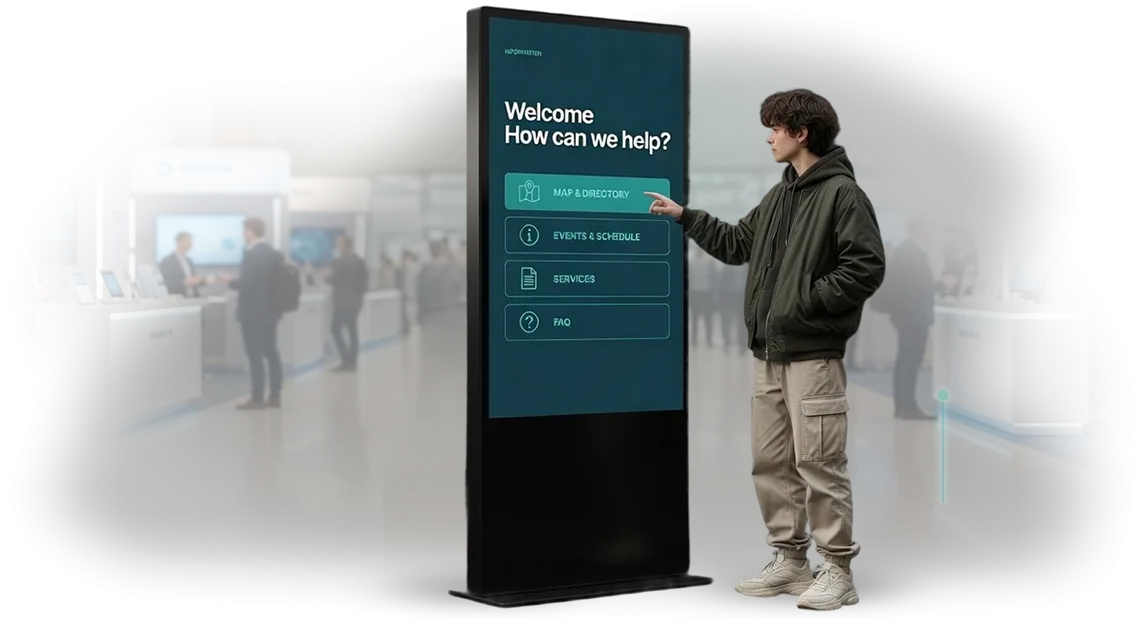
An interactive kiosk without integration with the patient management system is a beautiful but useless device in the lobby.
The patient approaches it to book an appointment with a doctor or take a place in the electronic queue, but the terminal sees neither the schedule, nor available slots, nor up-to-date data.
As a result, the patient still ends up in the queue at the reception desk — and the time the kiosk was supposed to save is lost again.
Worse still, without integration with the medical system, errors appear: manual data entry leads to duplicates and typos, and the lack of synchronization with the actual appointment time leads to incorrect tickets.
The patient arrives for the appointment, but the doctor is busy or the office has changed. The result is conflicts, dissatisfaction, and additional strain on the staff, who have to resolve every situation manually.
A "smart" panel on its own does not solve the queue problem.
What solves it is the combination: the kiosk must operate in a single ecosystem with the patient management system (EMR) — only then does it become a full-fledged tool for appointments, electronic queuing, and patient information.
Wehave been designing such integrations for medical institutions for over 10 years and know how to connect a terminal to your infrastructure so that it genuinely relieves the reception desk.
So when choosing an interactive kiosk, the first thing to check is whether it is integrated with your patient management system. Without that connection, the device does not save time — it creates new queues and errors.
We address this issue at the project stage: the kiosk is initially designed in conjunction with your EMR, so patients book their appointments with doctors, and the queue at the reception desk disappears.
Why clinics need interactive kiosks: key benefits
An interactive kiosk in a clinic is not just a screen in the lobby, but a tool that changes the work of everyone involved in the process.
Patient convenience starts at the doorstep: the visitor independently selects a service, books a convenient time, and sees the current queue status — without the long wait at the desk. Instead of a crowd at the reception, the patient gets a calm, predictable visit.
For administrators, automating the reception area removes the main routine: the kiosk accepts requests, verifies available slots, and prints tickets and referrals.
Staff stop juggling phone calls and visitors, and the freed-up time is directed toward personal attention and handling non-standard situations. This noticeably reduces the workload on staff and decreases the number of errors during appointment booking.
The clinic owner gains several strategic benefits at once. Improved service leads to greater loyalty: patients return and recommend the clinic.
A kiosk integrated with patient management systems streamlines the data flow — management sees the real workload of offices, the popularity of services, and can plan resources without lengthy data collection.
The result is a short checklist for management: the patient saves time and gets through the visit without stress; the administrator is free of routine operations and works with full efficiency; the clinic gets an automated reception, transparent statistics, and the reputation of a modern center.
The specific configuration depends on the clinic's objectives, but the benefits scale with the flow of patients: the more visitors, the more visible the effect.
Kiosk formats: from self-service appointment booking to patient management
Each interactive kiosk format solves its own task: one helps the patient book an appointment, another helps quickly find an office, and a third relieves the reception desk.
The maximum effect comes from combining formats with integration into the patient management system: data from the kiosk immediately enters the electronic medical record, bypassing manual entry and staff errors.
| Kiosk format | Who it is for | What it gives the patient |
|---|---|---|
| Appointment kiosk | Patients without a prior appointment | Appointment booking in 1–2 minutes, shorter queues |
| Wayfinding kiosk | Visitors to the medical center | Quick office search, fewer questions for staff |
| Info kiosk | Patients in the lobby | Current services, promotions, preparation guidelines for tests |
| EMR integration | Administrators and doctors | Visit immediately in the electronic record — no double entry or data loss |
The key point: formats can easily be combined in a single device. An appointment kiosk can simultaneously show wayfinding and provide guidance on how to prepare for an examination, with all events automatically transferred to the patient management system.
A properly selected kiosk works for the doctor and the administrator. The patient gets to the appointment faster, the reception desk is relieved of repetitive questions, and management sees the real workload of departments. This reduces operating costs and increases patient loyalty.
How we implement a kiosk in your clinic: 6 steps
Implementing a kiosk is not a purchase of a device, but a small project that must fit into an already operating clinic.
To make sure everything goes smoothly, we guide you through a clear six-step process — from the first discussion to the moment the kiosk starts accepting patients.
- Brief and process analysis. We study how appointment booking currently works, where queues occur, and what scenarios your specific patients need.
- Project plan and approval. We set deadlines, responsible parties, the scope of work, and the integration scheme between the kiosk and your patient management system, including the electronic record.
- Scenario configuration. We prepare the interface: appointment booking, ticket issuance, status checking, payment, staff hints — all tailored to your internal rules.
- Integration with your system. The kiosk exchanges data with the medical system, so appointments appear in the electronic record immediately, without manual transfer or errors.
- Test launch and staff training. We verify processes on-site and train administrators and doctors so they work confidently with the new entry point.
- Launch and support. We bring the kiosk into operation, monitor its performance, update scenarios to match schedule changes, and promptly respond to staff questions.
With this sequence, you always know what stage the project is at, what happens next, and when the kiosk will start genuinely relieving the reception desk. We handle all the technical details — you just monitor the results.
What you get in the package together with the kiosks
You get not just a device, but a complete turnkey solution. We — our team — have put together a delivery package so that the kiosk starts delivering value from day one, without involving your IT staff and without missing deadlines.
The standard package includes:
- Ready-to-use kiosks with a touchscreen, a durable enclosure, and a well-thought-out design — suitable for lobbies, waiting areas, and corridors of the clinic.
- Pre-installed software with integration into the patient management system (EMR): patients book appointments themselves, check the schedule, and receive their ticket.
- Operating instructions for staff: simple, clear, with pictures and typical patient questions.
- Training for administrators and receptionists: a short practical course after which staff work confidently with the kiosk.
- Licensed software and scheduled updates: no hidden fees, no downtime, and no "improvisation" by staff.
- Official warranty and technical support: we stay in touch while the kiosk operates at your facility.
This package addresses the customer's main concern — "what if something breaks?". You know in advance that the equipment is covered by warranty, the staff is trained, and all instructions are in place. All that remains is to turn on the kiosk and show it to patients.
Case study: how kiosk integration sped up appointment booking at a medical center
Kiosk implementation is most often associated with retail — but in medicine, they save what matters most: people's time and nerves. The patient does not arrive empty-handed: they need help, not a battle with a queue at the desk.
That is exactly why integrating a kiosk with the electronic medical record delivers results that are visible immediately — to both patients and administrators.
The "Vita" medical center faced a familiar challenge: peak load in the morning and evening, 15–20 minutes of waiting at the administrator just to book an appointment.
At the same time, the number of errors from manual data entry was growing — both the EMR and the patients themselves suffered.
We connected the kiosk to the existing patient management system, and the patient journey changed: the visitor selects a doctor at the kiosk, the system verifies schedule availability, and updates the electronic record without staff involvement.
| Metric | Before implementation | After implementation |
|---|---|---|
| Time to book a doctor's appointment | 12–15 minutes | 2–3 minutes |
| Queue at the desk during peak hours | up to 15 people | 2–3 people |
| Appointments made via kiosk without an administrator | 0% | 35% |
| Patient data errors per week | 8–10 cases | 1–2 cases |
The most valuable part here is not numbers for the sake of numbers. The reduced queue, the time to book, and the administrator's workload changed the atmosphere of the reception department and allowed staff to focus on patients rather than paperwork.
After two weeks of kiosk operation, the center kept it permanently and moved some administrators from booking to more important tasks. And for patients, interacting with the kiosk became so familiar that the share of self-service bookings continues to grow.
What if you need a non-standard kiosk solution?
A standard kiosk handles typical tasks, but every clinic has its own scenarios: a narrow specialization, a specific booking process, non-standard patient routing, or internal regulations. In such cases, an off-the-shelf solution requires customization — and that is normal. We do not force the clinic to fit the kiosk; we adapt the kiosk to your processes.
Individual requirements are not only about appearance. Often the workflow logic needs to change: first show the schedule of a specific department, then collect additional data, and only then transfer the appointment to the patient management system (EMR).
Or simplify the interface down to a single screen for fast self-service booking without an administrator.
We start by analyzing your current process: who books patients and how, what data is collected at the entry point, and what happens afterward.
Then we propose a scenario that preserves your team's familiar workflow while adding the kiosk's advantages — speed, patient independence, and reduced load on the reception desk.
All customizations are approved before launch so you understand in advance how patient interaction will change.
If the clinic has specific characteristics — multiple branches with different rules, special patient categories, or confidentiality requirements — we take them into account at the design stage.
A non-standard solution may include additional data collection screens and special authorization scenarios through the EMR. The key is that the kiosk becomes a natural part of the system, not a separate "black box."
The bottom line: you get a kiosk that works exactly the way your clinic needs it to. We handle the design, development, and integration — you control the result at every stage.
Common concerns before launching kiosks: honest answers
We understand: questions arise before launching kiosks — that's normal. The fear that technology will fail, staff won't adapt, and patient data will be at risk is familiar to every clinic manager. We answer the most common concerns honestly, so that decisions are made based on facts.
How much does launching kiosks cost?
The cost depends on the number of locations, the configuration, and the depth of integration with your patient management system. After the brief, we prepare a transparent cost estimate with no hidden fees, and payments are split into stages: start, delivery, launch. The budget is clear before the work begins.
What happens if the kiosk freezes in the middle of appointment booking?
The kiosk runs on professional hardware and refined software proven in dozens of clinics. In the event of a failure, the system restarts itself, and patient data is not lost — it is saved in your EMR. A fallback mode allows the administrator to switch the flow to themselves.
How secure is the transmission of patient data?
Security is a priority. Access to the electronic medical record goes through a secure channel with role-based access control. The kiosk only sees the information needed for booking and does not store it after the session. Everything complies with personal data requirements.
Won't staff resist working with new technology?
Training takes a couple of hours, and the interface follows the logic of familiar booking processes: cards, referrals, schedules. We provide short cheat sheets and video instructions. Staff quickly see the benefit — fewer queues, more time for real patient interactions.
How long does the launch take?
The timeline depends on the number of locations and the depth of integration, but it is usually a few weeks from brief to launch. Exact dates are fixed in the contract, and the pilot period is supported by our team. We launch during "quiet" hours to avoid disrupting patient flow.
Order kiosk development with integration tailored to your clinic
An information kiosk only delivers value when it is embedded in the clinic's real processes. We develop kiosks and connect them to your patient management system, so appointments and data immediately enter the electronic record, and the reception desk is relieved.
Start with a free consultation — we will review your situation, calculate the project, and propose a solution that pays off.
How the work proceeds
We take on the entire cycle — from inquiry to launch and support. You don't need to understand the details of integration; we accompany the project at every stage.
- You submit a consultation request — we discuss the clinic's objectives, kiosk formats, and integration requirements.
- We study the current processes: how appointment booking works, patient routing, and where queues occur.
- We calculate the project: timeline, scope of work, connection points to the patient management system.
- We design the interface around your brand and configure EMR integration — no "raw" solutions or hidden customizations.
- We run testing on real scenarios, train administrators, and launch the kiosk.
- We remain on support: we update scenarios, monitor stability, and help add new features.
Submit a request to order a kiosk
To order a kiosk or get a consultation, fill out the form on the website — we will contact you within one business day. We will clarify the details, calculate the project, and prepare a commercial proposal tailored specifically to your clinic.
We work remotely across the entire country, so we can start any day — don't waste time searching for contractors and dealing with technical issues.