

Customers leave if the kiosk does not work with video conferencing systems
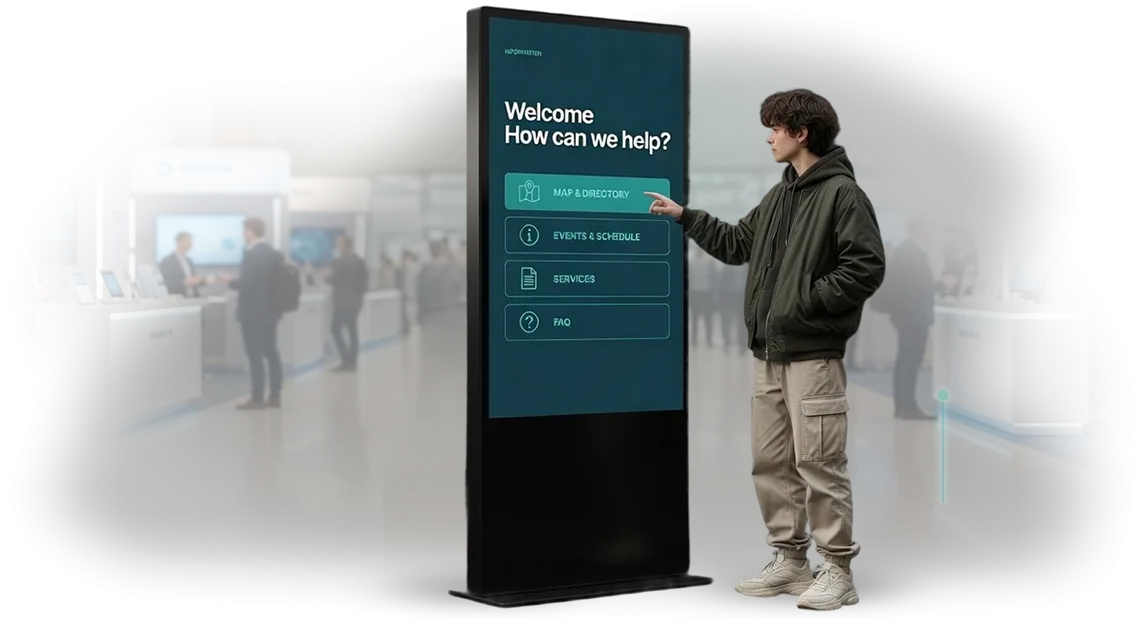
When a customer approaches a kiosk, they have a specific question or need. If the machine offers only a static menu and no live response, the visitor leaves.
This often happens because the interactive kiosk has no video link with a consultant: the person has no one to discuss details with, and they lose trust in the brand.
As a result, the business loses not just one customer but an entire channel of inquiries. A visitor who does not receive a consultation leaves no request, makes no purchase, and does not return.
Meanwhile, the company has already invested in equipment and placement—but the kiosk works in vain instead of turning attention into requests and sales.
Video conferencing in a kiosk solves this problem. A remote consultant appears on the screen in seconds, answers questions, helps choose a product, and immediately accepts the request.
This format brings personal communication back into a digital point—and for the customer, it is a sign that the company is available and ready to help right here and now.
By losing customers due to limited functionality, you also lose repeat sales and recommendations. Introducing video communication is not a technical improvement but a direct tool for retaining your audience.
That is why we focus on seamless kiosk integration with video conferencing systems, so that every touchpoint ends with a result.
What a live video link with an expert gives a kiosk
A kiosk that merely displays a catalog rarely holds attention and often leaves the visitor alone with a question they cannot get answered. A potential customer leaves, and the business loses contact at the most important stage—at the moment of decision-making.
Live video communication with an expert turns a static point of information into a full-fledged dialogue, where a complex product can be explained in a minute and objections can be resolved immediately.
This works on emotion and trust: a live human face evokes more sympathy than any text or video. The visitor feels that their problem is actually being solved, and this directly increases loyalty—they will return to you, not to a competitor with less attentive service. For the brand, this format means a reputation as a company that listens to its customers.
The conversion benefit is also obvious: a person who receives qualified advice at a kiosk is significantly more likely to move to the target action—a request, a purchase, or an appointment.
The expert can steer the dialogue in time, clarify details, and gently guide toward a decision, which is impossible with simple information viewing. In effect, you get a personal manager at every point of presence without the cost of expanding your staff.
Finally, one expert using remote support can serve several kiosks across different cities or offices. This expands your audience reach: even in remote locations, the customer receives the same level of service as in the central office.
As a result, the kiosk becomes a full-fledged sales and brand awareness tool, not just an information stand.
Kiosk operation formats with video conferencing systems
A kiosk with video conferencing turns a lifeless point of information into a live channel of communication with the customer. The visitor receives an expert answer in real time, and you get increased conversion and loyalty without expanding your staff.
The choice of format depends on your tasks and readiness to invest; below are typical scenarios we implement.
We do not lock ourselves into a single solution and select a scheme to fit your business process. All formats run on professional equipment and are easy to update.
| Format | For whom | What it gives the customer |
|---|---|---|
| Direct video call “consultant on the line” | Retail, showrooms, banks | Quick help for the visitor—without a duty employee on the floor |
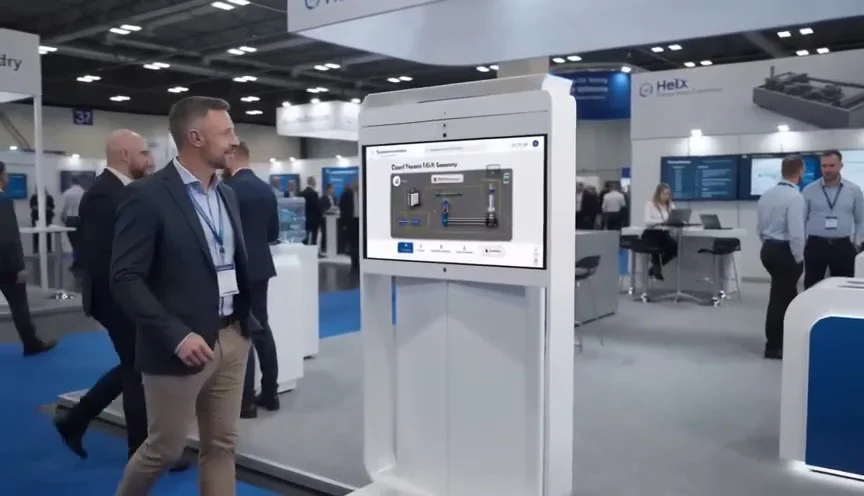
| Expert broadcast to the kiosk | Exhibitions, events | Live presentation for a flow of guests and savings on speaker travel |
| Co-browsing mode | Working with legal entities, complex products | The manager sees what is happening on the screen and guides the customer step by step |
| Switching to the right specialist | Networks with multiple locations | The call reaches the relevant employee according to schedule and language |
| Dialogue recording and reporting | Marketing, quality control | It is clear what questions concern customers and how to improve the communication script |
Any of these formats can be combined: for example, the kiosk first shows a presentation and then, on request, switches to live video. This way you get both automation and human involvement where it closes the deal. We will advise which option suits you and take care of setup and support.
How the project goes: from brief to launch
An interactive kiosk project with video communication is not a “black box” but a transparent process with clear stages.
We have structured the work so that at each step you know what is happening, what you are getting, and when the result will be ready—and you can influence the project during the approval stage.
- Brief and task analysis — we record who the kiosk is for, what usage scenarios are needed, and how video conferencing will be embedded: a guest talking with a manager, remote consultation, or communication with the office. You get a precise understanding of scope and requirements.
- Planning and approval — we propose the solution architecture, stage composition, and timeline. We approve layouts, logic, and the list of functions—you see the plan before development begins.
- Design and development — we create a touch-screen-adapted interface and set up integration with the video conferencing system. The finished solution is branded to fit your corporate style, so the kiosk looks natural in the interior.
- Testing and refinement — we verify all scenarios: quick connection to a conference, switching between participants, and behavior during a connection drop. We eliminate issues before launch, so you get a stable result.
- Launch and staff training — we install the kiosk on site, configure the equipment, and conduct a short briefing for employees. Your team knows how to accept a call, end a session, and update the contact base.
- Support and evolution — we monitor system performance, update content, and add new features when the business requires it. You are not left alone with the technology: you have a reliable communication channel with us.
This stage order removes surprises: you approve key decisions in advance instead of learning about them at the final demo. Each step ends with a clear result—from an approved plan to a working kiosk with video communication.
What is included in the delivery package for your kiosk
You receive not just a device but a ready-made solution for interactive interaction with visitors. The package includes everything needed for the kiosk to work from day one: a configured interface, video conferencing integration, documentation, and training for your team.
We have prepared a list of exactly what you will get after project delivery. This is a turnkey set—without hidden work or additional purchases.
- A kiosk interface configured for your tasks and corporate style—visitors understand how to use it even without prompts.
- Video conferencing system integration: guests can connect to an online session or negotiations directly from the kiosk screen.
- Documentation for administrators and users: instructions for startup, daily maintenance, and handling typical situations.
- Staff training: a short training session after which your employees confidently work with the kiosk and assist visitors.
- Technical support during launch and after—we stay in touch until the system becomes stable.
- Software updates and remote maintenance: the kiosk always runs on the latest version without your involvement.
This package saves you time looking for separate contractors for individual parts of the project. Everything is already configured, tested, and ready to go—all that remains is to turn on the kiosk and invite the first users.
Case study: how a kiosk with video communication increased requests by 1.5 times
A retail chain with high traffic loses some customers where live consultation is needed. Sellers do not have enough hands for everyone, the queue grows, and the visitor leaves without submitting a request.
We closed this gap by combining an interactive kiosk with a video communication system—now a customer gets a consultant in one click without waiting for them in the store.
It works simply: at the product stand, the visitor presses a button on the screen. The specialist answers via video, shows details, and immediately creates an inquiry—the request enters the store’s accounting system even if the customer never makes a purchase.
Project results
In the first month of the pilot zone, the ПланетаСтрой chain received a tangible increase.
The number of targeted requests from kiosks grew by 1.5 times compared to regular stands with paper catalogs, and the average check of visitors who used video consultation turned out higher than that of those who simply studied the display.
Floor staff stopped being distracted by routine questions—video communication took over the routine. Salespeople focused on those already ready to buy and requiring personal presence. This reduced the load on personnel during peak hours and sped up service for live customers.
After the first stage, the client expanded the project to all major locations in the chain. The case showed that video consultations in retail are not an experiment but a working tool that turns visitor flow into measurable requests and repeat inquiries within a short period.
If your chain has a similar situation—visitors are there, but consultation is lacking—tell us about your task. We will calculate what increase in requests a kiosk with video communication will bring at your specific locations.
How to choose the right integration format for your task?
When a client asks how to choose the right format for integrating video communication into a kiosk, we always start with the business task. One thing is a quick consultation with an operator, another is multi-party negotiations or an online meeting for a group of participants.
Both the equipment and the usage scenario depend on this: where the kiosk is located, who approaches it, and how long the session lasts.
We assess the load: the expected number of simultaneous users, frequency of requests, whether a shared screen or a separate meeting room is needed.
This allows us to choose the right configuration—from a simple “press and talk” to a full meeting room with presentation capabilities. This approach makes the solution selection transparent and clear, without diving into technical details.
It is also important how the kiosk fits into your infrastructure. For example, if you already have a corporate video conferencing system, we will configure the integration so that users do not need to figure out anything beyond their familiar interface.
Our task is to make communication work as simply as opening a door and not require support from your staff.
When selecting a format, we take into account kiosk requirements: microphone quality, performance under ambient noise, and screen size for comfortable communication.
All these parameters are aligned with client and guest expectations—so the session starts without delay, the sound is clear, and the image does not fail at the crucial moment.
If you are unsure which format suits you, we invite you for a consultation. We will analyze your task, offer two or three options with an assessment of implementation speed and user convenience, and you will make a decision based on transparent arguments, not technical jargon.
Frequent questions and doubts about kiosk development
Before developing an interactive kiosk, clients have the same doubts: will the equipment break, will it fit into the existing system, will we meet the deadline. The answers to frequent questions are below—so you can make a decision calmly, without technical details.
What if the kiosk breaks down during an event?
We assemble kiosks from professional equipment and check every unit before shipment. If an unusual situation does arise, an engineer is available—remotely helping to eliminate the cause, and if necessary, traveling to the site. Most problems are solved within hours, so your scenario will not stop.
Is the kiosk compatible with our video conferencing system?
The kiosk works with popular video communication services and can be integrated with your corporate platform.
Before launch, we run a short communication test, agree on the scenario, and configure everything according to your regulations—from participant authorization to call recording. You will not have to change your familiar tools.
How long does kiosk development take?
A typical project takes two to four weeks from the moment the scenario is approved. If you need a non-standard design or deep integration with internal services, the timeline increases, but we fix the launch date in the contract. Two weeks before the event, you receive a tested kiosk and instructions for staff.
What warranty do you provide?
The equipment has a warranty—usually from 6 to 12 months depending on configuration.
For the software part and integration, the warranty lasts for the entire cooperation period: if errors are found in the project, we will fix them without additional charges and within agreed deadlines. The main thing is that you get a working tool that will not let you down at the right moment.
Leave a request—let’s discuss your project
Leave a request—and we will analyze your task for free: we will look at how an interactive kiosk fits into your company’s current processes and offer an integration option with video conferencing systems to fit your budget. No abstract promises—only specifics on timeline, scope of work, and results.
After a short consultation, you will receive:
- Cost and timeline estimate—an understanding of the budget before work begins, without hidden surcharges at the implementation stage.
- Video conferencing integration scheme—how the kiosk will connect to your scenarios: negotiations, remote consultations, information panels for visitors.
- Format recommendations—kiosk, stand, or stationary panel: what suits your tasks and space.
- Turnkey examples—we will show how similar solutions work in your industry and what of that applies to you.
- Launch plan—a step-by-step route from brief to working kiosk, with clear checkpoints.
We work remotely across the CIS and have been delivering projects that pay off for over 10 years: reducing staff load, speeding up service, and increasing customer loyalty.
Leave a request for a consultation—and we will contact you within one business day, answer questions about cost, and offer a solution that can be launched quickly and without unnecessary risks.