


Complex airport flyer route in the airport: how to fix it
A passenger at the airport for the first time? Even an experienced traveler gets lost when signs contradict each other and check-in counters are hidden around corners. A complex airport flyer route is a chain of losses: missed flights, queues, constant questions to staff. Each such case is lost profit for airlines and an extra burden on airport services.
The passenger journey begins long before the security screening area. Already at the entrance, one needs to understand where to go, where to get a boarding pass, and how to check in baggage. If passenger navigation is poorly designed, even a simple flight turns into a quest. The result is stress, delays, negative reviews, and reduced loyalty to the airport.
Airports with high loads and tenants whose revenue depends on the time passengers spend in shopping and dining areas suffer the most. When the route is confusing, people don't stroll around the terminal — they run to the exit. This reduces income from commercial spaces and undermines the hub's reputation.
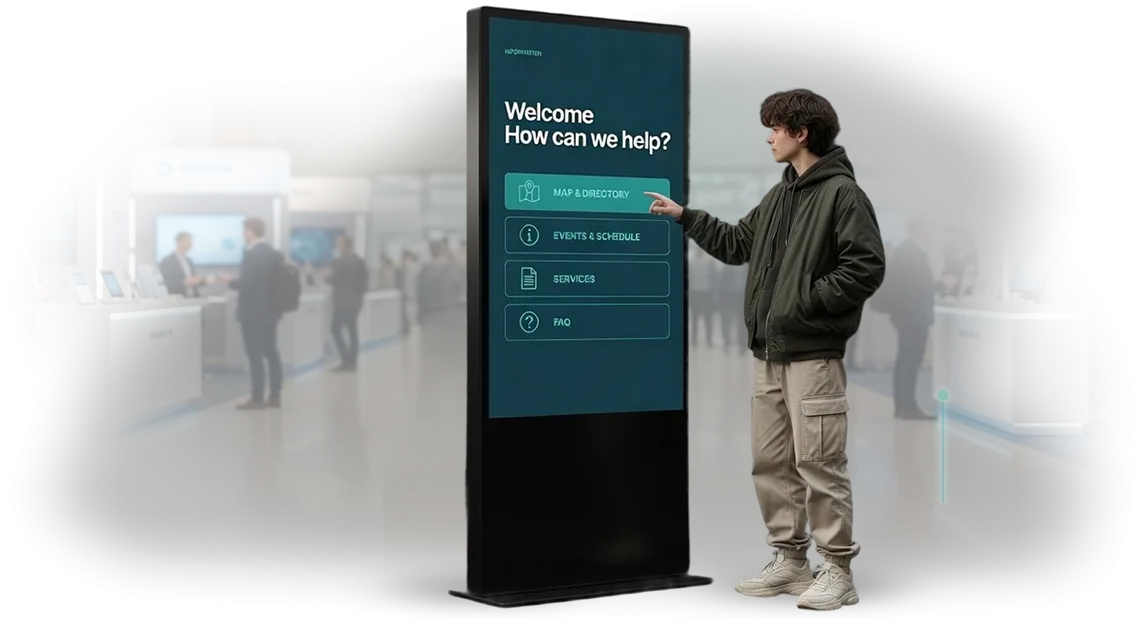
Improving an airport starts with analyzing the real passenger route. An airport check-in kiosk is a key waypoint that relieves counters and sets the direction of the flow.
Properly placed kiosks and clear navigation reduce the time from entrance to boarding, lower staff workload, and increase passenger satisfaction.
We help airports rebuild the airport flyer route so that every passenger feels confident and the airport earns more. We'll analyze your terminal, find bottlenecks, and offer a solution that pays off through lower costs and higher commercial revenue.
Airport without queues: 5 benefits of self-service kiosks
The check-in queue is the main source of stress for passengers and a direct threat to loyalty. According to our observations, the longer a person stands in line, the lower the chance they will choose that airline again. Self-service kiosks solve the problem: check-in takes a minute instead of 15–20 minutes of waiting.
1. Speed of service. Passengers choose their own seat, print their boarding pass, and go to security without a queue. During peak hours, the flow isn't blocked and the terminal runs more calmly — this reduces the overall load on the entire departure area.
2. Staff relief. Employees stop performing routine operations like document scanning. The freed-up time is redirected to non-standard situations: oversized baggage, assisting special categories of passengers, helping at counters. Service quality grows without expanding the team.
3. Useful data. Each kiosk is a source of passenger flow information. Our engineers implement the Passenger Flow Analytics platform, which collects anonymized data on check-in time and zone occupancy.
The airport sees bottlenecks and plans shifts and resources more accurately — without manual reports at the end of the day.
4. Passenger loyalty. When a person manages their own check-in, they feel in control and get less anxious. A repeat flight with the same airline becomes more likely — customers return for predictability and speed.
5. Non-aviation revenue. The kiosk screen is a showcase for ancillary services: priority boarding, business lounge access, extra baggage allowance.
Everything is arranged in one click, so a single terminal generates additional revenue — the exact amount is calculated after an audit — without hiring sales staff.
We design and implement such kiosks turnkey. We work on professional equipment that withstands high terminal loads and provide support after launch. Want to remove queues and strengthen service — we'll show you how it looks in practice.
Kiosk formats for check-in and navigation
Passengers appreciate when the path from the entrance to boarding is clear and doesn't require standing in queues. The kiosk format determines how quickly a person completes their task: check in, find their way, or pay for an additional service. Properly selected kiosks reduce the workload on staff and speed up service during peak hours.
We select the kiosk type according to your airport's real scenario — from passenger numbers to typical routes. Here's how different formats solve specific tasks.
| Format | Who it's for | What it provides |
|---|---|---|
| Check-in kiosk | Passengers with and without baggage, families with children, people with limited mobility | Self-service check-in in 1-2 minutes without a queue, the ability to choose a seat and print a boarding pass. The airport relieves staffed counters |
| Navigation info kiosk | Transit passengers, arriving passengers, greeters, airport visitors | Finding an exit, counter, cafe, pharmacy, or taxi on the terminal map. Passengers reach the right zone faster, and the flow of questions to staff decreases |
| Service payment kiosk | Passengers buying extra baggage, business lounge access, priority boarding, or insurance | Payment without going to a cashier or standing in queues. The airport increases ancillary revenue and collects data on passenger preferences |
This separation allows not mixing different scenarios in one device and not forcing passengers to figure out unnecessary functions. Each kiosk does one task as quickly and clearly as possible.
When designing, we calculate the number of kiosks for peak loads so that no crowds form during departure hours.
The interface is adapted to age, digital skill level, and the needs of people with disabilities — the screen itself prompts the next step and, if necessary, switches to another language.
As a result, the airport gets not just hardware but a well-thought-out system that reduces queues, increases passenger loyalty, and pays for itself through higher ancillary sales. We'll help you choose the format and calculate the configuration for your terminal.
How we implement kiosks: 7 steps to launch
Implementing a check-in kiosk at an airport is not just installing a device. Passengers need to find their bearings quickly, avoid creating new bottlenecks, and make it to boarding on time.
We've built a clear seven-step process: it takes from two weeks to two months depending on the scale.
- Brief and flow analysis — we analyze passenger routes, peak loads, and the points where a kiosk will reduce the queue. Based on the results, we propose the optimal location and usage scenario.
- Plan and estimate — we fix the timeline, budget, and responsible parties. You get a transparent estimate without hidden surcharges.
- Layout approval — we show an interface prototype that takes your brand style into account. We make revisions until full approval.
- Turnkey development — we create the enclosure, software, and configure integration with your check-in system. We do all the work turnkey: from blueprint to installation.
- Test launch — we test the kiosk on a real passenger flow, collect metrics, and fix any issues before the official opening.
- Staff training — we conduct a short training session and provide clear instructions. Employees confidently help passengers in the first days.
- Launch and support — we support the kiosk after launch: update information, monitor stability, and respond quickly to requests.
Each stage ends with a clear result — you always know what is happening and when the kiosk will start working. At the output, you get a solution that reduces check-in queues and helps passengers confidently move toward boarding.
What's included in the delivery: a package for your airport
We hand over not separate parts but a working self-service kiosk "turnkey." This approach saves the airport from coordinating multiple contractors: all equipment, software, and installation are assembled into one responsible package.
You know the composition, timeline, and cost in advance — without hidden surcharges at the launch stage.
Kiosk delivery package contents
- Kiosk hardware: vandal-resistant enclosure, touch panel, built-in boarding pass printer, and barcode scanner. Everything is designed for round-the-clock operation in the terminal area.
- Kiosk software: pre-installed check-in interface, the airport passenger route map (airport flyer route), and integration with your booking system. The passenger travels from the entrance to boarding without staff assistance.
- Kiosk installation: our engineers handle delivery, installation, connection, and configuration within the agreed time. No need to hire third-party contractors.
- Staff training: a separate training session for employees who meet passengers at the kiosk. They learn to solve typical situations and guide people correctly.
- Warranty service: scheduled inspections, software updates, and replacement of components during the warranty period. If a kiosk breaks down, it is restored upon request.
- Operational documentation: clear instructions for the operator and a memo on daily equipment startup.
Such a package covers the full cycle — from purchase to daily operation. The airport gets one document and one point of responsibility. If you need to expand functionality, we'll supplement the delivery with new modules without replacing the base equipment.
Case study: how kiosks reduced check-in queues
During peak hours, the check-in queue is the main source of stress for both passengers and airport staff. Delays at counters result in the risk of missing flights, negative reviews, and extra workload for employees.
We knew this could be fixed and took on a project for the international airport "Aviagrad".
How we reduced check-in queues
First, we studied the passenger flow during peak hours and identified bottlenecks. It turned out that most people with electronic tickets still went to the counter — simply because they didn't know about the kiosks.
We installed convenient touch-screen terminals in the entrance area, made the interface intuitive even for those using such devices for the first time, and integrated them with the airport's booking system.
A month after launch, queues dropped by 40%, and passenger satisfaction grew by 20%. People handle check-in and seat selection on their own, while airport staff switched to solving non-standard issues.
Average processing time was cut in half, and the airport was able to accept more flights without expanding counters.
What it gave the client
The implementation of the kiosks paid off within a few months. Passengers stopped missing flights due to queues, and the airport itself saw a noticeable improvement in punctuality indicators.
After the pilot project, the client ordered additional terminals for the baggage claim area and international flights — the solution became part of their permanent infrastructure.
The case confirmed: even one targeted improvement to the check-in process changes the overall passenger experience and the airport's operational efficiency. If you are looking for a way to speed up customer service and reduce staff workload, such kiosks are a proven solution.
We are ready to audit your passenger flow and propose a scenario that will deliver measurable results in the first months.
How to choose a kiosk format for your traffic?
Choosing a kiosk format starts not with a catalog but with the passenger route (airport flyer route): where the passenger slows down, gets lost, and creates a queue. You calculate the peak load and friction points — and then select the device types and their quantity.
For a regional airport with a single flow, two universal kiosks are enough; for a hub with transfers, you need separate zones for check-in, navigation, and boarding.
Relying on average traffic is a mistake: kiosks must withstand peak hours. For example, in a project for the regional airport Vektor, we installed four kiosks along the departure route — check-in time was halved, and passengers stopped asking for directions to the exit.
| Situation | Which kiosk is needed | What you get |
|---|---|---|
| Up to 300 passengers per hour, single flow | Universal "check-in + information" kiosk | Passengers complete check-in without expanding the team |
| 300–1000 passengers, multiple flights | Separate kiosks for check-in, bag tag printing, and navigation | Queues dissolve, staff workload drops |
| More than 1000 passengers, transfers | Self-check-in cascade and information kiosks at transfer points | Fewer delays, higher throughput |
The number of kiosks is calculated simply: take the peak load, multiply by the average operation time, and divide by the acceptable queue length.
This gives a range that we then verify on your terminal floor plan — taking into account security zones, transfer flows, and retail areas where passengers get distracted from the route.
Bottom line: the right format is the one that solves the problem of a specific point in your terminal and fits the budget. We select a configuration for your traffic rather than selling an "average" kiosk.
Send us your terminal floor plan and peak hours — we'll calculate a kiosk package that will pay off in the first season.
Frequently asked questions about check-in kiosks
Before launching kiosks, airport managers have the same questions: will the equipment break down at the peak of the season, how will it fit into existing systems, who will train the staff, and when will it all pay off.
We answer the main concerns — without complex technical details, only what affects airport operations and passenger flow.
How reliable are the kiosks and what happens if one fails?
Kiosks are designed for round-the-clock operation in high-traffic areas. We use industrial components and configure remote monitoring — our team sees the status of each device and reacts before passengers notice a problem.
If one kiosk is unavailable, the others continue to work, and check-in can always be switched to a counter — this is a standard situation that we practice together with your staff.
How do the kiosks integrate with airport systems?
Integration does not require replacing the existing infrastructure. Kiosks connect to your check-in and passenger flow management systems, while airport operations do not stop — we configure everything in stages and test it on real scenarios.
For passengers, it looks like a familiar check-in screen, and for your team, it is another service channel with clear statistics.
Will we have to train staff and how will passengers get used to the kiosks?
The interface is designed so that passengers can manage without help: large prompts, a step-by-step scenario, seat selection, and boarding pass printing take less than a minute.
We conduct a short training session for your employees — usually a couple of hours, including handling non-standard situations. Staff are not replaced by kiosks but freed up for those who really need help — this reduces the load on counters and cuts queues.
When do kiosks pay off?
It all depends on passenger flow, but on average, kiosks pay off in 1–2 years through reduced check-in time and workload redistribution.
Based on our projects: on a route with 2–3 thousand passengers per day, kiosks handle up to half of all check-ins, freeing up 2–3 counters and allowing staff to be redirected to serving passengers with special needs.
We make an accurate calculation at the brief stage — for your traffic, number of flights, and peak hours.
Still have questions — we'll send a payback calculation for your airport and show how kiosks will fit into your current logistics. Just describe the passenger flow and the layout of the check-in area.Order kiosk development and get results
We value the passenger's time and money: the shorter the check-in queue, the higher the loyalty and the more repeat flights with your airline. Our engineers design kiosks for a specific location — taking into account the flow, layout, and your scenarios, not a template.
That's why you get not just a terminal but a tool that speeds up check-in and reduces staff workload.
How we structure the work
We take on the entire cycle — from brief to post-launch support. Below are the stages that every order goes through:
- Request and free consultation — we analyze your task and current bottlenecks.
- Location audit — we study passenger flow, peak hours, and usage scenarios.
- Cost and timeline calculation — we fix the budget and work plan before the start.
- Design concept and ergonomics — we design the enclosure, screen, and interface for your area.
- Software development and integration with your booking systems.
- Production, delivery, and installation of equipment.
- Testing, launch, and staff training.
What you get when ordering
- A personalized solution for your location and passenger flow, not an "off-the-shelf" product.
- Free audit and kiosk cost calculation before you make a decision.
- Fixed timelines and budget — without hidden surcharges.
- Warranty on equipment and software.
- Support and updates after launch — you're never left alone with the equipment.
- Fast payback by relieving check-in counters and reducing queues.
Fill out the form on the website — within one business day we'll conduct a free consultation, calculate the cost of your kiosk, and offer an option that fits your budget and timeline. You'll get a ready-made "turnkey" solution and can launch check-in faster.