

4 Types of Wayfinding: Which Navigation Kiosk Should You Choose?
Visitors get lost in large buildings, waste time searching for the right department, and sometimes leave without making a purchase — this is a familiar pain point for owners of shopping malls, business centers, clinics, and airports.
Every lost guest means not only a spoiled impression but also lost revenue, as well as extra strain on staff who are distracted by “where is it?” questions.
The solution is a well-designed wayfinding system that helps people quickly orient themselves and reach their destination without stress.
A navigation kiosk is one of the most effective wayfinding tools: it works around the clock, answers guests’ questions, and relieves employees. We develop interactive kiosks that fit into any interior and are clear to every visitor — from a child to an elderly person.
Our experience is confirmed by the installation of kiosks at Sheremetyevo Airport, where they help passengers quickly find exits, check-in counters, and waiting areas.
Why Wayfinding in a Building Matters
Proper navigation directly affects key business metrics. When a visitor easily finds the right store or office, they get less tired, accomplish more, and are more likely to return.
Good wayfinding reduces visitor loss, increases time spent in the building, and boosts the number of repeat visits.
In addition, navigation systems help manage the flow of people: directing them to less crowded areas and informing them about promotions and services. This turns an ordinary map into a tool that works for your results rather than just hanging on a wall.
Overview of 4 Types of Navigation Systems
Today, there are four main types of navigation, and each has its own purpose. Static signs and plaques are the baseline — they work without electricity but do not adapt to changes.
Floor navigation — lines and pictograms on the floor — is good for quickly directing people along corridors but does not answer complex questions. Mobile assistants via QR codes save space but require guests to interact with their smartphones.
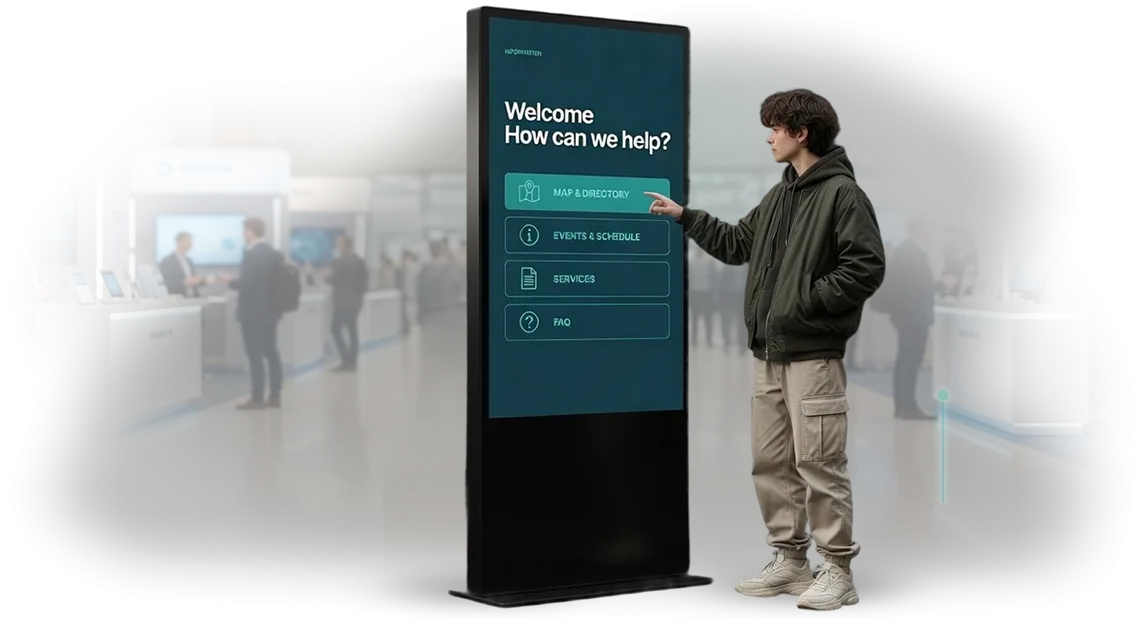
The fourth type is interactive kiosks: a touchscreen with a map, search, and route building. These deliver the most value: they instantly respond to a specific request, show the path, and can advertise your services.
The choice of type depends on the building area, visitor flow, and your goals — we will help you select the optimal combination, and if needed, combine several types into a single system.
Benefits of an Interactive Kiosk: Growth in Loyalty and Revenue
For Visitors
An interactive kiosk removes the main source of guest frustration — the inability to quickly find the right department, product, or service point. Instead of waiting for a consultant, visitors get a route in seconds and head straight to their destination.
This kind of care is felt on an emotional level: people remember a place that was easy to navigate and come back again.
Convenience also means less stress in unfamiliar surroundings: a shopping mall, clinic, or business center stops being a maze. The visitor feels in control of the situation, which directly influences loyalty.
A satisfied guest spends more time, is more willing to make purchases, and recommends the venue to others.
For Business
A kiosk relieves staff of routine questions like “where is it” and “how do I get there” — employees focus on actual sales and customer service instead of repeating the same thing a hundred times a day.
The load on the information desk decreases, queues shrink, and every hour of team time freed up converts into service quality and revenue.
Beyond navigation, the kiosk becomes a point for additional sales: the screen can display promotions, new arrivals, and special offers at the moment a visitor is already near the relevant destination.
This increases the average ticket without advertising costs — the offer reaches a person who is ready to act.
Analytics is a separate source of value. The kiosk records where visitors go, which routes are popular, and which zones sit idle. Based on this data, you can adjust the placement of departments, promo materials, and staff, turning navigation into a flow-management tool.
The result is higher loyalty, better conversion, and measurable returns from every area of the space.
Navigation Kiosk Formats for Business Needs
Navigation kiosks solve a practical problem: they help visitors quickly find the right office, department, or exit without distracting staff. The format determines how convenient and noticeable the interactive stand will be in a specific space. Below are three basic solutions that cover most business scenarios.
| Format | Who It’s For | What It Gives the Client |
|---|---|---|
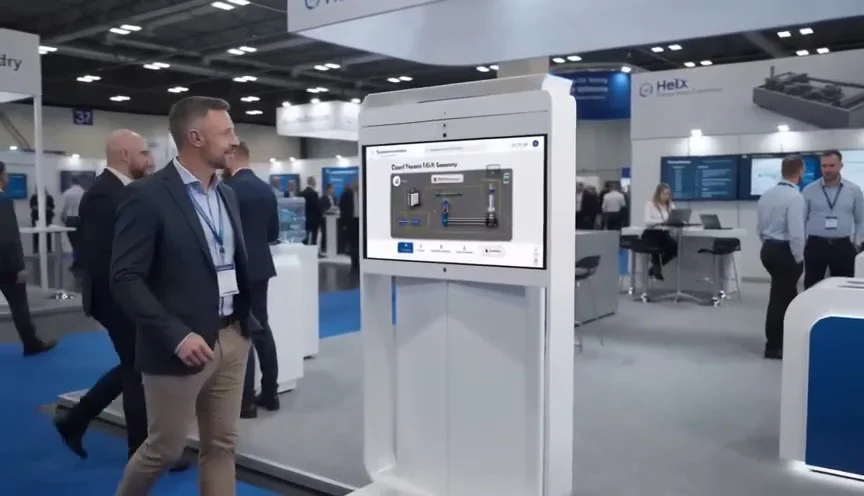
| Floor-standing kiosk | Shopping malls, clinics, business centers, museums | Easy access and a visible spot in the lobby or at intersections of visitor flows. Reduces the load on the information desk and speeds up visitor movement: they don’t need to search for an office using signs. |
| Wall-mounted kiosk | Small spaces, corridors, waiting areas, boutiques | Saves floor space and does not block passage. Works as an information point at the decision-making spot — where a person stands and chooses which direction to go. |
| Outdoor kiosk | Entrance groups, university grounds, parks, campuses | Meets visitors before they enter and works in any weather. The route becomes clear while still outside, and the flow of people is distributed without crowding at the entrance. |
How to Choose a Format
Focus on three conditions: the size of the space, traffic, and the point where a person decides on their route. A floor-standing kiosk makes sense where there are many people and enough space to approach it.
A wall-mounted kiosk is for compact corridors and waiting areas where every square meter matters. An outdoor kiosk is for when the flow needs to be directed before visitors even enter the building.
We help you choose a format based on your floor plans and visitor scenarios: we visit the site, study the routes, and propose a solution with navigation logic and design that matches the style of the space.
After launch, you get a kiosk that reduces the burden on staff and increases customer loyalty — visitors orient themselves with ease and come back again.
How Kiosk Development Works: 7 Steps from Brief to Launch
We structure our work so that you always know what is happening and what comes next. Each stage ends with a clear outcome, with no “technical surprises.”
- Brief and immersion — we study the location, audience, and purpose of the kiosk. We approve the technical specification.
- Prototype and scenarios — we show the screen logic step by step. You see the visitor journey before development begins and can make changes without rework.
- Layout approval — we create a design in your brand style: colors, logo, tone of voice. After your “yes,” we start assembly.
- Development and configuration — we program the logic, connect maps, catalogs, and schedules. The kiosk comes to life on a test stand.
- Enclosure manufacturing and installation — we build the enclosure for your space and install the equipment on site. The structure is durable and does not obstruct passage.
- Testing and debugging — we check all scenarios from first touch to result and eliminate anything that might confuse guests.
- Launch and support — we turn on the kiosk, train your team, and stay in touch. We refine content and features after launch.
How Long the Project Takes
The project takes from three to eight weeks: the more complex the scenarios and design, the longer it takes. A basic navigation kiosk with a map and search takes about a month. If a product catalog or integration with your database is added, allow up to two months.
Timelines and budget are fixed in the contract, and each stage ends with a checkpoint. You see progress and can make adjustments before launch.
What’s Included in the Delivery: A Complete Launch Kit for Navigation
So that navigation works right away rather than after lengthy refinements, we deliver a ready-to-use kit. It covers everything — from the kiosk itself to installation and support. All you have to do is mark the points on the map and launch.
- Touchscreen kiosk tailored to your interior: enclosure, screen, and mounting hardware are selected for the specific task.
- Navigation software: map, object search, and route building. Content is updated through a simple admin panel — without calling a programmer.
- Screen layouts in your brand style: clear pictograms and large buttons so any visitor can use the navigation.
- Installation and commissioning: we visit the site, install the kiosk, configure scenarios, and test it on real routes.
- Staff training and instructions: your administrators can add new points and temporary announcements themselves.
- Warranty on equipment and software, including parts replacement and system updates for the entire term.
- Delivery to the site and insurance during transport.
Additional Options
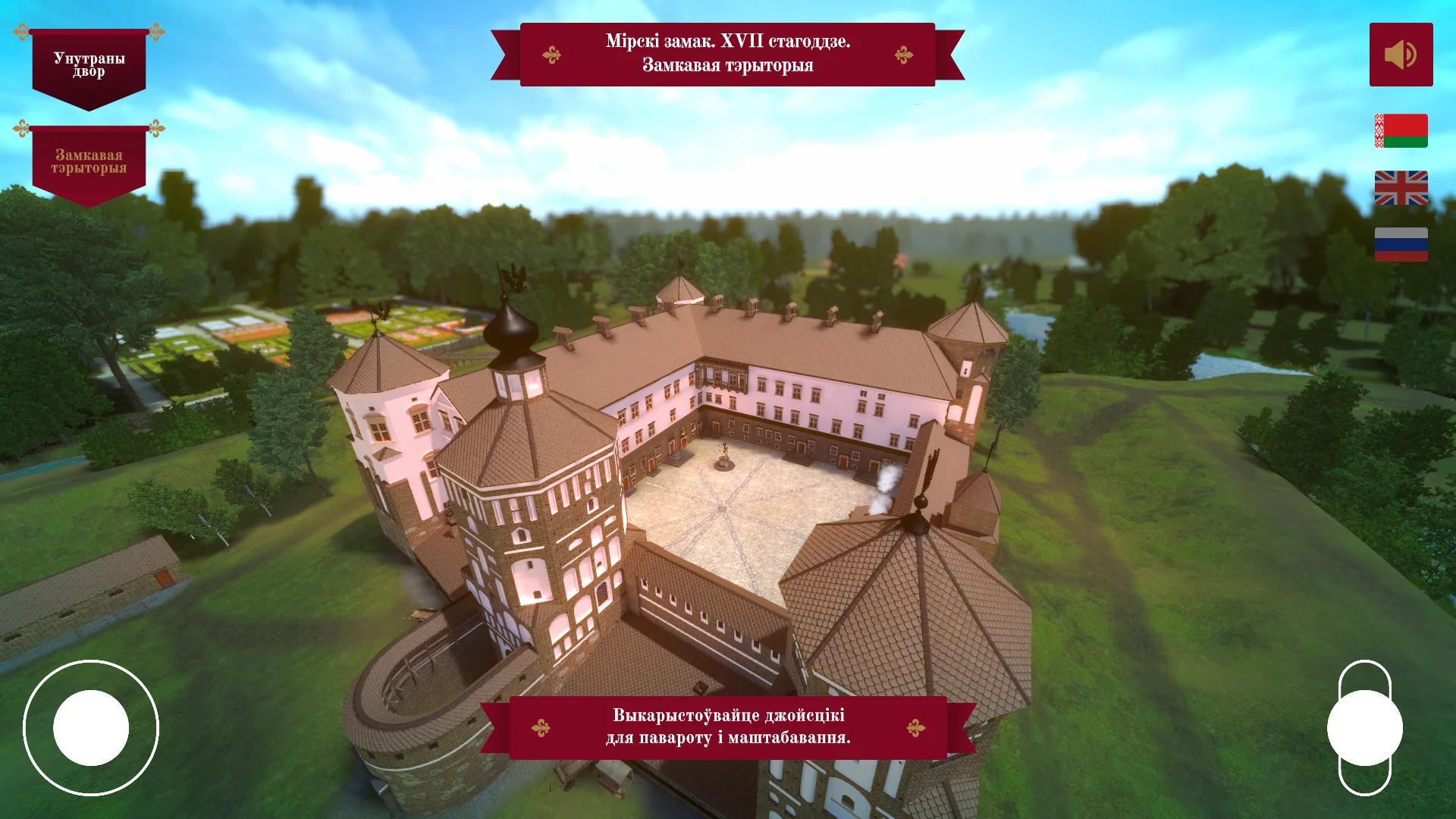
The standard configuration suits most projects. If you need a custom enclosure — in your brand color, with vandal protection, or built-in audio — we can add that too. For international visitors, we can install a multilingual interface: from two languages to full localization.
All options are included in the kit without delaying the launch date. You get turnkey navigation and can start using it right away.
Case Study: How a Kiosk Reduced Queues and Increased Sales
Gym visitors don’t like queues: the longer the wait at reception, the worse the first impression and the lower the desire to return.
At the same time, administrators are forced to answer hundreds of the same questions — where is the locker room, how to book a workout, what does the membership include — and consequently have less time to sell additional services.
We proposed moving the routine to an interactive kiosk: the client chooses the right zone, sees the route on the map, books a session with a trainer, or buys a massage and pool visit.
The administrator stays for live communication and complex questions, while the kiosk handles the flow of repeat scenarios.
Project Results
A month after launch, the reception queue halved — clients began spending less time on check-in and got to the gym floor faster. Additional service sales grew by 30%: the kiosk suggested relevant offers at the exact moment a person was planning their visit.
The kiosk was used by 6 out of 10 club visitors daily, and the average ticket for extra services increased thanks to automatic recommendations for trainers and spa treatments.
The chain’s management noted the reduced load on reception and ordered the system for two other clubs — with the same navigation and sales configuration.
Frequently Asked Questions About Navigation Kiosks
Clients rarely doubt the value of navigation, but they often ask: what if the kiosk breaks down, who will update the maps, and how long will the launch take?
These are normal questions — the kiosk must run without failures during peak hours and not require a dedicated specialist from your side.
We address four main concerns: warranty, maintenance, content updates, and timelines. Below are short answers that make our level of responsibility clear.
What warranty does the kiosk come with?
On equipment and pre-installed software — a warranty of up to 12 months. If something fails, we repair or replace the component free of charge. Your kiosk does not sit idle; it keeps working.
Who handles maintenance?
We take maintenance on ourselves: regular checks, preventive servicing, and configuration. You don’t need to hire a separate employee — simply report a task, and we take it from there. If needed, we add remote monitoring to spot issues before visitors notice them.
How are maps and information updated?
Through a simple admin panel: upload a new file — and the screen shows current data. You can update the map, add a tenant, or change opening hours in a couple of minutes, without a programmer. Automatic synchronization with your internal systems is also possible.
How long does development take?
A standard kiosk with navigation and a catalog — 4 to 6 weeks from the moment layouts are approved. This timeframe includes design, equipment setup, and testing. If you need a custom enclosure or integration with your system — we will discuss individual timelines.
Before launch, we show a test version and review navigation scenarios together with you. This gives you confidence that the kiosk will be convenient for visitors and will not require constant oversight from your side.Order Kiosk Development: What You Get
Ordering is simple: you submit a request — then we handle the entire process, from idea to a working kiosk. Within a few minutes of your inquiry, our engineer will contact you, clarify the task, and propose a solution that fits your budget and timeline.
What you receive immediately after submitting a request:
- Engineer consultation — we analyze the task and recommend the optimal kiosk format and configuration without unnecessary options.
- Cost estimate within 1 business day — we lock in the exact price before work begins, with no hidden charges.
- Design project as a gift — we adapt the interface to your brand style and usage scenarios.
- Discount on your first order — we will discuss individual terms if you need a kiosk urgently or in bulk.
- A clear work plan — you will know all stages, timelines, and responsible people before signing the contract.
- Support after launch — we help with installation, train your staff, and stay in touch.
Click the “Submit a request” button at the bottom of the page — it is not binding. Already during the conversation, you will understand whether our solution fits you and what is needed to implement it.
How to Choose a Wayfinding Format for Your Facility?
There is no universal solution: the navigation format must match the size of the facility, the intensity of traffic, and the budget. For a small exhibition, floor graphics are enough, while a shopping mall or airport needs full touchscreen kiosks.
A mistake at the start leads to rework — guests get lost, staff get distracted by the same questions, and we receive requests for modifications within a month of operation.
The main criterion is not the type of equipment but the use case. If a facility welcomes thousands of visitors daily, stationary kiosks with a map and category search are cost-effective. For a space with low foot traffic, an interactive sign or a mobile version is sufficient.
Budget also plays a role: a wall-mounted touchscreen is less expensive than a floor-standing structure, and a single navigation point can be adapted to your brand style without losing functionality — this maintains brand recognition.
Navigation quality directly depends on data. For accurate mapping, we use up-to-date information about the facility layout and verified mapping services — for example, Yandex.Maps for checking address data and terrain geometry.
This gives the client confidence that visitors will reach their destination faster, and management will receive analytics on requested directions — from restrooms to stores.
We recommend starting with an audit: we study the layout, measure traffic at different times, and identify decision points (entrance, elevators, intersections).
Based on this data, we propose 2-3 formats within your budget so that you choose not the “cheapest” or “most expensive” option, but one that pays off. This way, you get navigation that speeds up guest movement, reduces the load on staff, and increases loyalty to the space.