


Wallpaper is chosen by eye — without AR, customers go to competitors
A buyer chooses wallpaper based on a small sample in the catalog and mentally transfers it to their wall — but almost always hesitates. How will the pattern sit in the interior? Will it be too dark or too busy? Will it match the furniture?
Without answers to these questions, the decision is put off for days, and often the buyer simply goes to a competitor where such an option already exists.
For business, this is a direct loss: sales drop, the deal cycle lengthens, and the share of returns and dissatisfied customers grows. The seller cannot show how the wallpaper will look in a specific room — and the buyer is not ready to risk money blindly.
The task is not to offer more options, but to remove the fear of making a mistake before the purchase.
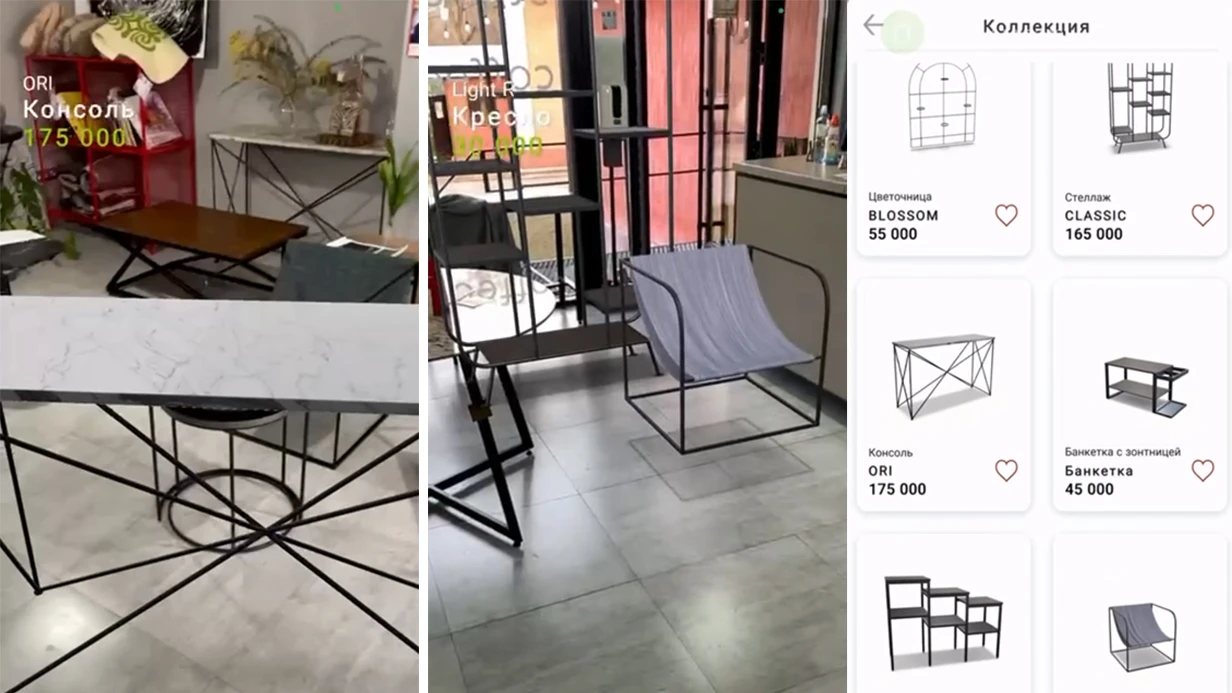
This is where AR visualization helps. The buyer points their smartphone camera at their wall and sees how the selected wallpaper looks in their actual interior — in daylight or evening light, next to the sofa, rug, and window.
They stop guessing and start choosing: this is no longer an abstract roll, but a ready-made solution for their room.
The result for business is customer confidence and a higher average ticket. When a person sees wallpaper on their own wall, they make decisions faster, are more willing to buy more rolls, and return for repeat purchases.
We build an AR visualization system that keeps the buyer on your site and increases sales without discounts.
What AR visualization gives your business
A wallpaper buyer rarely imagines how a pattern will look on their walls under real lighting and in combination with furniture. They hesitate, postpone the decision, and often go to competitors where the choice seems easier.
AR visualization removes this uncertainty: the person points their smartphone camera at the wall and sees the selected wallpaper in their own interior, in scale and under current light. The doubt is gone — the decision is made quickly.
The first advantage is higher conversion. The customer stops relying on imagination and delays the order less. Stores that have enabled visualization note that the share of customers placing an order on the day of their visit increases noticeably.
This works both in the showroom and on the website: the visitor uploads a photo of the room and "scrolls through" collections.
The second is fewer returns. Wallpaper is often returned because the pattern looks different in the interior: a different scale, a different saturation. AR shows an honest result before the purchase, so there is no disappointment after hanging. Fewer returns means fewer logistics losses and higher trust in the store.
The third is a higher average ticket. Seeing how impressive premium collections look, buyers are less likely to choose the cheapest option. Customers are bolder in combining wallpaper: they take a base covering and add an accent wall from a more expensive series. The order amount grows naturally, without pushy upselling.
Separately — the brand. A store where you can "try on" wallpaper is perceived as modern and caring. People tell their friends about it, and customers return for wallpaper for other rooms. The technology becomes part of the service that constantly brings in new customers.
AR wallpaper selection formats: from catalog to wall try-on
It is hard for a wallpaper buyer to imagine how a pattern will sit on the wall: when choosing from a catalog, they see only a fragment, not the full picture of the interior.
This is the main reason for prolonged hesitation, postponed purchases, and returns — the customer is afraid of making a mistake with scale or color.
AR visualization removes this fear. We offer three formats that differ in the depth of immersion and solve different business problems — from quick viewing of samples to full try-on on the walls of a specific room. All that remains is to choose the right one or combine them for your point of sale.
| Format | Who it's for | What it gives the customer |
|---|---|---|
| AR catalog | Retail stores and showrooms | The buyer points the camera at a sample and sees it in scale without unrolling the roll. They find "their" option faster, and it's easier for the seller to show the range and increase the average ticket. |
| Virtual try-on | Online stores and websites | The customer "applies" the selected wallpaper to a photo of their room or through the camera in real time. You can immediately see how the pattern combines with furniture and lighting — fewer doubts, lower return rate. |
| Virtual showroom | Manufacturers and designers | Collections are presented in 3D space with ready-made interior solutions. The buyer arrives at the store with a clear request, the deal cycle shortens, and the brand looks modern. |
We will help you choose the right format, integrate it into your website or app, and train your staff. As a result, the buyer trusts the assortment, and sales become predictable — without unnecessary "try-ons" at the offline point.
How development works: from brief to launch
We don't start development until we understand your task. The process is transparent: you see the result at every stage and can influence it before launch. A project typically takes four to six weeks, depending on the number of scenes.
- Brief — we record why you need AR wallpaper visualization: where it will be used (website, catalog, showroom), who your audience is, and what result you expect. You receive a document with goals and success criteria.
- Plan — we define the scope of work, timelines, and approval checkpoints. You always know what is happening in the project and when it will be ready — without having to chase the manager.
- Design and prototype — we work out the scenario: how the visitor selects wallpaper, tries it on walls, and changes rooms. We show mockups and an interactive draft before the main development — so you can make edits without extra costs.
- Development — we create a full-fledged application and integrate it into your website or catalog. We handle the technical details — you don't need to dive into the intricacies, you only see the result.
- Testing — we check the operation on different devices and in different scenarios so the user doesn't encounter errors. You get a stable product that won't fail at launch.
- Release and support — we connect the application, help with the launch, and stay in touch after the release. If improvements are needed, we'll quickly discuss and implement them.
At every stage, you get a clear result. This approach eliminates surprises: you see in advance how the visualization will work and make decisions based on facts.
What you get as part of the ready solution
You get not just a wallpaper visualization application, but a fully ready-to-use tool that can be immediately used in sales and marketing. We deliver the project turnkey: no hidden stages or abstract promises — only a result that brings value to your business.
The ready solution includes:
- An application adapted to your tasks. Wallpaper visualization in the interior with your catalog, corporate style, and usage scenarios in mind — customers see how the wallpaper will look in their homes.
- Source codes and technical documentation. You receive full rights to the solution and all necessary documentation. This means you are not tied to a specific contractor and can develop the product with any team.
- An admin panel for content management. Update the wallpaper catalog, prices, descriptions, and promotions yourself — without contacting developers every time you need to add a new collection.
- Training for your employees. We conduct practical training for sales managers and marketers: they will learn to use the application, upload materials, and analyze statistics.
- Warranty support. During the warranty period, we fix errors, update, and maintain the product for free. You are protected from downtime and unexpected expenses.
- Post-launch support. We stay in touch: help with improvements, advise on development issues, and are always ready to offer new solutions for your business.
This scope of delivery covers all the main fears of the customer: you get the product, the rights to it, the knowledge of your team, and reliable technical support. All that remains is to launch the application and start selling — we've taken care of everything else.
Case study: 34% conversion growth in an interior store
A buyer at an interior store often cannot imagine how specific wallpaper will look on their walls under evening light, with their furniture, and in their dimensions. They hesitate, postpone the decision, go away "to think" — and end up buying somewhere else. For the wallpaper store chain Krasivy Dom, this problem was the main reason for low conversion.
We proposed a simple solution: AR visualization right in the showroom. The buyer points their smartphone camera at the wall — and the selected roll "comes to life" on the real surface.
They can change the pattern, scale, and see how it combines with the floor and furniture without leaving the rack.
What changed
The implementation took less than a month, and the result changed the store's economics. Within two months, conversion from visitor to buyer grew by 34%, and the number of placed orders tripled.
People stopped being afraid of making a mistake — they immediately see the result and confidently take wallpaper that suits their interior.
What is especially valuable is that customers began to return more often. The AR try-on creates the impression of a "living" store that people tell their friends about.
The share of repeat purchases grew, and the average ticket increased due to additional rolls — the buyer sees the full picture and takes more than they planned.
This case shows: AR is not a toy, but a tool that directly affects revenue. If your store is losing customers at the selection stage, let's discuss how to adapt the solution to your assortment.
How to choose the AR visualization format for your task?
The choice of AR wallpaper visualization format depends on the scale of the business and the goal you are solving.
For a small showroom or design studio, it is important to quickly show the client how the selected wallpaper will look in their room — without long preparation and extra investment.
For a store chain, on the contrary, a single standard is needed that works the same way at all locations, trains staff, and collects statistics on buyer preferences. So first determine what is critical for you: speed of launch or process controllability.
Small businesses are more often suited to a lightweight mobile solution: the buyer points the camera at a sample, and the wallpaper is "overlaid" on the photo of their interior.
This format requires no special equipment and launches quickly — from a few days to a couple of weeks.
You get a tool that increases the customer's confidence in the choice, reduces the number of returns, and increases the average ticket through additional rolls selected "on the spot."
For store chains and large dealers, a full-featured platform with a collection catalog, article number linkage, and integration with your accounting system is more suitable.
This allows you to keep all locations in a single digital ecosystem, update the assortment centrally, and see which wallpaper is most often tried on in different regions.
Based on this data, you make decisions about purchasing and promotions rather than relying on the intuition of salespeople.
There is also an intermediate option — AR visualization as part of an exhibition stand or showroom. Here, the technology works to attract attention and engage: the visitor "brings the interior to life," takes photos, and shares them on social media.
This format suits both small businesses and chains if your goal is not just to sell wallpaper but to create a memorable experience and expand audience reach.
The final decision should be made based on three factors: business size, frequency of collection updates, and existing infrastructure. We help you decide on the format before development begins — we conduct a short audit of tasks and offer the option that pays off the fastest.
As a result, you get not just technology, but a working tool that solves a specific business task: sales growth, customer loyalty, or network scaling.
Frequently asked questions and client concerns
Before launching AR wallpaper visualization, every client asks the same question: "What if the application breaks, stops updating, or my clients don't like it?" This is a normal concern — your sales and reputation depend on how the tool works.
That's why we design the solution with a safety margin from the very start: a reliable server side, backup scenarios, and a clear support system.
Below are answers to the most common concerns. If you see your question in the list — that's a good sign: it means you are already thinking about the long-term result, not just a pretty picture.
What does the contract guarantee?
We specify the warranty period and performance obligations. If a failure occurs during the warranty period, we fix it at our expense. You don't need to understand the technical side: just report the problem, and we take it into work.
What happens if the application breaks?
We provide a backup scenario for you and your clients. For example, the application works via the internet, but even with a connection loss, it preserves key functions — the display of samples in the interior will not be interrupted. All user data is protected and will not be lost.
How does post-launch support work?
We don't hand over the project and forget about it. We follow a defined protocol: we respond to your requests within a business day, and to urgent issues — faster. We regularly update content and features when wallpaper collections or design trends change.
Will the application become outdated in a year?
Technology evolves, but we build on current platform versions and track their updates. The maintenance plan includes adaptation to new devices and operating systems. We make sure the application stays modern and your clients continue to use it.
Order development of an AR application for your business
An AR application for wallpaper visualization helps the client "try on" the covering on the walls of their room before purchasing. This reduces returns, increases catalog conversion, and sets your brand apart from competitors. Tell us about your task — and we'll show how it works with your assortment.
Leave a request for a free calculation — within two business days you will receive a specific proposal: the solution format, timeline, and budget for your business. No abstract promises, only what will actually bring value.
What you get after reaching out:
- A free consultation — we'll analyze your task and advise where AR will have the maximum effect: catalog, showroom, website, or application.
- A preliminary calculation of cost and timeline without hidden conditions.
- A demonstration of similar projects — we'll show examples from our practice so you can see the result in advance.
- An integration plan with your wallpaper catalog: fast collection loading, accurate color rendering, pattern scaling.
- A presentation of the solution for your team and approval of all details before development starts.
We work remotely and have been creating AR projects for business for over 10 years. We use professional equipment and proven tools, so your product will run stably on customers' smartphones without failures or long loading times.
Fill out the form — it takes a couple of minutes. We'll get in touch, answer your questions, and prepare a free calculation tailored to your business. Start with a simple step — and within a few days you'll know how AR visualization will increase wallpaper sales in your store.