

UX/UI for VR/AR: why users leave because of an inconvenient interface
A user puts on a VR headset expecting an immersive experience. But if the first thing they see is a confusing menu, unreadable prompts, or unfamiliar controls, they'll take the headset off within the first minutes.
In virtual and augmented reality, discomfort is felt more acutely: even a small interface error causes disorientation or motion sickness. As a result, customers leave, and you lose the money invested in development.
Why do users leave? The reasons almost always lie in low-quality VR interface design: cluttered screens, unnatural gestures, lack of clear prompts.
In AR, there's the added complexity of interacting with the real world — virtual elements must assist rather than obstruct, or questions arise about augmented reality usability.
Without polished UX/UI, even a technically powerful application looks unfinished, and every such experience becomes a reputational risk: users share their frustration in reviews and on social media.
We design interfaces that keep users engaged. We specialize in UX/UI design for VR/AR, accounting for how people perceive virtual environments; we test scenarios with real users and turn complex technology into an intuitive experience.
The result: your product guides customers to the desired action, and a one-time purchase grows into repeat engagement.
What thoughtful interface design delivers in virtual reality
A well-designed interface in virtual reality determines whether your product becomes a beloved tool or a disappointment. When a user puts on the headset, they enter an unfamiliar environment: without clear navigation and guidance, even an interesting idea loses its audience.
Professional UX/UI design translates the task into a language intuitively understood by every guest — this removes the main entry barrier.
Engagement grows with usability. A person who understands from the very first step where to look and what to do doesn't leave the session within the first minutes — they immerse themselves in the scenario: examining details, interacting with objects, sharing emotions.
Every additional hour spent in the app means more contact points with the brand and a higher likelihood that the visitor will return.
The interface's value to business shows up directly in sales. In VR/AR, decisions are harder to make than on a regular website: there's no familiar mouse or buttons.
Competent design leads the user to the target action — a request, a product choice, a subscription — without unnecessary questions or mistakes. The conversion rate of such sessions is several times higher because every step feels like a natural continuation of the previous one.
Improving the user experience builds audience loyalty.
People remember not the features but the feeling of "I want more of this." A positive scenario creates trust in the product and in your company as a whole: the client recommends you to partners, participates more willingly in future activities, and forgives minor imperfections. In this way, design becomes a long-term investment in reputation.
In the end, professional UX/UI pays for itself in every project: increased engagement, higher sales, and sustained loyalty are not abstract benefits but measurable results you get from day one.
That's exactly why we start with user scenario analysis instead of jumping to visuals — so your VR/AR product starts driving business results from the very first minutes of launch.
UX/UI formats for VR/AR: finding the right fit for your task
An interface in virtual or augmented reality is more than just on-screen buttons. The format determines how quickly users figure out what to do and whether they enjoy the interaction. Choosing the right UX/UI format saves development time and boosts conversion to the desired action.
Different interface types serve different purposes: from a simple overlay hint on the real world to a fully-fledged three-dimensional menu. To pick the right one, we analyze the use case, the audience, and the environment where the app will run.
| UX/UI format | For whom | What it gives the client |
|---|---|---|
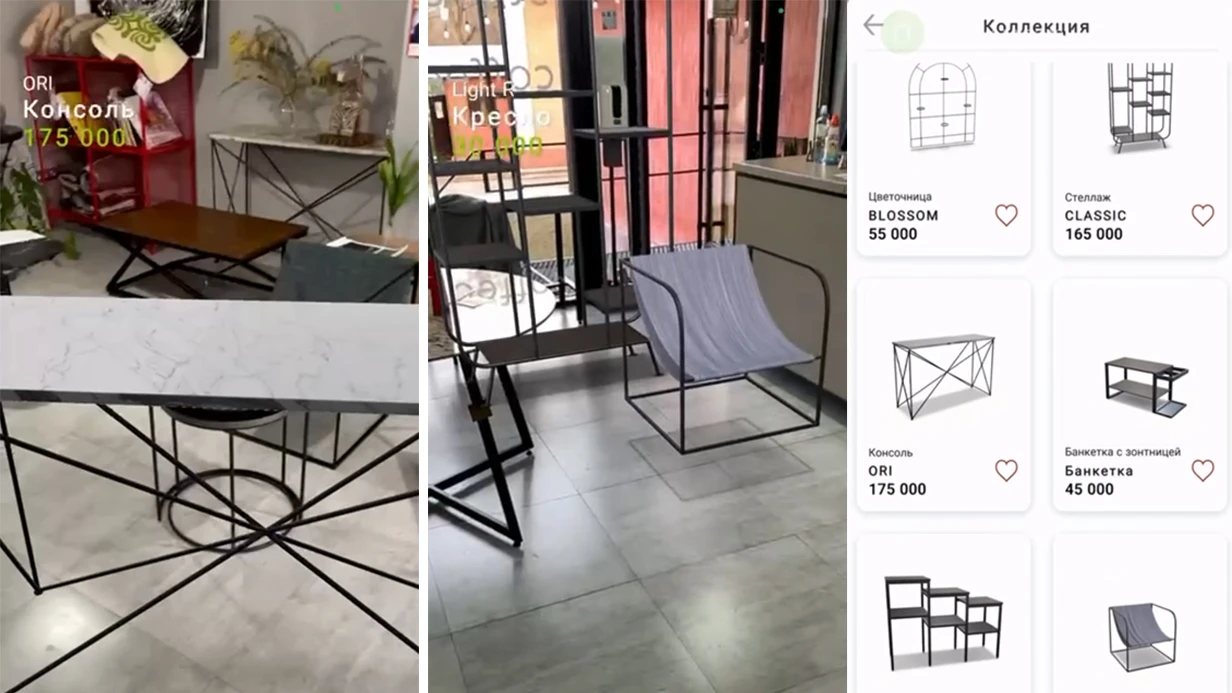
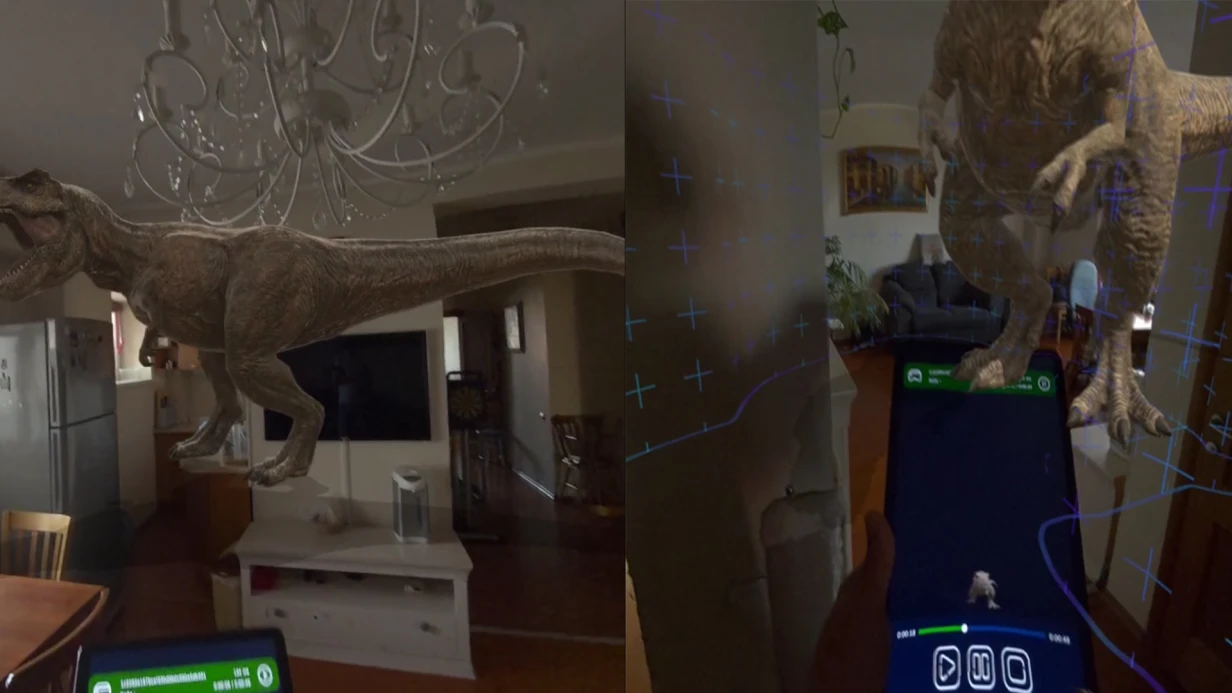
| Augmented reality | For events, showrooms, and instructions | Prompts and content appear directly on top of the real object — the user doesn't have to switch their attention |
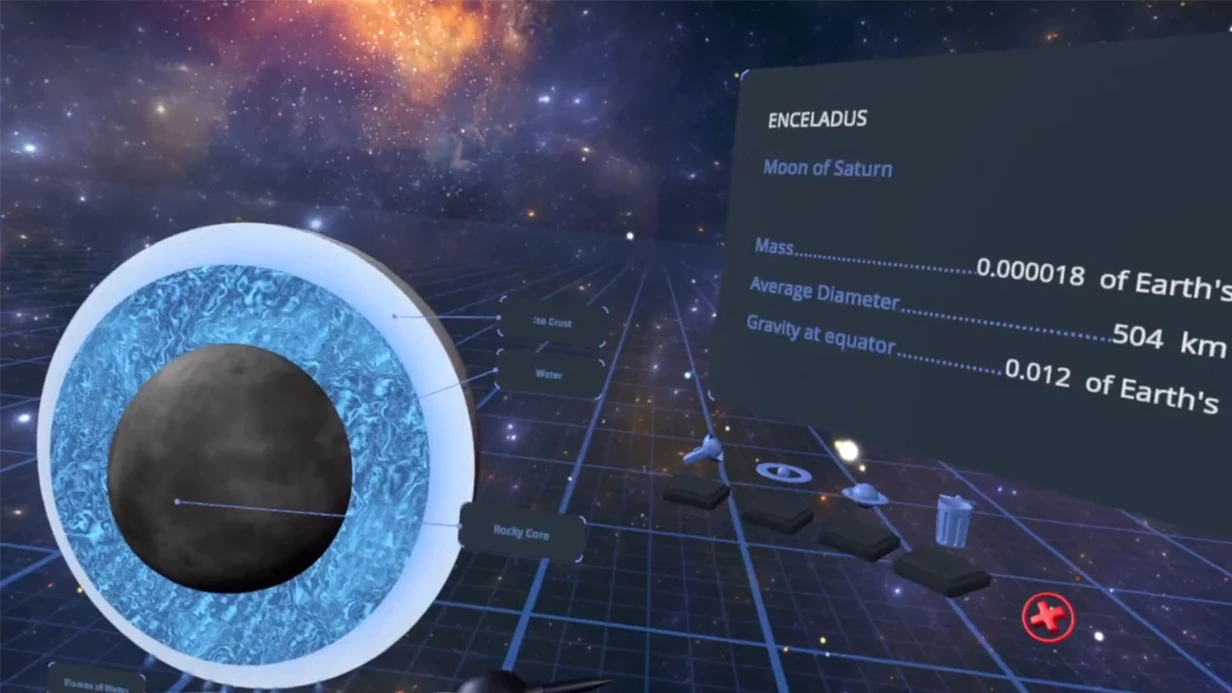
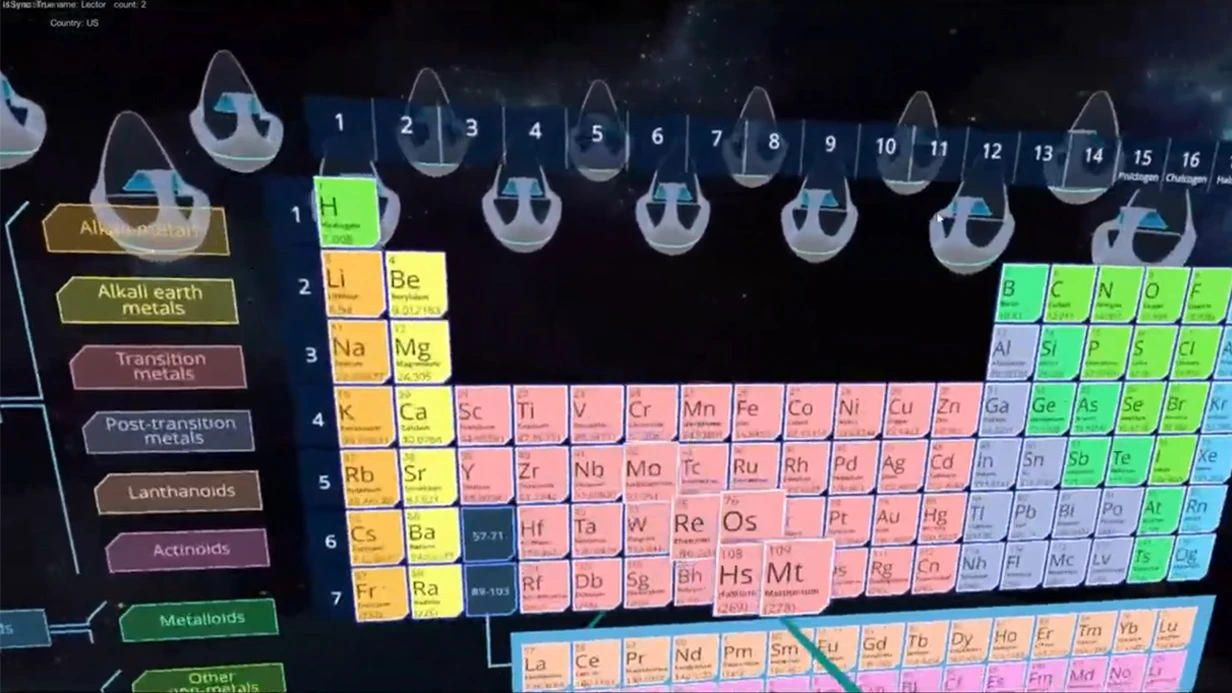
| Spatial 3D interfaces | For training and product presentations | All elements exist in space, viewable from different angles, and can be interacted with naturally |
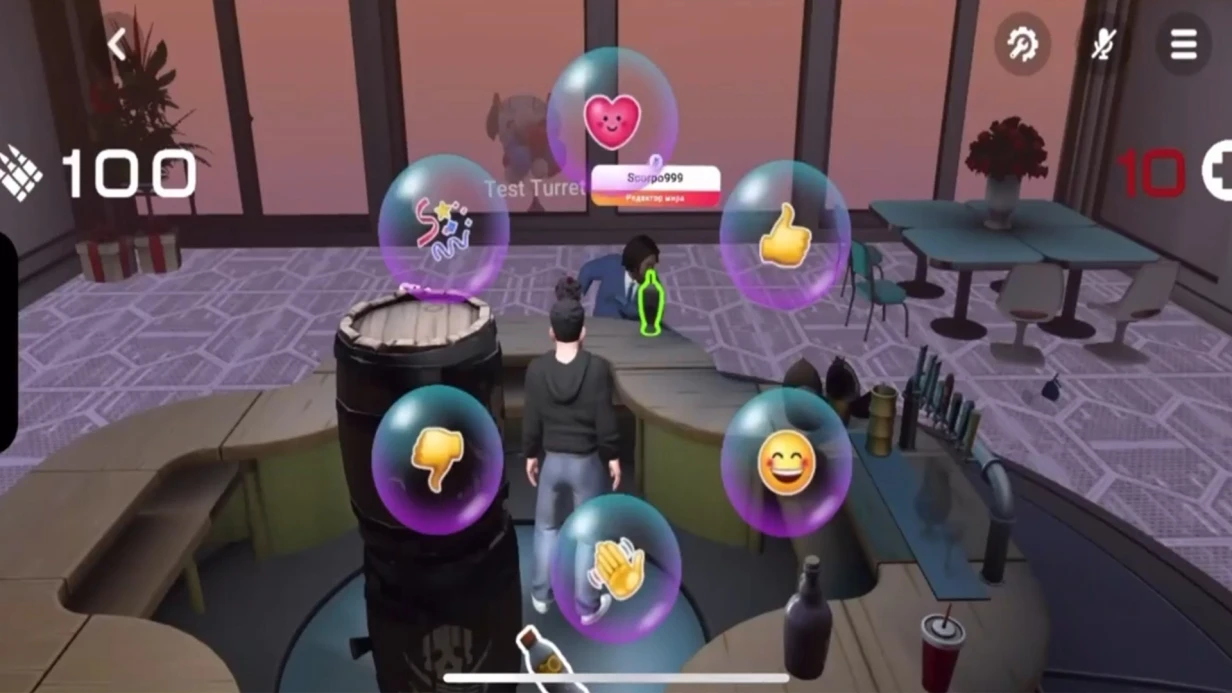
| Gesture and voice control | For exhibitions and interactive installations without controllers | Visitors get involved quickly — no "how do I use this" barrier |
| Ready-made screen and component sets | For teams preparing a project for development | A consistent interface speeds up launch and reduces errors at the implementation stage |
How to choose the right format
Start with a question: what should the user accomplish in your scenario? If you need to quickly orient someone in space, AR prompts are the answer. If the goal is to teach a complex process, a spatial interface with visual 3D elements works best.
We'll help you select the format during the brief and show how it will work in your context. No need to dive into development — you'll get a clear picture of timelines and scope.
How we design interfaces for spatial applications
Spatial interfaces break the usual rules: there's no cursor or windows, and the user interacts with digital objects directly in the environment. For such a product to be comfortable rather than just spectacular, a well-tuned design process is needed.
We've structured our work so you can see the interface taking shape at every stage and influence it before the project goes into development.
- Brief and goals. We dive into the scenario of your employees or clients: where they'll use the app, what tasks they'll solve, what should happen in a single session. We define clear success criteria for the interface.
- Interaction concept. We map out the flow of movements and actions: how the user looks around, selects an object, opens a menu, and navigates back. We explain the logic in simple terms — no technical details.
- Interactive prototype. We build a clickable model of the future interface — you can view it on screen and in a headset. You see the logic and interaction before the first line of code is written.
- Design approval. We present visual solutions: colors, typography, element sizes, animation. You approve each screen and submit revisions in a convenient format — this is your checkpoint.
- Implementation and assembly. We transfer the approved design into a working application. We verify how the interface behaves on professional equipment, ensuring stable performance without "lag" or distortion.
- Testing with a real audience. We invite representatives of your users — they walk through key scenarios while we note where difficulties arise. We fix everything that gets in the way of comfort.
- Launch and support. We hand over the finished solution with documentation and train your team. We stay available for refinements and feature expansion after launch.
Each stage concludes with a tangible deliverable: a diagram, a prototype, a mockup, or a working version. You always know where the project stands and can adjust course without wasting time or budget.
This approach prevents surprises at the final stage and delivers an interface that people truly understand.
What's included in the delivery: a complete package for your project
You don't get mockups "for show" — you get a package that a development team can start working with right away. After the project is complete, we hand over all design artifacts, from research to final files.
Everything is structured and documented, so specialists on any side won't have to ask unnecessary questions.
- UX research and user scenarios. We describe how your audience interacts with the app, what tasks they accomplish, and where pain points arise. This is the foundation for the logic and functionality of the future product.
- Interactive prototypes. Clickable mockups for testing the user journey before development begins. You see how the app works and can make changes early — saving both budget and schedule.
- Design concept and visual style. An interface adapted to the specifics of virtual and augmented reality: readable elements, comfortable viewing angles, intuitive navigation. All in your brand style, with the user in mind.
- Design system and UI kit. A set of reusable components — buttons, panels, icons, input fields. Your team will assemble new screens faster and maintain a unified style without inconsistency.
- Source files in editable formats. We hand over all mockups, graphics, and assets so you can make changes yourself or delegate them to contractors — without quality loss or hard-coded limitations.
- Developer handoff guide. Ready recommendations on animation, transitions, spacing, and interface states. Developers won't have to fill in the blanks — they'll start coding right away instead of asking questions.
- Post-delivery support. We answer your team's questions, participate in reviews, and help adapt the design when new tasks arise or requirements change.
We include an approval checklist at every stage — you can always see what's done and what's left. The entire package lives in one place, accessible to you and your team, so nothing gets lost and you never have to dig through emails for files.
Case study: how an interface change boosted user retention
Users don't forgive an inconvenient interface, even when the technology is impressive. This is especially visible in VR: the moment you complicate navigation or overload the screen, the visitor leaves without figuring out the product. Most app owners blame the content, but the root cause is often UX/UI.
That's what happened to a client — the developer of a VR simulator for staff training. The platform delivered stable technical results, but only 30% of users returned on the second day.
People got lost in the menu, struggled to find the features they needed, and gave up on the training within the first steps.
We audited the interface: reviewed session recordings, collected feedback, and identified four key drop-off points.
We then redesigned the scenarios — simplified the entry, put primary actions front and center, added contextual hints, and shortened the path to the first training session by three times. Nothing changed technically — only the screen logic.
A month later, the metrics had shifted significantly. User retention rose by 38%, the share of completed training sessions jumped from 41% to 76%, and the average session length nearly doubled.
The client didn't just get an updated interface — they got a predictable outcome: more employees complete the training course, and the platform became the primary tool in daily training.
After the launch, the client immediately ordered the next stage — adapting the interface to other use cases. A repeat request like that is the best proof that the design works for the business rather than simply "looking pretty."
How to choose a design format for your spatial project?
There's no single answer like "here's the best format" — and that's normal. A spatial interface can serve different business goals: impressing guests at a presentation, training employees in a complex procedure, or simplifying product selection in a catalog.
The design format directly determines the budget, the launch speed, and how users perceive your brand. A mistake at the start costs more than refinements at the testing stage.
The criteria for choosing UX/UI lie in three areas: business goal, audience, and use case. For a mass-market event, where a visitor spends two minutes in the headset, you need a simple, intuitive interface — large prompts, instant entry, zero learning curve.
For corporate training, where an employee works with the app for hours, ergonomics matter: readability, navigation logic, eye comfort, and no wasted movements.
Swap these requirements around, and you'll either overpay for excessive functionality or end up with a solution that doesn't work.
Spatial interfaces have their own specific requirements. In a conventional 2D app, the user looks at the screen and operates a cursor. In VR/AR, a person interacts with their gaze, gestures, and voice — that changes the entire design logic.
Elements must be at comfortable distances, prompts must appear at the right moment, and the interface must not overload perception or cause discomfort. All of this is tested on real equipment and real users before launch, so you don't face any surprises after release.
We take a systematic approach to choosing the format: we study your task, audience, and expected outcome, build prototypes, and test them against target scenarios. This way, you get a design that solves exactly your problem, without overpaying for needless complexity. Book a consultation — we'll show you how it works in practice.
Frequently asked questions about interface development for spatial projects
Before starting VR/AR interface development, clients ask the same questions: how long the project will take, what the budget will be, whether the solution will work with existing equipment, and what happens after launch. We answer directly — no technical jargon, just business language.
How long does interface development take?
Timelines depend on the complexity of the scenario. Simple projects take 2-3 weeks; complex ones with integration take up to 2-3 months. At the brief stage, we lock in the dates and write them into the contract.
How is the price determined?
The price is made up of scenario design, interface design, and integration with your system. After the brief, we give you the exact figure — no hidden extras. The estimate is fixed in the contract and doesn't change.
Will the interface work on my equipment?
Yes. We create universal solutions that adapt to most professional devices. At the brief stage, you tell us the model — we check compatibility and optimize the interface if needed.
What if I don't like the design?
Every project includes two rounds of revisions. You see intermediate versions and make adjustments before the layout is finalized. Changes within the agreed scope are included at no extra cost.
What support is there after launch?
After the project handover, we stay in touch: we help with updates, add new features, and advise your team. If needed, we sign a maintenance agreement.
If your question isn't covered here, write to us — we'll respond within one business day.Ready to discuss an interface for your project? Submit a request
Before talking about cost and timelines, it's important to understand the task: who the interface is for, what conditions it will work in, and what business results you expect.
That's why we suggest starting with a short form — it's free, takes a couple of minutes, and carries no obligation.
In the form, describe your project or simply write what you'd like to accomplish: we'll ask the right questions, suggest options, and show how the task can be solved. You'll get not abstract promises, but specifics tailored to your case.
By submitting a request, you receive:
- a VR/AR consultation with a specialist who will dig into your task and goals;
- a preliminary cost and timeline estimate — no hidden items or surprise surcharges;
- interface format recommendations: what best suits your audience and use case;
- examples of our work and solutions from similar projects — so you know the quality and results;
- a clear next-steps plan: what to prepare, how the work will proceed, and when to expect the first results.
The consultation comes with no strings attached. Even if you're still weighing an idea and aren't ready to start development, you'll get an honest picture: what's actually feasible, how long it will take, and what challenges could come up.
If you need to order UX/UI design for VR/AR — submit a request right now. We'll discuss your project, estimate the scope of work, and propose a solution that works for your business.