

Digital Twins: How to Stop Production Losses
Every minute of downtime, equipment does not generate profit—and you still have to pay for it.
A production manager often learns about a problem after the fact: when the line has already stopped, when a defective batch has been shipped, when a changeover has eaten an entire shift. The cause is almost always the same—processes are too complex to see the bottleneck in advance.
Because of these "blind spots," the enterprise loses more on repairs, excess material consumption, and missed deadlines than primary reporting suggests. Moreover, the losses only become visible at the end of the month, when nothing can be fixed.
We close this problem with digital twins—a virtual copy of equipment and production flows that lives in parallel with the real workshop. It lets you see everything and "play it out" in advance.
A Digital Twin Is Not a Model but a Management System
A digital twin is not just a beautiful 3D model for presentations. It is a constantly updated "copy" of your production, where data from sensors, machine tools, automated control systems, and manual operations flows in real time. The system compares actuals with the plan and instantly shows where deviations occur.
For the customer this means one thing: you stop learning about problems after the train has already left the station. The manager sees that area No. 3 is starting to fall behind before it leads to a missed shipment.
The dispatcher gets not dry statistics but a clear picture: which machine will soon need maintenance, where work-in-progress is piling up, which order should be launched next.
That is why a digital twin is not an IT project but a management tool that pays for itself quickly.
Where Real Savings Come From
- Equipment downtime—reduced through predictive maintenance. The system shows in advance which component may fail, and repairs are scheduled into a production window rather than in the middle of a shift.
- Excess raw material consumption—every deviation from the production process is visible. Defects are detected at an early stage, not after shipment to the customer.
- Personnel efficiency—you can see where operators are forced to wait, where operations are duplicated, and where equipment setup takes longer than it should.
- Transparency for management—a unified picture of the workshop, section, or entire site, which makes it easy to report to owners or auditors.
How It Works in Practice
We do not build a "digital copy for the sake of a copy." First, we find the points of loss—usually 2–3 processes that generate the maximum losses. Then we digitalize exactly those processes and tie them to real production data.
Then you get a working tool: not a report but a system that suggests decisions. It is used in the daily work of shop floor foremen, process engineers, and the production director—each sees their own slice: from shift tasks to overall line utilization.
What We Guarantee
- A local model is launched within 6–10 working weeks—without stopping production.
- The digital twin connects to your equipment and tracking systems without replacing the existing asset base.
- You get not a "project for the sake of a report" but a working tool with employee training.
Downtime Stops Being a Surprise
The best way to combat losses is not heroic efforts at the moment of an accident but visibility in advance. A digital twin turns chaos of deviations into a controlled process: you know when to intervene, where to look, and what decisions will be made an hour from now.
Contact us—we will explain how this applies specifically to your production cycle.
What a Virtual Model of a Facility Gives an Enterprise
A virtual model of an enterprise is a digital copy of a facility on which decisions are tested before investment. our team builds such models using professional equipment, so the result is accurate and ready for industrial operation.
Cost Reduction
The model identifies design errors before equipment is purchased and construction begins. Making corrections on a digital facility is many times cheaper than rework on site.
Personnel training also moves into the model: employees practice actions without stopping production and without risk. This reduces losses from downtime, defects, and emergency situations.
Increased Reliability
An industrial facility is thousands of interconnections. A virtual model tests them dynamically, shows bottlenecks, and makes it possible to prevent failure before launch.
The operations service gets not a static diagram but a working tool for monitoring states. Resources are planned more accurately, spare parts are ordered on time, and the risk of unscheduled shutdown is reduced.
Faster Facility Commissioning
Project approval and commissioning at a real facility drag on for months. A virtual model removes unnecessary iterations: changes are verified in hours, not weeks.
As a result, the time from concept approval to launch is reduced by a third. The facility starts generating profit earlier—without sacrificing quality.
Profit Growth
Fast launch and low costs directly affect the financial result. The company produces more, spends less on operations, and recovers the project faster.
The virtual model becomes the foundation for further improvements. It is used to plan modernization, expansion, and new products—that is, investing in something that has already proven effective.
Digital Twin Formats for Business Objectives
A digital twin is a virtual copy of a real facility that constantly reflects the current state of production, warehouse, or construction.
Instead of dozens of reports and meetings, a manager gets a single visual model showing equipment utilization, material balances, schedule risks, and problem areas. This approach saves hours of management time and helps decisions be made based on facts rather than intuition.
Each facility requires its own approach, so we have identified standard development formats—from a single section to an entire power grid. All of them adapt to the scale and specifics of the business, and we handle implementation and configuration ourselves.
| Format | For whom | What it gives the client |
|---|---|---|
| Factory digital twin | Business owner, production director | A unified picture of the enterprise: line utilization, inventory, and downtime. Decisions are made based on objective data, not guesses |
| Workshop digital twin | Workshop manager, shift foreman | Real-time control of work progress, quick identification of bottlenecks, and training of new employees without stopping the production cycle |
| Warehouse digital twin | Logistics manager, warehouse supervisor | A visual product placement scheme, automatic inventory checks, and reduced time spent searching for items. Simple and clear warehouse stock control |
| Power grid digital twin | Chief power engineer, operations service | Load and grid condition monitoring, risk forecasting, and prevention of accidents. Less downtime—stable operation of the entire enterprise |
| Construction site digital twin | Project manager, customer | Transparent control of deadlines and work volumes, comparison of the plan with the actual state. The customer sees what they are paying for and can check the contractor |
How a Project Runs: From Brief to Launch
Any digital twin implementation project starts with a chaos of inputs: different expectations and tight deadlines. To ensure a predictable result, we break the work into transparent stages with mandatory approval points—you always know what is happening.
Project Stages
- Brief and immersion in the task. On a call, we record goals, audience, and use scenarios—you learn how the digital twin will affect your business before the start.
- Plan and estimate. We prepare the architecture and work plan with clear deadlines and approval points. You see what you are paying for and when you will get the result.
- Concept approval. We show a prototype and discuss details. Edits at this stage do not require additional payment—this removes the fear of "getting something wrong."
- Implementation. We build a working version, checking with you at key milestones. Intermediate demos eliminate divergence from expectations.
- Testing and refinement. We verify stability, usability, and data correctness on real scenarios. You get a guarantee of failure-free operation on launch day.
- Launch and support. We deploy the solution, train the team, and stay in touch after launch—quickly making changes for new tasks.
What Is Included in the Delivery and Documentation
Transparent delivery means the customer understands exactly what they receive after the project is completed and how to use it.
We provide not just a "product" but a package your team can start working with right away: from the digital twin itself to instructions and training. This removes dependence on us and makes the result reproducible.
- A ready digital twin of the facility or process—a working environment that reflects the current state and operating logic. You get a reference point for daily decisions and control.
- Interfaces for managing and viewing data—configurable dashboards where key parameters are visible, scenarios can be switched, and reports can be generated without developer involvement.
- Source materials and export to open formats—you are not tied to us forever. If desired, any technical specialist on your side can develop the system further.
- Technical documentation for the system—a description of components, settings, and requirements. Written in plain language so your employees can understand the details without "magic."
- User instructions for employees—short guides: how to run a scenario, what to do in an emergency, how to update data.
- Training for your team—a practical session with the employees who will work with the digital twin. They learn the system on real examples, not from slides.
- Development plan and recommendations—what can be improved further, how to scale the project, and where to get support. This saves time in subsequent iterations.
Implementation Example: Results at a Real Facility
For the machine-building holding PromKomplekt, we created a digital twin of an assembly workshop. The customer wanted to test how changing parts logistics would affect machine utilization—without stopping production or risking the current plan.
This is the value of the approach: the model lets you test decisions before they hit the real site. The project was supervised by the production director, so the main criterion was not technical details but a measurable result.
The first version of the model appeared three weeks after the project started. At the real facility, a changeover scenario was immediately tested: instead of six hours of downtime, the line was down for only two.
In the first month of operation, productivity grew by 12%, and downtime due to poor shift coordination fell by almost a third.
To assess the economic effect, we compared three months before and three months after launch: the increase in equipment utilization allowed the project to pay for itself in less than two quarters.
The customer's production manager described the results as follows: "We stopped guessing—every step is visible on the model before it happens on the floor.
We felt the economic effect in the very first quarter, even though we did not replace a single machine." Such feedback is as valuable as numbers: the owner sees not a "pretty picture" but a management tool that directly affects utilization and revenue.
Today the twin is also used as a simulator for new employees—the onboarding time has halved. The customer is already preparing to scale it to two neighboring workshops, and we are adapting the scheme using accumulated data.
This is the best outcome of the case: the digital twin turned out not to be a one-off experiment but a scalable solution that continues to deliver value after launch.
How to Choose the Right Format for Your Task?
The right digital twin format is determined by two questions: what exactly are you digitalizing and what business problem are you solving.
Training employees to work with dangerous equipment is one scenario, while monitoring the condition of a network of stores or workshops is quite another.
Therefore, we start not with technology but with your goal: reduce downtime, accelerate product launch, improve safety, or establish remote interaction.
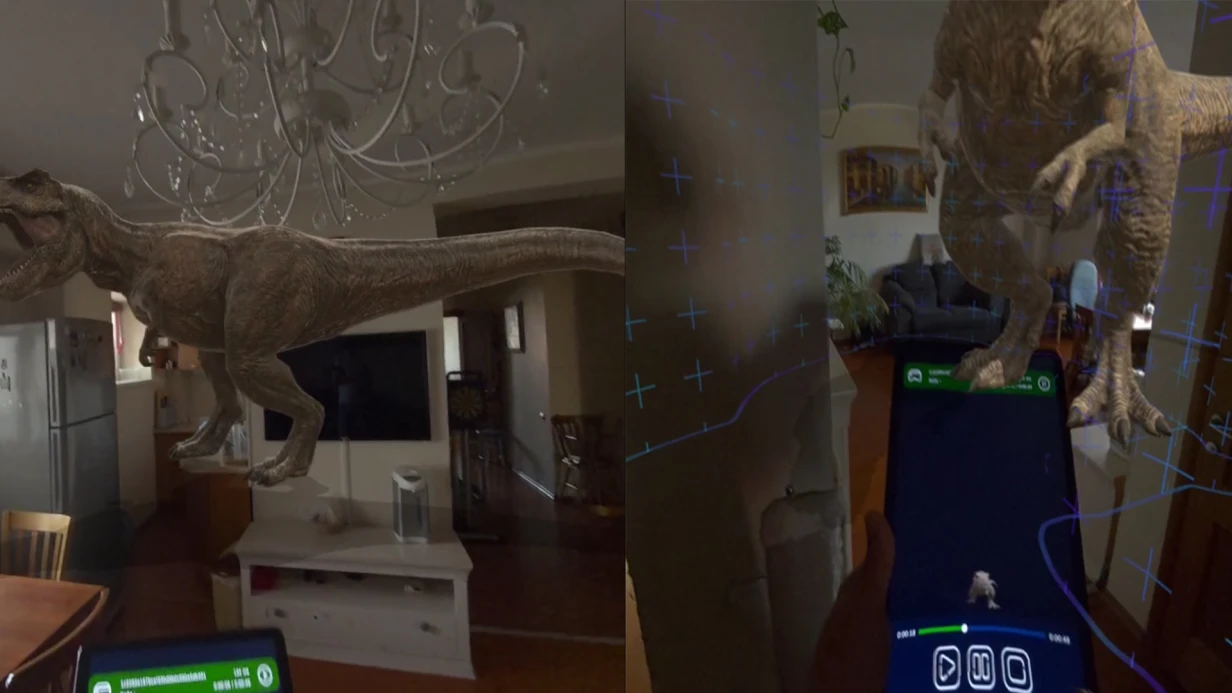
The second criterion is scale. For a single facility, a standalone VR solution is sufficient; for distributed infrastructure, lightweight access via AR from a tablet or phone is better.
The more deployment points, the more important simple data updates and minimal staff training become. These parameters directly affect the budget and payback period.
| Format | Type of facility and task | What the business gets |
|---|---|---|
| VR twin | Complex equipment, hazardous conditions—personnel training | Safe training, faster shift readiness, fewer mistakes |
| AR twin | Production lines, workshops, maintenance service | Step-by-step instructions overlaid on the real facility, reduced downtime |
| MR twin | Buildings, infrastructure, project teams in different cities | Visual decision alignment, faster project approval |
| Process digital twin | Production line, logistics, warehouse | "What if" forecasting, efficiency growth without stopping operations |
As the table shows, the same facility can be represented in different formats—it all depends on who will use the twin and how. During a consultation, we review your case, clarify scale and goals, and then propose a format that delivers measurable results in a short time.
You should choose not the most impressive option but the one that solves your task faster and pays back the investment.
Frequently Asked Questions and Concerns Before Starting
Before a project starts, customers ask the same questions. That is normal: a new format requires confidence in deadlines, quality, and practical value. We answer the main concerns directly so you can make a decision based on numbers, not feelings.
How long does development take?
Timelines depend on complexity and scope. For a typical pilot project—4–8 weeks. We work in stages: brief, prototype, implementation, testing, and launch. You see results at every step and can make edits before the final version, and we fix deadlines in the contract.
How accurate will the digital model be?
Accuracy is tailored to your task: a lightweight model is enough for an overview presentation, while a detailed one is needed for equipment condition monitoring. We use professional equipment and proven data processing.
Most importantly, the model works for business results: it accelerates training, simplifies approvals, and reduces errors.
Is it hard to integrate the solution into current processes?
We design the solution with your infrastructure in mind. In most cases, existing systems do not need to be changed—data is transferred through standard formats and configurable scenarios.
Employees get a clear interface with the required access levels, and technical support stays in touch after launch.
How can I know the development will pay off?
We assess payback even before the start: we identify which tasks will become faster or cheaper—training, control, sales. Then we calculate the effect in days saved and error reduction. You receive an investment return plan and make a decision before work begins, with no hidden costs.
If you still have a question that is not on the list, just ask us. After a 10-minute discussion, you will understand whether the format fits your task and how quickly you can get results.Let’s Discuss Your Task and Suggest a Solution
While competitors are only testing hypotheses, your project can already deliver measurable results—from cost reduction to increased customer loyalty. Digital twins in VR/AR/MR pay off faster when the decision is made in time and backed by the right expertise. We work remotely and take on projects of various scales—from a demo stand to a corporate system.
Leave a request on the website, and you will receive a preliminary project estimate on the next business day. During the consultation, we will clarify tasks, deadlines, and expected impact, and propose a format that suits your business.
What you get after contacting us:
- A preliminary calculation of cost and timelines—without hidden conditions or abstract promises.
- An analysis of your task for feasibility: where VR/AR/MR will deliver the greatest return, and where a simple solution is sufficient.
- An implementation plan with clear stages and checkpoints—you always understand what is happening at each step.
- A format matched to your audience: employee training, product demonstration, or a digital twin of a facility.
- A demonstration scenario or prototype at the first stage—to see the solution in action before full development.
- A solution presentation for internal approval—in the language of benefits, not technology.
- Ongoing support and maintenance after launch.
The next steps are simple: send a request, we contact you within one business day, hold a short consultation, and send you an estimate. If the project turns out to be impractical, we will honestly say so and suggest a more effective alternative.
Start with a free consultation—it is not binding, but it gives clarity on timelines and budget. Leave a request right now to reserve a convenient time for discussion.