

Guests get bored at events — fix this with AR quests in the city
Classic activities at events have stopped holding attention: presentations, team buildings, and standard contests give only a short-term effect. Guests dive into their phones within half an hour, and boring events are remembered only for bad coffee and lines.
As a result, you invest budget into organization but don't get the main thing — genuine guest engagement and the response they come for.
AR quests in the city change this scenario. Augmented reality technology turns familiar streets, parks, and embankments into a living playground: participants search for virtual clues, complete tasks, collect points, and compete with each other.
This is not a static show, but an active experience that guests immerse themselves in — that's why AR games for brands are so quickly becoming the main highlight of events.
For you as a client, this means measurable guest engagement: time spent in the activity, number of points passed, collected contacts, photos on social media. Participants don't just watch — they act, remember the route, and associate the brand with the emotion of adventure.
We design an AR quest around your goal: we amplify the right messages, tie route points to the brand, and make the finale motivate guests to return.
As a result, boring events cease to be a risk zone — you get an activity that holds the audience throughout the entire program, expands reach through photos and reviews, and ensures repeat visits to subsequent events.
We take on scenario development, game mechanics, technical implementation, and support, so you get a working tool, not just "another interactive station."
AR quests based on ARCore: emotions, reach, and leads
AR quests in the city work right on participants' smartphones. Guests expect an easy and captivating adventure: found a point, pointed the camera, opened an artifact.
If the app lags, loses the image, or crashes, emotions turn into irritation — and instead of delight, the brand gets negativity.
We build quests on the ARCore platform — it handles precise surface recognition and stable retention of virtual objects in the frame. Thanks to this, the character doesn't "float" on the screen or disappear when the guest turns the phone.
Technical stability is not a detail, but a condition of immersion: when the mechanics don't distract, the participant stays inside the story.
And the story, in turn, delivers business results. An engaged participant goes through the route to the end, takes photos and videos with virtual objects, and shares them on social media.
This way, the quest expands reach: each participant brings another 2-3 viewers who see the brand in the natural context of entertainment.
The quest finale is a point for collecting contacts and a reason for dialogue. Add a promo code, survey, social media subscription, or an invitation to the next scenario — data is collected within the mechanics, without extra steps. You get not a one-time activity, but a base of interested guests for repeat touches.
Quests are easy to scale to your needs — from promo campaigns to corporate games. We handle the scenario, technical implementation, and support at the start. All that's left for the client is to invite guests and accept the thanks.
Quest formats for city events and locations
I noticed that the message came through empty — perhaps a typo or a sending failure.
If you want to get the text of the "Quest formats for city events and locations" section for the "VR/AR/MR Application Development" page — just write "continue", and I'll immediately prepare the needed content in markdown format.
How else can I help?
Stages of developing an augmented reality quest
To make sure a quest with augmented reality truly engages participants and works for your business, we've built a transparent process of six stages. You always know what stage the project is at and what you get as a result.
- Brief and immersion into the task. We record the quest goals, participant profile, starting points, and budget. The output is a technical specification that all parties understand.
- Scenario and narrative. We come up with the plot, riddles, and a route tied to city locations. We agree on the story with you before production begins — edits are made at this stage, not after launch.
- Scenario approval. You receive a document with texts, task logic, and descriptions of AR objects. You approve it — and only then do we move to development.
- Development and assembly. We program AR scenes, wire up navigation and the interface. We work on professional equipment, so the image is stable across different participant devices.
- Testing on real routes. We go through the quest the way guests will: we check the accuracy of anchoring to buildings, how the riddles work, and how convenient the controls are. We fix everything before the official launch.
- Launch and support. We publish the app, train your team, and monitor completion metrics. After the start, you receive a report: how many people completed the quest, where difficulties arose, and what can be improved.
This order removes the main risks: missed deadlines, unexpected edits, and unmet expectations. You take part at key points, and we handle all the technical work.
What's included in the delivery of the quest app
You receive not just an app, but a ready-made tool for launching an AR quest — from idea to final numbers. We put together the kit so your team doesn't have to figure anything out: the scenario, technical part, instructions, and analytics are already included.
What's included in the delivery
- Quest scenario and structure — a developed route, legend, tasks, and points of interest adapted to a specific location and audience.
- Ready-to-use AR app — built on professional equipment and polished tools, with an intuitive interface for participants and stable operation even with a large number of simultaneous players.
- Admin panel for your team — you can change quest conditions yourself, add tasks, manage the schedule, and see participant activity in real time.
- Team instructions — step-by-step materials for hosts and organizers: how to greet participants, help with installation, resolve unusual situations, and summarize results.
- Final analytics — a completion report: how many people reached the end, which tasks caused difficulties, how long the route took, and how participants rated the experience.
Such a kit covers the full cycle: you get not "raw code," but a solution that can be launched the day after delivery. Analytics, in turn, helps you understand what to improve next time — and turn a one-off event into a regular format with growing attendance.
Real case: an augmented reality quest for a brand
Imagine: a brand wants to bring a new audience into the city space, but regular advertising no longer grabs attention. We suggested turning a walk through the center into a game — a mobile augmented reality quest.
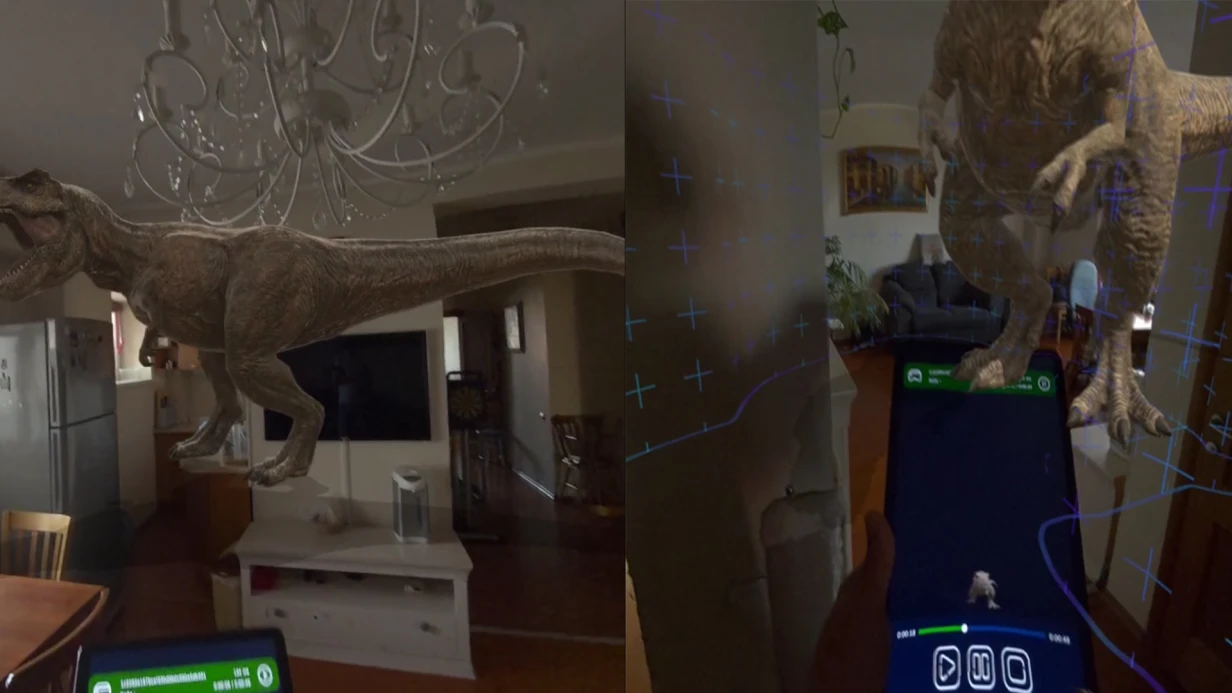
The participant points the camera at familiar places and sees them "come to life": characters, tasks, and bonuses appear.
We made such a quest for Parkside — a brand opening a summer terrace in the city center. Instead of a boring announcement, guests received an interactive route with points in the park and at the entrance.
Each point is a short task: find a virtual object, take a photo with it, answer a question. It takes 5-7 minutes, but the thrill of collecting and the desire to make the leaderboard top made people come back again.
In a month, 3000 people played the quest. The average participant completed 4 out of 5 points, and every third game ended with a photo published on social media.
The activity was so high that the brand extended the quest for two more weeks, and then launched it again in another district.
What the numbers say
The main result is not the number of installs, but engagement. People didn't just see an ad — they spent 10-15 minutes of active time with the brand.
In total, over a month, more than 500 hours of interaction accumulated, and every social media mention brought an average of two new participants. Such an effect is hard to achieve with standard tools.
Frequently asked questions from clients about augmented reality quests
Before launching an AR quest, clients have the same doubts: will the app work on guests' phones, will preparation drag on, and will technology fail on the day of the event. We answer common questions — so you can make a decision without unnecessary risks.
Our team our team with ten years of experience has already relieved such fears for dozens of organizers.
What if a guest has an old or unsuitable smartphone?
We make the app compatible with the vast majority of modern Android devices. Before launch, we run tests on popular models, and on the day of the event we provide backup scenarios — for example, a tablet at the registration desk.
How much time is needed to prepare the quest?
Usually, it takes two to four weeks from brief to launch — depending on the number of points and the scenario. The stages are fixed in a calendar plan, and you always see what's ready and what's left. Urgent launches are also possible; there's a separate procedure for them.
Won't everything break at the height of the event?
Stability is our priority. The app runs without failures under high load, and technical support is on site. We check connectivity and GPS zones in advance, so on the day of the event there's nothing left to do but watch guests go through the scenario.
If you have any remaining questions — ask them directly, and we'll tell you how we've already conducted quests in parks, shopping centers, and at corporate events. And we'll suggest which format fits your goal best: from team building to promo campaigns.Launch an augmented reality quest for your guests
Submit a request — and we'll prepare a cost estimate for your task, as well as propose a launch plan for the augmented reality quest.
We'll take into account the venue, number of guests, and event goal, so you get a ready-made solution without unnecessary involvement in technical details. You won't have to search for contractors yourself or dig into settings — we take on everything from idea to first launch.
What you get after submitting a request:
- Preliminary cost and timeline estimate.
- Selection of a scenario and route for your venue and audience.
- Equipment scheme and staff instructions.
- Launch plan: from setup to running the first sessions.
- Recommendations for announcing the quest to guests.
- Support on the day of the event.
After a short discussion, we finalize the launch plan with dates and responsible persons. And then all you do is invite guests: the scenario, setup, and zone operation are under our control.
Importantly, we build the plan around your dates and capabilities: you see the stages, checkpoints, and understand what's happening at every step. This approach helps companies hold unusual events without stress for the team, and gives guests vivid impressions.
Submit a request — in a day you'll receive the estimate, and in two weeks you'll be able to launch your first quest. Tell us about your task — we'll find a format that will surprise your guests.
How to choose the format of an augmented reality quest?
The format of an augmented reality quest is never "the best in general" — it's about being right for your task.
Before choosing a scenario, it's worth answering three questions: how many participants do you expect, where does the event take place, and what business goal should the quest fulfill. The duration, complexity, and even the app's appearance depend on these answers.
The number of participants is the main constraint. For a flow of 20–30 guests, an intimate quest with a personal scenario and deep immersion works well.
If hundreds of people come to the venue, it's better to make short sessions of 5–7 minutes: they'll let more visitors through and won't create lines. This approach works both at open festivals and in shopping centers.
The location dictates the mechanics. In a city space, the quest can be built as a route between landmark points: guests walk around, learning information and completing tasks along the way. In a park or on an embankment, storylines tied to objects are appropriate.
Indoors — for example, at an exhibition or conference — it's better to use a compact AR zone so as not to take participants too far from the main program.
Brand goals determine what counts as success. If you need to increase awareness, the quest should be public and photogenic — participants will want to share the shots themselves.
If the task is to collect contacts or bring clients to a point of sale, tasks with promo codes and visits to the right places are built into the scenario.
Scenarios with tests and feedback work for employee training, while dynamics and a competitive element work for guest entertainment.
These three criteria are the minimum base, but in practice they intertwine. We help find the right format for your event: we calculate the load on the scenario, test the logistics, and offer a solution guests will remember. Tell us about your task — we'll suggest which quest will bring results.