




Furniture Arrangement in the Showroom: Why Customers Leave for Competitors
Buyers rarely decide to purchase expensive furniture based on a catalog image. They need to picture how a sofa will fit into the living room, whether the color will match the wallpaper, and whether a wardrobe will overwhelm the room.
Without that, there are doubts, delayed decisions, and a visit to competitors who already offer such a service.
While the customer mentally "tries on" the item against their own interior, their confidence in the purchase fades. Wrong proportions, unclear scale, fear of making a mistake — all of this drags out the sale and lowers the showroom's conversion rate.
Regular photos and catalogs don't create a sense of presence, so attention shifts to those who can show the product in a real setting.
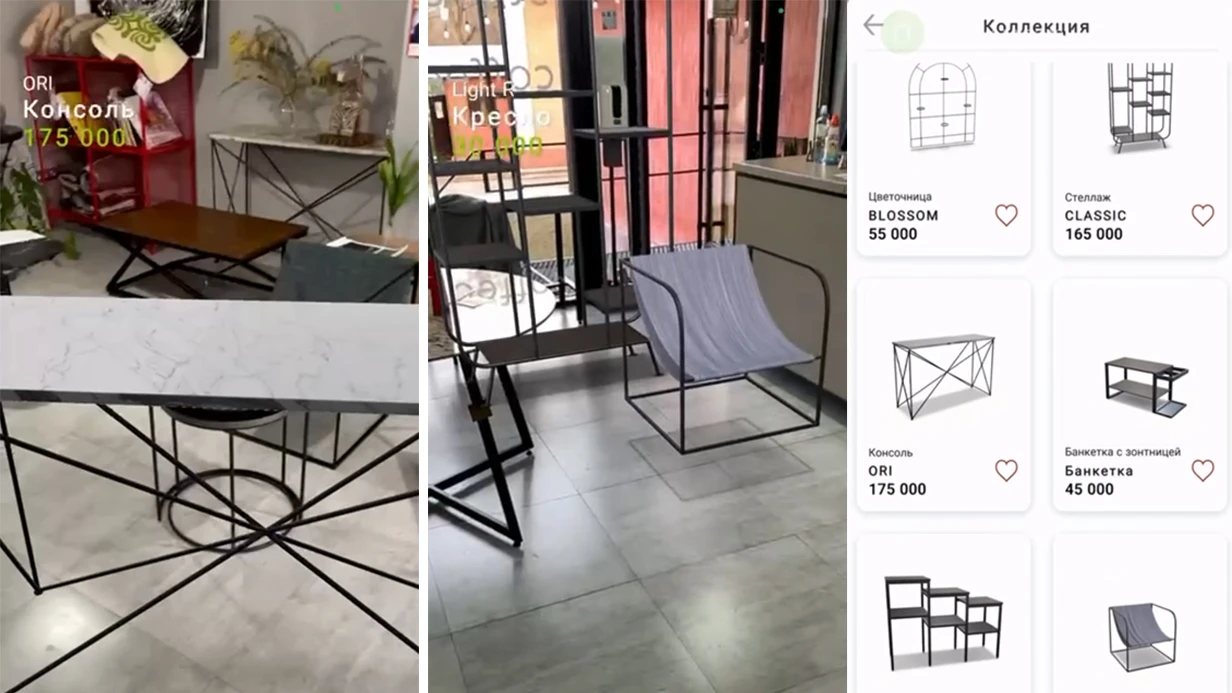
An AR application for furniture arrangement solves this problem: the visitor sees a sofa, table, or kitchen unit right in their own room, at actual size and with correct color relationships.
This is not just a demonstration — it's a tool that removes the main objection: "I'm not sure how this will look in my home."
As a result, the showroom gains a loyal buyer rather than a casual observer. Such visualization shortens the time needed to decide on an order, increases the average ticket, and leaves the impression of a modern brand that people trust. We help you implement this — without complex integration and with a focus on your bottom line.
What an AR App Delivers for the Furniture Business
Many furniture companies lose customers because of the fear that "it might not fit." A buyer looks at a sofa in a catalog but cannot imagine it in their living room — and closes the website. An AR app for furniture arrangement removes that doubt.
Conversion Growth
The buyer sees a sofa, wardrobe, or armchair at real scale — right in their own room. They no longer have to guess how colors and dimensions work together. Confidence in the choice means fewer abandoned carts and more paid orders. This means website conversion grows without extra discounts.
Fewer Returns
Returning furniture means logistics costs, packaging, and a loss of resale value. When customers see the dimensions and proportions before purchasing, they make fewer mistakes.
Fewer orders that "didn't fit the size" or "look different in person." The savings are felt immediately, and managers spend their time on new customers instead of processing returns.
Loyalty and Repeat Purchases
A brand that simplifies the choice is remembered. An AR tool shows that the company cares about the customer and keeps up with the times. After a positive experience, a person is more likely to come back for another product and tell their friends about you. That means repeat customers and referrals without spending on advertising.
You don't need complex software to gain these benefits — you need an application that your customers can open on their smartphones. Our team build AR solutions for the furniture business, from idea to finished product. Reach out for a consultation — we'll show you examples and propose a solution.
AR Solution Formats for Furniture Arrangement
A furniture buyer can't picture how a sofa will fit into their room — hence the doubts, postponed purchases, and returns. The more arrangement options you give the customer, the higher your conversion and average ticket.
We match the AR solution format to your task: from simple viewing of a single model to a full 3D planner.
Below is a comparison table of the main formats. All of them run on proven augmented reality tools (ARCore by Google), so they work on most modern smartphones without additional devices.
| Format | Who It's For | What It Gives the Customer |
|---|---|---|
| Catalog with AR viewing | Online stores, catalogs | The customer sees the item in their own space, decides faster, fewer returns |
| Virtual try-on in the app | Furniture showroom, display room | The customer arranges 2–3 items themselves, feels the space — sales through the app |
| 3D room planner | Designers, large sellers | Full layout with all furniture placement, saving the project and sending it to a consultant |
| Web-AR without installation | Marketing campaigns, landing pages | Instant viewing on a phone via a link — engaging visitors without an extra step |
Which format to choose depends on your goal. If you need to quickly lift catalog conversion, a simple AR viewer is enough. If you work with designers and complex projects, you need a planner. We'll help you determine the best option for your budget and launch expectations.
How AR App Development Works: 7 Steps
Every project starts with getting deep into your task. We break the work into seven clear stages — you always know what's happening and what result you'll get at each step.
-
Brief and task analysis. We immerse ourselves in your business: we capture goals, target audience, usage scenarios, and key furniture arrangement moments. Output: an accurate work plan and timeline without hidden surprises.
-
Prototype and scenarios. We design an interactive prototype: how the user selects items, moves them around the room, and changes parameters. You see the future app before development begins.
-
Interface design. We create visuals that match your brand style and look natural in AR mode. Intuitive hints guide the customer to the right actions without any training.
-
Application development. We build the AR functionality, connect your furniture catalog, and set up realistic dimensions and lighting. You get a working product ready for visitor traffic.
-
Testing on devices. We verify furniture placement accuracy across different smartphone models and lighting conditions. This ensures visitors won't hit errors and delete the app.
-
Launch and publication. We publish the app to the stores, set up user action tracking and analytics. We hand over promotion guidelines and recommendations for growing conversion.
-
Support and evolution. We stay in touch after launch: we update the app for new devices, process user feedback, and add features on request. This lets the app grow together with your business.
What the AR App Deliverable Includes
When you order an AR app, it's important to understand exactly what you receive and how to use it in daily operations. We've put together a transparent delivery package — no "raw" code or confusing files, just working tools for growing sales and easy management.
Each item addresses a specific business need: from product demonstration to content control and staff training. Here's what the standard package includes:
- A ready-made AR app for your task — adapted for the smartphones and tablets your customers use. The buyer points the camera at a marker or the floor and sees how the furniture fits into the room: changes color, texture, checks the scale.
- An admin panel for content management — you add new models, edit descriptions, prices, and promotions yourself, without involving developers. This saves weeks of waiting and money on every catalog update.
- Instructions and video guides for staff — a clear training system so in-store managers can master the app in 15 minutes and confidently help customers make a choice.
- Technical documentation and access credentials — all the information your team and contractors need, including system structure and operating rules.
- Warranty support after launch — we're available throughout the warranty period: we fix errors promptly, update compatibility, and help with any questions about the app.
- Transfer of source materials and settings — you're not locked in with us in the future: all rights, access credentials, and data remain yours, and we're happy to keep supporting the project if you wish.
This package lets you launch the tool immediately after setup and scale it later without extra approvals. You get not just an app but a complete system for increasing conversion and reducing returns caused by furniture that "didn't work out."
If you'd like to discuss your task and get an exact delivery scope for your business format — write to us, and we'll prepare a proposal within a day.
Case Study: Furniture Showroom Tripled Sales with AR
A real-world case: a furniture showroom selling wardrobes and sofas through a catalog was losing customers at the try-on stage.
Photos don't convey true scale, so after delivery customers often returned items — and undecided buyers kept postponing their purchase "for later." The goal was not to attract more traffic but to remove the fear of making the wrong furniture choice.
We developed a mobile AR app for furniture arrangement for the MebelStyle chain. The buyer points the camera at the floor in their room, selects a model — and it appears before them at real scale.
They can move it, rotate it, change the upholstery, and immediately decide whether the item works. This acts as a virtual try-on: instead of guessing from photos, customers get an accurate picture based on the room's real geometry.
Results After Launch
- Showroom sales grew 3x within the quarter.
- Catalog conversion increased by 45%.
- Delivery refusals dropped by half.
- The share of repeat orders grew by a third.
For us, this is a demonstrative case: AR doesn't replace a live conversation with a salesperson; it removes the main objection — "I can't tell how this will look in my home." The app paid for itself in the first month and kept working as an ongoing sales channel.
After launch, the showroom ordered an expansion for apartment layouts from us — customers who saw measurable value came back and wanted to build on the result.
Frequently Asked Questions About AR App Development
Before ordering an AR app for furniture arrangement, clients tend to ask the same questions: how long it takes, how difficult it is for users, and what happens if the result doesn't match expectations. We answer directly, without technical jargon — the way you'd ask us over the phone.
How long does it take to develop a furniture arrangement app?
On average, a basic version takes 4 to 8 weeks from layout approval. The timeline depends on the feature set: we can quickly build a demo for an exhibition or a full catalog with filters and virtual try-on. At the first brief, we give you an exact date and lock it into the contract — no surprise delays.
How difficult is it for my customers and employees?
The user simply points the smartphone camera at the floor, selects a furniture model from the catalog, and sees how it looks in the room. The controls are a couple of simple gestures — nothing to install or configure.
We usually add a short video hint so even an unprepared person can complete the first launch in under a minute.
What if I realize I want to change something during development?
That's completely normal, which is why we build in two rounds of revisions after showing the first versions. You see the result on your smartphone screen and share your feedback: change a color, add a model, adjust a scenario.
Anything within the agreed scope is included at no extra charge. Larger changes are discussed separately — but in advance, before we start, not after completion.
What happens if the app doesn't work on a customer's phone?
We test the AR solution on different devices so it runs on most modern smartphones. If a specific model has issues, the user sees a clear message with a recommendation.
After launch, you get warranty support: we monitor performance, fix bugs, and update the app when operating systems change.
What guarantees do you provide?
The main guarantee is a fixed estimate and timeline in the contract, plus the transfer of all source materials to you. You're not dependent on us after the project is complete.
On top of that, three months of free support: if anything needs to be refined or fixed after release, we handle it at no additional cost.
How to Choose the Right AR Format for Your Task?
Start with the task, not the technology: the AR format should solve a specific business problem, not just impress. If a customer is choosing furniture in an online store, they need to see how the sofa will fit into the living room.
If you're training staff on assembly and maintenance, you need step-by-step instructions with detailed views. The same product in different scenarios requires different solutions.
Orient yourself around three questions: who is the user, where does the interaction happen, and what should happen afterward.
For retail furniture sales, a mobile app is usually the best fit — the buyer points the camera at the room, sees the item at real scale, and can order immediately.
If shortening the path to the first touch matters, a lightweight web format works well: it opens via a link without installation but falls short of an app in smoothness and scenario complexity.
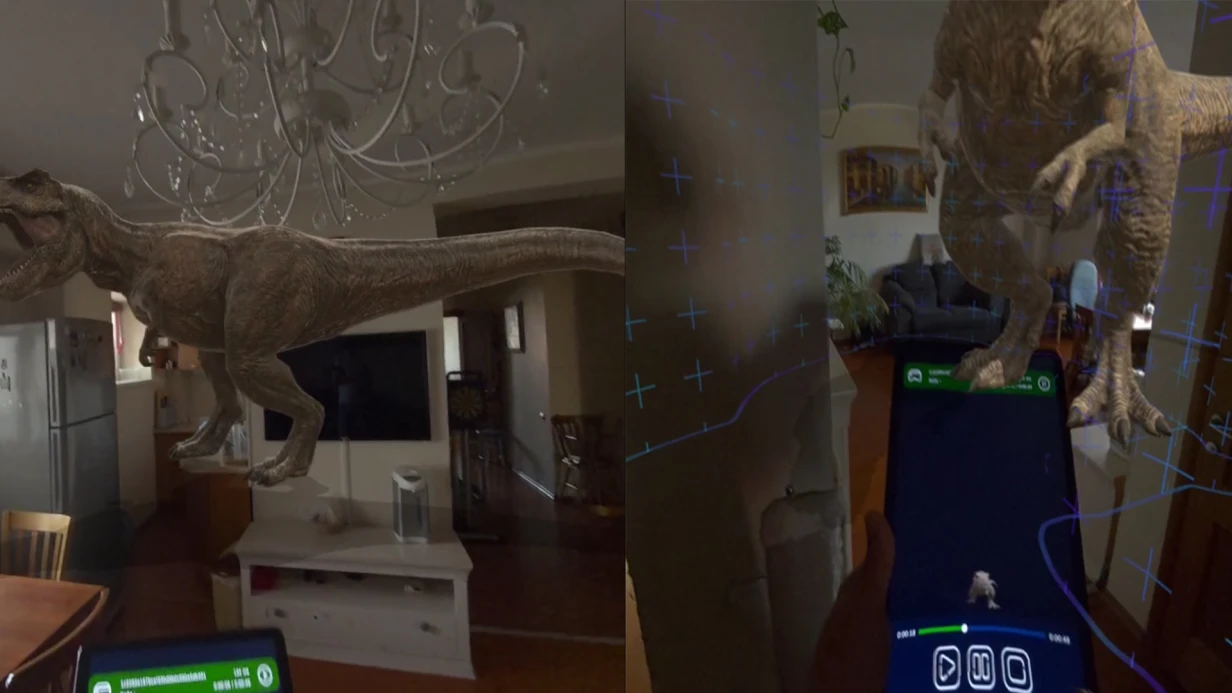
For showrooms, exhibitions, and B2B negotiations, mixed reality glasses add impact: a virtual furniture sample stands in a real space, can be inspected from every angle, and its finish can be changed.
This format costs more and requires preparation, but it creates an impression no catalog can match. The key is not to overpay for spectacle where a stable, clear 3D visualization on a smartphone screen is enough.
Test the format against a real task: will it bring more leads, raise conversion, or reduce returns? AR in furniture arrangement delivers measurable value — buyers make fewer size mistakes and are more willing to complete the purchase.
If that's your goal, choose the format that gets into the customer's hands as simply as possible and requires no special skills.
We help you find your bearings before development starts: we analyze the scenario, audience, and sales channels, then propose the right format — from a compact mobile solution for an online store to an immersive project for presentations. That way you get a tool that solves your problem, not an expensive technology demo.
Ready to Get an AR App Cost Estimate?
The cost of an AR app for furniture arrangement depends on the scenario, the number of objects, integrations, and timelines. Giving you an exact figure without diving into your task would be misleading. So we first study your business process, and only then prepare the estimate.
Submit a request — we'll consult you for free and prepare a transparent cost calculation for your task. In the estimate you'll receive:
- a clear scope of work: which features go into the first phase and which will come later;
- timelines and development stages with checkpoints;
- format recommendations: AR for a catalog, showroom, or mobile app;
- integration options with your catalog, website, and warehouse stock;
- examples of our solutions for furniture brands and showrooms;
- a fixed cost with no hidden add-ons.
Then it's up to you: start the project or come back to it later. No obligations and no pushy selling — only value for your business.
Send a request or call us — we'll discuss your task online at a convenient time. We'll show you case studies, answer your questions, and propose a solution that drives sales, not just a pretty picture.