

When manual inspection of buildings and premises slows down business
Manual inspection of buildings and premises eats up resources that could go toward business growth. Each specialist visit means hours of waiting for tenants and employees, access coordination, and report preparation.
Expanding the scale of a facility or property portfolio automatically increases the cost of inspections, because the speed of work remains the same—linear—while expenses grow.
Inspection accuracy is also tied to money. The human eye notices far from everything, and conclusions depend on the experience and attentiveness of the individual specialist.
A defect missed at an early stage turns into expensive repairs, idle premises, or even a dispute with a tenant a year later. The more properties there are, the higher the risk of such losses, and the more costly each overlooked flaw becomes.
Inspection speed directly hits business processes. While waiting for inspection results, deals are frozen, decisions about repairs or lease renewals are postponed.
Approvals, issuing orders, and accepting completed work all remain paused, and waiting time is perceived by clients as low service quality.
Manual checks also mean lost money on repeat visits. The client pays for every visit, but often it is necessary to return: something was not recorded, somewhere they forgot to take a photo, and data from different inspections is stored separately and is hard to compare. That is why companies are moving to digital tools that make the process transparent and fast.
A mobile AR application solves all these problems: it speeds up data capture, increases accuracy, and removes part of the routine. Below, we will look at exactly how it works and what results a business owner gets.
What benefits mobile AR brings to property inspection
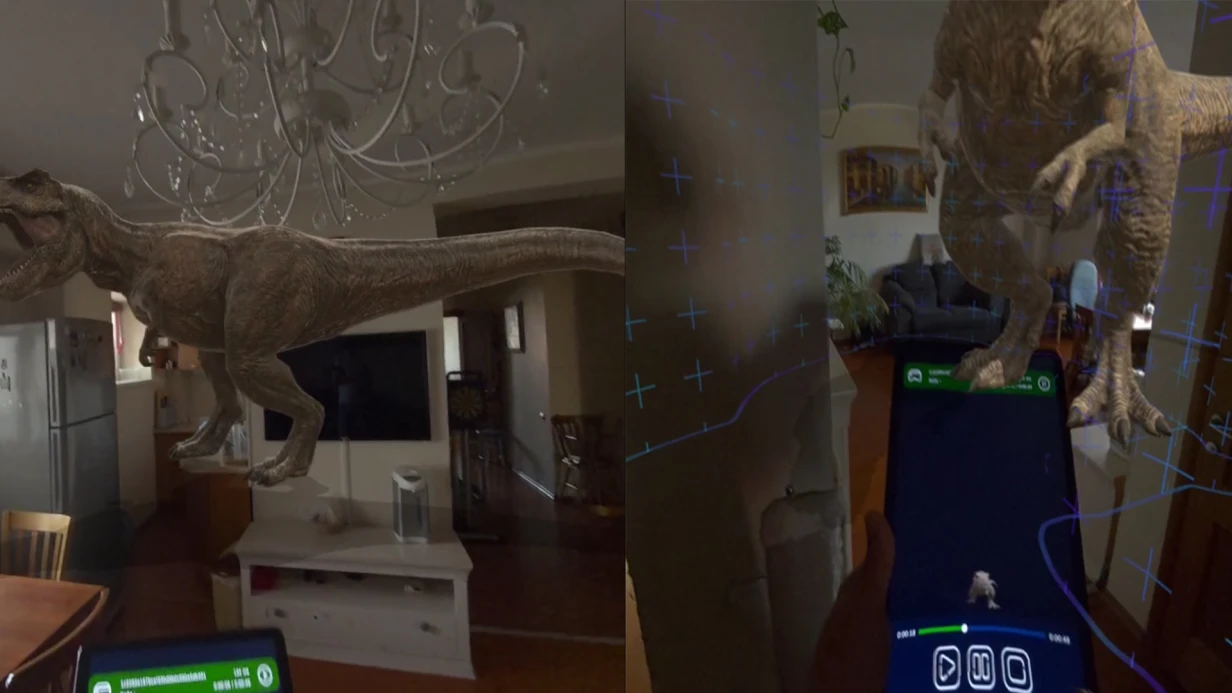
Mobile AR inspection turns a smartphone into a measuring tool that even employees without technical training can use. Instead of laser rangefinders and tape measures—the camera; instead of paper reports—a digital protocol.
The inspector walks through the building and sees problem areas on the screen: deviations, cracks, traces of moisture. What used to take a team of three people is now handled by one specialist in a single walkthrough.
The benefit for business is time savings and human safety. A regular inspection of a large facility takes half a day; with an AR application based on ARKit, all measurements and photo documentation are collected in one hour.
The freed-up time can be directed to other properties: one inspector manages to cover a third more buildings per month.
Moreover, the employee does not need to approach hazardous areas—augmented reality shows hidden utilities in advance, and a person does not risk their life during a check.
Data accuracy no longer depends on the fatigue or experience of the performer. Digital markings are superimposed directly on the surface, so every defect is recorded in a single coordinate system and automatically included in the report.
The manager gets the current condition of properties without traveling to the site. It is exactly such applications that we create at our team: well-tuned tools and professional equipment deliver stable results in any lighting conditions and on different devices.
The mobile format requires neither network deployment nor stationary scanners—a smartphone is enough, so the solution pays off quickly and scales easily across the entire building portfolio.
Development formats: from rapid audit to regular monitoring
Choosing the format of an AR application for inspecting the condition of buildings and premises comes down to two questions: how often the property needs to be checked and how detailed the audit should be.
A one-time acceptance of a new building, a monthly walkthrough of a shopping center, and an annual expert review of a business center are different tasks, and one solution will not work here.
The functionality of the application, the depth of collected data, and the interface for employees directly depend on the scope of the inspection.
We help you choose the right format at the briefing stage—without unnecessary options or overpaying. To do this, we analyze your inspection process: who walks the property, what deviations are recorded, and how the result is documented.
Based on this data, we offer one of the application types—from a rapid audit to a system for regular monitoring of the entire building portfolio. Below are the typical formats we work with.
| AR application format | For whom | What it gives the client |
|---|---|---|
| Rapid property audit | Property acceptance, one-time expert review | Recording defects in augmented reality: photos, comments, automatic report in a single visit |
| Checklist walkthrough | Management companies, facility maintenance services | The employee follows a route and marks deviations in the interface—all data is collected into a single database |
| Regular change monitoring | Properties with a history of cracks, leaks, or finishes | Comparison of condition with the previous visit, the system shows dynamics and warns about critical changes |
| Full inspection tied to a floor plan | Large buildings and complexes | All inspection points are tied to the building plan, search by structural elements, and generation of reports |
If your scenario is not similar to any of the above—no problem. We design custom formats for AR solutions and, if needed, combine several types in one application to make the inspection as convenient as possible for your team.
How we build a project: stages from brief to launch
Any project to create a mobile application for building inspection starts with uncertainty: what the result will be, when it will be possible to see it, and what to do if something goes wrong.
We remove these questions through a transparent process: each next step logically follows from the previous one, and you always know what stage the work is at and when you will receive the finished solution.
The approach is based on six stages. They help avoid losing anything important, coordinate details on time, and launch the application without unnecessary downtime.
-
Brief and task analysis. You describe how building inspections are currently conducted, what types of premises exist, and what needs to be recorded. We ask questions to understand the workflow and turn it into a technical specification.
-
Prototype and plan. We show what the screen will look like, in what order the specialist enters data, and where the result is displayed. We agree on timelines for the stages and fix the scope of work so that you can see the budget and dates.
-
Workflow scenario approval. We discuss the details: how to select a property, add a deviation, attach a photo or comment. We approve the logic so that no surprises arise on site.
-
Application development and assembly. We configure the screens and logic according to the approved scenario and connect suitable tools for recognition and navigation within the premises. We show you an intermediate result for control.
-
Testing on real properties. We test the application in conditions close to real ones: navigation, defect recording, and saving drafts. You receive a working prototype, and we make adjustments.
-
Launch and support. We install the application on your team's devices, provide brief training, and hand over the instruction manual. We stay in touch to quickly resolve emerging issues and refine functionality.
What is included in the finished application and support
You receive not just an application for building inspection, but a ready-to-use working tool that solves the task of monitoring the condition of premises from day one.
The package includes everything needed for launch and daily use: the application itself, adaptation to your properties, employee training, and technical support.
-
Turnkey application. A mobile AR solution for scheduled and extraordinary inspections: the employee points the camera at a property, sees the element status, and immediately records comments. The application works on the team's standard devices, without expensive equipment.
-
Adaptation to your properties and regulations. We configure the structure of premises, defect types, and inspection scenarios—inspectors follow checklists rather than relying on memory.
-
Employee training. We conduct short practical sessions for staff: how to use the application and what to do in non-standard situations. By launch, your team works confidently and without downtime.
-
Clear documentation. Instructions for inspectors and administrators, as well as process descriptions for your internal regulations. Everything in Russian, without technical jargon.
-
Technical support. A dedicated communication channel with our team: we help during failures, answer employee questions, and fix errors with priority.
-
Updates and development. We regularly improve the application: add new features based on your feedback and update it for new mobile device versions. Your tool does not become outdated after a year.
-
Result guarantee. We fix the deadlines, scope of work, and interaction procedure in a contract. If something goes wrong, you do not remain alone with the problem.
Such a package allows you to launch inspections within a few weeks and immediately get a transparent picture of the condition of buildings: where repairs are needed, which properties are under control, and what risks are emerging. And we continue to support you after launch so that the application remains an effective tool.
Real case: how a shopping center network reduced inspection time
Manual inspection of the condition of premises means hours of walkthroughs, paper checklists, and scattered photos.
In the shopping center network <cite>City Mall</cite>, checking one floor took up to three hours, and the results had to be transferred to spreadsheets—with this approach, some defects were lost, and reports were delayed by several days.
For the management company, this meant downtime and conflicts with tenants: faults were detected late, and the repair budget was spread thin.
We developed an AR application for tablets: an employee points the camera at a wall, ceiling, or engineering system, and the application records the condition and automatically saves the data. This eliminates manual data entry and ties every comment to a specific location in the building.
Here is what changed after implementation:
- Inspection time for a floor was cut from 3 hours to 40 minutes.
- Data completeness increased by 30%—defects that were previously missed are now recorded immediately.
- A report is generated at the end of the walkthrough—the manager sees the condition of the property on the same day.
The network's management also appreciated the transparency: every property is checked according to a single standard, and data from all shopping centers can be compared. This simplified repair planning and negotiations with tenants.
Over the course of a year, the shopping center network switched to regular AR checks for all 14 properties. Inspector labor costs fell by half, and a repeat order to expand functionality confirmed that the technology solves a real business task.
How to choose an application format for your property?
The choice of format depends not on fashion but on the specific task: what needs to be inspected, how often, and who will use the application.
For regular inspection of an entire building, a mobile AR solution is logical, while for a detailed analysis of a complex component or employee training, VR or MR is suitable. Once you understand the type of property and the budget, you can easily choose a tool that will pay off.
The basic difference between formats. An AR application "overlays" data onto the real object through the screen of a smartphone or tablet: you see the building and immediately get highlighted problem zones.
The VR format fully immerses you in a digital copy of the object—convenient when it is difficult to reach the actual building.
MR solutions combine reality with digital hints and are more often used for complex collaborative work where access to several layers of information at once is needed.
| Format | For whom | What it gives the client |
|---|---|---|
| Mobile AR | Owners of small buildings, management companies | Quick inspection from a phone, minimal costs, instant defect recording |
| VR | Large properties, holding companies with remote branches | Full digital copy, safe training, inspection without traveling to the site |
| MR | Construction supervision, design bureaus | Overlay of the design onto the real object, deviation control, simultaneous work of several specialists |
Budget and property complexity are the main criteria.
If you need to regularly inspect dozens of premises with in-house staff, a mobile AR application will be the most practical: employees already know how to use smartphones, and the result is a structured report with photo documentation.
For a single valuable property or a complex engineering structure, VR/MR is worth considering: initial investments are higher, but savings on logistics and mistakes quickly pay them off.
Practice shows that most clients overpay by choosing a format that is too "sophisticated" for simple tasks. The specialists at our team help you conduct an audit and offer a solution tailored exactly to your task—without unnecessary options and with a clear budget. Leave a request, and together we will choose a format that works for your result.
Answers to frequently asked questions about AR solution development
Developing an AR solution for building inspection raises questions even at the idea stage. Timelines, budget, integration with existing processes, and data accuracy are the main points of uncertainty.
We have collected answers to these questions so that you understand how the work will be structured and what results you will get.
How long does it take to develop an AR application for inspection?
The timeline depends on the complexity and scope of tasks. A few weeks are enough for a pilot project; for a full solution, it takes from several weeks to several months.
At the first stage, we record the requirements and propose a calendar plan so that you see all key milestones and control the process.
How is the budget formed and what does the cost depend on?
The budget consists of the scope of functionality, the number of premises types, and the required accuracy. We do not name a price out of thin air: after the brief, you receive a transparent estimate broken down by stages. If necessary, you can start with a minimal version and expand it as you use it.
How does an AR solution integrate with existing processes?
We adapt the application to your regulations and systems: from simple report export to integration with real estate databases. At the start, we determine what data is needed and where to send it so that AR becomes a working tool rather than a separate experiment.
How accurate is AR inspection data?
Modern technologies allow recording the parameters of premises with sufficient accuracy for practical tasks. We use professional equipment and calibration to keep measurement results stable. This is confirmed by test measurements on your properties even before launch.
We invite you to a free consultation
The first step toward an application for building inspection is a free consultation. During it, we will discuss your task, show how augmented reality accelerates checks of the condition of premises and helps employees record defects faster.
You will get an understanding of the scope of work and approximate timelines without any obligations.
Starting a project is simple: leave a request on the website, and we will contact you within one business day.
At the consultation, we will examine the task in detail, record the requirements, and select a suitable solution—from simple scanning of premises to a complete reporting system. Then you decide for yourself whether to move on to development or stop at the discussion.
What you get immediately after contacting us:
- A personal consultation: our expert will study your situation and answer questions.
- A preliminary assessment of the project: complexity, timeline, team, and work stages.
- A selection of solution format: an application for smartphone or tablet, a version for employees or contractors.
- A demonstration of similar projects so you can see the result before development starts.
- An understanding of the economics: which functionality is needed first and what not to save on.
- A clear plan of next steps, even if you decide to start the project later.
After the consultation, if the proposal suits you, we prepare a commercial offer and get to work. You do not overpay for anything extra—we develop exactly the functionality that pays off in your team's daily work.
The technical side, infrastructure, and support remain on us; all you need to do is evaluate the result. Leave a request to discuss your task and take the first step toward implementing AR inspection.